
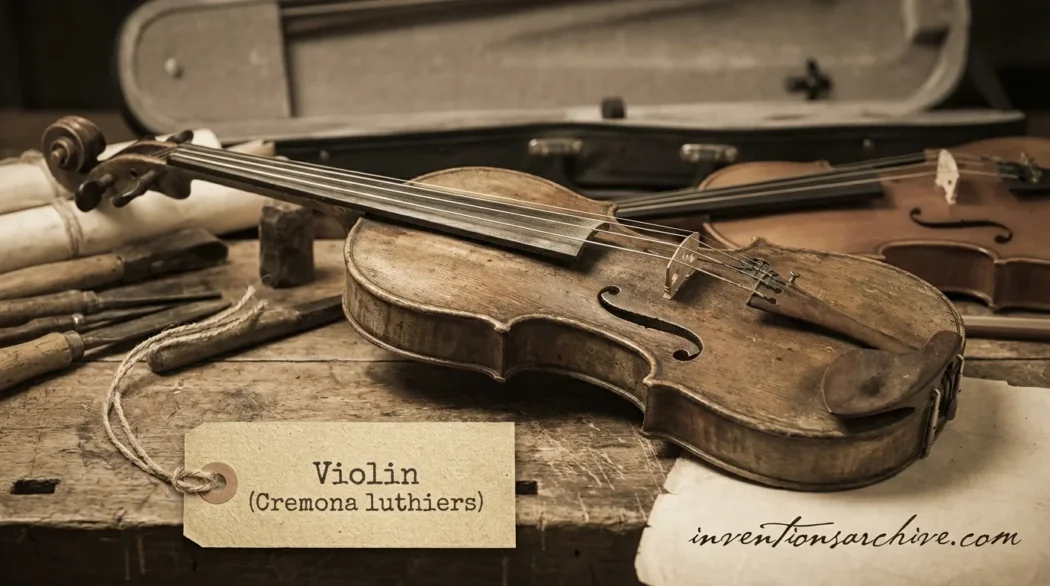
| Detail | Value |
|---|---|
| Invention Name | Violin (Cremona luthiers) |
| Short Definition | Four-string bowed instrument; tuned in fifths; acoustic resonator body |
| Approximate Date / Period | Early 16th century (Approximate); standardized features by the mid-1500s (Approximate) |
| Date Certainty | Approximate (surviving instruments and records vary) |
| Geography | Northern Italy; especially Cremona |
| Inventor / Source Culture | Anonymous / collective; early masters include the Amati workshop |
| Category | Music technology; acoustic design; craft manufacturing |
| Need It Answered | Portable, loud-enough melody instrument for ensembles and dance music |
| Material / Technology Basis | Spruce top; maple back/sides; arched plates; soundpost; bass bar; bow friction |
| How It Works | Bow drives string vibration → bridge couples energy → plates + air resonate → projected sound |
| First Main Uses | Dance and popular music; later court and theatre ensembles |
| Spread Route | Italian workshops → European courts and cities → global orchestral standard |
| Why It Matters |
|
| Fields It Shaped | Performance, composition, instrument making, acoustics research, music education |
| Predecessors | Medieval fiddles; rebec; lira da braccio |
| Successors | Modern violin family standards; electric violins; extended-range variants |
| Related Variants | Baroque violin; five-string violin; silent/electric violin; fractional sizes |
| Key Places and Names | Cremona; Amati; Stradivari; Guarneri; Bergonzi |
A violin looks small in the hands, yet it can fill a hall. That paradox comes from a design that settled into its familiar outline in Northern Italy about five centuries ago, then was polished—year after year, bench after bench—by makers whose workshops (the Italian word bottega) turned craft into a repeatable art.
Table of Contents
What the Violin Is
The violin is a bowed string instrument built to turn tiny string motion into audible sound. It does that with a light wooden body, a bridge that transfers vibration, and an internal support system that keeps the structure stable while it vibrates freely.
Core Parts
- Body: arched top and back plates with ribs
- F-holes: openings that shape airflow and response
- Bridge: a “mechanical translator” between strings and wood
- Soundpost and bass bar: internal supports that also steer vibration
- Neck, fingerboard, and pegs: the playing and tuning system
Standard Tuning
Most modern violins use G–D–A–E tuning in perfect fifths (G3, D4, A4, E5). Pitch standards can vary by ensemble, yet A4 = 440 Hz is widely used today.
Short version: four strings, one bow, lots of physics.
Why Cremona Matters
Cremona is not just a place on a map; it is a living craft ecosystem. In UNESCO’s description of the local tradition, violin makers train through a close teacher–pupil chain, work in workshops, and keep methods hand-based rather than industrial. It also notes a typical output of three to six instruments per year and construction that involves more than 70 pieces of wood(Details-1).
What “Cremonese” Often Implies
- Consistency without sameness (each piece of wood responds a bit differently)
- Workshop lineage and shared methods, passed hand to hand
- Instrument families made to work together: violin, viola, cello
- A quiet obsession with fit, balance, and long-term stability
There’s a local word that pops up in Italian conversations about the craft: liutaio (luthier). Simple word, demanding job. And in Cremona, it turned into a shared identity—workshop doors open, tools on the bench, the same problems solved again and again.
Early Evidence and Timeline
The violin did not appear out of thin air. Bowed instruments existed earlier, and Northern Italy already had a busy culture of instrument making. Still, surviving 16th-century violins show how fast the modern form locked in: four strings, a scroll, and the now-familiar f-shaped soundholes.
One well-documented example at The Metropolitan Museum of Art is an Andrea Amati violin dated ca. 1560. The museum notes that Amati is credited with creating early instruments of the violin family and with standardizing features such as the f-holes, scroll, and four-string layout(Details-2).
| Period | What Changes | Cremona Connection |
|---|---|---|
| Early 1500s | Forms converge toward the modern outline (Approximate) | Workshops in Northern Italy, including Cremona (Approximate) |
| Mid-1500s | Four-string violin form appears in surviving examples | Amati instruments provide evidence |
| 1600s | Model refinement; stronger projection for larger rooms | Methods spread through Cremonese schools |
| Late 1600s–1700s | Peak of classic workshop output; enduring “reference” models | Stradivari and Guarneri define styles |
| 1800s–today | Modern neck angle and setup become common; strings evolve | Cremona remains a training and making center |
A Modern Place to See the Lineage
The Museo del Violino in Cremona presents five centuries of local violin making and opened a new chapter in 2013, combining museum spaces with an auditorium and research activity(Details-3).
How the Violin Makes Sound
The bow does more than “rub” the strings. Rosin creates a stick–slip cycle: the hair grips, releases, grips again. That repeated motion drives the string, then the bridge, then the plates and the air inside the body.
Two Couplers Inside
- Soundpost: a small spruce dowel between top and back, near the treble side
- Bass bar: a long brace under the bass side of the top plate
They support the structure, yes, but they also shape how energy moves through the body. Tiny parts, outsized effect.
Air and Wood Working Together
The violin radiates sound through plate vibration and an air resonance in the cavity. The f-holes help the air “breathe,” which changes response and perceived loudness. A single note is never just one frequency; it is a stack of harmonics, shaped by the instrument’s resonances.
A small reality check: the violin does not “amplify” like an electronic device. It couples energy efficiently from string to air. That is why a well-built violin can sound clear even at low force, then open up when pushed.
Materials and Geometry
A classic violin is mostly two woods: spruce for the top and maple for the back, ribs, and neck. Makers picked them because they combine low mass with strength and predictable vibration—wood science, learned the hard way.
- Top plate (spruce): light, elastic, responsive
- Back and ribs (maple): tougher, reflective, durable
- Fingerboard (often ebony): dense, wear-resistant
- Varnish: thin protective coating; can affect damping, mainly protects and stabilizes
Geometry matters as much as materials. Arching, rib height, neck angle, and bridge curve all steer response. Change one, the whole “feel” shifts. Quietly. Sometimes annoyingly.
| Item | Typical Value | Why It Matters |
|---|---|---|
| Body length | ~355 mm (Approximate) | Sets air volume and plate area |
| String length | ~328 mm (Approximate) | Affects tension and playability |
| Main woods | Spruce + maple | Balances stiffness, weight, and stability |
| Internal supports | Soundpost + bass bar | Controls energy flow and structural load |
Baroque vs Modern Setup
Many famous Cremonese instruments live long lives by adapting. Necks were often reset and setups updated over centuries. So, when people say “a Strad violin,” they may be hearing a modern setup on a historic body.
A Note on “Varnish Myths”
The varnish can influence damping and feel, yet it cannot replace plate design, wood choice, and internal structure. No magic layer. Craft, measurement, repetition.
Cremona Schools and Masters
Cremona’s violin story reads like a family tree, yet it is also a technical lineage. The point is not celebrity; it is models, methods, and what later makers could learn by holding, measuring, and listening.
The Amati Line
Andrea Amati’s workshop is often treated as an early reference point for the modern violin family. One detail that gets repeated in museum notes is the use of an internal mould, which encourages consistency in outline. That “mould” point matters. It points to repeatability in shape—repeatability that lets a school form.
Stradivari as a Reference Maker
The Smithsonian’s violin collection materials highlight research into the craftsmanship of Antonio Stradivari (1644–1737)(Details-4). Many later makers treated Stradivari’s patterns as a target, then adjusted for their own taste and the rooms musicians played in.
What Strad Models Often Share
- Clean, controlled arching that supports quick response
- Balanced thickness patterns (not “thin everywhere”)
- A geometry that tends to stay stable over time
Guarneri del Gesù and a Different Voice
The Library of Congress profile of a Guarneri violin identifies Giuseppe Guarneri del Gesù as a Cremona maker (1698–1744) and describes a pair of violins made around 1730 from the same piece of wood(Details-5). Makers and players often describe Guarneri instruments as having a punchy, direct character—less “polished,” more raw edge. (That’s subjective. Still, the comment repeats because the feel can be real.)
Why These Names Stay Relevant
- They left surviving instruments that can be measured, scanned, and played
- They built within a shared shop culture, not isolated “one-off” experiments
- They shaped templates that modern makers still test against
Some people expect a single “best” model. In practice, musicians pick what matches their hands and ears. Taste plays a role; so does repertoire, hall size, and even the humidity on a given week. Real life stuff.
Types and Related Violins
“Violin” sounds like one fixed object. In use, it branches into variants—some for historical performance, some for teaching, some for amplification, some just for comfort. The core geometry stays recognizable.
By Setup
- Baroque violin: typically lower-tension gut strings, lighter setup choices
- Modern violin: higher-tension strings, standardized fittings, strong projection
- Electric violin: pickups and solid or semi-hollow bodies for stage use
By Size and Range
- Full size: the common adult instrument
- Fractional sizes: 1/2, 1/4, 1/8, etc., mainly for younger players
- Five-string violin: adds a low C string (modern variant)
“Fiddle” vs “Violin”
Same instrument, different context. People use fiddle when they mean a folk style, certain tunings, or a performance tradition. The box, strings, and bow remain the same. (Language does that—one object, many lives.)
Science and Preservation
Modern research treats classic Cremonese violins as both cultural objects and engineered systems. Non-destructive tools—CT scanning, microscopy, and wood dating methods—help separate myth from measurable structure. Museums also keep records of wear, repairs, and setup changes, because history leaves marks. Literally.
Modern institutions link listening with study: concert use, careful documentation, and non-destructive measurement. Makers also keep a practical truth in mind—every piece of wood behaves a bit differently—so “rules” stay flexible.
What Scientists Look For
- Arching and plate thickness patterns
- Material properties: density, stiffness, damping
- Repair history: patches, bass bar replacements, neck resets
- Wear patterns that show how instruments were held and played
Why It Still Matters in 2026
Classic instruments set a benchmark, while modern makers bring new measurement and new materials knowledge. Players get more choice. And listeners? They get that familiar voice, still fresh.
FAQ
What makes a Cremonese violin “Cremonese”?
People usually mean a tradition centered in Cremona: apprenticeship in workshops, shared methods, and a style shaped by long local practice. It is craft history, not a single secret recipe.
Did one person invent the violin?
The violin is best treated as a collective development in Northern Italy. Individual makers mattered, yet the instrument’s familiar form came from workshops building, comparing, and refining instruments across generations.
Why do f-holes look like that?
Their shape helps control airflow and flexibility of the top plate near the bridge. That affects response, brightness, and how quickly the instrument “speaks.” Makers also treat the f-hole area as a structural zone, not just an opening.
What does the soundpost actually do?
The soundpost supports the top under string load and transfers vibration between top and back. It also influences balance across strings, because it sits close to where the bridge sends energy into the body.
Are Stradivari and Guarneri violins identical in design?
No. They share a broader Cremonese template, yet makers used different arching choices, thickness habits, and visual details. Players feel those differences as response and color, not as a checklist.
Is “fiddle” a different instrument?
Usually, no. “Fiddle” often signals a style or tradition, while “violin” signals a classical setting. The object can be the same; the music changes.