
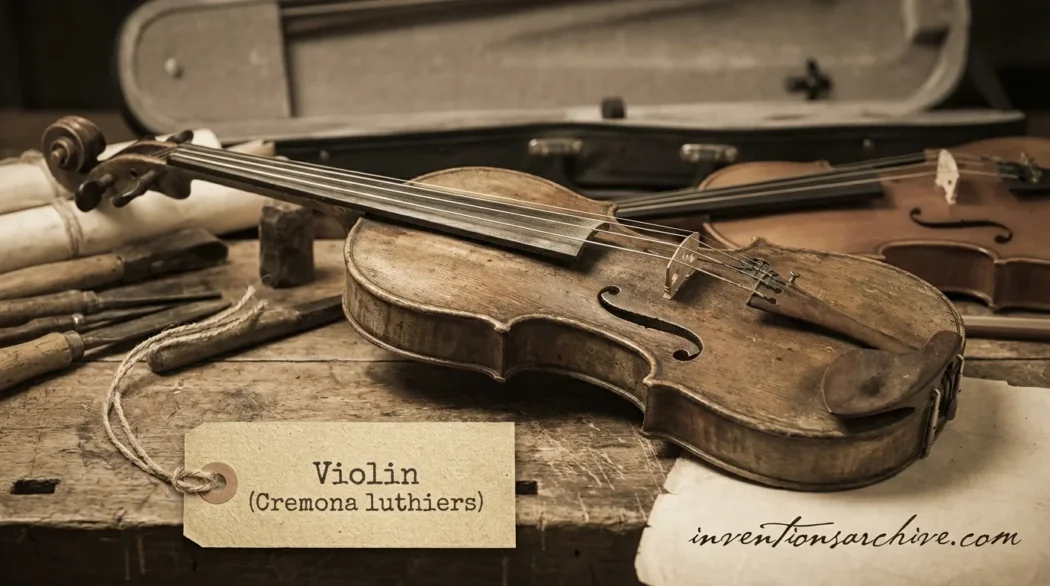
| Invention Name | Violin — Cremonese Tradition |
|---|---|
| Short Definition | A four-string bowed instrument whose classical form was established and refined by northern Italian makers, especially the luthiers of Cremona. |
| Approximate Date or Period | Approximate Essentially modern violin-family forms appear around 1550; classical Cremonese development continued into the eighteenth century. |
| Geography | Cremona, Lombardy, northern Italy, alongside an early parallel tradition in Brescia. |
| Inventor or Source Culture | Attribution varies No single inventor is securely established. Andrea Amati was among the earliest makers to define the Cremonese violin form. |
| Category | Bowed string instrument; chordophone; musical-instrument craftsmanship. |
| Importance | Cremonese workshops established influential violin proportions, construction practices and models that became reference points for later makers. |
| Evidence Status | Based on surviving evidence Sixteenth- to eighteenth-century instruments, labels, workshop material and museum collections survive. |
| Main Problem Solved | Provided a compact bowed instrument with rapid articulation, wide melodic range and enough projection for professional ensemble and solo use. |
| Development Path | Northern Italian bowed instruments → Andrea Amati and the Amati family → Nicolò Amati’s workshop → Guarneri, Rugeri and Stradivari traditions → later modernization and worldwide imitation. |
| How It Works | The bow excites the strings; the bridge transfers vibration to the carved body, where the top, back, enclosed air, bass bar and soundpost contribute to sound radiation. |
| Traditional Materials | Spruce for the top, maple for the back, ribs and neck, with harder woods used for fittings and fingerboards. |
| Major Cremonese Makers | Andrea Amati, Antonio and Girolamo Amati, Nicolò Amati, Andrea Guarneri, Giuseppe Guarneri “del Gesù,” Francesco Rugeri, Antonio Stradivari and Carlo Bergonzi. |
Cremona and the Formation of the Violin
The violin was not suddenly invented in a single workshop. Bowed instruments had circulated in Europe for centuries, and several related forms existed in Renaissance Italy. What changed during the sixteenth century was the emergence of a recognizable violin family with four-string instruments built in repeatable sizes and suited to professional musical ensembles.
Surviving evidence places this transformation in northern Italy, particularly Cremona and Brescia, around the middle of the sixteenth century. The Metropolitan Museum of Art dates the appearance of violin-family instruments in essentially modern form to about 1550 and identifies Andrea Amati of Cremona as one of the first generation of makers associated with the four-string violin and standardized violin-family sizes.[a]
This distinction matters because Andrea Amati should not be described simply as the undisputed inventor of the violin. Makers working in Brescia, including the tradition later associated with Gasparo da Salò, belonged to the same broader northern Italian environment. The surviving record supports a process of development rather than a single documented moment of invention.
Cremona nevertheless became unusually influential because its workshops turned violin making into a durable craft tradition. Designs, working methods and workshop knowledge passed between generations and between families. Amati models influenced later makers, while Stradivari and Guarneri developed recognizable alternatives rather than merely repeating what came before.
Andrea Amati and the Earliest Cremonese Instruments
Andrea Amati stands near the beginning of the documented Cremonese tradition. His surviving instruments demonstrate that by the sixteenth century the violin already possessed the features that make it immediately recognizable: a waisted body, arched front and back, four strings, f-shaped sound holes, a fingerboard, bridge and scroll.
An Andrea Amati violin held by The Metropolitan Museum of Art is dated to about 1560 and is among the earliest surviving violins. Its construction uses spruce and maple, while painted and gilded decoration reflects the courtly setting in which some early Cremonese instruments circulated.[b]
Decoration on surviving Amati instruments also shows that the early violin could function as a prestigious commissioned object rather than merely a utilitarian musical tool. Instruments associated with royal and aristocratic patrons were sometimes embellished with heraldic devices, painted motifs and inscriptions. The craftsmanship therefore combined acoustic function with the visual expectations of elite Renaissance culture.
The importance of the Amati workshop lies less in one isolated feature than in the coherence of the complete instrument. Body outline, arching, corner shape, sound-hole placement and proportions were organized into models that could be reproduced and adjusted. This approach helped establish the violin as a recognizable family of related instruments rather than a collection of loosely similar bowed forms.
Why the Violin Worked So Well for Sixteenth-Century Music
The violin had qualities that suited professional musicians. Its strings responded quickly to the bow, allowing sharply articulated rhythms, rapid melodic movement and considerable variation in volume and attack. Compared with many bowed instruments used in domestic music, the violin could produce a more immediate sound well suited to dance and public performance.
Sixteenth-century professional groups increasingly used combinations of violins, violas and bass instruments. The different sizes created an ensemble covering several registers while retaining a related tonal character. This family relationship became one of the violin’s enduring advantages: the same structural idea could serve soprano, middle and bass ranges.
The instrument also lacked frets. A violinist could therefore alter pitch continuously, shape intonation according to musical context and move freely between positions. The same property demanded considerable skill, but it allowed an expressive flexibility that became increasingly valuable as seventeenth-century music placed greater emphasis on instrumental virtuosity and solo playing.
The Acoustic Structure Inside the Wooden Body
A violin produces little useful volume from vibrating strings alone. The body acts as the principal radiating structure. When a bowed string vibrates, its motion reaches the bridge, which transmits changing forces to the carved spruce top. The top interacts with the ribs, back and air enclosed inside the body.
Two internal components are especially important. The bass bar is attached beneath the top on the bass side and helps distribute vibration while supporting the plate. The soundpost stands between the top and back near the treble side of the bridge. It is not glued permanently in place. It provides structural support and forms an important mechanical connection between the two plates.
The f-holes serve more than a decorative purpose. Their openings allow the enclosed air to interact with the air outside the instrument while also changing the mechanical behavior of the top plate. Shape, placement, arching, plate thickness and the properties of the wood therefore work as parts of one acoustic system.
Cremonese makers did not have modern acoustic measurement equipment. Their control came through material selection, workshop experience, geometric practice and repeated evaluation of finished instruments. Small differences in arching, graduation, outline or setup could produce instruments with noticeably different responses.
Nicolò Amati and the Survival of the Cremonese School
The continuity of Cremonese violin making was threatened during the seventeenth century. Famine and epidemic disease struck northern Italy around 1630, severely reducing the community of established makers. Nicolò Amati, Andrea Amati’s grandson, became the central figure through whom much of the Cremonese workshop tradition continued.
A 1669 Nicolò Amati violin in The Metropolitan Museum of Art illustrates the mature work of the family. The museum describes Nicolò as the preeminent Amati maker and notes the responsiveness and refined character associated with his instruments.[c]
Nicolò’s workshop is especially important because its influence extended beyond the Amati family. Andrea Guarneri learned within this environment, and other makers connected to the workshop established their own traditions. The exact relationship between Nicolò Amati and Antonio Stradivari is less certain. Stradivari’s early instruments show clear Amati influence, but surviving census evidence does not establish him as a conventional resident apprentice in the Amati household.
Nicolò also developed a larger model often called the Grand Amati. Rather than abandoning the visual balance associated with earlier Amatis, he adjusted the dimensions and proportions. His work demonstrates how Cremonese violin making evolved through controlled variations of inherited models.
From One Workshop Tradition to Several Families
The seventeenth-century Cremonese system was not a single uninterrupted master-to-pupil chain. Family relationships, workshop employment, observation of neighboring makers and access to existing instruments all contributed to the circulation of ideas.
| Period | Makers or Workshops | Development |
|---|---|---|
| Mid-16th Century | Andrea Amati | Early surviving Cremonese violins show an established four-string form and highly organized body proportions. |
| Late 16th–Early 17th Century | Antonio and Girolamo Amati | The family workshop maintained and developed Andrea Amati’s models. |
| Mid-17th Century | Nicolò Amati | Larger models and an influential workshop helped transmit Cremonese methods to makers beyond the immediate family. |
| Late 17th Century | Guarneri, Rugeri and Stradivari workshops | Distinct Cremonese styles emerged from a shared local craft environment. |
| Around 1700–1720 | Antonio Stradivari | Stradivari developed the forms associated with his most celebrated mature period. |
| Early–Mid-18th Century | Guarneri “del Gesù,” Bergonzi and others | Individual makers pursued different outlines, arching and tonal responses within the broader Cremonese tradition. |
Stradivari Did Not Simply Copy Amati
Antonio Stradivari is the best-known Cremonese luthier, but his historical importance depends on experimentation rather than the preservation of a single supposedly perfect recipe. His early work reflects the influence of the Amatis, yet his instruments changed repeatedly during his long career.
During the 1690s Stradivari experimented with the model now called the long pattern, characterized by a somewhat longer and narrower body. He later moved away from it. Around the beginning of the eighteenth century he returned to broader proportions and produced many of the violins associated with the period commonly called his “Golden Period,” roughly 1700 to 1720.
The 1711 “Antonius” violin at The Metropolitan Museum of Art belongs to this mature period. The museum records its principal materials as maple, spruce and ebony and notes that Stradivari experimented with violin shape and arching. More than 600 instruments from the Stradivari workshop are known to survive today.[d]
One noticeable tendency in mature Stradivari work is flatter arching compared with many earlier Cremonese instruments. Arching affects the stiffness and vibration of the plates, so changes to it were acoustically meaningful rather than merely stylistic. Stradivari also altered outlines, sound holes, edgework, purfling and proportions over the course of his career.
There is therefore no historically accurate single “Stradivarius design.” A violin from the 1690s can differ materially from one made after 1700, even though both came from the same workshop.
Guarneri “del Gesù” and a Different Cremonese Ideal
Giuseppe Guarneri, usually known as Guarneri “del Gesù”, provides an important counterexample to the idea that Cremonese excellence meant copying Stradivari. Born into another Cremonese violin-making family, he developed instruments with a strong individual character.
Guarneri’s outlines, f-holes, arching and workmanship could differ noticeably from the visual regularity associated with many Stradivari instruments. Surviving examples sometimes appear less meticulously finished in secondary details, yet his finest violins became highly prized by virtuoso players.
The Smithsonian identifies Bartolomeo Giuseppe Guarneri, who lived from 1698 to 1744, as the last and most celebrated member of the Guarneri violin-making family. His familiar “del Gesù” name is connected with the IHS monogram and cross appearing on his labels.[e]
By the late eighteenth and nineteenth centuries, instruments by Stradivari and Guarneri del Gesù had acquired exceptional reputations among leading violinists. Their parallel reputations are revealing: the history of Cremonese making produced several successful acoustic and stylistic solutions rather than one universally correct model.
Wood, Arching and the Cremonese Construction System
The classical violin body combines woods with different mechanical properties. Spruce is normally used for the top because it offers a useful relationship between low mass and stiffness. Maple is commonly used for the back, ribs and neck. The back may be cut from one piece or joined from two pieces, and figured maple can produce the flame visible on many historic instruments.
The ribs create the body’s outline and connect the top and back. In traditional Cremonese construction they are associated with work around an internal mould. Blocks at the corners and ends provide structural joining points. After the rib structure is established, the carved plates are fitted to it.
Purfling—the narrow inlaid lines running near the edges of the top and back—has a decorative role but is physically integrated into the plates rather than simply painted onto their surfaces on classical examples. The edge, channel and purfling together became areas where individual makers developed recognizable working styles.
The arching of the top and back is another defining feature. The violin is not constructed like a flat-sided box. Its plates rise in carefully controlled curves. Arching height and shape influence stiffness and how different regions of a plate move under string excitation. Cremonese makers changed these curves from one model to another, which is one reason instruments from different workshops cannot be reduced to identical dimensions.
Varnish Is Visible, but It Is Not a Lost Magical Formula
The varnish of old Cremonese violins has attracted generations of speculation. The visual surfaces of well-preserved Amati, Stradivari and Guarneri instruments can be striking, and makers clearly paid attention to both preparation of the wood and the coatings applied over it.
It is misleading, however, to explain the reputation of Cremonese instruments through a single lost varnish secret. A violin’s behavior depends on the interaction of its wood, arching, plate thickness, dimensions, internal structure, bridge, soundpost, strings and later setup. Varnish forms only one part of that physical system.
The same caution applies to claims about mysterious wood treatments or undiscovered formulas. Historical instruments can be studied with imaging, chemical analysis, dendrochronology and detailed measurement, but no single substance has replaced the importance of design and skilled construction as an explanation for the Cremonese tradition.
Historic Cremonese Violins Are Usually Not in Their Original Setup
A surviving Stradivari or Amati violin may retain a seventeenth- or eighteenth-century body while incorporating later changes made for new performance requirements. This is one of the most important distinctions when comparing a classical Cremonese violin with a violin as its maker originally supplied it.
As concert halls grew and violin technique changed, many older instruments received longer fingerboards, altered neck arrangements, stronger bass bars and different bridges. Gut strings were supplemented or replaced by later string technologies. The chin rest itself is a nineteenth-century addition.
The Metropolitan Museum of Art notes that nearly all surviving Stradivari violins were modernized in response to later playing requirements. Its 1693 “Gould” Stradivari was eventually returned to a Baroque-style configuration using a shorter neck, appropriate fingerboard and tailpiece, different bass bar and gut strings.[f]
Calling an old Cremonese violin “original” therefore requires precision. Its wooden body may be substantially the work of the historic maker even though its neck, fingerboard, bridge, bass bar, fittings or other setup elements have been replaced or altered during centuries of use and restoration.
The Classical Workshop Era and Its Decline
Cremona’s most famous period extended across several generations rather than ending with the Amati family. Stradivari died in 1737, and Guarneri del Gesù died in 1744. Carlo Bergonzi and other makers carried Cremonese practices further into the eighteenth century, but the concentration of workshops that had made the city dominant weakened.
Meanwhile, violin making flourished elsewhere. Makers in Venice, Milan, Naples, the German-speaking lands, France and later many other regions developed local traditions. Some followed Amati or Stradivari models closely; others altered arching, outlines, construction details and varnishing practices to suit their own methods.
By this stage, the violin itself no longer depended on Cremona for survival. The instrument had become embedded in European musical life. Cremona’s lasting role instead became that of an influential reference tradition whose surviving instruments could be studied, copied and reinterpreted by later luthiers.
Why Stradivari and Guarneri Became Models for Later Makers
Later violin makers frequently described their instruments as being built on a “Stradivari model,” “Guarneri model” or “Amati model.” These terms usually refer to families of proportions and stylistic characteristics rather than exact replicas of one historical instrument.
A Stradivari-inspired violin may borrow the outline of a particular surviving instrument while adjusting arching, plate thickness, neck dimensions or setup. Guarneri-derived models may likewise vary considerably. Even careful copies must account for centuries of wear, restoration and deformation in the original.
This distinction also helps explain why a label bearing the name Stradivarius does not authenticate an instrument. For centuries, workshops and factories produced violins bearing labels that referred to famous Cremonese makers or indicated the model being copied. Identification of a genuine historic instrument instead depends on specialist examination of construction, materials, tool marks, provenance and other physical evidence.
Cremonese Violin Making as a Living Craft
Cremona did not become merely a memorial to eighteenth-century workshops. Violin making was revived and institutionalized in the city, supported by training, collections, competitions, workshops and organizations devoted to lutherie.
Traditional violin craftsmanship in Cremona was inscribed in 2012 on UNESCO’s Representative List of the Intangible Cultural Heritage of Humanity. UNESCO describes a living workshop practice based on specialist training, apprenticeship, hand construction, carefully selected seasoned woods and close adjustment of technique to the acoustic properties of individual materials.[g]
The modern tradition should not be treated as evidence that every present-day method is identical to the practice of Andrea Amati or Stradivari. Centuries of technical change separate them. Its continuity lies instead in the survival and transmission of skilled hand construction, model-based design, material judgment and the identity of Cremona as an active center of violin making.
The Museo del Violino now preserves and presents this history through instruments connected with the Amati, Stradivari, Guarneri, Rugeri and Bergonzi traditions, together with original Stradivari moulds and tools and material documenting later Cremonese lutherie.[h] These collections allow the history of the violin to be studied through physical objects rather than through legends about secret formulas or a single moment of invention.
Sources and Verification
- [a] Violin Makers: Nicolò Amati (1596–1684) and Antonio Stradivari (1644–1737) — The Metropolitan Museum of Art’s historical study documents the emergence of violin-family instruments in northern Italy around 1550, the Amati workshop, Stradivari’s changing models and the later modernization of historic instruments.
- [b] ex “Kurtz” Violin — The Metropolitan Museum of Art’s collection record documents a surviving Andrea Amati violin from about 1560, including its Cremonese origin and materials.
- [c] Violin by Nicolò Amati, 1669 — The museum object record identifies the instrument, describes Nicolò Amati’s position within the Amati family and discusses the continuation of Cremonese violin making after the crisis around 1630.
- [d] “Antonius” Violin — The Metropolitan Museum of Art documents this 1711 Stradivari violin, its materials, Cremonese manufacture and Stradivari’s experimentation with violin proportions and arching.
- [e] Guarneri Family of Violin Makers — Smithsonian Music provides institutional documentation on the Guarneri family and Giuseppe Guarneri “del Gesù,” including the origin of his familiar designation.
- [f] “Gould” Violin — The Metropolitan Museum of Art records the 1693 Stradivari violin and its restoration to a Baroque-style configuration, illustrating how historic Cremonese instruments were altered for changing performance practice.
- [g] Traditional violin craftsmanship in Cremona — UNESCO documents the living Cremonese craft tradition and its 2012 inscription on the Representative List of the Intangible Cultural Heritage of Humanity.
- [h] Museo del Violino — Cremona’s specialist violin museum documents five centuries of local lutherie and preserves collections associated with Amati, Stradivari, Guarneri, Rugeri and Bergonzi, together with historic workshop material.