
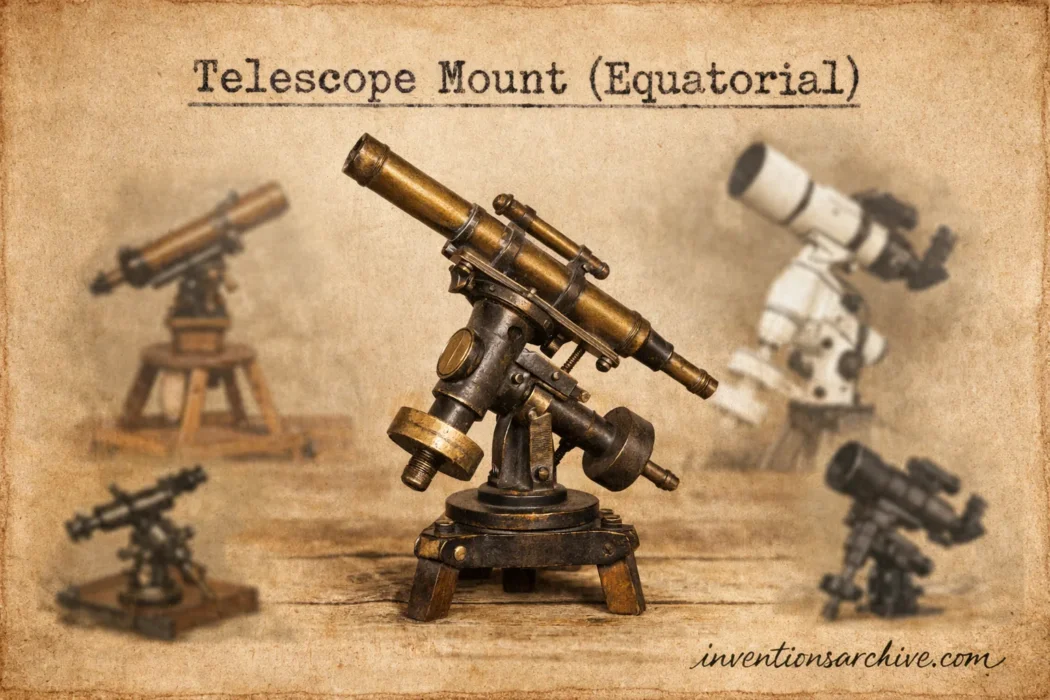
| Item | Details |
|---|---|
| Invention Name | Equatorial Telescope Mount |
| Short Definition | Mount that tracks the sky by rotating a polar axis parallel to Earth’s rotation axis. |
| Approximate Date / Period | Early 1800s — large refractors popularized “parallactic” mounting (Approximate) (Details-1) |
| Geography | Europe (optical workshops + observatories); later adopted worldwide |
| Inventor / Source Culture | Anonymous / collective (refined by instrument makers and observatories; no single “first” universally agreed) |
| Category | Scientific Instruments • Precision Mechanics • Astronomical Observation |
| Need / Motivation | Stable tracking during Earth’s rotation • long observing sessions • repeatable pointing |
| How It Works | One-axis tracking around the polar axis + a second axis for declination changes |
| Material / Technology Basis | Bearings • worm gear • counterweights • motor/drive control |
| First Common Use Cases | Observatories • star catalogs • micrometer measurements • early astrophotography |
| Spread Path | Professional observatories → instrument makers → amateur astronomy market |
| Derived Developments | Clock drives → encoder feedback → computerized pointing (“GoTo”) → robotic observatories |
| Impact Areas | Science • education • imaging • precision timekeeping |
| Precursors + Successors | Precursors: alt-az mounts, transit instruments • Successors: alt-az + derotation, hexapods, direct-drive mounts |
| Types Influenced | German • fork • horseshoe • English • equatorial platforms |
| Notes On “First” Claims | Debated — designs evolved in parallel across workshops and observatories |
An equatorial mount feels like a small trick of geometry made real: tilt one axis to match Earth, and the sky’s daily drift turns into something a single motor can follow. That simple idea is why equatorial mounts became a backbone for careful observing, from classic refractors in domes to modern backyard astrophotography rigs (and yes, even the quiet little remote observatories people run from a laptop after dinner).
Table Of Contents
What An Equatorial Mount Is
An equatorial mount is built around one idea: the mount’s polar axis is set parallel to Earth’s rotation axis, so a telescope can follow the sky’s diurnal motion by moving smoothly around that single axis. In practical terms, that’s why you’ll see the axes labeled Right Ascension and Declination on many designs, and why equatorial tracking avoids the field-rotation twist that appears when an alt-az mount tracks across the sky. (Details-2)
It sounds tidy on paper. In metal, it’s a carefully arranged compromise between geometry, stiffness, and smooth motion. Sometimes elegant. Sometimes a bit clunky. Still, the logic holds.
Why Tracking Needs Geometry
The sky does not “move” because stars drift on their own; Earth turns. That turn is steady enough that telescope engineers treat it like a fixed rate and design around it. When a mount copies that rotation, a star stays put in the eyepiece or camera frame instead of sliding away.
What One-Axis Tracking Buys You
- Cleaner motion: tracking is mainly one smooth rotation, rather than two changing speeds.
- More predictable behavior: small mechanical errors are easier to measure and correct.
- Stable framing: the view stays oriented (useful for imaging and measurement work).
What It Costs
- Tilting loads: the main bearing supports weight at an angle, not straight down.
- More setup sensitivity: tracking depends on how closely the polar axis matches Earth’s axis.
- Meridian constraints: some designs must reposition when a target crosses the local meridian.
That last point—meridian behavior—sounds like a niche detail. It’s not. It shapes how many equatorial mounts are built, how they balance, and how people plan long observing runs.
Axes and Coordinates
Equatorial mounts “speak” the same language as many sky maps: Right Ascension and Declination. Declination works like latitude on the celestial sphere. Right ascension works like longitude, often written in hours, because the sky’s rotation maps naturally onto time: 24h equals 360°, so 1h corresponds to 15° of sky rotation. (Details-3)
Two Axes, Two Jobs
- Right Ascension Axis (often called the polar axis): handles tracking motion.
- Declination Axis: offsets north/south of the celestial equator to reach targets at different declinations.
In casual talk, people blur these terms (“RA axis” becomes “the tracking axis”). It’s normal. Still, the underlying map stays the same, and that map is why equatorial mounts feel so intuitive once you’ve seen them in action.
That tilt note matters: at a given site, the polar axis angle matches local latitude. It’s a quiet constraint that shaped observatory design for generations—some mounts even look “custom fit” to their location because, well, they are.
Sidereal Tracking and Drives
A tracking drive tries to match Earth’s rotation relative to the stars, not the Sun. That reference is called the sidereal rate. The mean interval tied to this motion is about 23h 56m 04s of civil time for one sidereal day, while sidereal time itself runs in a 24-hour cycle. (Details-4)
From Clockwork To Controllers
Early equatorial systems leaned on mechanical regulation—gears, escapements, and careful machining. Today, many mounts use motor drives with electronic control. Same goal, different toolbox. The mount still lives or dies on the same basics: smooth rotation, consistent speed, and low backlash in the drive train.
- Worm gear drives: common because they turn fast motor motion into slow, precise axis rotation.
- Encoders: measure position, helping a controller correct drift or recover pointing after a stop.
- Direct-drive (in some high-end systems): reduces gear artifacts, trading them for other engineering challenges.
One small but real point: tracking errors get discussed in arcseconds, which sounds abstract until you remember that long exposures turn tiny tracking mistakes into visible star streaks. Short exposure? You might not notice. Long exposure? Suddenly you do. Immediately.
Mount Families and Variations
Equatorial mounts are a family, not a single shape. Designers kept the same geometric rule—one axis parallel to Earth—and then rearranged metal around that rule for balance, stiffness, and clearance. That’s why you’ll see wildly different silhouettes that still behave like cousins.
Common Designs
| Type | What It Looks Like | Typical Strengths | Typical Tradeoffs |
|---|---|---|---|
| German Equatorial | T-shaped head with counterweight shaft | Versatile payload range; easy to swap optical tubes | May require meridian flip; counterweight balance is always part of the story |
| Fork (On Wedge) | Fork arms holding the tube on both sides | Comfortable for many tube styles; stable for visual observing | Large forks get bulky; wedge alignment can be finicky |
| Horseshoe / Yoke | Open “U” or horseshoe supporting polar axis | Good pole access for large instruments; high stiffness | Usually observatory-scale; not portable |
| English Cross-Axis | Cross-shaped structure with supported RA axis | RA axis supported at both ends; can be very rigid | Geometry can limit access near the pole; complex structure |
| Equatorial Platform | Tilting platform under an alt-az telescope | Gives equatorial tracking to mounts that otherwise can’t track well | Limited tracking time per run; needs reset |
Notice the pattern: every design is juggling clearance, center of mass, and how the tube moves near the meridian and pole. That’s the real design pressure, not aesthetics.
A Note On Meridian Flip
Some German equatorials track a target until the telescope approaches the mount’s “no-go” geometry, then reposition to keep tracking on the other side. The phrase meridian flip sounds dramatic. In practice it’s just mechanical clearance meeting the sky’s path.
Load, Balance, and Rigidity
Equatorial mounts are sometimes described with a single number—payload capacity—but that number hides the more telling details: where the weight sits, how long the tube is, and how vibration dies out. Two setups can weigh the same and behave very differently. Annoyingly so.
What “Stable” Really Means In Practice
- Stiffness: the mount resists flex under changing angles.
- Damping: small shakes fade quickly rather than ringing.
- Repeatability: returning to the same coordinates lands in the same place.
Engineers chase those properties with bearing design, thicker castings, better fasteners, and drive trains that don’t “spring” under load. It’s not glamorous, but it’s where performance comes from.
Balance sits in the middle of this topic. A well-balanced system reduces strain on motors and reduces uneven gear contact. A badly balanced one can behave like it’s “sticky” in one direction and “loose” in the other. Same mount, totally different night.
Where Equatorial Mounts Show Up Today
Equatorial mounts never disappeared; they just diversified. You’ll still find them in classic domes, but also in compact setups that fit in a car trunk, and in remote systems that run unattended for hours. The goal stays the same: keep a target steady while Earth rotates.
Imaging And Measurement
For long-exposure imaging, the appeal is straightforward: steady tracking plus stable framing. That framing matters when stacking many exposures, measuring small position shifts, or comparing repeat shots over weeks. Same coordinates, same orientation—it keeps work tidy. Tidy helps.
Robotic Observatories
Automated systems favor predictability. Equatorial mounts offer a direct mapping between sky coordinates and mount motion, which plays nicely with catalogs and scheduling software. Add encoders and weather safety systems, and you get that modern “lights-out” workflow people love.
A Quick Reality Check
- Equatorial does not mean “perfect tracking.” It means the geometry is on your side.
- Electronics do not erase mechanics. They work with whatever the gears and bearings give them.
- Setup matters because the polar axis must match Earth’s axis closely for accurate long tracking.
Questions People Ask
What makes an equatorial mount different from an alt-az mount?
An equatorial mount is built so one axis is parallel to Earth’s rotation axis, letting tracking happen mainly through one steady rotation. An alt-az mount moves in altitude and azimuth, which usually means two changing motions to track a target and a rotating field unless derotation is added.
Why is the axis called “Right Ascension”?
Right ascension is a sky coordinate measured along the celestial equator, often written in time units. Many equatorial mounts name the tracking axis after that coordinate because the axis motion maps naturally onto RA.
Does an equatorial mount remove field rotation?
For tracking a target, yes: the mount’s geometry keeps the camera or eyepiece orientation stable relative to the sky when the polar axis is aligned well. That stable orientation is one reason equatorial mounts remain popular for imaging.
What is a “meridian flip,” and why does it happen?
On many German equatorial mounts, the telescope approaches a geometry where parts would collide or run out of clearance as a target crosses the local meridian. The mount repositions to keep tracking safely on the other side. It’s a clearance issue, not a sky-mystery.
Why do people talk so much about balance?
Balance affects how smoothly the drive system loads the gears and bearings. A well-balanced setup tends to track more consistently because the drive isn’t fighting uneven torque as the telescope changes orientation.
Is there a single inventor of the equatorial mount?
Not in the clean “one person, one day” sense. The idea evolved through instrument making and observatory practice. Some documented early 1800s systems (often called “parallactic” mountings) show the concept clearly in use, but the broader development is collective.