
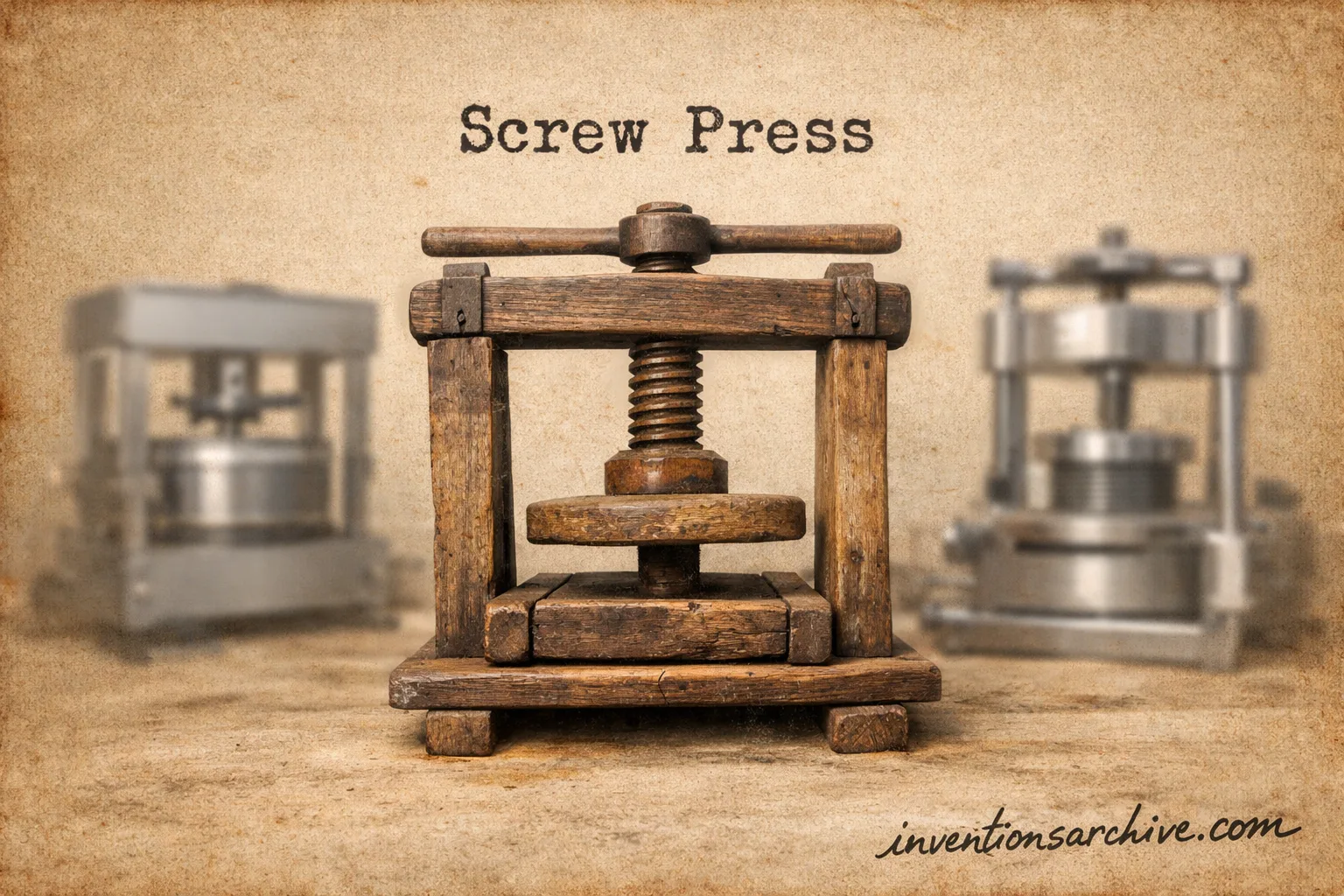
| Invention Name | Screw press |
|---|---|
| Short Definition | A mechanical press that turns rotary motion from a screw into slow, strong, controlled linear pressure. |
| Approximate Date or Period | Likely 1st–2nd century BCE for early screw-press development; clearly used in Roman-era pressing by the 1st century CE Approximate [a] |
| Geography | Greek Mediterranean and Roman Empire Attribution varies |
| Inventor or Source Culture | Anonymous / collective mechanical tradition; often linked with Greek screw theory and Roman agricultural use |
| Category | Manufacturing; agriculture; mechanics; printing; material processing |
| Main Problem Solved | Producing steady pressure with more control than hand pressing, weights or simple levers alone |
| How It Works | A threaded screw moves through a fixed nut or beam, pushing a platen or ram downward as it turns |
| Material and Technology Base | Heavy wooden screw; wooden frame; nut beam; pressing plate; stone or wooden press bed; later iron and steel parts |
| Early Uses | Olive oil pressing; grape pressing; cloth pressing; later printing and bookbinding |
| Evidence Status | Written records, technical descriptions, archaeological press remains and later museum reconstructions Based on surviving evidence |
| Development Path | Lever and weight presses → screw press → wooden hand press → fly press, book press, screw oil press and machine press |
| Related Inventions | Simple screw; lever press; wine press; oil press; printing press; screw jack; fly press |
| Modern Descendants | Bookbinding presses; fly presses; laboratory presses; small oil expellers; industrial screw presses; power-screw actuators |
| Why It Matters | It made pressure more repeatable, compact and controllable across food production, craft work, printing and later manufacturing |
The screw press is one of the clearest examples of an old mechanical idea becoming useful in many different settings. A turning screw could press olives, grapes, cloth, paper, book covers or metalwork with a kind of steady pressure that was difficult to get from hands, stones or simple beams alone. Its importance does not come from a single dramatic invention moment. It comes from a practical change: the screw gave workshops and farms a controlled way to turn rotation into force.
What the Screw Press Is
A screw press is a press built around a power screw. When the screw is turned, it moves a pressing plate, platen or ram. That movement is usually slow, but it can apply strong pressure over a small distance.
The invention belongs to the same broad mechanical family as the screw jack, vise and threaded clamp. The difference is purpose. A fastener screw holds objects together. A screw press uses the screw to press, squeeze, flatten, shape or transfer force.
In early settings, that pressure was useful for extracting liquid from grapes or olives. In later workshops, it helped flatten cloth, bind books, press paper onto inked type, shape materials and hold workpieces under pressure. The same idea moved from farms to print shops and craft benches because the principle was simple, adaptable and durable.
The Problem It Answered
Before screw presses, people could still press materials. They used hands, feet, stones, weights, wedges, beams and lever arrangements. These older methods worked, but each had limits.
- Hand and foot pressing was simple, but pressure was limited and uneven.
- Stone weights could add force, but they were bulky and hard to control.
- Lever presses multiplied force, but long beams required space and careful handling.
- Rope, winch and weight systems could be effective, but they added complexity.
The screw press answered a very practical need: it allowed a person or small group to apply controlled pressure in a compact machine. That did not make every older press obsolete. It gave farms and workshops another option, especially where steady downward pressure was more useful than a long sweeping lever motion.
| Before the Screw Press | What Changed After It |
|---|---|
| Pressure came mainly from hands, feet, weights, wedges or long beams. | A turning screw could create slow, repeatable downward pressure. |
| Large lever systems often needed long rooms or open working space. | Some screw presses could work in a more compact vertical frame. |
| Pressure could be difficult to increase gradually. | The screw allowed finer control because each turn moved the platen a small distance. |
| Different pressing jobs needed different arrangements of stones, beams or baskets. | The same mechanical principle could be adapted for oil, wine, cloth, paper, bookbinding and workshop use. |
| Flat, even pressure was harder to achieve in some craft processes. | The platen-style screw press made more even pressure useful for printing and binding. |
How It Worked in Simple Terms
The screw press works because a screw is, mechanically, a spiral form of an inclined plane. Turning it changes rotational motion into linear motion. In a press, that linear motion pushes a platen or ram against the material below.
The action is slow by design. Slow movement is not a weakness here. It gives control. A worker could turn a handle, bar or wheel and bring the pressing surface down little by little. In a wooden agricultural press, the screw might press a beam or plate onto crushed grapes, olive paste, cloth or another material. In a printing press, the screw drove a platen down onto paper and inked type.
Earlier Ideas and Tools Before It
The screw press did not appear in an empty space. Several earlier ideas made it possible.
The Lever
The lever was one of the oldest ways to multiply human effort. Long beams were useful in pressing because a small force at one end could produce larger force at another point. Many ancient wine and oil presses relied on beam-and-weight arrangements.
The Screw as a Mechanical Idea
The screw was known before the screw press became common. It appeared in different forms, including water-lifting devices and theoretical discussions of simple machines. For a press, the important step was using the screw not as a pump or fastener, but as a way to create pressure.
Pressing Beds, Baskets and Weights
Pressing crops also required other parts: baskets, mats, press beds, channels for liquid, containers and sometimes stone weights. The screw was only one part of a larger working system. That is why archaeological remains can be difficult to interpret. A stone press bed may survive while the wooden screw has disappeared.
How the Origin Is Understood
The screw press is best described as a collective mechanical development. Some reference works place its probable invention in Greece during the 1st or 2nd century BCE, while Roman-era evidence shows wooden screws in agricultural and cloth-pressing contexts. That date should be treated as approximate, not as a signed invention record.
Scholars studying Roman and Late Antique wine and oil presses compare written sources such as Cato, Pliny and Hero with archaeological evidence. That comparison is important because a text may describe a machine type, while surviving remains may show how local workshops actually built and used pressing systems in different regions.[c]
There is also a survival problem. Wood was central to many screw presses, but wood rarely survives as well as stone. Archaeologists may find press beds, weights or installation cuts, while the threaded screw and wooden frame are gone. This makes the earliest surviving evidence different from the true first use.
Main Materials and Mechanical Parts
Early screw presses were usually built from materials that made sense locally. Heavy timber was useful because large wooden screws could be shaped and turned. Stone was useful for press beds, weights and durable installations. Later machines used iron, steel and precision-threaded parts.
Common parts included:
- Threaded screw: the rotating part that moved pressure downward or upward.
- Nut or threaded beam: the fixed threaded element through which the screw moved.
- Platen, plate or ram: the pressing surface.
- Frame: the structure that resisted the force of pressing.
- Bed or tray: the surface holding the material being pressed.
- Handle, bar or wheel: the part used to turn the screw.
In agricultural presses, the material being pressed might be fruit pulp or olive paste. In printing, it was paper against inked type. In bookbinding, it might be folded sections, boards, glued covers or finished books held flat while drying.
| Stage | Form | What Changed |
|---|---|---|
| Earlier Tool | Hand, foot, stone, wedge and lever pressing | Pressure existed, but it was less controlled and often required more space or labor. |
| Mechanical Step | Screw as a simple machine | Rotary motion could be turned into linear force. |
| Agricultural Press | Wooden screw press for grapes, olives or cloth | Pressure could be increased gradually and applied in a compact arrangement. |
| Craft Adaptation | Book, paper and cloth presses | Flat pressure became useful for drying, flattening and finishing materials. |
| Printing Adaptation | Wooden hand printing press | The screw-and-platen idea helped transfer inked type to paper. |
| Later Forms | Fly press, screw jack, industrial screw press and screw expeller | Metal parts, better threads and powered systems extended the same principle into workshops and industry. |
Early Uses
Oil and Wine Production
The best-known early uses were agricultural. Olives and grapes had to be crushed or pressed to extract liquid. Press technology mattered because extraction was not only a household task. In many regions, it connected farming, storage, trade, diet and workshop organization.
A screw press could press a mass of crushed material more steadily than a simple weight alone. Yet older and newer forms often stayed in use together. A small farm, a large estate and an urban workshop did not all need the same press.
Cloth and Material Pressing
Pressing cloth was another early use. Pressure could flatten, compact or finish textiles. The same basic machine logic also suited leather, paper and other materials that benefited from flat, even compression.
Printing
The screw press became especially famous through the wooden hand printing press. Gutenberg did not invent the screw press itself. The stronger claim is that early European printing adapted an existing pressure technology to a new purpose: bringing paper into firm, even contact with inked movable type.
Related articles: Crank Handle [Medieval Inventions Series], Spring Scissors [Ancient Inventions Series]
The original Gutenberg press has not survived, and the physical details are uncertain. The International Printing Museum notes that the earliest surviving press is from the mid-16th century and that the earliest illustration of a press is from 1499, decades after Gutenberg’s work. It also describes the wine or olive oil press connection as an informed assumption rather than a preserved original machine record.[d]
Main Types and Variations
The screw press changed because different trades needed different kinds of pressure. Some versions were tall and wooden. Others were compact bench tools. Later machine presses used metal frames, wheels or powered motion.
| Type or Variation | Typical Setting | Main Use |
|---|---|---|
| Direct Screw Press | Agricultural and workshop pressing | Applies pressure more directly through a screw and platen or beam. |
| Lever-and-Screw Press | Wine and oil production | Combines beam leverage with screw-controlled adjustment or pressure. |
| Twin-Screw Press | Technical descriptions and later workshop forms | Uses two screws to improve balance or holding force. |
| Wooden Hand Printing Press | Early print shops | Presses paper against inked type using a screw-driven platen. |
| Bookbinding Press | Binderies and small workshops | Holds books, covers and paper sections flat under pressure. |
| Fly Press | Metalworking and craft shops | Uses a screw with a weighted handle or flywheel to deliver pressing force. |
| Modern Screw Oil Press | Food and material processing | Uses a rotating screw within a chamber to compress seeds or other material. |
How It Spread and Changed Over Time
The screw press spread less like a single product and more like a useful mechanical pattern. Agricultural pressing, textile finishing, paper handling, printing and workshop clamping all needed pressure. Once the screw principle was understood, different trades could adapt it.
Ancient and Late Antique presses varied by region. Some places kept lever-and-weight systems. Others used screw-assisted arrangements. In the medieval and Renaissance periods, the screw press became visible in printing and book production. After that, better metalworking made stronger screws, more durable frames and more specialized presses possible.
Modern screw presses can look very different from ancient wooden machines. Some use a platen and screw in a way an ancient craftsperson would recognize. Others, such as continuous screw oil presses, use a rotating screw inside a cage or chamber to compress material as it moves through the machine. Modern engineering studies still analyze screw-press behavior in oil extraction, pressure distribution and material flow.[e]
What Changed Because of It
The screw press changed work by making pressure more repeatable. That matters in more than one field.
- Agriculture: it helped process olives, grapes and other pressable materials with better control.
- Textiles: it supported finishing, flattening and compacting cloth.
- Printing: it helped turn inked type and paper into repeatable printed pages.
- Bookbinding: it gave binders a way to hold paper and covers flat during finishing.
- Workshops: it became part of vises, presses, jacks and forming tools.
- Industry: it influenced later machines that use threaded force, controlled compression or screw-driven motion.
The change was practical rather than sudden. A screw press did not make older methods disappear. It gave people a better option where controlled pressure, compact form and repeatability mattered more than speed.
Common Misunderstandings
Gutenberg Did Not Invent the Screw Press
Gutenberg’s printing achievement used pressure technology that already existed. His importance belongs to printing: movable type, ink, press adaptation and production method. The screw press itself is older.
The Earliest Evidence Is Not Always the First Use
Ancient wooden screws rarely survive. A date based on written records or surviving installations tells us what is currently documented, not necessarily the first moment the idea was used.
The Screw Press Was Not Only an Agricultural Tool
Its early reputation comes from wine and oil production, but the same principle later served cloth pressing, printing, bookbinding, metalworking and laboratory pressing.
It Did Not Replace Every Older Press
Lever, weight and screw systems continued to coexist. A technology can be effective without becoming universal. Local cost, material, crop type and workshop habits shaped what people used.
Related Inventions
The screw press sits inside a wider history of pressure, motion and workshop tools. These related inventions help place it in context:
- Simple screw: the mechanical principle behind the press.
- Lever press: an important predecessor and companion technology.
- Wine press: one of the most visible agricultural uses.
- Olive oil press: a major Mediterranean processing technology.
- Printing press: the best-known later adaptation of screw-driven pressure.
- Screw jack: another power-screw tool that turns rotation into lifting force.
- Bookbinding press: a craft descendant using flat, steady pressure.
- Fly press: a later workshop press using screw motion with added momentum.
Frequently Asked Questions
Who invented the screw press?
No single inventor can be named with confidence. The screw press appears to have developed from ancient screw mechanics and practical pressing needs in the Greek and Roman Mediterranean world.
When was the screw press invented?
A cautious date is the 1st or 2nd century BCE for early development, with Roman-era use clearly visible by the 1st century CE. The date remains approximate because the evidence is a mix of written references, technical descriptions and archaeological remains.
How does a screw press work?
A screw press works by turning a threaded screw through a fixed threaded part. That turning motion moves a platen, ram or beam slowly in a straight line, creating controlled pressure on the material below.
What was the screw press first used for?
Its early uses included pressing grapes, olives and cloth. These uses fit the strengths of the machine: steady pressure, gradual adjustment and a frame that could apply force in a controlled way.
Did the screw press lead to the printing press?
It helped make the European wooden hand printing press possible as a pressure mechanism. Gutenberg’s printing system adapted screw-driven pressure to paper and movable type, but the older screw press itself was not a printing invention.
Are screw presses still used today?
Yes. Modern versions appear in bookbinding, small workshops, laboratories, metalworking and food or oil processing. Some are simple manual presses, while others use powered screw mechanisms in industrial equipment.
Sources and Verification
- [a] Screw | Machine Components & Uses in Manufacturing | Britannica — Used to verify the screw as a mechanical component, the approximate Greek/Roman dating of the screw press, and early Roman uses in wine, olive-oil and cloth pressing. (Reliable because it is an established editorial reference with subject review.)
- [b] Pliny’s Presses: the True Story of the First Century Wine Press — Used to verify the importance of Pliny’s wine-press passage and the need for careful interpretation of Roman press technology. (Reliable because it is a peer-reviewed academic journal article published by De Gruyter Brill.)
- [c] Wine and Oil Presses in the Roman to Late Antique Near East and Mediterranean: Balancing Textual and Archaeological Evidence — Used to verify that scholars compare textual evidence and archaeological evidence for Roman and Late Antique wine and oil presses. (Reliable because it is hosted by the Australian National University Open Research Repository.)
- [d] Gutenberg Press — International Printing Museum — Used to verify the uncertainty around Gutenberg’s original press, the 1499 illustration evidence, and the likely adaptation of wine or olive oil press technology for printing. (Reliable because it is an official museum collection page.)
- [e] Mathematical Modeling of Screw Press Configuration for Processing Safflower Oil — Used to verify that modern screw presses remain active engineering subjects in oil-processing research and material-compression analysis. (Reliable because it is a peer-reviewed engineering article in an academic journal.)