
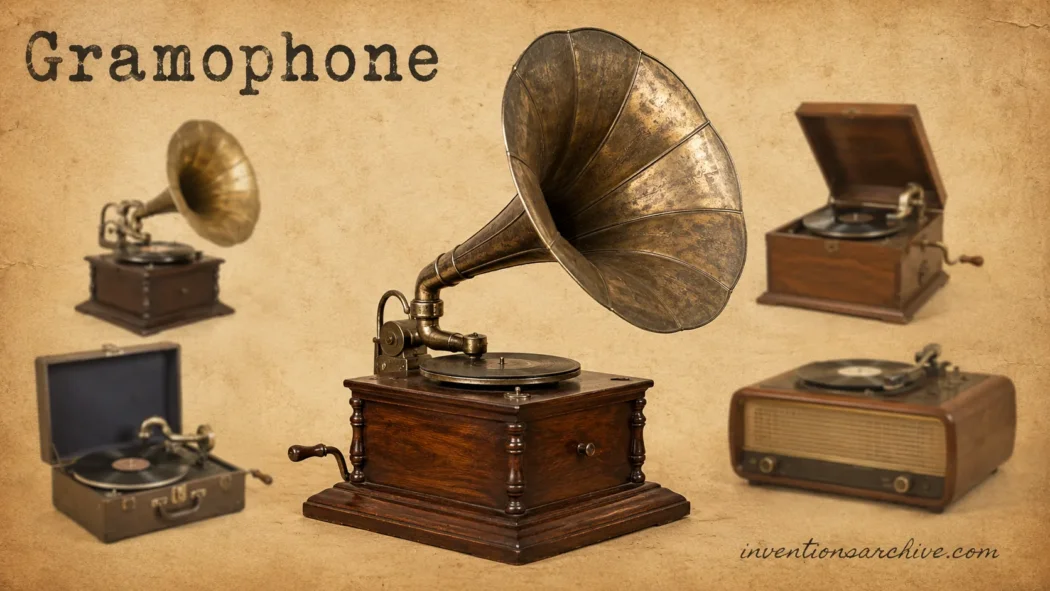
| Invention Name | Gramophone |
|---|---|
| Short Definition | A mechanical sound recording and playback system based on a laterally cut disc record and an acoustic reproducer. |
| Approximate Date / Period | 1887 patent period Confirmed [a] |
| Main Geography | Washington, D.C.; later Germany, England, and wider European markets |
| Inventor / Source Culture | Emile Berliner, German-born American inventor |
| Category | Communication; sound recording; entertainment technology; manufacturing |
| Evidence Status | Patent records, museum objects, institutional histories Based on surviving evidence |
| Main Problem Solved | Fragile cylinder recordings were hard to duplicate in large numbers and awkward to store. |
| How It Worked | A needle followed a side-to-side groove; vibrations moved a diaphragm and horn to reproduce sound. |
| Material / Technology Base | Zinc masters, hard rubber discs, shellac compounds, steel needle, diaphragm, horn |
| Early Use | Public demonstrations, home music, spoken performance, commercial disc records |
| Development Path | Phonautograph and phonograph → gramophone → shellac record systems → electric recording and vinyl discs |
| Related Inventions | Phonautograph, phonograph, graphophone, disc record, spring motor, electric recording |
| Surviving Evidence | Patent specifications, museum collection objects, early records, institutional timelines |
| Modern Descendants | Record players, vinyl LPs, disc-based music formats, record pressing systems |
| Why It Matters | It helped turn recorded sound from a fragile demonstration technology into a reproducible commercial medium. |
The gramophone was not simply an old music player with a large horn. It was a new way to store, copy, sell, and hear recorded sound. Earlier machines had proved that speech and music could be captured, but Berliner’s disc system made recorded sound easier to reproduce in quantity. That shift changed listening at home, the business of music, and the long technical path that led to modern records.
What the Gramophone Is
A gramophone is a mechanical sound device that uses a flat disc record rather than a cylinder. In its classic acoustic form, it plays a record through a steel needle, sound box, diaphragm, tone arm, and horn. No electrical amplifier is needed. The sound comes from physical vibration.
The main difference was the groove. Berliner’s system used a lateral groove, meaning the groove moved side to side. Many cylinder systems used a vertical or “hill-and-dale” motion. This technical choice mattered because a disc with a steady-depth groove could guide the reproducing needle across the surface while carrying sound information in the groove walls.
The gramophone also changed the business logic of recorded sound. A single master could lead to many copies. That made it more suitable for selling music, spoken performances, comic sketches, and other recordings to a broad public.
How Its Origin Is Traced
Emile Berliner began work on the gramophone in the mid-1880s, after earlier sound devices had already shown both promise and weakness. The Library of Congress timeline for Berliner records that he began work on the gramophone in 1886, received his first gramophone patent in 1887, demonstrated the machine at the Franklin Institute in 1888, and moved through celluloid, hard rubber, and later commercial disc forms during the following years. [b]
That sequence is important. The gramophone did not appear as a finished household product in one moment. It moved through experimental discs, public demonstrations, toy-market issues, hard rubber records, shellac pressings, and improved playback machines.
Berliner’s name is central because his patents and companies helped establish the lateral-cut disc record. Yet the gramophone sits inside a wider line of sound recording history. The phonautograph, Edison’s phonograph, and Bell-Tainter graphophone all shaped the problem Berliner was trying to solve.
The Problem It Answered
Before the gramophone, sound recording had already reached the public imagination. The trouble was practical use. Early recordings could be fragile, short-lived, hard to duplicate, hard to label, and difficult to sell as standardized products.
The Library of Congress account of the gramophone describes the limits of wax cylinders: they could wear out, they were not easy to mass-produce, and their groove system required mechanical guidance to keep the stylus properly aligned. Berliner’s disc format answered these problems by using a harder, flatter, more easily copied record surface with a groove that could guide the reproducer across the disc. [c]
| Before the Invention | What Changed After It |
|---|---|
| Recorded sound relied heavily on cylinder formats, often fragile and awkward to store. | Flat discs could be stored upright, labeled more easily, and handled as commercial objects. |
| Commercial copying of recordings was limited and slower. | Disc records supported stampers and repeatable copies from a master. |
| Playback mechanisms often needed careful mechanical feeding across a cylinder. | The disc groove helped pull the stylus and tone arm across the record face. |
| Recorded sound was still often seen as a technical wonder or dictation tool. | Recorded music became a stronger home entertainment product. |
| Titles and performers were harder to attach directly to a cylinder. | The center of a disc allowed etched or paper label information. |
How the Gramophone Worked in Simple Terms
A gramophone worked by turning stored groove shapes back into sound. During playback, the record rotated at a steady speed. A needle rested in the groove. As the groove moved side to side, it shook the needle. The needle moved a diaphragm in the sound box. The diaphragm pushed air, and the horn helped project the sound into the room.
The system was fully mechanical. The groove stored the movement pattern. The needle read it. The diaphragm translated that movement into air vibration. The horn made the sound more audible. This is why an acoustic gramophone can play without electricity.
Earlier Ideas and Tools Before the Gramophone
The gramophone belongs to a chain of nineteenth-century sound experiments. Each earlier device answered part of the problem, but none created the same commercial disc-record system.
The Phonautograph
Édouard-Léon Scott de Martinville’s phonautograph traced sound vibrations visually. It could record the shape of sound, but it was not originally a playback machine. Its importance for the gramophone story is conceptual: it showed that sound waves could be drawn as a physical trace.
Edison’s Phonograph
Thomas Edison’s 1877 phonograph could record and play back sound. The Smithsonian describes it as a device in which sound waves moved a diaphragm and stylus, making indentations on tinfoil wrapped around a rotating drum; during playback, the stylus retraced those marks and recreated a recognizable sound. [d]
Bell and Tainter’s Graphophone
The graphophone improved the cylinder approach by using wax cylinders and was aimed strongly at business dictation. The Smithsonian notes that Alexander Graham Bell and his Volta Laboratory associates developed wax cylinder records and a machine that could record and play them. [e]
These predecessors make the gramophone easier to understand. Berliner did not invent recorded sound itself. His important step was the disc-based, laterally cut, more reproducible form that helped recorded sound become a durable commercial product.
Main Materials, Mechanism and Technical Principle
The early gramophone was a meeting point of small mechanical parts and material experiments. The record material mattered as much as the sound box. A playable disc had to hold fine groove detail, survive repeated playback, and be practical to copy.
Berliner’s early work included experiments with zinc masters, celluloid, hard rubber, and later shellac-based pressings. The German Patent and Trade Mark Office describes the 1887 patent as involving side-writing groove technology and notes the movement from earlier experimental materials toward shellac mixtures that were better suited to the mass market. [f]
- Record surface: carried the groove pattern that stored sound movement.
- Needle: followed the groove and transferred movement to the reproducer.
- Diaphragm: vibrated in response to the needle’s motion.
- Tone arm: carried vibration from the reproducer toward the horn path.
- Horn: projected sound mechanically into the room.
- Turntable and motor: kept the disc rotating while playback occurred.
The technical principle was simple to describe but difficult to perfect: keep the disc moving steadily, let the groove guide the needle, and turn tiny groove movements into air vibrations without losing too much sound.
Early Uses and Public Reception
The gramophone first developed through demonstration and experiment, then moved toward commercial listening. A prototype was used for a public demonstration in Philadelphia in 1888, and commercial versions later offered listeners a growing supply of popular and classical performances. The Smithsonian notes that Berliner’s work led to the first commercially successful disc record and a machine to play it, and that mass-produced records gave homes access to professional musicians, vocalists, orators, and comic performers. [g]
This was a real change in daily life. Before commercial recordings, home music usually meant live singing, a family instrument, a visiting performer, or a public venue. The gramophone made it possible to hear a selected performance again and again. It also helped separate music from the place where it was performed.
How It Spread and Changed Over Time
The gramophone spread through patents, demonstrations, small-scale manufacturing, and later record-company networks. Germany played an early role because some of the first laterally cut disc records were issued there on a small scale. The United States became important through Berliner’s companies and through later manufacturing linked to Eldridge R. Johnson and the Victor Talking Machine Company.
| Stage | Form | What Changed |
|---|---|---|
| Earlier Idea | Phonautograph | Sound vibrations could be traced visually, but not originally played back as a consumer recording. |
| Earlier Playback Machine | Tinfoil phonograph | Recorded and reproduced sound, but early recordings were fragile and limited. |
| Improved Cylinder System | Graphophone and wax cylinder | Improved recording medium and business dictation use, still tied to cylinder format. |
| Invention Stage | Berliner gramophone | Moved toward lateral-cut disc records and acoustic disc playback. |
| Commercial Form | Hard rubber and shellac discs | Made disc records more practical for repeated sale and distribution. |
| Later Form | Electric recording, 78 rpm discs, LPs, singles | Improved recording range, playback quality, duration, and consumer formats. |
The gramophone did not remain fixed. Early hand-cranked machines gave way to better spring-driven motors. External horns later gave way to cabinet designs with hidden horns. Shellac discs became the common commercial format before vinyl LPs and singles reshaped listening in the twentieth century.
Main Types and Variations
“Gramophone” can refer to several related forms. The word is often used loosely, but the variations show how the machine changed as records, motors, and home furniture changed.
| Type or Variation | Main Features | Historical Role |
|---|---|---|
| Experimental Gramophone | Early disc trials; zinc masters; changing record materials | Helped test lateral groove recording and disc playback. |
| Hand-Cranked Disc Gramophone | Manual rotation or simple mechanical drive | Important in demonstrations and early market forms. |
| Spring-Motor Gramophone | Wound motor turned the disc more steadily | Made home listening easier and less dependent on hand turning. |
| External-Horn Gramophone | Visible horn; acoustic amplification | Became the familiar public image of the early gramophone. |
| Cabinet Gramophone | Horn and motor placed inside furniture-style cabinet | Made the machine fit more naturally into domestic rooms. |
| Portable Gramophone | Compact case design with folding or internal horn path | Made disc playback more movable during the acoustic era. |
| Later Electric Record Player | Electrical pickup and amplifier instead of acoustic horn | Not a classic gramophone, but a direct descendant of disc playback culture. |
What Changed Because of the Gramophone
The gramophone changed recorded sound in several concrete ways. Its impact was not only technical. It affected homes, performers, factories, labels, shops, and listening habits.
- Music became repeatable: a listener could hear the same performance many times.
- Performers reached distant audiences: singers, speakers, bands, and instrumentalists could be heard beyond the performance room.
- Records became manufactured products: stamping and pressing made sound part of industrial production.
- Labels and catalogs mattered: recorded selections could be listed, sold, collected, and compared.
- Home listening changed: the living room became a place for recorded performance, not only live family music.
Common Misunderstandings
The Gramophone Did Not Invent Recorded Sound Itself
Recorded sound existed before the gramophone. Edison’s phonograph could record and play back sound in 1877. The gramophone’s special place is the laterally cut disc system and its route toward commercial copying.
The Horn Was Not the Storage Medium
The horn did not hold the recording. It projected sound. The recorded information was stored in the physical groove of the disc.
“Phonograph” and “Gramophone” Are Not Always Used the Same Way
In some places, “phonograph” became a broad word for record players. In other contexts, “gramophone” stayed more closely tied to disc machines. Historical usage varies by country and period.
The Classic Gramophone Was Not an Electrical Speaker
Acoustic gramophones used mechanical vibration and horn projection. Later record players used electrical pickups, amplifiers, and loudspeakers, but those are later descendants rather than the original mechanism.
Related Inventions
- Phonautograph: an early device for tracing sound vibrations visually.
- Phonograph: Edison’s recording and playback machine using a rotating cylinder form.
- Graphophone: a wax-cylinder system developed by Bell and Tainter’s Volta Laboratory circle.
- Disc Record: the flat recorded medium that became central to the gramophone’s success.
- Spring Motor: a mechanical drive that made steady home playback easier.
- Shellac Record: the durable commercial record material strongly associated with early disc music.
- Electric Recording: a later recording method that improved frequency range and recording control.
- Vinyl LP: a later disc format that continued the flat-record tradition in a new material and speed system.
Frequently Asked Questions
Who Invented the Gramophone?
The gramophone is chiefly associated with Emile Berliner, whose 1887 patent and later improvements helped establish the lateral-cut disc record and acoustic disc playback system.
How Was the Gramophone Different from the Phonograph?
The classic gramophone used flat disc records with lateral grooves. Edison’s early phonograph used a cylinder form. The disc format became easier to copy, store, label, and sell in large numbers.
Did Early Gramophones Need Electricity?
No. Classic acoustic gramophones used a mechanical needle, diaphragm, and horn. The groove moved the needle, the diaphragm vibrated, and the horn projected the sound.
Why Were Disc Records Important?
Disc records were easier to store and label than cylinders, and they supported repeated copying from master records. That made recorded sound more suitable for commercial distribution.
Is a Modern Record Player a Gramophone?
A modern record player is a descendant of the gramophone’s disc playback tradition, but it usually uses electrical pickups, amplifiers, and speakers rather than an acoustic horn.
Sources and Verification
- [a] Gramophone: specification forming part of Letters Patent No. 372,786, dated 1887 November 8 — Used to verify the 1887 patent record, patent date, inventor attribution, and patent-document evidence. (Reliable because it is a Library of Congress record of a United States Patent Office document.)
- [b] Emile Berliner (1851 to 1929) — Used to verify Berliner’s development timeline, including work beginning in 1886, the 1887 patent, the 1888 demonstration, and early commercial steps. (Reliable because it is a Library of Congress collection essay.)
- [c] The Gramophone — Used to verify the technical problem of cylinder systems, Berliner’s lateral disc approach, early materials, copying method, and commercial development. (Reliable because it is a Library of Congress historical essay tied to the Emile Berliner collection.)
- [d] Edison’s Talking Machine — Used to verify Edison’s 1877 phonograph mechanism and its role as an earlier sound recording and playback device. (Reliable because it is a Smithsonian National Museum of American History exhibition page.)
- [e] Bell’s Graphophone — Used to verify the Volta Laboratory graphophone, wax cylinder records, and business-dictation context. (Reliable because it is a Smithsonian National Museum of American History exhibition page.)
- [f] DPMA | Gramophone — Used to verify the German patent-office description of Berliner’s gramophone patent, lateral side-writing groove, material development, and later shellac record path. (Reliable because it is published by the German Patent and Trade Mark Office.)
- [g] Berliner’s Gramophone — Used to verify the commercial importance of Berliner’s disc record, mass-copying process, 1888 prototype context, and home-listening impact. (Reliable because it is a Smithsonian National Museum of American History exhibition page.)