
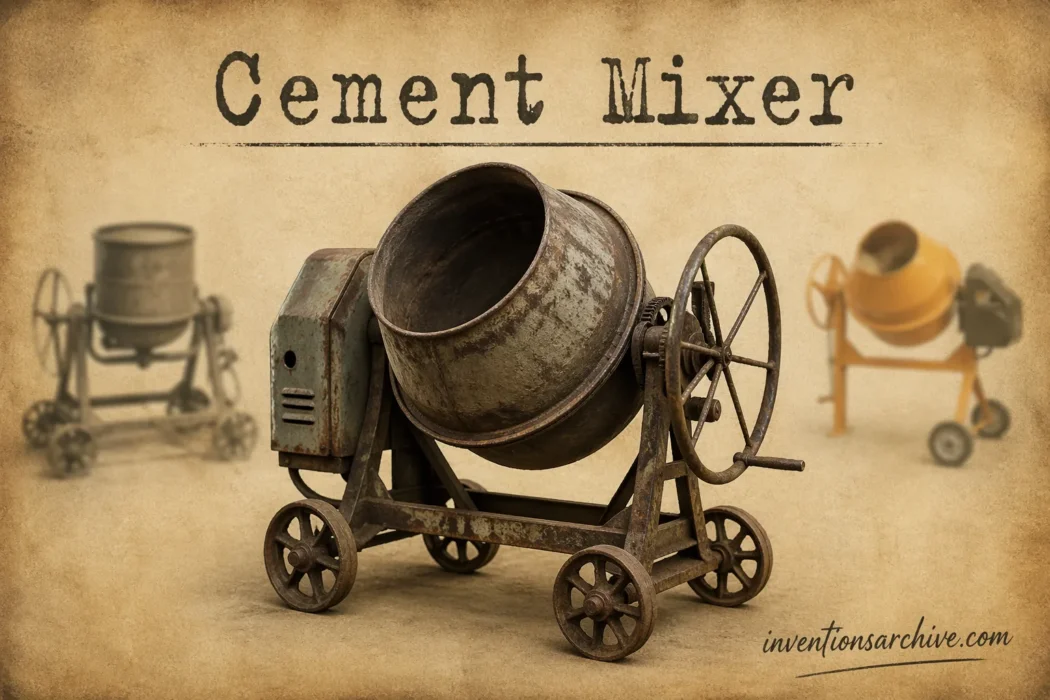
| Data Point | Information |
|---|---|
| Invention Name | Cement mixer / concrete mixer |
| Short Definition | A machine that combines cement, aggregates, water, and sometimes admixtures into workable concrete or mortar. |
| Approximate Date / Period | Late 19th to early 20th century Approximate / attribution varies |
| Early Credited Site Mixer | Gebhard Jaeger, Columbus, Ohio, 1905 archival attribution (Details-1) |
| First Portable Patent Evidence | Richard Bodlaender, “Mortar Mixer,” U.S. patent issued February 9, 1904 (Details-2) |
| Truck Mixer Milestone | Stephen Stepanian, Columbus, Ohio; 1916 self-discharging motorized truck mixer design (Details-3) |
| Geography | United States, Germany, United Kingdom, and later global construction markets |
| Inventor / Source Culture | Multiple inventors; no single clean origin for every mixer type |
| Category | Construction machinery; material processing; concrete production; transport equipment |
| Need Behind the Invention | More uniform concrete; less hand labor; faster site work; better timing before setting |
| How It Works | Rotating drum or pan folds wet material while internal blades lift, tumble, shear, and discharge the mix |
| Technology Base | Steel drum, paddles or blades, rotation, gravity, gear drive, electric motor, gasoline engine, diesel engine, hydraulic drive |
| First Main Use | On-site mortar and concrete mixing for paving, foundations, building work, and later ready-mixed delivery |
| Spread Route | Worksite mixers → portable mixers → truck mixers → ready-mix plants → automated batching systems |
| Derived Developments | Transit mixer trucks, central-mix plants, self-loading mixers, volumetric mixers, concrete pumps, automated batching controls |
| Main Impact Areas | Construction speed, material consistency, urban building, road work, bridges, concrete supply chains |
| Discussion Around “First” | Contested: early site mixer, portable patent, and truck mixer each have separate origin stories |
| Predecessors and Successors | Before: hand mixing, mortar tubs, wheelbarrows. After: ready-mix trucks, twin-shaft mixers, computerized batch plants |
| Types Affected by the Invention | Portable drum mixer, tilting drum mixer, non-tilting drum mixer, reversing drum mixer, pan mixer, twin-shaft mixer, truck mixer |
Cement mixer is the common name, but the machine usually mixes concrete, not cement alone. Cement is the powdery binder. Concrete is the finished mix of cement, water, sand, gravel or crushed stone, and sometimes added materials. That small naming mistake matters, because the invention did not create cement. It solved a different problem: how to turn heavy, wet, fast-setting ingredients into a more even, workable concrete mix at a speed builders could actually use.
Short versions of this invention often name one person and move on. That is too neat. The cement mixer grew from several related machines: fixed site mixers, portable mortar mixers, drum mixers, truck-mounted mixers, and later ready-mix delivery systems. Each solved a slightly different problem. Put together, they changed concrete from a slow on-site chore into a controlled construction material.
Contents
What the Cement Mixer Actually Mixes
A cement mixer is better understood as a concrete mixer. It brings together several materials that behave differently when wet. Cement reacts with water. Sand fills smaller spaces. Gravel or crushed stone gives bulk and strength. Admixtures, when used, adjust workability, setting behavior, air content, or durability.
The American Cement Association describes ready mixed concrete as material batched from a central plant and delivered in a plastic condition, usually made with aggregates, portland or blended cement, water, and sometimes supplementary cementitious materials, fibers, or chemical admixtures (Details-4). That is the material a mixer handles. The mixer’s job is movement, distribution, and timing.
Plain difference: cement is one ingredient. concrete is the combined material. A “cement mixer” on a building site is usually mixing concrete or mortar, not manufacturing cement powder.
Why Hand Mixing Was Not Enough
Hand mixing worked for small batches, but it had clear limits. The worker had to turn dense material over and over until the paste coated the aggregate. The batch could dry at the edges. One corner might hold too much water; another might stay dusty. On larger jobs, that inconsistency became expensive.
- Uniformity: the mixer spread cement paste through the batch more evenly.
- Speed: the rotating drum produced more material in less time than shovels and tubs.
- Workability: the mix stayed movable long enough to place and shape.
- Scale: builders could plan larger pours with less guesswork.
Not glamorous. Very useful.
Invention History and Early Evidence
The cement mixer does not have a single neat birth certificate. The phrase can refer to a small portable machine, a site mixer, a mortar mixer, or a truck mixer. Because of that, the invention story has several names attached to it. Gebhard Jaeger, Richard Bodlaender, T. L. Smith, and Stephen Stepanian all appear in the early story, but not for the exact same machine.
Early Site Mixing Machines
Concrete construction expanded quickly as portland cement became more common and cities needed pavements, foundations, factories, waterworks, and taller buildings. Builders needed a machine that could handle wet aggregate and cement paste without relying only on manual turning. That is where early site mixers entered the picture.
Jaeger is often connected with an early concrete mixing machine in Columbus, Ohio, around 1905. The date is useful, but it should be treated carefully because “first concrete mixer” depends on what type of mixer is meant. A fixed or site machine is not the same thing as a portable mixer, and neither is the same thing as a ready-mix truck.
The 1904 Portable Mortar Mixer Patent
Richard Bodlaender’s 1904 U.S. patent is one of the clearest early records for a portable mixing machine. The patent describes a conveyance with a revolving mixing receptacle that could mix material during motion. In simple terms, it treated motion itself as part of the mixing process.
This is why Bodlaender’s “Mortar Mixer” matters. It moved the idea away from a stationary tub and toward a machine that could travel with the job. The machine was not a modern compact electric mixer. It was more like a horse-drawn mixing vehicle with a rotating drum. Still, the logic feels familiar: put the batch inside a rotating container and let mechanical motion do the heavy work.
The Truck Mixer Problem
The next leap was harder: mixing or agitating concrete while transporting it by motor vehicle. Fresh concrete has a short useful window. It must arrive workable, not separated, not too dry, and not already stiff. A truck mixer had to balance weight, rotation, discharge, engine load, road movement, and the need to place material at the job.
Stephen Stepanian’s 1916 self-discharging motorized mixer design sits in this part of the story. The early design faced technical and patent barriers, yet it pointed toward the modern ready-mix truck: a vehicle that could carry concrete and keep it moving until delivery.
Why the First Inventor Question Is Messy
Ask “Who invented the cement mixer?” and the honest answer is: it depends on the mixer type. Jaeger is tied to early concrete mixing machines. Bodlaender has strong patent evidence for a portable mortar mixer. Stepanian belongs to the truck mixer story. T. L. Smith and other manufacturers helped shape early commercial drum designs.
That is not a weak answer. It is the accurate one. The cement mixer was an invention family, not a single object that appeared fully formed in one workshop.
How the Cement Mixer Works
A cement mixer works by forcing dense materials to fold into each other repeatedly. The drum rotates. Internal fins or blades lift the material and let gravity pull it down. The cycle repeats until the paste coats the aggregates and the batch becomes workable. In a pan or twin-shaft mixer, blades move through a fixed or semi-fixed mixing chamber instead.
Drum, Blades, and Gravity
The classic drum mixer uses a tilted or horizontal rotating container. Inside, blades interrupt the smooth sliding of the material. Without blades, the mass could simply roll in place, especially when wet. With blades, the mix lifts, drops, folds, and turns.
- Drum: holds the batch and provides the rotating chamber.
- Blades or paddles: break up sliding motion and push material through the drum.
- Drive system: turns the drum by electric motor, engine, gearbox, belt, or hydraulic system.
- Opening or chute: controls charging and discharge.
The motion is simple to watch but clever in effect. Gravity becomes part of the mixing tool.
Mixing Versus Agitation
Mixing and agitation are close, but they are not the same. Mixing turns separate materials into a more uniform batch. Agitation keeps already mixed concrete from settling, stiffening unevenly, or separating during transport.
This distinction explains the ready-mix truck. The rotating drum may complete the mixing process, or it may mainly agitate material that was already mixed at a plant. Different systems do different work. Same drum shape, different purpose.
Why Water Changes Everything
Water starts the chemical reaction in cement and also affects workability. Too little water makes placement difficult. Too much water can weaken the hardened concrete and raise shrinkage risk. A mixer cannot fix a poor mix design by itself. It can only distribute the materials it receives.
Important engineering point: the mixer improves uniform distribution. It does not magically improve cement quality, aggregate grading, curing, or design strength.
Main Types and Variations
The cement mixer became useful because it adapted. Small repairs, paving, precast factories, tunnel work, bridges, and ready-mix delivery do not need the same machine. Over time, the invention split into several practical forms.
Portable Drum Mixer
The portable drum mixer is the familiar small site machine. It usually has a tilted rotating drum, a stand or frame, wheels, and an electric or gasoline drive. It fits small pours, repair work, masonry mortar, and jobs where a ready-mix truck would be too large or unnecessary.
Its strength is mobility. Its limit is batch size. The operator can place it close to the work area, but the small drum cannot supply large continuous pours.
Tilting Drum Mixer
A tilting drum mixer rotates while tilted for mixing, then tilts farther to discharge. This simple discharge method works well for many small and medium batches. The design also keeps the machine easy to understand: one drum, one angle change, one discharge path.
The tilting action mattered in early concrete work because it reduced the effort needed to remove heavy wet material from the drum.
Non-Tilting Drum Mixer
A non-tilting drum stays in one position. Material enters and exits through defined openings or chutes. These machines suit repeated production where stability and continuous workflow matter more than simple tilting discharge.
They can be less convenient for small casual work, but in production settings their fixed structure helps with repeatability.
Reversing Drum Mixer
A reversing drum mixer changes drum direction to switch between mixing and discharge. In one direction, internal blades move material inward and fold it. In the other direction, the blade geometry pushes the mix out.
This design is a neat mechanical trick: the same drum performs two tasks by reversing rotation.
Pan and Vertical-Shaft Mixers
Pan mixers use a circular pan and rotating blades. Some designs rotate the pan, some rotate the arms, and some combine motions. They are common where batch control and uniform mixing are valuable, such as precast concrete, laboratory work, and specialty mixes.
Compared with a simple drum, a pan mixer can apply stronger shearing action. That helps with stiff mixes and colored or fine-grained materials.
Twin-Shaft Mixers
Twin-shaft mixers use two horizontal shafts with mixing arms. The shafts turn through the batch and create strong cross-mixing action. These machines often appear in high-output concrete plants because they can mix quickly and evenly.
They are production machines. Not backyard tools.
Continuous Mixers
A continuous mixer feeds materials in and discharges mixed material without stopping for separate batches. This suits work where a steady stream is useful. The machine depends on accurate feeding because the mix quality comes from a constant relationship between material flow and mixing energy.
Transit Mixer Trucks
The transit mixer truck turned the cement mixer into a delivery system. Its drum can rotate on the way to a job, keeping concrete plastic and reducing separation. It also made concrete production less tied to small on-site piles of sand, cement bags, and hand labor.
Truck mixers changed the geography of concrete. A central plant could serve many jobs across a city, while the rotating drum protected workability during travel. That single shift helped ready-mixed concrete become normal on larger construction sites.
Self-Loading and Volumetric Mixers
Self-loading mixers combine loading, batching, mixing, and transport in one mobile machine. Volumetric mixers carry separate materials and measure them as concrete is produced. These machines answer a different need: flexible supply where a conventional plant or truck schedule may not fit the job.
They show how far the idea moved from one rotating drum. The invention became a system.
Engineering Details that Changed the Machine
The visible part of a cement mixer is the drum, but the useful invention sits in small engineering decisions: blade angle, drum speed, discharge height, frame balance, drive power, and the way material enters the machine.
Drum Shape
Early and modern mixers often use conical, double-cone, cylindrical, or partly tapered shapes. These forms affect how material moves inside the drum. A good drum does not merely spin concrete around its wall. It encourages lifting, folding, and discharge.
Shape controls flow. That is the quiet part of the invention.
Blade Angle and Folding Action
Internal blades make the batch move in a controlled path. They lift material, push it forward or backward, and reduce dead zones. In truck mixers, spiral blades can help charge, agitate, and discharge depending on direction and design.
Bad blade geometry wastes energy. Good geometry makes a heavy mix move with less struggle.
Power and Drive Systems
Early machines used animal motion, steam power, hand cranks, gasoline engines, and mechanical gearing. Later mixers adopted electric motors, diesel engines, hydraulic drives, and automated controls. These changes did not alter the basic need, but they changed the scale and reliability of the machine.
- Electric drive: common on small site mixers and controlled plant equipment.
- Gasoline or diesel drive: useful where electrical supply is limited.
- Hydraulic drive: common in truck mixers and heavy mobile systems.
- Computerized batching: used in plants to control material proportions before mixing.
Discharge Control
Mixing is only half the job. The concrete must leave the machine without harsh segregation or wasted material. Chutes, gates, conveyors, and pump interfaces developed because builders needed to place concrete where the formwork was, not merely where the mixer happened to stop.
This point often gets missed. A mixer that cannot discharge well is only a rotating container.
Why It Changed Building Work
The cement mixer changed construction by making concrete easier to control. It reduced the gap between material science and site labor. Before mechanical mixing, a builder could choose good cement and clean aggregate, yet still lose quality through uneven hand mixing. The mixer narrowed that gap.
More Consistent Concrete
Consistency is not a decorative benefit. Concrete carries loads, resists weather, fills forms, and bonds with reinforcement. When the mix varies from one part of the batch to another, the finished work can vary too. Mechanical mixing helped builders produce batches with more even paste coating and aggregate distribution.
Larger Pours and Better Timing
Concrete work depends on timing. A batch must be mixed, moved, placed, consolidated, and cured. A cement mixer made the first part faster and more predictable. Truck mixers added another layer by linking mixing with transport.
For city work, that mattered a lot. Streets, sidewalks, foundations, bridge decks, and floors could be planned around supplied concrete instead of only around laborers turning material by hand.
Ready-Mix Concrete as a New Supply Model
The mixer also helped create a new business model. Concrete could be batched at a plant, delivered in a rotating drum, and placed at a job while still workable. That moved part of quality control away from the crowded jobsite and into the plant.
This did not remove skill from concrete work. It shifted the skill. Proportioning, batching, transport, placement, finishing, and curing all still mattered.
Limits, Names, and Common Misreadings
The cement mixer is easy to recognize, so people assume its story is simple. It is not. A few common mistakes keep showing up.
Cement Mixer Is a Common but Loose Name
The phrase “cement mixer” survives because it is short and familiar. Technically, most of these machines mix concrete or mortar. Cement alone is only the binder, and dry cement powder is not the finished building material.
The Machine Does Not Make Cement
Cement manufacturing is a separate industrial process involving mineral raw materials, heating, clinker production, and grinding. A cement mixer works after cement has already been made. It uses cement as one ingredient in a wet construction mix.
Different machine. Different industry.
There Is No One-Size Mixer
A small portable drum mixer, a precast plant twin-shaft mixer, and a transit mixer truck all belong to the same broad family, but they serve different jobs. Calling them all “cement mixers” hides the engineering choices behind them.
First Invention Claims Need Context
Some sources name Jaeger. Some point to Bodlaender’s patent. Truck mixer histories highlight Stepanian. The better approach is to ask: first in which category? First site mixer? First portable patent? First truck mixer design? The answer changes.
Safety and Environmental Notes
A cement mixer is not a toy version of construction machinery. It handles heavy rotating parts, wet alkaline material, dust before mixing, moving vehicles, and heavy discharge loads. OSHA notes that safety issues exist across concrete production and construction, including manufacturing, portland cement use, and concrete worksite activity (Details-5).
This article explains the invention, not operating procedures. Still, the safety context belongs here because the machine changed labor by replacing some hand work with mechanical motion. That motion must be controlled.
- Mechanical movement: rotating drums, gears, belts, and hydraulic systems require guarding and trained handling.
- Material exposure: wet cement paste can irritate skin, and dry dust needs careful control in professional settings.
- Washout water: leftover slurry must be managed responsibly because it is alkaline and can carry suspended solids.
- Waste reduction: accurate batching and delivery can reduce returned material, but poor planning can still create waste.
Environmental note: the mixer itself does not make concrete low-impact. Better batching, efficient delivery, recycled washout management, supplementary cementitious materials, and durable design all influence the footprint of concrete work.
Invention Family and Later Developments
The cement mixer kept changing because concrete kept changing. New admixtures, higher-strength mixes, precast production, pumped concrete, roller-compacted concrete, fiber-reinforced mixes, and automated plants all placed new demands on mixing equipment.
From Mechanical Drum to Controlled Production
The early problem was physical: how to mix heavy wet material without exhausting people. The later problem became technical: how to produce repeatable concrete with controlled slump, air content, strength targets, and delivery timing.
Modern plants can weigh ingredients, record batches, and load truck mixers with far greater control than early jobsite machines. Yet the old principle remains visible. A rotating or mechanically stirred chamber still brings separate materials into one workable mass.
Why the Invention Still Matters
Concrete is everywhere in ordinary life: floors, driveways, water channels, curbs, bridges, foundations, tunnels, dams, and precast elements. The cement mixer sits behind many of those objects. Quietly, often unnoticed.
Its value is not elegance. Its value is control. It made concrete mixing faster, steadier, and easier to scale.
Questions People Often Ask
Who invented the cement mixer?
No single inventor cleanly owns every form of the cement mixer. Gebhard Jaeger is linked with an early concrete mixing machine in 1905, Richard Bodlaender patented a portable mortar mixer in 1904, and Stephen Stepanian is tied to the early truck mixer story.
Is a cement mixer the same as a concrete mixer?
In common speech, yes. Technically, “concrete mixer” is more accurate because the machine usually mixes cement with water, sand, gravel or crushed stone, and sometimes admixtures.
What problem did the cement mixer solve?
It reduced the labor and inconsistency of hand mixing. The machine helped produce more even batches, faster work, and better timing before fresh concrete began to stiffen.
How does a rotating drum mixer work?
The drum rotates while internal blades lift and fold the wet materials. Gravity pulls the material down, and repeated motion distributes cement paste through the aggregates.
Why was the truck mixer important?
The truck mixer connected concrete production with delivery. It allowed concrete to be mixed or agitated during transport, which helped ready-mixed concrete serve larger and more distant jobs.