
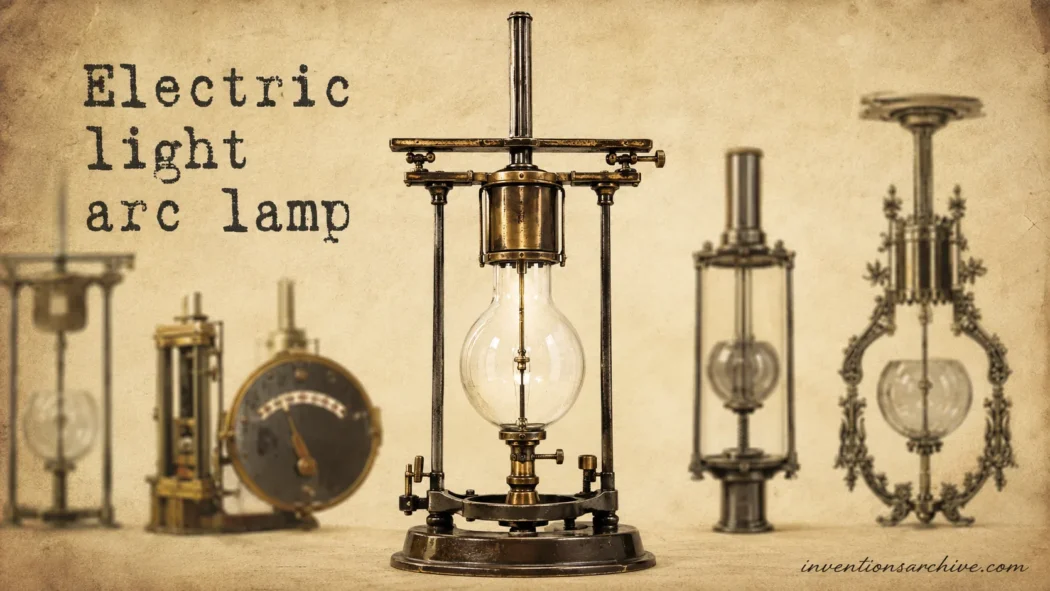
The electric arc lamp was one of the first forms of electric light to move from laboratory demonstration into streets, factories, stations, theaters, and large public spaces. It produced light not by a glowing filament, but by an electric arc formed between two electrodes, usually carbon rods. Its story is not the story of one simple invention by one person. It is a chain of battery experiments, carbon electrodes, dynamos, automatic regulators, public-lighting contracts, and later lamp designs that made high-intensity electric lighting practical before the ordinary incandescent bulb became dominant.
| Invention Name | Electric arc lamp; also called the carbon arc lamp in many early forms |
|---|---|
| Short Definition | A lamp that creates intense light from an electric arc between two separated electrodes |
| Approximate Date / Period | Early experiments: 1808–1810 Attribution varies; practical commercial use: 1870s [a] |
| Main Geography | Britain for early experimental arc lighting; France and Britain for Yablochkov systems; United States for Brush commercial arc lighting |
| Inventor / Source Figures | Humphry Davy for early arc-light experiments; Pavel Yablochkov and Charles F. Brush for major practical forms |
| Category | Energy; lighting; electrical engineering; public infrastructure |
| Main Problem Solved | Providing very bright artificial light for large spaces before smaller, safer electric lamps became practical |
| How It Worked | Electric current crossed a short gap between electrodes, creating a luminous arc that gave off strong light |
| Material / Technology Base | Carbon rods, electrode holders, regulators, dynamos or other current sources, and protective or diffusing globes |
| Evidence Status | Based on surviving evidence for patent models and museum objects; Approximate for earliest demonstration dates |
| Surviving Evidence | Patents, patent models, museum lamps, technical descriptions, and public-lighting records |
| Brush Patent Evidence | Brush’s 1878 patent described automatic adjustment of carbon sticks for a continuous light [b] |
| Museum Object Evidence | A Smithsonian Brush arc lamp patent model is dated ca. 1878 and associated with Cleveland, Ohio [c] |
| Development Path | Voltaic battery experiments → carbon arc lamp → regulated commercial arc lamps → incandescent and discharge lighting |
| Related Inventions | Voltaic pile, dynamo, Yablochkov candle, incandescent lamp, electric street-lighting system, mercury and xenon arc lamps |
| Modern Descendants | High-intensity discharge lamps, projection lamps, searchlights, some scientific illumination systems |
| Historical Importance | It helped prove that electricity could power public lighting systems, not only laboratory demonstrations |
What the Electric Arc Lamp Was
An electric arc lamp was a lighting device that used electricity to create a bright arc between two electrodes. In the best-known early versions, those electrodes were carbon rods. When the ends were close enough, current could pass through the gap and produce a brilliant, hot, white light.
The lamp’s strength was also its difficulty. The arc was intense enough for streets, squares, railway stations, factories, and large halls, yet it was not gentle or convenient for ordinary rooms. Early arc lamps could flicker, hiss, give off heat, and consume their carbon rods. Keeping the gap between the carbons steady became one of the central engineering problems.
This made the arc lamp different from the later incandescent lamp. The incandescent bulb enclosed a glowing filament inside a bulb. The arc lamp depended on an open electrical discharge or a protected discharge between electrodes. It was brighter, harsher, and better suited to large spaces than to the home.
Why It Appeared When It Did
The idea of an electric arc could exist before society had the means to use it widely. Early batteries could produce spectacular demonstrations, but they were costly and limited as everyday power sources. A lamp for public use needed more than a visible arc. It needed a reliable current supply, a way to hold and feed the carbon rods, and a system that could run for useful periods.
The 1870s changed the situation. Dynamos made it easier to generate strong electric current, and inventors began turning laboratory effects into systems for streets and industry. Commercial arc lighting therefore belongs to the same larger story as central power stations, public infrastructure, and the early electrical industry.
The Problem It Answered
Before electric arc lighting, cities and buildings depended on candles, oil lamps, lanterns, and gas lighting. These systems could be useful, but they had clear limits in large spaces. They needed fuel handling, regular lighting and maintenance, and many individual flame points to illuminate broad areas.
The arc lamp answered a different need: very strong light from a small number of points. A single arc lamp could illuminate a street corner, a factory yard, a station platform, or a large public room more forcefully than many older lamps. That made it attractive where brightness mattered more than softness.
| Before the Electric Arc Lamp | What Changed After Practical Arc Lighting |
|---|---|
| Large areas often needed many candles, oil lamps, or gas lamps. | One high-intensity electric lamp could light a much larger area. |
| Public lighting depended on fuel supply, flame maintenance, and manual lighting routines. | Central electrical systems could power lamps from a generator or station. |
| Factories, docks, railway spaces, and streets had limited night visibility. | Large workplaces and public spaces gained brighter artificial light after dark. |
| Older lamps were better suited to small pools of light. | Arc lighting suited broad outdoor and high-ceiling spaces, though not ordinary domestic rooms. |
| Lighting was mostly a local fuel-and-flame problem. | Lighting became part of a larger electrical infrastructure problem: generation, wiring, maintenance, and regulation. |
How the Lamp Worked in Simple Terms
The lamp worked by maintaining a narrow gap between two electrodes. In early carbon arc lamps, the carbon rods first had to be close enough for current to pass. Once the arc formed, the rods slowly burned away. If the gap became too wide, the light weakened or stopped. If the gap was poorly controlled, the light could become unstable.
That is why regulators mattered. A Smithsonian description of a Thomson-Houston arc lamp explains the practical principle clearly: carbon rods were mounted so that an electro-mechanical regulator could maintain the proper operating distance as the rods were consumed. A glass globe could also diffuse the intense light. [d]
Earlier Ideas and Tools Before It
The electric arc lamp depended on several earlier ideas and tools. The voltaic pile made sustained electric current available for experiments. Carbon materials gave early experimenters suitable electrode surfaces. Later, the dynamo made electric lighting far more practical because it could generate current continuously for public or industrial use.
Older lighting technologies also shaped the need for the arc lamp. Candles, oil lamps, and gas lamps were not replaced all at once, but they set the practical comparison. Electric arc lighting had to prove that it could be bright enough, economical enough, and maintainable enough to justify the new electrical equipment around it.
From Earlier Experiments to Later Forms
The arc lamp’s development line is easier to understand as a sequence. The invention began as a scientific effect, became a public-lighting device, and then gave way in many everyday settings to lamps that were easier to control.
| Stage | Form | What Changed |
|---|---|---|
| Earlier Tool | Voltaic batteries and experimental electrical circuits | Made visible electrical arcs possible in laboratory demonstrations |
| Early Arc Light | Davy-style carbon arc demonstration | Showed that electricity could create a powerful artificial light |
| Practical Step | Dynamo-powered arc lighting | Moved the lamp from short demonstrations toward public and industrial use |
| Improved Form | Regulated carbon arc lamps | Used mechanical and electrical controls to keep the arc more stable |
| Parallel Form | Yablochkov candle | Used parallel carbon rods and reduced the need for a complex regulator |
| Later Forms | Incandescent lamps and discharge lamps | Shifted many lighting uses toward smaller, steadier, safer, and easier-to-maintain lamps |
| Modern Descendant | Mercury, xenon, and other high-intensity arc/discharge lamps | Preserved the value of intense light for specialized uses rather than everyday room lighting |
Main Types and Variations
There was no single universal arc lamp. Different inventors solved the same problem in different ways: how to create a bright arc, feed the electrodes, control the gap, and power several lamps with useful reliability.
| Type or Variation | Main Feature | Historical Use or Importance |
|---|---|---|
| Open Carbon Arc Lamp | Used two carbon rods with an exposed or partly protected arc | Useful for very bright outdoor or large-space lighting, but maintenance-heavy |
| Regulated Arc Lamp | Used a mechanical or electro-mechanical regulator to control the carbon gap | Helped make arc lighting more practical for streets and industrial spaces |
| Yablochkov Candle | Placed parallel carbon rods separated by insulating material | Reduced regulator complexity and became a well-known commercial arc-lighting form |
| Brush Arc Lamp | Used regulating mechanisms and systems suited to multiple lamps | Important in American street and public lighting during the late nineteenth century |
| Double-Carbon Arc Lamp | Included more than one pair or arrangement of carbons to extend operation | Addressed the problem of carbon consumption and lamp duration |
| Enclosed Arc Lamp | Placed the arc in a more protected globe or enclosure | Improved steadiness and reduced some maintenance issues in later designs |
| Specialized Modern Arc Lamp | Used gases or vapor systems rather than simple carbon rods | Continued the arc-light principle in projection, scientific, and high-intensity lighting |
Early Uses and Spread
The earliest arc lamps were not household lamps. They were too intense, too demanding, and too visible as pieces of infrastructure. Their first strong role was in places where a bright light source could justify the cost and effort: streets, public squares, docks, factories, theaters, stations, and some scientific instruments.
In the United States, public adoption was closely tied to Charles F. Brush’s system. The Library of Congress notes Brush’s 1879 Cleveland Public Square demonstration and the 1880 installation of Brush arc lamps in Wabash, Indiana, where four lamps were placed above the courthouse to illuminate the town. [e]
Cleveland also became an important early setting. Case Western Reserve University’s Encyclopedia of Cleveland History records that gaslights dominated Cleveland street lighting until 1879, when Brush arc lamps were installed on tall standards in Public Square; it also notes that Brush lamps appeared in other cities including New York, Montreal, Boston, Philadelphia, Baltimore, and San Francisco. [f]
What Changed Because of Arc Lighting
Arc lighting changed the scale of artificial illumination. It made electric light visible to the public before most homes had electric bulbs. A person walking through a city square or past a factory yard could see that electricity was not just a scientific curiosity. It could light public space.
Related articles: Morse code [Industrial Age Inventions Series], Metal Lathe [Industrial Age Inventions Series]
The change was practical. Night work became easier in some industrial spaces. Outdoor areas could be lit from fewer points. Street lighting became tied to central electrical supply. Businesses and municipalities began thinking about light as an electrical service, not only as a set of individual flames.
The lamp also changed engineering priorities. Designers had to solve electrode wear, current control, series circuits, lamp failure, glare, diffusion, maintenance, and cost. These problems helped shape early electrical engineering as a public utility discipline.
Limits and Later Replacement
The arc lamp was powerful, but it was not comfortable for every setting. Its light could be harsh. The carbons were consumed. The lamp could hiss or flicker. Later observers also noted problems associated with arc-light systems, including radiation, interference, and other drawbacks. The American Institute of Physics describes how dynamo arc lamps introduced electricity as a public amenity but were gradually displaced in many urban uses as incandescent lighting improved. [g]
That replacement does not make the arc lamp a failed invention. It means it occupied a specific historical role. It was well suited to the first stage of public electric lighting, when brightness over distance mattered more than small size, silence, or domestic comfort.
Common Misunderstandings
The Arc Lamp Was Not Simply the Same as the Light Bulb
The arc lamp and the incandescent light bulb are both electric lamps, but they work differently. The arc lamp creates light from an electrical discharge between electrodes. The incandescent bulb creates light from a heated filament.
Humphry Davy Did Not Create the Whole Commercial System
Davy’s early demonstrations showed the arc-light principle, but practical public lighting needed later dynamos, regulators, carbon-feed systems, and electrical infrastructure. That later work involved inventors and companies across several countries.
The Brightest Lamp Was Not Always the Best Lamp
Arc lamps were valuable because they were bright. That same brightness made them poorly suited to small rooms. Softer, steadier, easier-to-maintain lamps became better choices for homes and many indoor settings.
The Earliest Evidence Is Not the Same as the First Possible Use
Surviving patents, museum objects, and institutional records show what can be verified. They do not always prove the very first moment an idea was tried, especially for early laboratory demonstrations.
Related Inventions
- Voltaic pile — made sustained electrical experiments possible before large generators.
- Dynamo — supplied practical current for public and industrial arc lighting.
- Yablochkov candle — a simplified carbon arc lighting form with parallel carbons.
- Brush arc-light system — helped turn arc lamps into a commercial public-lighting system.
- Incandescent lamp — became better suited to homes and many indoor spaces.
- Electric street-lighting system — combined lamps, generators, wiring, maintenance, and public contracts.
- Mercury and xenon arc lamps — later high-intensity descendants of the arc-light principle.
- Searchlight and projection lighting — specialized uses where strong concentrated light remained valuable.
Frequently Asked Questions
Who invented the electric arc lamp?
Humphry Davy is usually associated with the early experimental arc light, but the practical electric arc lamp was developed by later inventors, including Pavel Yablochkov and Charles F. Brush. The safest answer is that the arc lamp developed in stages rather than appearing as one finished invention by one person.
How did an electric arc lamp make light?
It made light by passing electric current across a small gap between electrodes. In early carbon arc lamps, the glowing arc between carbon rods produced an intense light that could illuminate large spaces.
Why were carbon rods used in early arc lamps?
Carbon could serve as an electrode material for producing a bright arc. The challenge was that the rods were gradually consumed, so practical lamps needed a way to maintain the correct gap as the carbons burned away.
Where were arc lamps used first?
Early arc lamps were used in experiments and later in places needing strong light, such as lighthouses, theaters, streets, factories, railway stations, public squares, docks, and large halls.
Why did incandescent lamps replace many arc lamps?
Incandescent lamps were smaller, steadier, quieter, and better suited to homes and ordinary indoor lighting. Arc lamps remained useful where very intense light was needed, but they were less convenient for everyday domestic use.
Sources and Verification
- [a] Arc Lamp – 1876 – Magnet Academy — Used to verify the early arc-light context, Davy reference, Yablochkov candle, dynamo importance, and later arc-lamp descendants. (Reliable because it is an institutional educational source from the National High Magnetic Field Laboratory.)
- [b] US203411A – Improvement in electric lamps – Google Patents — Used to verify Brush’s 1878 patent description for automatic carbon adjustment in electric lamps. (Reliable because it reproduces a historical patent record and specification.)
- [c] Brush arc lamp with two carbons | National Museum of American History — Used to verify the surviving Smithsonian patent-model evidence, approximate date, maker, and Cleveland association. (Reliable because it is an official museum collection record.)
- [d] Thomson-Houston Single Arc Lamp | National Museum of American History — Used to verify the carbon-rod arrangement, electro-mechanical regulator, consumption of rods, and globe diffuser. (Reliable because it is an official museum collection description.)
- [e] Lighting America: The Early Adoption of Electric Light | Worlds Revealed — Used to verify Brush’s Cleveland Public Square demonstration and the 1880 Wabash installation context. (Reliable because it is a Library of Congress institutional publication.)
- [f] STREET LIGHTING | Encyclopedia of Cleveland History | Case Western Reserve University — Used to verify Cleveland street-lighting context, the 1879 Brush installation, and later spread to other cities. (Reliable because it is a university-hosted historical encyclopedia entry.)
- [g] Turn on the Lights – AIP.ORG — Used to verify the public role of dynamo arc lamps and their limitations before later incandescent street lighting became more common. (Reliable because it is an institutional article from the American Institute of Physics.)