
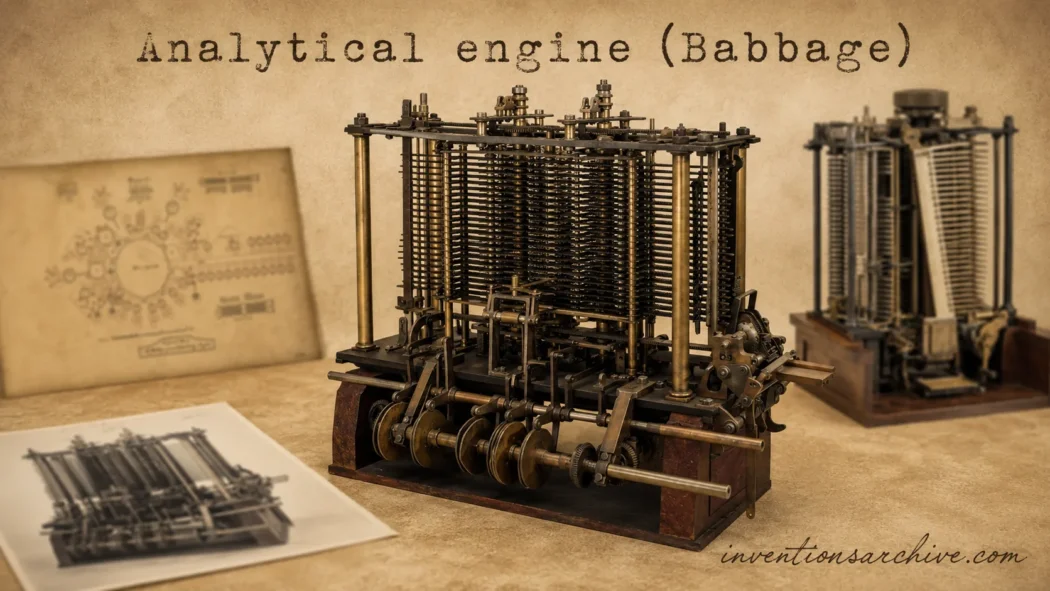
| Invention Name | Analytical Engine |
|---|---|
| Short Definition | A proposed programmable mechanical digital computing engine with memory, arithmetic processing, punched-card control, and output mechanisms. |
| Approximate Date / Period | Conceived in 1834; revised through Babbage’s later life Based on surviving evidence |
| Geography | London, England; later explained through scholarly circles in Turin, Geneva, and Britain |
| Inventor / Source Culture | Charles Babbage; interpretation and publication later shaped by Luigi Menabrea and Ada Lovelace |
| Category | Computing, mathematics, calculation, information processing, education, science |
| Evidence Status | Designs, notations, notebooks, trial pieces, and later publications survive; no complete working engine was finished in Babbage’s lifetime Confirmed |
| Main Problem Solved | Reducing human error and labor in mathematical calculation, then extending calculation toward general-purpose computation |
| How It Worked | Decimal digit wheels represented numbers; a store held values; a mill performed arithmetic; punched cards controlled operations and variables |
| Material / Technology Basis | Precision metal gears, shafts, racks, wheels, mechanical notation, punched cards, proposed steam power |
| First Use Area | No practical public service; used as a design, research program, demonstration concept, and published computing model |
| Development Path | Mathematical tables and mechanical calculators → Difference Engine → Analytical Engine → programmable computers |
| Surviving Evidence | Trial model, portion of the mill, engineering drawings, notebooks, mechanical notations, published 1843 description |
| Related Inventions | Difference Engine, Jacquard loom, punched cards, mechanical calculators, tabulating machines, electronic digital computers |
| Modern Descendants | Stored data processing, programmable machines, CPU-memory architecture, algorithmic computation, software-controlled digital systems |
| Main Importance | It moved beyond automatic arithmetic toward a machine that could, in principle, follow changing instructions and reuse stored intermediate results. |
The Analytical Engine was Charles Babbage’s most ambitious computing design: a nineteenth-century plan for a mechanical, programmable, general-purpose calculating machine. It was not a laptop ancestor in a simple visual sense. It was a large, gear-driven design that tried to separate memory from arithmetic processing, accept instructions through punched cards, and produce printed results. That mix of ideas is why the Analytical Engine occupies a special place in the history of computing, even though Babbage never completed the full machine.
What the Analytical Engine Was
The Analytical Engine was a proposed automatic computing engine. It was meant to do more than repeat one fixed calculation. Babbage designed it to accept different operations, store numbers, move intermediate results, and print output.
In simple terms, the machine had two central parts: the store, where numbers and intermediate values would be held, and the mill, where arithmetic work would be performed. This separation is one reason historians connect the machine to later computer architecture. The Computer History Museum describes Babbage’s engines as decimal digital machines, with number values represented by gear wheels; it also notes that the Analytical Engine used punched-card programming and had a store and mill. [b]
The important point is precision: the Analytical Engine was not a working electronic computer. It was a nineteenth-century mechanical design that anticipated several ideas later seen in programmable computers.
How Its Origin Is Traced
Babbage’s work began with a more specific problem: printed mathematical tables. In the early nineteenth century, navigators, engineers, astronomers, surveyors, bankers, and clerks depended on tables of logarithms and other values. These tables were produced by human labor and could contain errors from calculation, copying, typesetting, or printing.
The Difference Engine was Babbage’s first major answer to that problem. It was designed to calculate tables by mechanical means. When the Difference Engine project stalled, Babbage began thinking about a much broader machine. The Science Museum explains that, in 1834, Babbage conceived the Analytical Engine as a more demanding machine designed to perform any calculation set before it, with punched-card programming, a store, and a mill. [c]
That shift matters. The Difference Engine was aimed at a narrow, valuable task. The Analytical Engine asked a larger question: could a machine be arranged so that instructions themselves guided many different kinds of calculation?
The Problem It Answered
Before the Analytical Engine, complex calculation depended on people, printed tables, hand copying, and simpler calculating devices. This was workable, but it was slow and fragile. A small error in a table could travel into navigation, engineering, astronomy, or finance.
Babbage’s first concern was not entertainment, office typing, or personal computing. It was trusted calculation. The Analytical Engine expanded that concern into a larger design: a machine that could follow different sequences of operations without being rebuilt for each new problem.
| Before the Invention | What Changed After It |
|---|---|
| Mathematical tables were prepared by human computers, copying, checking, and print production. | Babbage proposed machines that could reduce repeated manual calculation and printing errors. |
| Mechanical calculators usually carried out limited arithmetic tasks. | The Analytical Engine pointed toward a machine that could follow changing instruction sequences. |
| A machine was often designed for one main calculation pattern. | Babbage separated data storage, arithmetic processing, and control, making the design more general. |
| Instructions were mainly human procedures written in books, tables, and working notes. | Punched cards suggested a way for instructions and data movement to be represented mechanically. |
| The main users of calculation were specialists in navigation, astronomy, engineering, surveying, and finance. | The design helped later thinkers imagine programmable machines for science, symbols, tables, and eventually information processing. |
How It Worked in Simple Terms
The Analytical Engine can be understood as a mechanical calculation system with separate roles for storage, processing, control, and output. Its design used decimal numbers, not binary electronics. Each digit would be represented by the position of a wheel.
The Store
The store was the part intended to hold numbers. In modern language, people often compare it to memory. That comparison is helpful, but it should not be pushed too far. The store was mechanical, decimal, and physically large.
The Mill
The mill was where arithmetic operations would take place. It was the processing part of the design. Addition, subtraction, multiplication, and division were central operations. Babbage’s mechanical challenge was to move numbers into the mill, perform operations reliably, and return results to the store.
Punched Cards
Punched cards were used as the control idea. They were not invented by Babbage; the Jacquard loom had already shown how punched cards could control patterned weaving. Babbage adapted the idea for mathematical operations and variable handling.
Output
The Engine was intended to produce results through printing or related output mechanisms. This was not a minor detail. For Babbage, avoiding human transcription errors was part of the original calculation problem.
Earlier Ideas and Tools Before It
The Analytical Engine did not appear from nowhere. Several older tools and ideas made it thinkable.
- Printed mathematical tables created the practical need for more reliable calculation.
- Mechanical calculators showed that arithmetic could be embodied in wheels and gears.
- The Difference Engine gave Babbage a working path into automatic calculation.
- The Jacquard loom showed how punched cards could direct a machine through a sequence.
- Precision engineering made complex gear trains, shafts, and repeated parts more plausible.
- Mathematical notation helped Babbage describe operations that could be carried out by machinery.
The invention sits between craft and computing: it needed metalworking skill, but its deepest novelty was the idea of a machine directed by symbolic instructions.
Main Materials, Mechanism, and Technical Principle
The Analytical Engine was a mechanical design. Its physical language was metal: wheels, rods, pinions, racks, barrels, shafts, and frames. The machine’s calculations depended on the positions and movements of parts, not electricity.
The technical principle was simple in outline and hard in practice. A number could be represented by mechanical position. Operations could be represented by controlled movement. Cards could tell the machine which operations to perform and which variables to use.
Babbage’s surviving papers are vital here because they do not only say that the machine was imagined. They show the design work behind it. The Science Museum Group’s Babbage Papers include notebooks, engineering drawings, and notations that describe how parts were intended to act; the archive also includes Analytical Engine drawings, functional descriptions, and notations of calculations from the 1830s. [d]
Early Uses and Real-World Context
The full Analytical Engine was not used in offices, laboratories, or government services because it was never completed. Its early use was therefore intellectual and demonstrative rather than practical.
It served several real contexts:
- Mathematical research: it gave Babbage a way to think about general calculation as a machine process.
- Public explanation: it became a subject of lectures, essays, and technical interpretation.
- Engineering design: it pushed questions about precision parts, control, carriage, storage, and output.
- Education and computing history: it later became one of the clearest early examples of programmable-machine thinking.
This is why the Analytical Engine is not best understood as a failed product. It was an unfinished invention with a strong surviving design record.
How It Spread and Changed Over Time
The Analytical Engine did not spread through factories or sales. It spread through plans, demonstrations, explanations, correspondence, and later museum and archive work.
Luigi Menabrea’s account, based on Babbage’s ideas, was published in French in 1842. Ada Lovelace translated and expanded that account in 1843, adding notes that discussed the Engine’s wider possibilities. The Science Museum’s history of women in computing explains that Lovelace’s notes were around three times the length of Menabrea’s original text and included a detailed treatment of Bernoulli numbers, often described as the first published algorithm for a machine. [e]
That publication helped move the Analytical Engine from a private technical project into a written intellectual object. Later readers could study not only the gears, but the idea of instructions acting on data.
Development Path From Earlier Tools to Later Forms
The Analytical Engine is easiest to place in history as a line of development. Some links are direct. Others are conceptual rather than mechanical.
| Stage | Form | What Changed |
|---|---|---|
| Earlier Need | Printed mathematical tables | Calculation had to be repeated, checked, copied, and printed with fewer errors. |
| Earlier Tool | Mechanical calculators and table-making methods | Arithmetic could be mechanised, but usually for limited tasks. |
| Predecessor | Babbage’s Difference Engine | Automatic table calculation became a serious engineering project. |
| Invention | Analytical Engine | Control, storage, arithmetic, and output were arranged for more general calculation. |
| Published Explanation | Menabrea’s account and Lovelace’s 1843 notes | The machine was explained as a programmable device with wider symbolic possibilities. |
| Later Form | Tabulating machines and early programmable computers | Punched-card control and automatic data processing became practical in later systems. |
| Modern Descendant | Digital computers | Electronic machines later carried out programmable operations at high speed and scale. |
Main Types, Versions, and Related Forms
The phrase “the Analytical Engine” can hide an important detail: Babbage revised the design many times. It is safer to think of it as a family of designs rather than one finished machine.
| Form | Connection to the Analytical Engine | Evidence or Status |
|---|---|---|
| Difference Engine No. 1 | Predecessor focused on mathematical tables, not general-purpose programming. | Partly built; demonstrated as a finished portion of an unfinished engine. |
| Early Analytical Engine Designs | Babbage’s first move from special-purpose calculation toward general-purpose computation. | Known through drawings, notes, and later explanations. |
| Store and Mill Arrangements | Internal design idea separating stored values from arithmetic processing. | Shown in design records and museum interpretation. |
| Punched-Card Control | Proposed means for directing operations, variables, and calculation flow. | Connected to Jacquard-style card control and Babbage’s machine plans. |
| Trial Model / Mill Portion | Physical remnant of the larger Analytical Engine project. | Surviving museum object Based on surviving evidence |
| Later Interpretive Reconstructions | Modern scholarship and archive work used surviving drawings to understand the design. | Research-based, not a complete Babbage-built machine. |
What Changed Because of It
The Analytical Engine did not change daily life in Babbage’s lifetime. It did not process business records, guide ships, run factories, or teach students in classrooms as a working machine. Its effect was slower and more conceptual.
It changed the way a machine could be imagined. A calculating device no longer had to be only a faster hand calculator. It could be a system with stored values, variable operations, reusable instructions, and printed output.
Later computing did not simply copy Babbage’s metal design. Electronic computers used different materials, different speeds, and different engineering principles. Still, many later readers saw in the Analytical Engine an early map of ideas that became familiar: memory, processing, input, output, operations, and programs.
Common Misunderstandings
The Analytical Engine attracts simplified claims because it sits close to the origin story of modern computing. A few careful distinctions make the history clearer.
“It Was the First Working Computer”
Not exactly. It was an early design for a programmable general-purpose computing machine, but the complete Analytical Engine was not built and used in Babbage’s lifetime.
“Babbage Invented Modern Electronic Computing”
Babbage worked with mechanical parts, not electronics. His design anticipated several computing ideas, but later electronic computers came through different materials, institutions, and engineering traditions.
“Ada Lovelace Built or Designed the Machine”
Lovelace did not build or design the Analytical Engine. Her role was in explaining and extending the meaning of Babbage’s machine, especially through her 1843 notes.
“The Earliest Surviving Evidence Proves the First Idea”
Surviving objects and papers show what is currently documented. They do not always capture the first private thought, sketch, or conversation behind an invention.
A Published Record That Preserved the Idea
One reason the Analytical Engine remained visible is that it entered print. Menabrea’s “Sketch of the Analytical Engine Invented by Charles Babbage” was published with Lovelace’s notes in 1843. This text gave readers a structured account of the machine and helped preserve the language of cards, operations, variables, and mathematical procedure around Babbage’s invention. [f]
The printed record also shows why simple credit labels can be misleading. Babbage’s engineering design, Menabrea’s explanation, and Lovelace’s notes each belong to a different part of the invention’s public history.
Related Inventions
The Analytical Engine becomes easier to understand when placed beside the inventions and systems around it:
- Difference Engine — Babbage’s earlier automatic calculating machine for mathematical tables.
- Jacquard Loom — an earlier punched-card-controlled textile machine that helped inspire card-based control.
- Punched Cards — a durable way to encode instructions or data for later machine reading.
- Mechanical Calculator — the wider family of gear-based arithmetic devices that preceded programmable computing.
- Tabulating Machine — later punched-card data-processing equipment used in large-scale record handling.
- Electronic Digital Computer — a later machine family that made programmable computation practical at far greater speed.
- Computer Program — the instruction sequence concept that later became central to software.
Frequently Asked Questions
Who invented the Analytical Engine?
Charles Babbage designed the Analytical Engine. Ada Lovelace did not invent the machine, but her 1843 notes helped explain its wider meaning and are central to its history.
Was the Analytical Engine ever completed?
No complete Analytical Engine was finished in Babbage’s lifetime. Trial pieces, drawings, notebooks, and mechanical notations survive, which is why the invention is known through both objects and documents.
Why is the Analytical Engine important?
It is important because it joined several ideas associated with later computing: stored values, arithmetic processing, external instructions, punched-card control, and automatic output.
How was the Analytical Engine different from the Difference Engine?
The Difference Engine was aimed at producing mathematical tables through a specific calculation method. The Analytical Engine was broader: it was designed to follow different instruction sequences for more general calculation.
Did the Analytical Engine use electricity?
No. The Analytical Engine was a mechanical design based on gears, wheels, shafts, and punched cards. Steam power was proposed for driving the machine, but it was not an electronic computer.
Sources and Verification
- [a] Babbage’s Analytical Engine, 1834-1871. (Trial model) — Used to verify the surviving trial model, date range, Babbage attribution, and incomplete construction status. (Reliable because it is an official Science Museum Group Collection object record.)
- [b] The Engines | Babbage Engine | Computer History Museum — Used to verify the store, mill, punched-card programming, decimal digital nature, and general-purpose computing interpretation. (Reliable because it is an institutional computer history museum source.)
- [c] Charles Babbage’s Difference Engines and the Science Museum — Used to verify the mathematical table problem, the Difference Engine background, and the 1834 move toward the Analytical Engine. (Reliable because it is an official Science Museum institutional history page.)
- [d] The Babbage Papers — Used to verify the surviving archive of notebooks, engineering drawings, notations, and Analytical Engine calculation records. (Reliable because it is an official Science Museum Group archive catalogue record.)
- [e] Women in Computing | Science Museum — Used to verify Ada Lovelace’s translation, notes, Bernoulli number discussion, and the published algorithm context. (Reliable because it is an official Science Museum educational history page.)
- [f] Sketch of the Analytical Engine invented by Charles Babbage, Esq. — Used to verify the 1843 published text by Menabrea with notes by the translator. (Reliable because it is a public-domain archive transcription of the historical publication.)