
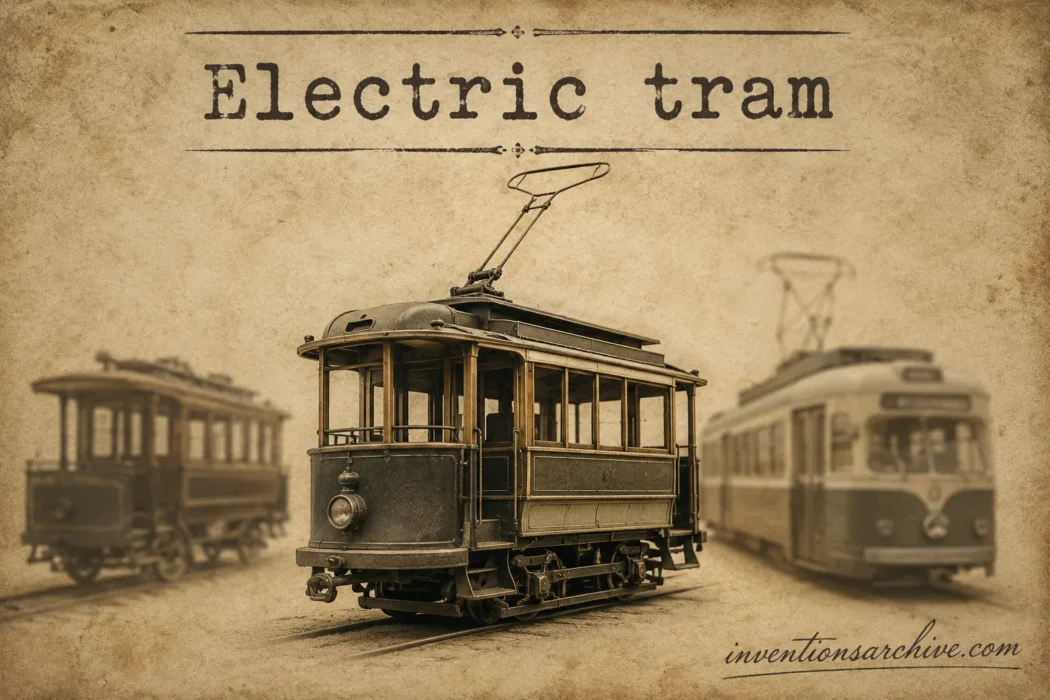
| Invention Name | Electric tram |
|---|---|
| Short Definition | A rail-guided urban passenger vehicle powered by electricity rather than horses, steam, or cable traction. |
| Approximate Date / Period | 1880–1881 Based on surviving evidence |
| Geography | St. Petersburg; Berlin-Lichterfelde; later Richmond, Virginia |
| Inventor / Source Culture | Collective electrical-traction development; linked to Fyodor Pirotsky, Werner von Siemens, Siemens & Halske, and Frank J. Sprague |
| Category | Transport; electrical engineering; urban infrastructure |
| Evidence Status | Early demonstration: 1880 Attribution varies; regular electric tram line: 1881 Confirmed |
| Main Problem Solved | More reliable, scalable urban movement than horse-drawn trams on busy city streets |
| How It Worked | Electric current powered traction motors that turned the tram wheels along fixed rails |
| Material / Technology Base | Steel rails, electric motor, current collector, wiring, controllers, insulated supports |
| Early Use | Urban passenger service; short local railway links; public transit experiments |
| Development Path | Horse tram → electric tram experiment → regular electric tramway → scalable trolley system → modern light rail |
| Related Inventions | Electric motor; dynamo; overhead wire; trolley pole; pantograph; light rail vehicle |
| Surviving Evidence | Institutional records, museum histories, engineering milestone records, preserved tramway components |
| Modern Descendants | Streetcars, light rail, tram-train systems, low-floor articulated trams |
| Why It Matters | It moved electric traction from experiment to daily city transport. |
The electric tram was an urban rail vehicle that used electricity to move passengers through streets on fixed rails. It looked familiar enough to people who already knew horse trams, yet its operating principle was different. Instead of animal power, an electric motor turned the wheels. Instead of feeding and resting horses, the operator depended on a power supply, current collection, rails, controllers, and maintenance crews trained for electrical equipment.
This change mattered because the tram was not only a vehicle. It was a street-level transport system. It needed rails, electricity, current return, stops, depots, schedules, and public trust. The invention therefore sits between mechanical transport and electrical infrastructure.
What the Electric Tram Was
An electric tram, also called an electric streetcar or trolley car in some countries, is a rail vehicle designed mainly for local passenger service. It runs on tracks laid in streets, reserved lanes, or mixed urban corridors. Its power comes from an electrical source rather than from horses, steam engines, or moving underground cables.
The early tram did not instantly replace every older system. Horse trams, steam tramways, and cable cars continued in many places. The electric tram became persuasive when it proved that it could carry passengers regularly, climb city grades more effectively than horse vehicles, and run frequent service without the daily limits of animal power.
Why the Electric Tram Appeared When It Did
The electric tram appeared when several older lines of invention met at the same time. Cities were growing. Street traffic was becoming harder to manage. Horse-drawn tramways had limits: animals needed food, rest, stables, and constant care. Steam engines worked well on railways, but they were not ideal for crowded streets.
Electrical engineering was also changing quickly. Generators, electric motors, insulated wiring, and distribution systems were becoming practical enough to leave the laboratory. By the late nineteenth century, the question was no longer only whether electricity could move a vehicle. The more useful question was whether it could move passengers day after day in a city.
Earlier Tools and Ideas Before It
The electric tram grew out of several earlier systems:
- Horse-drawn tramways: rail-guided street vehicles pulled by horses.
- Steam tramways: small steam-powered rail vehicles used in some urban and suburban routes.
- Cable cars: cars pulled by a moving underground cable, best known from steep urban routes.
- Electric motors and dynamos: the electrical machines that made traction power more practical.
- Urban rail tracks: the fixed street rails that allowed smoother movement than ordinary road wheels.
Seen this way, the electric tram was not a sudden replacement for the streetcar idea. It was a new power system added to an already familiar urban vehicle form.
How It Worked in Simple Terms
The basic electric tram system had three main parts: the car, the power supply, and the track. Electricity reached the tram through rails, overhead wires, conduit systems, or later current collectors. Inside or beneath the vehicle, traction motors converted electrical energy into wheel movement.
In the early Lichterfelde system, contemporary museum material describes a short 2.5-kilometer route, a direct-current motor, and an early method of feeding current through the rails. The same source notes that this rail-current arrangement was not a fully satisfying long-term solution, which helps explain why overhead-wire collection later became so important.[c]
Most later electric streetcars used overhead wires. A trolley wheel or other collector touched the wire and carried current to the tram’s motors. Museum object records for trolley insulators show why insulation mattered: non-conductive materials helped isolate the electrified contact wire from its supports.[d]
The Problem It Answered
The electric tram answered a practical urban problem: how to move many people along fixed city routes without depending on animal power. Horse trams were useful, but a large horse-tram system required many animals, stables, feed, cleaning, and replacement teams. In dense streets, that created a real operating burden.
Electric traction changed the calculation. A tramcar could draw power from a central supply and run repeated trips without the biological limits of horses. It also made it easier to think about longer routes, higher service frequency, and more predictable operation.
| Before the Electric Tram | What Changed After It |
|---|---|
| Horse trams depended on animal teams, stables, feed, and rest cycles. | Electric cars drew power from a supply system and could support more regular service. |
| Steam and cable systems worked in some places but were harder to adapt to every street. | Electric traction gave cities a flexible rail-based option for many routes. |
| Short urban routes often faced limits in speed, grade, and operating cost. | Electric motors improved traction and helped urban rail expand into wider networks. |
| Transport and electricity were often treated as separate fields. | The tram linked urban transport to power generation, distribution, maintenance, and electrical engineering. |
From Early Experiments to Practical Systems
The electric tram’s history is clearest when the word first is used carefully. Pirotsky’s 1880 St. Petersburg work belongs to the experimental origin story. Siemens & Halske’s 1881 Lichterfelde line belongs to the story of regular electric tram operation. Frank J. Sprague’s 1888 Richmond system belongs to the story of large-scale practical adoption.
| Stage | Form | What Changed |
|---|---|---|
| Earlier Tool | Horse tram | Rail guidance made street movement smoother, but power still came from animals. |
| Early Experiment | Electrified tramcar demonstration | Electricity showed that it could move a street rail vehicle. |
| Regular Service | Lichterfelde electric tramway | Electric traction entered public passenger operation on a short route. |
| Scalable Model | Richmond electric street railway | A larger system proved electric street railways could operate as practical city networks. |
| Modern Descendant | Light rail and low-floor tram | Electric urban rail continued with safer current collection, improved controls, and accessible vehicle design. |
Sprague and the Scalable Electric Streetcar
Frank J. Sprague did not erase the earlier work of Pirotsky or Siemens. His importance lies in making electric street railway operation more convincing at city scale. The Richmond Union Passenger Railway began operating in February 1888, and the IEEE engineering milestone record describes it as the lasting prototype for electric street railways because of its practicality and operating performance. The same record notes that many earlier attempts had not yet produced a dependable replacement for animal-powered street railways.[e]
This is one reason short histories can be confusing. One source may focus on the first electric tram demonstration. Another may focus on the first regular line. Another may focus on the first broadly successful street railway system. Each claim can be meaningful, but only when the type of evidence is named.
Main Parts and Technical Principles
The electric tram combined mechanical and electrical parts into one working system. The exact arrangement changed by city and period, but the main principles stayed recognizable.
- Rails: guided the car and often helped complete the electrical return path.
- Traction motors: converted electrical energy into motion.
- Current collector: connected the car to its power supply, often through a trolley pole, bow collector, or pantograph.
- Controller: allowed the operator to regulate power to the motors.
- Braking system: helped slow or stop the car under urban operating conditions.
- Power distribution: linked generating stations, wires, feeders, and substations to the tramway.
The technical step that mattered most was not simply putting a motor on a car. It was making the motor, power supply, track, collector, and daily operating routine work together.
Related articles: Dynamo (electric generator) [Industrial Age Inventions Series], Railway System [Industrial Age Inventions Series]
Main Types and Variations
| Type or Variation | Power or Collection Method | Typical Context |
|---|---|---|
| Rail-Current Electric Tram | Current supplied through running rails or rail-based conductors | Early experimental and first-generation systems |
| Overhead-Wire Trolley Tram | Trolley pole or wheel collecting current from an overhead wire | Late nineteenth- and early twentieth-century street railways |
| Conduit Electric Tram | Power collected from a protected channel below street level | Used where overhead wires were restricted or disliked |
| Pantograph Tram | Roof-mounted collector pressing against overhead wire | Common in many later tram and light rail systems |
| Battery or Wireless Tram | Onboard energy storage or route-based charging | Modern systems where overhead equipment is limited in selected areas |
| Low-Floor Articulated Tram | Electric traction with accessible multi-section vehicle design | Modern urban transit and light rail corridors |
How It Spread and Changed Over Time
Once electric traction became reliable, tramways spread because they matched the needs of growing cities. They could connect residential districts with workplaces, markets, schools, stations, and public institutions. The rails gave a visible route. The timetable gave routine. The electric supply gave operators a way to run frequent service.
Early systems were not all identical. Some cities used overhead wires. Some tested conduit power. Some kept older horse or cable lines for a time. Vehicle bodies changed from simple wooden cars to larger enclosed cars, then to multi-car and articulated designs. Current collectors also changed, moving from early rail-current arrangements and trolley poles toward bow collectors, pantographs, and newer charging methods.
Modern tram and light rail systems still carry the older idea forward: electric urban rail serving repeated local journeys. Siemens Mobility, for example, traces its European tram and light rail work back to the 1881 electric tram in Berlin and describes later streetcars and light rail vehicles as part of that long transport line.[f]
What Changed Because of the Electric Tram
The electric tram changed urban travel in practical ways. It made scheduled public transport less dependent on animal labor. It helped cities extend routes into new residential areas. It gave electrical companies and transport operators a reason to build shared infrastructure. It also helped make electric traction familiar to the public.
The effect was not only mechanical. The tram changed how people thought about distance inside a city. A workplace, school, market, or railway station could become easier to reach if it lay along a tram line. That made the electric tram part of urban planning, not just vehicle history.
Common Misunderstandings
The Electric Tram Was Not a One-Person Invention
The electric tram is often linked to a single name, but that is too simple. Pirotsky, Siemens, Sprague, motor designers, electrical suppliers, city authorities, and tramway operators all shaped the invention’s practical history.
The First Demonstration and the First Durable System Are Different Claims
An early electric movement of a tramcar proves that the idea worked in a limited setting. A regular urban tramway proves that passengers, operators, power supply, track, and maintenance could work together over time.
A Tram Is Not the Same as a Cable Car
Both run on rails, but a cable car is pulled by a moving cable. An electric tram carries its own traction motors and draws electrical power from a rail, wire, conduit, or onboard source.
Modern Trams Are Not Just Old Streetcars
Modern light rail and low-floor trams come from the same lineage, but their braking, accessibility, controls, passenger information systems, and power equipment can be very different from nineteenth-century vehicles.
Related Inventions
The electric tram fits into a wider history of transport and electrical engineering. These related inventions help place it in context:
- Horse-drawn tramway — the rail-guided street vehicle that electric traction improved.
- Electric motor — the machine that made powered tram movement possible.
- Dynamo / generator — the electrical source behind early traction power systems.
- Trolley pole — a current collector used by many overhead-wire streetcars.
- Pantograph — a later roof-mounted collector used on many trams and trains.
- Electric trolleybus — a related road vehicle powered from overhead wires but not running on rails.
- Light rail vehicle — a modern descendant of the electric tram idea.
Frequently Asked Questions
Who invented the electric tram?
The electric tram is better described as a collective invention. Fyodor Pirotsky is linked to an 1880 electric tramcar demonstration, Werner von Siemens and Siemens & Halske are linked to the 1881 Lichterfelde electric tramway, and Frank J. Sprague is linked to the practical large-scale electric street railway system in Richmond in 1888.
Was the electric tram the same as a trolley car?
In many places, especially in North America, an electric streetcar was called a trolley car because it collected current from an overhead wire using a trolley pole or related current collector. The words tram, streetcar, and trolley often overlap, but local usage varies.
What made electric trams better than horse trams?
Electric trams did not need teams of horses, stables, feed, or rest cycles. Once the electrical and track infrastructure was in place, they could support more frequent service and larger urban networks.
Are modern light rail systems descended from electric trams?
Yes. Modern light rail systems use newer vehicles, controls, accessibility features, and power equipment, but they continue the same basic idea of electric rail-based urban passenger transport.
Sources and Verification
- [a] Российский трамвай: 140 лет на службе у пассажиров — Used to verify the 1880 St. Petersburg electric tramcar demonstration associated with Fyodor Pirotsky and the later delay before regular Russian electric tram service. (Reliable because it is a city electric transport museum source.)
- [b] The first electric trams! – Deutschlandmuseum — Used to verify the Siemens & Halske Lichterfelde electric railway, the May 1881 public-service context, and the short route linked with the Cadet School. (Reliable because it is a museum history page using institutional historical material.)
- [c] Der Strom · Eisenbahngeschichte — Used to verify technical details of the Lichterfelde system, including the direct-current motor, route length, early rail-current power supply, and Siemens’s earlier electric railway display. (Reliable because it is a regional museum and railway-history source.)
- [d] Trolley Insulator, circa 1885 — Used to verify how many electric streetcars collected power from overhead wires and why insulating materials were part of tramway electrical infrastructure. (Reliable because it is an official museum object record from The Henry Ford collection.)
- [e] Milestones: Richmond Union Passenger Railway, 1888 — Used to verify Sprague’s Richmond system, its IEEE Milestone status, and its role as a practical prototype for later electric street railways. (Reliable because it is an IEEE Engineering and Technology History Wiki milestone record.)
- [f] Streetcars and light rail vehicles – Siemens Mobility Global — Used to verify the continuing line from the 1881 Berlin electric tram to later streetcar and light rail vehicle development. (Reliable because it is an official Siemens Mobility page about tram and light rail vehicles.)