
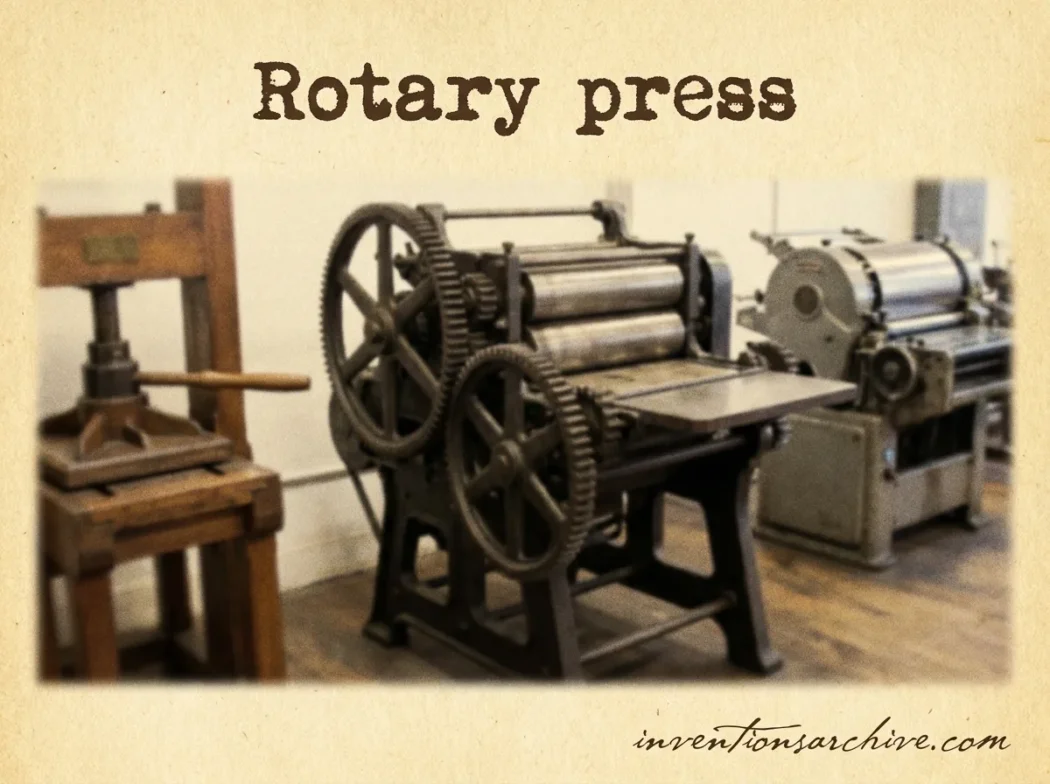
| Invention Name | Rotary press, more precisely the rotary printing press |
|---|---|
| Short Definition | A printing press that prints by passing paper between rotating cylinders carrying inked printing surfaces. |
| Approximate Period | Practical cylinder printing: early 1810s Based on surviving evidence; Hoe rotary press patent model: 1847 Confirmed |
| Main Geography | Britain, Germany, and the United States |
| Inventor / Source Culture | Friedrich Koenig and Andreas Bauer for the practical power-driven cylinder press; Richard March Hoe for the influential American type-revolving rotary press [a] |
| Category | Communication; manufacturing; publishing technology |
| Main Problem Solved | Slow hand-fed printing and limited newspaper output |
| How It Worked | Curved type, plates, or image surfaces met paper through rotating cylinders rather than a flat press bed alone. |
| Material / Technical Basis | Metal cylinders, printing plates or type forms, inking rollers, paper sheets or paper web |
| Early Use | High-volume newspaper printing |
| Evidence Status | Confirmed for surviving patent models and museum records; Attribution varies for the broader invention line |
| Surviving Evidence | Patent models, museum objects, printing records, historical press descriptions |
| Development Path | Hand press → cylinder press → rotary press → web-perfecting press → modern offset and rotogravure systems |
| Related Inventions | Movable type, cylinder press, stereotype plate, web press, offset printing, rotogravure |
| Modern Descendants | Web-fed offset presses, commercial rotary presses, newspaper presses, package-printing systems |
| Why It Matters | It made large print runs faster, helped newspapers scale, and shaped industrial printing. |
The rotary press was not a single sudden break from all earlier printing. It was a long mechanical shift: printers moved from pressing paper against a flat surface to moving paper through rotating cylinders. That change sounds simple, but it altered the speed, scale, and rhythm of printing. Newspapers, catalogs, books, pictorial sections, and later commercial packaging all benefited from the same central idea: keep the press moving in a continuous cycle instead of stopping for every impression.
What the Rotary Press Is
A rotary press is a printing machine built around rotation. In a simple form, paper passes between two cylinders. One carries the printing surface, and the other provides pressure so the inked image transfers to the paper. This differs from a flatbed press, where the printing surface stays flat and the paper is pressed against it in a slower repeated motion.
The most important idea is continuous movement. A rotary press can feed paper through the machine while the cylinders keep turning. Later versions used a continuous roll of paper, often called a web. That made the machine especially useful for newspapers, where speed and repeated copies mattered more than decorative hand production.
Britannica describes the rotary press as a press in which paper passes between a supporting cylinder and a cylinder containing printing plates, and notes its main use in high-speed, web-fed printing such as newspaper production [b].
How the Origin Is Traced
The origin story has two layers. The first layer belongs to the cylinder press. Friedrich Koenig and Andreas Bauer built a power-driven cylinder press that moved paper over type by cylinder action. The Science Museum Group records the first practical machine appearing in 1812 and the famous 1814 use for The Times in London [c].
The second layer belongs to the true rotary idea: putting the printing form itself onto a rotating cylinder. Richard March Hoe’s work in New York is central here. The Smithsonian’s National Museum of American History holds a patent model for an improvement on Hoe’s rotary printing press, with patent number 5199 and a patent date of July 24, 1847 [d].
This means the safest wording is not “one person invented the rotary press.” A better statement is that rotary printing developed through several linked improvements, with Koenig and Bauer important for practical cylinder printing and Hoe important for the American type-revolving rotary press.
The Problem It Answered
Before rotary printing, presses were much slower because the work involved separate steps: inking, placing paper, pressing, removing paper, and repeating the cycle. Metal and cylinder presses improved that process, but the demand for newspapers kept rising. Publishers needed more copies, faster delivery, and machines that could handle repeated production without wearing down type too quickly.
The rotary press answered three practical needs:
- Speed: rotating parts allowed faster repeated impressions.
- Scale: large newspapers could print many copies in a shorter time.
- Workflow: later web-fed presses reduced the need for hand-feeding separate sheets.
Before and After the Rotary Press
| Before the Rotary Press | What Changed After It |
|---|---|
| Printing depended heavily on flat surfaces, hand feeding, and slower press cycles. | Cylinders allowed printing to become faster and more continuous. |
| Large newspaper runs required more labor and more time. | High-volume newspaper production became more practical. |
| Movable type could wear down during repeated printing. | Stereotype plates and curved plates later helped protect type and speed production. |
| Sheets often had to be handled separately. | Web-fed presses used continuous rolls of paper in later systems. |
| Printing and finishing were often separate operations. | Large modern rotary presses could combine printing with cutting, folding, and other finishing steps. |
How It Worked in Simple Terms
The rotary press used rotation to make printing less stop-and-start. Instead of one flat surface pressing down, a cylinder carried the printing surface through repeated contact with paper. Ink rollers spread ink, the image surface received it, and the impression cylinder pressed paper against the inked surface.
In early Hoe-style rotary letterpress machines, type or type forms were secured to a large cylinder. As that cylinder turned, several impression cylinders could press sheets against the type. In later web-fed systems, the paper came from a roll, passed through the press, and could be printed, cut, and folded as part of a more continuous production line.
This article explains the mechanism in historical and educational terms only. Large presses are industrial machines with moving cylinders, rollers, and powered parts. Their practical operation belongs to trained print workers and controlled workshop settings.
Earlier Tools and Ideas Before It
The rotary press grew from earlier printing systems rather than replacing them overnight. Its main predecessors were:
- Hand presses: useful for books and smaller print runs, but slow for mass newspaper work.
- Iron presses: stronger and more durable than wooden presses.
- Flatbed cylinder presses: an important step because the paper could meet the type through cylinder action.
- Movable type and locked forms: the printing surface that early rotary letterpress machines had to secure safely onto a curve.
- Stereotype plates: later curved metal duplicates that made rotary newspaper printing more practical.
The Library of Congress describes the shift from flat-bed hand presses to rotary presses as one of the major jumps in newspaper printing, and also notes later improvements such as stereotype plates, paper web, web-perfecting presses, and folding machinery [e].
Development Path
| Stage | Form | What Changed |
|---|---|---|
| Earlier Tool | Hand press and flatbed press | Paper was pressed against a flat inked surface in repeated cycles. |
| Early Mechanized Step | Power-driven cylinder press | Paper met the printing form through cylinder movement. |
| Rotary Invention Line | Type-revolving rotary press | The printing form itself was arranged on a cylinder. |
| Improved Form | Stereotype and curved plate rotary press | Curved plates helped protect movable type and suited repeated newspaper runs. |
| Web-Fed Form | Continuous paper roll press | Paper could feed through the machine from a roll instead of separate sheets. |
| Modern Descendant | Offset, flexographic, and rotogravure rotary presses | Rotary cylinder principles continued in commercial, newspaper, and packaging printing. |
Main Materials and Technical Principle
The rotary press depended on strong materials and precise mechanical movement. Cast iron, steel, brass, wooden supports, rollers, type metal, and later curved plates all played a role. The main technical principle was not just “spinning.” It was controlled contact: ink, plate, paper, and pressure had to meet at the right moment.
The important parts usually included:
- Plate or type cylinder: carried the image, type, or printing plate.
- Impression cylinder: pressed paper against the printing surface.
- Inking rollers: spread ink evenly across the printing area.
- Paper feed: supplied sheets or, in later presses, a continuous roll.
- Cutting and folding units: added to later newspaper systems.
The real advance came when these parts worked as one timed system. A press that could rotate but could not control ink, paper tension, plate position, and registration would not produce reliable print.
Early Uses
The rotary press became closely tied to newspapers because newspapers needed speed. A book printer could work with slower press runs if quality, layout, and binding were the main concerns. A newspaper publisher faced a different challenge: each issue had to be printed quickly, distributed on time, and produced in enough copies to match public demand.
Early use also shows why the rotary press spread through industry rather than private homes or small workshops. It was large, costly, and tied to skilled labor. Its value appeared when one machine could serve a whole publishing operation.
How It Spread and Changed Over Time
Rotary press development moved across workshops, newspaper offices, patent systems, and manufacturing companies. Britain was important for the early power-driven cylinder press. The United States became important for Hoe’s rotary press and later web-fed newspaper systems. The technology then spread through newspaper publishing, commercial printing, and industrial print production.
One reason the invention changed so much is that each new problem created another mechanical answer. Printers wanted faster feeding, less type wear, better two-sided printing, improved image reproduction, more stable paper handling, and later better color control. The rotary press became a family of machines, not one fixed object.
Main Types and Variations
| Type or Variation | Main Feature | Typical Use |
|---|---|---|
| Type-Revolving Rotary Press | Movable type or type forms arranged on a rotating cylinder | Nineteenth-century newspaper printing |
| Sheet-Fed Rotary Press | Individual sheets pass through rotating cylinders | Commercial print work and smaller production runs |
| Web-Fed Rotary Press | Continuous paper roll feeds through the press | Newspapers, magazines, catalogs, high-volume print |
| Rotary Perfecting Press | Prints both sides of the paper in a linked process | Newspapers and repeated publication work |
| Rotogravure Press | Uses engraved cells on a cylinder to hold ink | Pictorial newspaper sections, magazines, packaging |
| Offset Rotary Press | Transfers the image from plate to rubber blanket, then to paper | Modern commercial printing, books, brochures, newspapers |
Rotary Press, Offset, and Rotogravure
Modern readers sometimes confuse “rotary press” with one exact printing method. It is more useful to treat rotary as a machine principle. Letterpress rotary, offset rotary, flexographic rotary, and rotogravure systems all use rotating cylinders, but they transfer ink in different ways.
Offset printing, for example, uses a plate cylinder, a rubber blanket cylinder, and an impression cylinder. Britannica explains that the inked image first transfers to a rubber cylinder and then to paper or another material, which is why the method is called offset printing [f].
Related articles: Bow Drill Tool [Ancient Inventions Series], Spring Scissors [Ancient Inventions Series]
Rotogravure followed a different path. The Library of Congress explains that rotogravure uses an etched cylinder with recessed cells to hold ink and became useful for high-quality pictorial newspaper sections and other high-volume print work [g].
What Changed Because of It
The rotary press changed printing by making speed part of the design. Earlier presses could be improved, strengthened, and mechanized, but they still carried many limits from the flat press tradition. Rotary printing made it easier to imagine the press as a moving production line.
Its effects were practical:
- Newspapers could print more copies in shorter production windows.
- Large urban publishers could serve wider readerships.
- Paper rolls, curved plates, and folding systems became central to print factories.
- Printing moved closer to industrial manufacturing than workshop craft alone.
- Later commercial printing systems kept the cylinder-based logic.
The change was not only about speed. It also changed planning. Publishers could think in terms of deadlines, editions, circulation, advertising pages, and regular distribution at larger scale.
Common Misunderstandings
It Was Not a Single-Person Story
Hoe is central to the rotary press story, but earlier cylinder press work by Koenig and Bauer also matters. Later web and plate improvements changed the machine again.
Cylinder Press and Rotary Press Are Related
A cylinder press may use a cylinder to press paper over a flat bed. A rotary press moves further by placing the printing form or plate on a cylinder.
Oldest Evidence Is Not Always First Use
A surviving patent model or record proves that a machine existed at that point. It does not always prove that no similar experiment came before it.
Rotary Does Not Mean One Printing Method
Rotary refers to cylinder-based movement. Letterpress, offset, and gravure rotary systems use different image-transfer principles.
Why the Rotary Press Appeared When It Did
The rotary press appeared when several conditions came together. Metalworking had improved. Steam and mechanical power were being applied to factories. Newspapers needed faster production. Urban readerships were growing. Paper supply, press engineering, and publishing business models were also changing.
That timing matters. A rotary press needed more than a clever cylinder. It needed durable materials, skilled machinists, stable type or plates, reliable ink distribution, and publishers willing to invest in larger machines. The invention belonged to industrial printing culture, not just to one workshop sketch.
Related Inventions
Inventions Connected to the Rotary Press
- Movable type: the older printing system that rotary letterpress machines had to adapt to curved motion.
- Cylinder press: the practical bridge between flatbed printing and rotary printing.
- Stereotype plate: a curved duplicate printing plate that helped high-volume press runs.
- Paper web: the continuous roll of paper that made later newspaper presses faster.
- Rotary perfecting press: a press form designed to print both sides in a linked process.
- Offset printing: a later printing method that kept rotary cylinder movement but changed ink transfer.
- Rotogravure: a cylinder-based intaglio process used for pictorial and commercial printing.
Frequently Asked Questions
Who invented the rotary press?
Richard March Hoe is strongly associated with the type-revolving rotary press of the 1840s, but the wider development also includes earlier cylinder press work by Friedrich Koenig and Andreas Bauer and later web-fed improvements by other inventors.
What was the rotary press used for?
Its best-known early use was high-volume newspaper printing. Later rotary principles also shaped magazines, catalogs, commercial printing, packaging, and pictorial printing systems.
How is a rotary press different from a flatbed press?
A flatbed press uses a flat printing surface. A rotary press uses cylinders, allowing paper and printing surfaces to move through repeated contact at higher speed.
Is offset printing a type of rotary printing?
Many offset presses use rotary cylinder movement, but offset printing is a specific ink-transfer method. The image transfers from a plate to a rubber blanket and then to paper.
Why did the rotary press matter for newspapers?
Newspapers needed fast repeated printing under strict deadlines. Rotary presses helped publishers print larger runs more quickly and made later web-fed newspaper production more practical.
Sources and Verification
- [a] Invention for Improvement in Rotary Printing Presses | National Museum of American History — Used to verify Hoe’s patent model, patent date, patent number, and surviving evidence. (Reliable because it is an official Smithsonian museum collection record.)
- [b] Rotary press | Britannica — Used to verify the technical definition of a rotary press and its cylinder-based printing principle. (Reliable because it is an edited institutional reference source.)
- [c] Scale Model of Koenig and Bauer Cylinder Printing Press, 1975-1978 | Science Museum Group Collection — Used to verify Koenig and Bauer’s early practical power-driven cylinder press and its 1814 newspaper context. (Reliable because it is an official museum collection record.)
- [d] Invention for Improvement in Rotary Printing Presses | National Museum of American History — Used to verify Richard March Hoe’s connection to the 1847 rotary printing press patent model. (Reliable because it is an official Smithsonian museum collection record.)
- [e] Printing Newspapers 1400-1900: A Brief Survey of the Evolution of the Newspaper Printing Press | Library of Congress — Used to verify the newspaper printing development path from hand presses to rotary presses, stereotype plates, paper web, and folding systems. (Reliable because it is published by the Library of Congress.)
- [f] Offset printing | Britannica — Used to verify the offset printing process and its cylinder-based transfer from plate to rubber blanket to paper. (Reliable because it is an edited institutional reference source.)
- [g] The Rotogravure Process | Library of Congress — Used to verify rotogravure as cylinder-based gravure printing and its use in pictorial and high-volume print work. (Reliable because it is a Library of Congress digital collection essay.)