
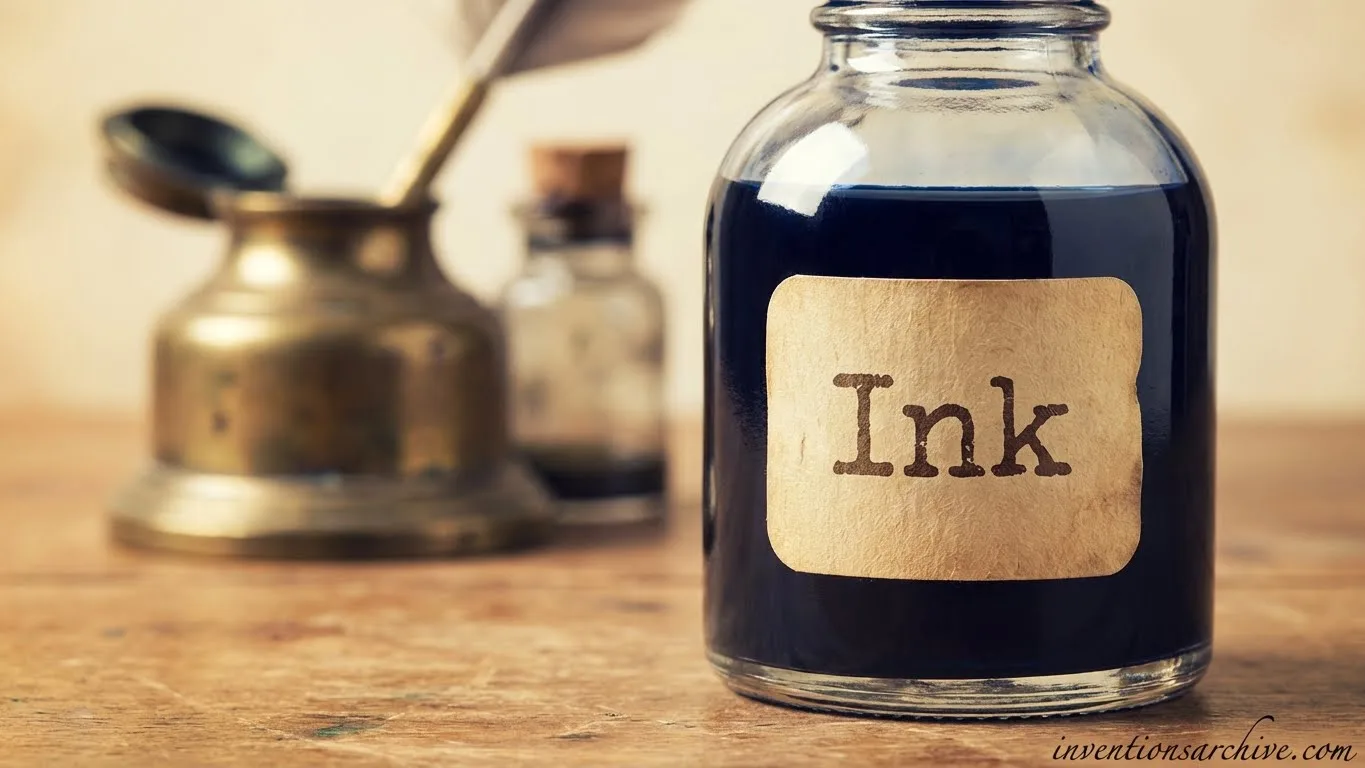
| Invention Name | Ink |
|---|---|
| Short Definition | A pigmented or dye-based substance used to make lasting marks for writing, drawing, printing, labeling, and record keeping. |
| Approximate Date / Period | Early writing inks: around 3200 BCE in Egypt Based on surviving evidence; other ink traditions developed in China and elsewhere over later centuries Attribution varies |
| Geography | Ancient Egypt, China, the Mediterranean world, later Islamic, European, and global manuscript and printing cultures |
| Inventor / Source Culture | Anonymous / collective scribal, artistic, and craft traditions |
| Category | Communication, writing, art, printing, material technology, record keeping |
| Evidence Status | Based on surviving evidence for early Egyptian use; Approximate for first invention; Attribution varies across cultures |
| Main Problem Solved | How to place visible, repeatable, portable marks on surfaces such as papyrus, parchment, paper, silk, wood, bamboo, labels, and later printed pages |
| How It Works | Color particles or dyes are suspended or dissolved in a liquid, paste, or solid medium, then transferred to a surface by reed, brush, pen, type, stamp, or nozzle |
| Material / Technical Base | Carbon black, soot, lampblack, mineral colorants, plant gums, animal glue, water, oils, tannin-rich materials, iron salts, dyes, resins, and modern synthetic pigments |
| Early Use | Administrative records, labels, religious texts, letters, contracts, school exercises, calligraphy, drawing, manuscript copying |
| Development Path | Natural color marks → carbon ink → prepared scribal inks → inksticks and inkstones → iron gall ink → printing ink → fountain pen, ballpoint, marker, and inkjet inks |
| Surviving Evidence | Papyrus documents, scribal palettes, ink wells, inksticks, inkstones, manuscripts, conservation studies, and chemical analysis of historic ink residues |
| Main Variations | Carbon ink, red mineral ink, Chinese inkstick ink, iron gall ink, printing ink, writing pen ink, India ink, dye ink, pigment ink, inkjet ink |
| Modern Descendants | Office ink, printing press inks, fountain pen ink, ballpoint paste, gel ink, marker ink, tattoo ink, inkjet printer ink, conductive and security inks |
| Why It Matters | Ink made written records more portable, readable, repeatable, and durable across administration, trade, education, science, religion, law, literature, and art |
The invention of ink was not a single event with one named inventor. It was a long material solution to a simple human need: making a mark that could travel beyond the voice. Early inks joined three things that had to work together: a visible colorant, a binder or vehicle, and a writing surface. When those parts met, records could move from memory to papyrus, bamboo, parchment, paper, and printed pages.
What Ink Is
Ink is a marking substance made to transfer color onto a surface. It may be thin like a liquid, thick like a paste, solid like an inkstick before grinding, or engineered as a modern printer fluid. The shared purpose is the same: ink must carry visible material and leave a readable trace.
Most historic inks can be understood through four parts:
- Colorant: soot, carbon black, lampblack, mineral pigment, plant dye, or synthetic pigment.
- Binder or vehicle: gum, glue, oil, water, resin, or another medium that helps the color move and stay in place.
- Tool: reed pen, brush, stylus-brush, quill, nib, type, stamp, roller, pen ball, felt tip, or printer nozzle.
- Surface: papyrus, parchment, paper, silk, bamboo, wood, clay labels, metal, fabric, plastic, or coated modern stock.
That combination explains why ink belongs to more than one field. It is a writing material, a drawing medium, a printing technology, and a record-keeping tool. It also explains why the word “ink” covers many different materials rather than one fixed recipe.
How Its Origin Is Traced
The origin of ink is traced through two kinds of evidence: written or archaeological objects that still carry ink, and scientific analysis of the material left on those objects. Papyrus fragments, wooden scribal palettes, ink wells, manuscript pages, and inkstones all help build the record.
One important Egyptian object type is the scribal palette. A British Museum scribal palette of Meryra has multiple ink pans and traces of black and red around the lower wells and pen slot, giving a physical example of how scribes organized more than one color for writing work.[b]
These objects show a practical system, not just a substance. Ink required storage, moistening, a writing tool, and trained use. A dry ink cake or pigment pan was not useful by itself. It became a working invention when a scribe could wet it, load a pen or brush, and create repeated marks.
Why the First Date Is Not Exact
The earliest surviving ink evidence is not the same as the first use. Organic writing surfaces can decay. Ink can fade, wash away, or be lost when documents are destroyed. For that reason, a date such as around 3200 BCE should be read as the earliest strong evidence now known, not a precise birthday for ink.
Ink is older than many surviving ink objects. The material may have been tested, mixed, or used on lost surfaces before the evidence that museums and laboratories can study today.
The Problem Ink Answered
Before ink became a regular writing material, people still made marks. They carved, painted, pressed, scratched, stamped, and incised. Those methods worked, but each had limits.
Carving into stone, bone, clay, or wood could be durable, yet it was slow. Painting with loose pigment could be visible, but not always easy to control for small signs. Incising marks into a surface could record information, but it did not suit every material. As administration, trade, teaching, religious practice, and correspondence grew, people needed a faster way to make clear marks on lighter surfaces.
| Before Ink Became Common | What Changed After Ink |
|---|---|
| Marks were often carved, pressed, painted, or scratched into harder surfaces. | Writing could be made quickly on lighter surfaces such as papyrus, parchment, paper, silk, wood, and bamboo. |
| Durable records could be heavy, slow to make, or hard to move in large numbers. | Documents became easier to store, carry, copy, send, and organize. |
| Color was useful, but fine written signs needed control and repeatability. | Ink allowed finer strokes, line variation, headings, corrections, and longer continuous texts. |
| Administrative systems depended on memory, oral reports, seals, tags, tallies, and local records. | Written accounts, letters, contracts, school texts, and archive documents could be made in larger numbers. |
| Images and signs could exist separately from ordinary writing tools. | Writing, drawing, annotation, copying, and later printing became part of the same material family. |
How Ink Worked in Simple Terms
Ink worked by carrying visible matter from a tool to a surface. In early carbon inks, fine black particles from soot or carbon black were held in a liquid or binding medium. The writing tool picked up the mixture and laid it on the surface. When the liquid dried, the dark particles remained.
That is the plain mechanism behind many early inks. The details changed from culture to culture. Some inks used a gum binder. Some used animal glue. Some were stored dry and reactivated with water. Some later inks, such as iron gall ink, darkened through chemical change after contact with air.
The technical challenge was not only making a dark mixture. The mixture had to be fine enough to write with, stable enough to store, and able to attach to the surface without spreading so much that signs became unreadable.
Earlier Ideas and Tools Before Ink
Ink did not appear in a vacuum. It grew from older marking habits and from the availability of dark materials. Fire produced soot. Minerals produced color. Plants and animal products produced gums and binders. Tools for drawing, brushing, and marking already existed.
Marking Traditions That Came First
- Incised marks: signs cut into bone, stone, clay, wood, or other hard materials.
- Painted marks: mineral or carbon pigments brushed or applied to surfaces.
- Seals and stamps: repeated symbols pressed into clay or other materials.
- Tallies and tokens: physical counting aids used before or alongside writing.
- Surface preparation: papyrus, parchment, silk, bamboo slips, wooden tablets, and later paper.
The important shift came when a color material could be prepared for small, repeated signs. Ink turned marking into a flexible daily practice. It suited lists, names, accounts, labels, exercises, notes, and drawings.
Main Materials and Technical Principle
Historic ink families differ because each depends on its own color source and binding method. The following table is not a recipe. It shows the main material logic behind several major types.
| Ink Type | Main Base | Common Use | Important Note |
|---|---|---|---|
| Carbon Ink | Soot, lampblack, or carbon black with a binder | Writing, drawing, manuscripts, early documents | Known for stable dark particles, though it can sit more on the surface than chemically bond with it |
| Red Mineral Ink | Iron-rich red ocher or other mineral colorants | Headings, emphasis, instructions, corrections, sacred or administrative marking | Often paired with black ink in scribal practice |
| Chinese Inkstick Ink | Pine soot or lampblack mixed with glue, pressed into solid sticks or cakes | Calligraphy, painting, scholarly writing | Liquid ink is made by grinding the solid ink with water on an inkstone |
| Iron Gall Ink | Tannin-rich plant material and iron salts in a writing fluid | Medieval and early modern manuscripts, legal records, letters, official documents | It can darken well, but some formulations damage paper over time |
| Oil-Based Printing Ink | Pigment mixed into a thicker oil-based medium | Relief printing, metal type, book production, printed images | Made to cling to type or plates and transfer under pressure |
| Modern Pen and Printer Inks | Dyes or pigments with engineered solvents, binders, resins, or additives | Fountain pens, ballpoints, markers, inkjet printers, packaging, security printing | Designed for flow, drying, color stability, surface compatibility, or machine delivery |
Early Uses of Ink
Ink changed daily work because it made writing faster and more portable. In Egypt, it supported administrative records, letters, contracts, religious texts, and illustrated papyri. The Metropolitan Museum of Art notes that papyrus became a major writing surface in Egypt and that surviving papyrus documents include household and administrative documents, letters, contracts, legal texts, illustrated narratives, and religious texts.[g]
In a scribal setting, ink was not a decorative extra. It was part of work discipline. Black ink could carry the main text. Red ink could mark headings, corrections, divisions, instructions, or important names. This color separation made documents easier to read, teach, and manage.
Where Ink Was Useful
- Administration: accounts, lists, labels, tax records, deliveries, storage notes.
- Education: exercises, model texts, corrections, copying practice.
- Trade: correspondence, receipts, contracts, shipment records.
- Religion and literature: sacred texts, ritual instructions, stories, hymns, commentaries.
- Art and design: line drawing, underdrawing, calligraphy, manuscript illustration.
- Science and measurement: diagrams, observations, tables, maps, and later laboratory notes.
Ink made information easier to repeat. A list could be copied. A letter could be sent. A contract could be stored. A lesson could be practiced again. That repeatability gave ink its long cultural reach.
Chinese Inksticks and the Inkstone System
China developed one of the most refined ink traditions: solid inksticks or cakes used with an inkstone. The Smithsonian’s National Museum of Asian Art describes traditional Chinese ink as a solid stick or cake made from pine soot or lampblack mixed with glue, pressed into shapes, then ground with water on an inkstone to produce liquid ink.[c]
This system solved a different storage problem. Instead of carrying liquid ink that might spill or spoil, a writer or painter could store a solid inkstick. Water and grinding controlled the darkness and flow. A calligrapher could make pale gray washes or dense black strokes from the same ink material.
Penn Museum’s account of Chinese ink notes that the earliest surviving description of making Chinese ink appears in the Ch’i-min Yao-shu, a 5th- or 6th-century encyclopedic work, while solid ink has been excavated from as early as the 3rd century BCE; it also stresses that the origin and early history of Chinese ink remain obscure despite the rich later record.[d]
Why Solid Ink Was Important
Solid ink changed storage, handling, and artistic control. It also tied ink to the other tools of East Asian writing: brush, paper, and inkstone. In this tradition, the making of liquid ink was not only preparation. It shaped the final line. The amount of water, the grinding time, and the quality of the soot and glue all affected the mark.
Archaeological science has also helped identify early Chinese inkstone use. A Heritage Science study of black residues on a grinding plate and grinding stone from the Changle Cemetery, dated to the Western Han period, identified pine-soot ink residues and described the implements as an early type of inkstone.[e]
How Ink Spread and Changed Over Time
Ink spread by following writing systems, schools, religious institutions, governments, trade routes, and book production. It rarely moved alone. It traveled with surfaces, tools, and habits.
| Stage | Form | What Changed |
|---|---|---|
| Earlier Marking | Pigment, carving, scratching, sealing, painting | Marks existed, but many were slow, heavy, local, or hard to repeat in long text. |
| Early Writing Ink | Carbon-based and mineral inks used with reed or brush tools | Writing became faster on light surfaces; black and red could organize documents. |
| Prepared Scribal Systems | Palettes, ink cakes, pens, brushes, ink wells | Ink became a repeatable working material in schools, offices, temples, and workshops. |
| Solid Ink and Inkstone | Chinese inksticks, cakes, grinding stones | Ink could be stored dry and prepared with controlled tone and flow. |
| Manuscript Ink | Carbon ink, iron gall ink, colored inks, rubrication | Book copying, official records, legal texts, and scholarly annotation expanded. |
| Printing Ink | Thicker inks suited to blocks, type, plates, and presses | Ink moved from hand-applied writing to repeatable mass reproduction. |
| Modern Descendants | Pen ink, ballpoint paste, gel ink, marker ink, printer ink, security ink | Ink was engineered for machines, speed, surface type, drying time, color, and durability. |
This path is not a straight line. Carbon ink did not disappear when iron gall ink became common in many manuscript settings. Hand ink did not vanish when printing grew. Modern printers did not replace all pens. Ink history is layered: older types remain useful where their properties still fit the job.
Iron Gall Ink and Manuscript Culture
Iron gall ink became one of the major writing inks for manuscript, legal, and administrative records in many later societies. It could produce a strong dark line and was widely used for centuries. The Library of Congress notes that iron gall ink has been used for the last several centuries and that some formulations can be extremely corrosive to documents, causing loss of text, bleeding, fading, strike-through, and acid migration.[f]
This is one reason ink history also belongs to conservation science. A document can look readable for a long time, then suffer damage because the ink and paper continue to react. Archives and libraries study those reactions to preserve records without harming them.
Detecting Carbon Ink Inside a Closed Scroll
Carbon ink was valued because it could leave a dark, stable mark on papyrus. The same material relationship becomes difficult when both the ink and the papyrus have been carbonized. The writing may still exist, but it can be faint and hidden inside compressed layers that cannot be separated safely.
In the 2026 work on PHerc. 1667, researchers used phase-contrast X-ray micro-tomography to image the scroll without physically opening it. Machine-learning models were trained to identify faint traces of carbon-based ink within the reconstructed surfaces, and papyrologists interpreted the detected writing as ancient Greek text.
This creates a modern evidence chain for historic ink: material residue → scan data → reconstructed surface → detected marks → human reading. The ink remains a physical substance, even when the first readable view of it appears on a digital surface.
Main Types and Variations
Ink variations developed because different tasks needed different behavior. A manuscript ink had to flow from a pen and remain readable. A printing ink had to cling to type or a plate. A brush ink had to respond to pressure and water. A printer ink must pass through a tiny nozzle without blocking it.
| Variation | Typical Form | Tool or System | Main Use |
|---|---|---|---|
| Carbon Writing Ink | Liquid or re-wettable material | Reed, brush, pen | Documents, drawings, manuscript writing |
| Red Scribal Ink | Mineral or pigment-based color | Reed, brush, pen | Headings, emphasis, notes, corrections |
| Inkstick Ink | Solid stick or cake before use | Brush and inkstone | Calligraphy, painting, scholarly writing |
| Iron Gall Ink | Reactive writing fluid | Quill, dip pen, manuscript tools | Legal, administrative, literary, and archival documents |
| Printing Ink | Viscous paste or liquid depending on process | Blocks, type, plates, rollers, presses | Books, newspapers, images, packaging, labels |
| Fountain Pen Ink | Flowing liquid | Reservoir pen and nib | Handwriting with controlled flow |
| Ballpoint and Gel Ink | Paste or gel | Rolling ball tip | Everyday writing with portable pens |
| Inkjet Ink | Engineered liquid | Printer nozzle | Digital printing on paper and coated media |
What Changed Because of Ink
Ink changed the speed and scale of written culture. It did not create writing by itself, and it did not remove every older method. It made writing easier to repeat, teach, transport, correct, decorate, and preserve.
Administration and Trade
Ink helped turn names, goods, quantities, dates, and instructions into portable records. This mattered in stores, temples, workshops, households, ports, schools, and offices. A written account could travel farther than spoken memory.
Education and Scholarship
Ink gave teachers and students a reusable model for copying and correction. It supported exercises, notes, commentaries, diagrams, and lists. Over time, it helped scholars compare texts, preserve observations, and create reference works.
Art and Calligraphy
Ink gave artists a controlled line. A brush could make a thin stroke, a broad stroke, a wash, or a dry mark. A pen could create small, regular signs. In many cultures, the quality of the ink line became part of artistic skill.
Printing and Mass Reproduction
Printing changed ink again. Handwriting ink was not enough for type, blocks, and plates. Printing needed materials that could sit on raised or prepared surfaces, transfer under pressure, and dry on paper. That shift helped move ink from the scribe’s desk to the print shop.
Common Misunderstandings
Ink Was Not Invented by One Person
There is no reliable single inventor for ink. It developed through repeated material experiments in more than one writing culture.
The Earliest Evidence Is Not the First Use
Surviving papyri, palettes, and residues show what has lasted. They do not prove that no earlier ink use existed on lost materials.
Ink Is Not One Material
Carbon ink, iron gall ink, printing ink, and inkjet ink work in different ways. They share a purpose, not a single chemistry.
Printing Ink Is Different from Writing Ink
A fluid that works with a reed or nib may fail on type or printing plates. Printing required inks with different body, tack, and drying behavior.
Related Inventions
Ink sits inside a larger chain of writing and reproduction technologies. These related inventions and materials help show where it belongs:
- Papyrus: a major early writing surface that made portable ink documents practical.
- Reed Pen: an early tool for transferring ink in controlled strokes.
- Writing Brush: central to East Asian ink traditions and many forms of calligraphy.
- Inkstone: used to grind solid ink with water into liquid writing ink.
- Paper: the surface that later made manuscript copying and printing far more scalable.
- Printing Press: a later system that required ink suited to type and repeatable impression.
- Fountain Pen: a writing instrument built around stored liquid ink and controlled flow.
- Inkjet Printer: a modern descendant that delivers engineered ink through tiny nozzles.
Frequently Asked Questions
Who invented ink?
Ink has no confirmed single inventor. The safest answer is that it was developed by anonymous scribes, artists, and material workers in several early writing cultures, especially ancient Egypt and China.
When was ink first used?
Strong early evidence points to ancient Egypt around 3200 BCE for ink used in early writing contexts. This is an approximate evidence-based date, not a proven first moment of invention.
What was early ink made from?
Many early black inks used carbon materials such as soot, lampblack, or carbon black held in a binder or liquid medium. Red inks often used mineral colorants. Chinese inksticks used soot or lampblack mixed with glue and pressed into solid form.
Is ink the same as paint?
Ink and paint can both carry color, but they are not the same in normal use. Ink is usually designed for writing, drawing, printing, or marking with controlled flow and fine lines, while paint is often made for broader surface coverage.
Why did ink matter so much for later inventions?
Ink made portable records, letters, books, drawings, labels, and printed pages easier to produce. Later inventions such as paper, the printing press, fountain pens, ballpoint pens, and inkjet printers all depended on ink or ink-like marking systems.
Sources and Verification
- [a] Red and black ink from Egyptian papyri unveil ancient writing practices — Used to verify the early Egyptian evidence date, the black/red ink distinction, and the scientific context of ancient papyrus ink analysis. (Reliable because it is an institutional research source from the European Synchrotron Radiation Facility.)
- [b] scribal palette | British Museum — Used to verify the surviving Egyptian scribal palette, its ink pans, and traces of black and red pigment. (Reliable because it is an official museum collection record.)
- [c] Four Treasures of a Scholar’s Studio (文房四寶) — Used to verify traditional Chinese inkstick composition and the use of an inkstone to produce liquid ink. (Reliable because it is an official Smithsonian National Museum of Asian Art educational resource.)
- [d] Expedition Magazine | Chinese Ink — Used to verify Chinese ink’s early written descriptions, excavated solid ink evidence, and the uncertainty around its earliest origin. (Reliable because it is published by the University of Pennsylvania Museum of Archaeology and Anthropology.)
- [e] Identification of the proto-inkstone by organic residue analysis: a case study from the Changle Cemetery in China — Used to verify scientific identification of pine-soot ink residues on early Chinese inkstone-related implements. (Reliable because it is a peer-reviewed article in Heritage Science.)
- [f] Corrosive Media: Iron Gall Ink Corrosion — Used to verify iron gall ink’s long use and its known conservation problems, including corrosion and text loss. (Reliable because it is a preservation science resource from the Library of Congress.)
- [g] Papyrus in Ancient Egypt — Used to verify papyrus as a major Egyptian writing surface and the types of surviving papyrus documents. (Reliable because it is an official Metropolitan Museum of Art essay by an institutional curator.)