
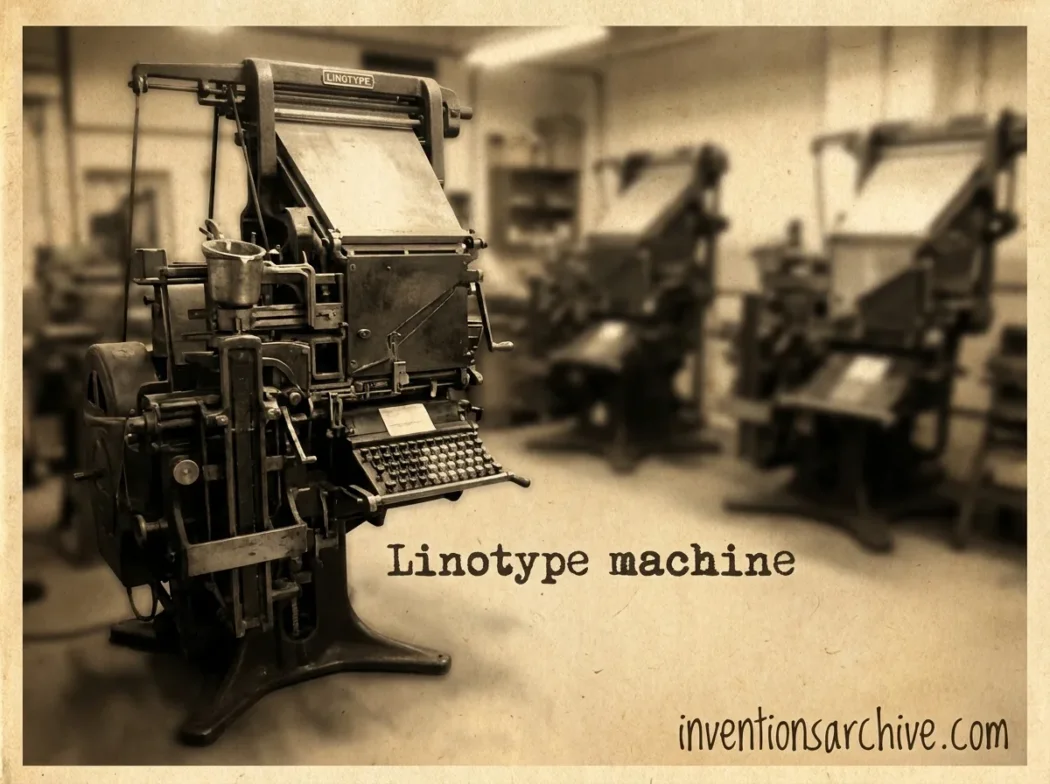
| Invention Name | Linotype machine |
|---|---|
| Short Definition | A keyboard-operated hot-metal linecasting machine that cast a complete line of type as one metal slug. |
| Approximate Date / Period | 1886 commercial introduction Based on surviving evidence [a] |
| Geography | Developed mainly in Baltimore, Maryland; first commercial use linked with New York newspaper printing; early production also spread to Britain. |
| Inventor / Source Culture | Ottmar Mergenthaler, a German-born inventor working in the United States. |
| Category | Communication; printing; manufacturing; education; publishing technology. |
| Main Problem Solved | Slow hand composition of individual metal type for newspapers, books, advertisements and other high-volume printed matter. |
| How It Worked | Keyboard input released matrices; a line was justified; molten type metal was cast into a single slug; matrices returned for reuse. |
| Material / Technology Base | Brass matrices, spacebands, type metal, mould, melting pot, distributor, keyboard and heavy mechanical frame. |
| Evidence Status | Surviving machines, museum objects, patent records and company records Confirmed |
| Surviving Evidence | Early Linotype machines, set metal forms, matrices, slugs, diagrams, patents and archival business records. |
| Development Path | Hand composition → experimental linecasting → Linotype machine → improved models → phototypesetting → digital page layout. |
| Related Inventions | Movable type, composing stick, typewriter, Monotype machine, Intertype machine, phototypesetting, desktop publishing. |
| Modern Descendants | Digital typesetting systems, page-layout software, font technologies and automated text composition tools. |
| Why It Matters | It changed the pace of text production by joining composition, justification, casting and matrix distribution in one machine. |
The Linotype machine was not a printing press in the strict sense. It was a typesetting machine: a mechanical system that prepared lines of printable metal type for presses to use. Before it became common, skilled compositors set page text by selecting small individual pieces of type by hand. Linotype changed that work by casting a full line at once, which made newspaper and book composition faster, more regular and easier to scale.
What the Linotype Machine Was
The Linotype machine was a mechanical composing and linecasting system. An operator used a keyboard to select small brass matrices, each carrying the recessed form of a letter or symbol. These matrices were assembled into a line, spaced to the correct width and then used as a mould face for casting a metal slug.
The word Linotype comes from the idea of a “line of type.” That is the essential difference between Linotype and older hand composition. A hand compositor built text from separate pieces of type. A Linotype operator produced a complete line that could be locked with other lines into a page form for printing.
This distinction matters because it corrects a common misunderstanding. The Linotype did not replace printing presses. It changed the work that happened before printing: composition, justification and preparation of type.
Why It Was Different From Hand Composition
Hand composition was skilled, accurate work, but it was slow when large volumes of text had to be prepared every day. Newspapers needed speed. Publishers needed consistency. Advertisers needed repeatable layout. The Linotype answered that pressure by bringing keyboard input, mechanical selection and metal casting into one coordinated process.
The Problem It Answered
By the late nineteenth century, faster presses could print more sheets than hand composition could comfortably feed. A newspaper might have the ability to print many copies, yet still be slowed by the time needed to set fresh text. Linotype addressed this bottleneck by making composition more like machine operation and less like sorting thousands of tiny pieces by hand.
| Before the Linotype Machine | What Changed After It |
|---|---|
| Compositors assembled text letter by letter from cases of movable type. | Operators used a keyboard to assemble matrices and cast a full line as one slug. |
| Distribution meant returning individual type pieces to their cases after printing. | Matrices returned mechanically to their magazine channels for reuse. |
| Daily newspapers faced a composition bottleneck, especially with late-breaking copy. | Large bodies of text could be prepared faster for newspaper pages. |
| Large editions depended on many skilled hand compositors and careful manual correction. | Composition became more mechanized, though it still required trained operators and maintenance. |
| Printing speed and typesetting speed were often mismatched. | Typesetting better matched the pace of industrial printing and mass publishing. |
How the Machine Worked in Simple Terms
In simple terms, the machine selected moulds, arranged them into a line and cast that line in metal. A patent record for Mergenthaler’s Linotype-machine describes matrices arranged across a mould, molten metal delivered from a melting pot and an ejector pushing the cast linotype out of the mould after casting. [c]
Main Working Parts
- Keyboard: The operator entered text by pressing keys, but the keyboard did not work like a modern computer keyboard.
- Magazine: A storage area held the brass matrices for letters, numbers and other characters.
- Matrices: Small brass moulds carried the character shapes that formed the printing face.
- Spacebands: Adjustable spacing pieces helped justify the line to the correct width.
- Assembler: Matrices and spacebands gathered into a line before casting.
- Mould and melting pot: The machine cast hot type metal into the assembled line.
- Distributor: After casting, matrices were sorted back into their channels for reuse.
The result was a metal slug with raised type on one edge. Printers could place many slugs together to form columns and pages. Once the job was finished, the metal could be remelted and reused.
Development Path From Earlier Tools to Later Forms
The Linotype grew from older printing practices rather than replacing them all at once. Its development joined several existing ideas: keyboard selection, reusable matrices, justified lines and casting type metal. ASME describes the Square Base Linotype as a machine with a 90-character keyboard, brass matrices, spacebands, molten pot metal and automatic matrix sorting; it also notes the later replacement of Square Base machines by improved designs beginning with the Simplex in 1892. [d]
| Stage | Form | What Changed |
|---|---|---|
| Earlier Tool | Hand-set movable type and composing stick | Text was built from individual metal sorts by trained compositors. |
| Pressure for Change | Faster presses and growing newspapers | Printing capacity increased, but manual composition remained slow. |
| Early Experiments | Mould-based linecasting attempts | Inventors tried to cast larger units of type rather than set each letter separately. |
| Linotype Machine | Keyboard-driven matrix assembly and slug casting | A full justified line could be cast in one metal piece. |
| Improved Forms | Square Base, Simplex and later magazine-change models | Machines became more practical, faster to manage and better suited to commercial print shops. |
| Parallel Systems | Monotype, Intertype and Ludlow linecasting | Different machines served different composition and casting needs. |
| Modern Descendant | Phototypesetting and digital layout software | Physical metal type gave way to optical, electronic and software-based composition. |
Main Types and Variations
Linotype was not one unchanging machine. Surviving artifacts show both early and mature forms. A circa 1915 machine in The Henry Ford collection, made by the Mergenthaler Linotype Company in New York, is catalogued as a composing machine made of brass, leather and metal, showing the durable industrial form the invention had taken by the early twentieth century. [e]
| Type or Variation | Main Feature | Historical Role |
|---|---|---|
| Experimental Mergenthaler-Clephane Machines | Early attempts to mechanize composition for legal and printed text. | Helped lead from mould experiments toward practical matrix linecasting. |
| Square Base Linotype | Early commercial design with the core keyboard, matrix and casting system. | Established the practical machine form in the late nineteenth century. |
| Simplex and Improved Linotypes | More refined mechanisms and improved commercial usability. | Made Linotype more suitable for larger newspaper and book operations. |
| Magazine-Change Models | Allowed faster changes between typefaces, sizes or matrix magazines. | Helped printers handle more varied work without stopping for long setup changes. |
| Non-Latin Script Adaptations | Modified fonts, keyboard systems and matrix arrangements. | Extended machine composition beyond standard Latin-alphabet newspaper work. |
| Related Linecasters | Intertype and Ludlow systems used different approaches to hot-metal composition. | Shared the larger move from hand-set type toward machine-aided composition. |
Language and Script Adaptations
One important part of Linotype history is its adaptation to different scripts. The Devanagari Linotype project, associated with Hari Govil and the Mergenthaler Linotype Company, worked around the difficulty of composing Indian scripts with far more character combinations than a standard keyboard could handle. Smithsonian/Lemelson material notes that Govil’s system reduced the number of characters needed and allowed Linotype composition for Hindi and several other languages using related script needs. [g]
This does not mean that Linotype solved every writing system equally well. It shows something more specific: the machine’s basic idea was strong enough to invite adaptation, but each script required careful typographic and mechanical planning.
Early Use and Spread
The first value of the Linotype was felt most strongly in newspaper offices, where deadlines made slow composition costly. A trained operator could turn manuscript or typewritten copy into fresh metal type slugs. Those slugs could then be arranged into columns and pages for printing.
As the machine spread, it also created a new skilled occupation: the Linotype operator. Training schools, practice copy, speed measurement and machine maintenance became part of the trade. Smithsonian/Lemelson records describe early twentieth-century Linotype instruction, operator speed measured in ems per hour and the company’s interest in formal training for machine operators. [f]
The machine’s spread was not only technical. It changed the rhythm of newspaper rooms, commercial print shops, advertising departments and book production. Editors could send more late copy. Newspapers could handle more text. Printers could produce long passages with greater speed and repeatable spacing.
What Changed Because of the Linotype
The Linotype machine mattered because it changed the economics and timing of printed text. It did not create mass literacy by itself, and it did not act alone. Cheaper paper, faster presses, transport networks, public education and growing urban readership all mattered too. Linotype’s role was narrower and more concrete: it made text composition faster and more industrial.
Related articles: Type casting machine [Industrial Age Inventions Series]
- Newspapers: Faster composition helped daily papers handle more pages, more editions and more late-breaking text.
- Books: Long passages of straight text became easier to compose at scale.
- Advertising: Commercial printers could prepare repeated text-heavy layouts more efficiently.
- Workshops: Print shops needed trained keyboard operators and mechanics, not only hand compositors.
- Typography: Matrix magazines and typeface systems encouraged more organized management of fonts and sizes.
- Later Publishing: The idea of machine-aided text composition carried forward into phototypesetting and digital layout.
Common Misunderstandings
Misunderstanding: The Linotype Was a Printing Press
The Linotype prepared type for printing. It did not usually print the finished newspaper or book page by itself. Presses still did the printing work.
Misunderstanding: It Was Just a Large Typewriter
The keyboard makes it look typewriter-like, but the action was different. Pressing a key released a matrix from a magazine. The machine then assembled, justified, cast and redistributed parts.
Misunderstanding: One Date Explains the Whole Invention
The 1886 date is important for practical use, but the invention developed through experiments before that and many improvements after it. Patents and surviving machines often document improvements, not only the first idea.
Misunderstanding: Linotype and Monotype Were the Same
Both belonged to hot-metal composition, but they served different needs. Linotype cast a full line as a slug. Monotype systems could cast individual characters, which suited different kinds of correction and typography.
Related Inventions and Later Developments
The Linotype machine sits in a wider history of text production. These related inventions and systems help place it in context:
- Movable Type: The older system of reusable individual type pieces that Linotype partly replaced in high-volume composition.
- Composing Stick: A hand tool used by compositors to assemble lines of movable type before machine composition.
- Typewriter: A keyboard writing machine that shares the idea of text entry, though not the same mechanism or purpose.
- Monotype Machine: A hot-metal typesetting system linked to individual character casting rather than full-line slug casting.
- Intertype Machine: A later linecasting competitor closely related to Linotype practice.
- Phototypesetting: A twentieth-century replacement that composed text photographically instead of in hot metal.
- Desktop Publishing: Digital page composition that moved many typesetting decisions into software.
Frequently Asked Questions
Who invented the Linotype machine?
The Linotype machine is mainly credited to Ottmar Mergenthaler, a German-born inventor working in the United States. Its practical form also depended on printers, business backers, operators, later engineers and manufacturing companies.
Why was the Linotype machine important?
It made high-volume text composition faster by casting an entire line of type at once. This helped newspapers, books and commercial printing handle more text with greater speed and regularity.
Was the Linotype machine a printing press?
No. It was a typesetting and linecasting machine. It produced metal type slugs that could be arranged for use on printing presses.
What did a Linotype operator do?
A Linotype operator read copy and used the machine keyboard to assemble matrices into lines. The machine then cast those lines as metal slugs for printing.
What replaced the Linotype machine?
Linotype machines were gradually replaced by phototypesetting and then by electronic and digital typesetting systems, including modern page-layout software.
Sources and Verification
- [a] Early Linotype composing machine, 1892 | Science Museum Group Collection — Used to verify the 1886 development attribution, the 1892 early square-base machine, early manufacture and the machine’s hot-metal linecasting role. (Reliable because it is an official museum collection record.)
- [b] Ottmar Mergenthaler | Science Museum Group Collection — Used to verify Mergenthaler’s biographical context, the court-reporter problem, the shift from papier-mâché experiments to metallic matrices and the early New York Tribune installation. (Reliable because it is an official museum biographical collection page.)
- [c] US558406A – Linotype-machine – Google Patents — Used to verify the machine’s mould, matrices, melting pot, molten metal delivery and slug ejection principles as described in a historical patent record. (Reliable because it reproduces a patent record with technical specification and drawings.)
- [d] #235 Ottmar Mergenthaler’s Square Base Linotype Machine — Used to verify the Square Base Linotype’s keyboard, matrix release, casting temperature context, automatic distribution and later Simplex development. (Reliable because it is an engineering-history landmark page from ASME.)
- [e] Linotype Composing Machine, circa 1915 — Used to verify a surviving mature Linotype artifact, its maker, place of creation, date range, materials and classification as a composing machine. (Reliable because it is an official museum collection record from The Henry Ford.)
- [f] A Simple Operation | Lemelson — Used to verify operator training, practical use, slugs, matrices, keyboard operation and speed-measurement context in early twentieth-century Linotype work. (Reliable because it is a Smithsonian Lemelson Center invention-history article.)
- [g] Devanagari Script for the Mergenthaler Linotype | Lemelson — Used to verify the Devanagari Linotype adaptation, Hari Govil’s role and the typographic difficulty of adapting non-Latin scripts to Linotype composition. (Reliable because it is a Smithsonian Lemelson Center article based on institutional archival material.)