
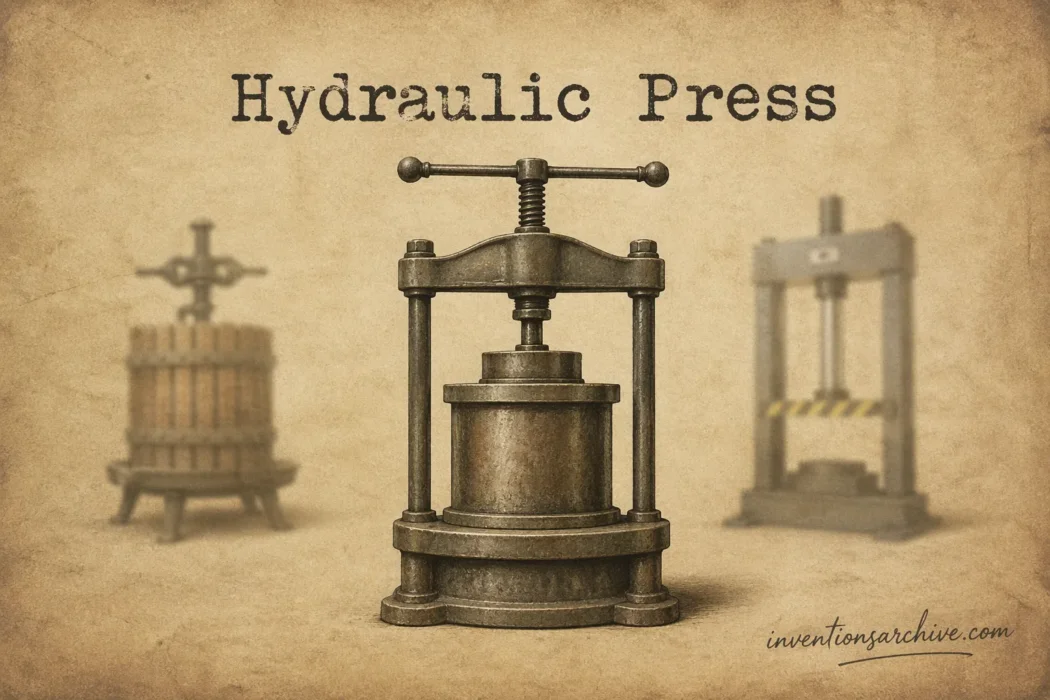
| Invention Name | Hydraulic Press, historically also called the Bramah press |
|---|---|
| Short Definition | A press that uses pressure transmitted through a confined liquid to produce controlled compressive force. |
| Approximate Date or Period | 1795 for Joseph Bramah’s British patent |
| Geography | Great Britain, particularly London |
| Inventor or Source Culture | Commonly attributed to English engineer Joseph Bramah; based on the fluid-pressure principle associated with Blaise Pascal |
| Category | Hydraulic machinery; industrial pressing and forming equipment |
| Importance | Turned fluid pressure into a practical means of generating and transmitting large mechanical forces. |
| Evidence Status | Confirmed patent attribution Bramah’s hydraulic press is associated with British Patent No. 2045 of 1795. |
| Main Problem Solved | Producing strong, controllable compression without relying only on very large levers, screws, or impact mechanisms. |
| Development Path | Fluid-pressure theory → Bramah’s practical press → improved seals and hydraulic machinery → industrial hydraulic presses with powered pumps and automatic controls |
| How It Works | Pressure applied to a confined liquid is transmitted through the hydraulic system and acts on a larger working piston or ram. |
| Technical Basis | Near-incompressible liquid, sealed cylinders, pistons or plungers, and controlled hydraulic pressure |
| Modern Uses | Metal forming, forging, molding, compaction, laminating, assembly, straightening, and materials testing |
Why Bramah’s 1795 Press Was Different
The hydraulic press appeared at a point when workshops could already create force with screw presses, levers, wedges, hammers, and other mechanical arrangements. Those methods worked, but producing very large forces could require long handles, massive structures, repeated impacts, or complicated gearing.
Joseph Bramah approached the problem through fluid pressure. In 1795 he patented a machine that used liquid in a confined system to transfer force to a working plunger. The patent, generally identified as British Patent No. 2045, became the historical basis for the machine later known as the Bramah press.[a]
Bramah did not discover the physical law behind the machine. The hydraulic press depended on ideas about pressure in fluids that had been investigated much earlier, especially in the seventeenth-century work of the French mathematician and physicist Blaise Pascal. Bramah’s achievement was to turn that principle into machinery capable of useful industrial work.
Pascal’s Fluid Principle Became Mechanical Force
A hydraulic press uses a liquid contained within a closed hydraulic system. When pressure is applied to that liquid, the pressure is transmitted through it. The University of Maryland’s Department of Physics describes this behavior through Pascal’s law: a change in pressure in an incompressible fluid is transmitted throughout the fluid, where it acts against the surfaces containing it.[b]
The press takes advantage of piston area. A force acting on a relatively small piston creates pressure in the liquid. That pressure can then act across the larger area of another piston or ram. Because the second working surface is larger, the resulting force can also be larger.
This does not create energy. The mechanical trade is between force and movement: a system that obtains a larger output force requires a corresponding change in how far the input and output parts move. Friction, deformation, fluid behavior, seals, and other losses also make real machines less than perfectly efficient.
That distinction is important. A hydraulic press is not simply a device in which liquid somehow generates force on its own. It is a force-transmission system that rearranges how an applied input is delivered to a load.
The Hard Part Was Making Pressure Practical
The underlying physics was known long before the Industrial Revolution, but a useful press required more than theory. High-pressure liquid had to remain contained while a plunger still moved through its cylinder. Leakage around the moving parts could reduce the effectiveness of an early machine and make sustained pressure difficult.
Sealing therefore became one of the defining engineering problems of the early hydraulic press. Historical accounts connect Bramah’s machinery with leather sealing arrangements that tightened under hydraulic pressure. The precise division of credit for refinements to the seal is less straightforward than the attribution of the 1795 patent itself. Later accounts have also associated Bramah’s exceptionally skilled employee Henry Maudslay with improvements to the self-tightening collar used in hydraulic machinery.
For the history of the invention, the safest distinction is that Bramah’s patent establishes his documented role in the hydraulic press, while workshop refinements helped make the system more reliable in practice. Modern hydraulic seals use very different materials and manufacturing tolerances, but they solve the same broad engineering problem: retaining fluid while permitting controlled motion.
From a Press to an Industrial Hydraulic System
Bramah’s machine demonstrated that pressurized liquid could do demanding mechanical work in a relatively controlled way. That made the press important beyond a single pressing task. It helped establish hydraulic power as a practical engineering method.
Unlike an impact machine, a hydraulic press can build its force through a pressing stroke rather than delivering it through a sudden blow. Compared with many traditional screw arrangements, hydraulic systems can also transmit force through pipes and cylinders rather than requiring the entire mechanical advantage to be created by gears, threads, or long levers at the working point.
During the nineteenth century, hydraulic machinery spread into factories, docks, engineering works, lifting equipment, and heavy manufacturing. The press became one member of a much wider family of machines in which liquid pressure moved loads or applied force.
The hydraulic press itself also diversified. Presses could be designed around different frame arrangements, working strokes, pump systems, control methods, and production tasks. The principle remained recognizable even as the machinery around it changed.
Pressing Changed Metalworking and Manufacturing
The ability to apply strong compression in a controlled movement gave hydraulic presses a natural place in manufacturing. Metal could be shaped against dies, straightened, compacted, assembled, or forced into forms that would be difficult to produce efficiently with hand tools.
Hydraulic pressing became particularly useful where a process benefited from force being maintained through part of the working stroke. In metal forming, this characteristic differs from machines that depend mainly on stored rotational energy or repeated impact.
Related articles: Dry Dock (Song Dynasty Design) [Medieval Inventions Series], Pound Lock [Medieval Inventions Series]
Modern hydraulic presses appear in several industrial processes:
- Forging and forming: shaping metal under sustained compressive force.
- Sheet-metal work: producing bends, drawn forms, and other shaped components.
- Extrusion-related processes: forcing material through or into controlled forms using industrial press machinery.
- Powder compaction: compressing powdered materials before later manufacturing stages.
- Laminating and bonding: maintaining controlled compression over layered materials.
- Assembly: fitting components where carefully controlled pressing is required.
- Materials testing: applying measurable compression to evaluate how specimens or components respond to load.
These applications do not all use identical machines. A laboratory testing press, a large forging press, and a production forming press can differ greatly in construction and control. Their shared ancestry lies in transmitting force through a hydraulic fluid to a working actuator.
Hydraulic Presses and Mechanical Presses Behave Differently
Hydraulic presses did not make mechanical presses obsolete. The two approaches developed alongside one another because different manufacturing tasks favor different kinds of motion.
A traditional mechanical press commonly obtains its working movement from mechanisms driven by rotating machinery. Depending on the design, this can permit rapid and highly repeatable production cycles. A hydraulic press instead creates the pressing action through hydraulic actuators, allowing force and movement to be controlled in ways suited to forming, holding, testing, and other operations.
For this reason, factories did not simply replace every older press with a hydraulic one. Manufacturers selected press systems according to the material, part geometry, production rate, required stroke behavior, tooling, control requirements, and scale of the work.
Water Gave Way to Modern Hydraulic Fluids and Controls
Bramah’s early hydraulic technology belonged to the age of water hydraulics. Later industrial systems increasingly used other hydraulic fluids, especially oils chosen for their lubrication, sealing compatibility, corrosion behavior, temperature characteristics, and ability to operate reliably in machinery.
The surrounding technology changed as well. Precision-made cylinders, stronger structural frames, improved seals, powered pumps, valves, instrumentation, electrical controls, and electronic sensors made hydraulic presses far easier to regulate than their early predecessors.
Contemporary industrial presses may integrate programmable control systems that coordinate pressure, position, speed, tooling, and production sequences. Feedback sensors can allow a machine to monitor its process rather than relying solely on the operator’s observation.
Modern equipment also reflects the hazards created by very large forces. Industrial hydraulic presses therefore incorporate engineered safeguards such as guarding, controlled access, pressure-management systems, and monitored machine controls. Their history can be explained through their operating principle, but their construction, maintenance, and operation belong to trained industrial practice rather than improvised machinery.
Surviving Bramah Equipment Provides Physical Evidence
Museum collections preserve evidence that the Bramah name remained attached to hydraulic machinery long after the original patent. The Science Museum Group holds a hydrostatic balance associated with Joseph Bramah and intended to demonstrate the principle of the hydraulic press. Its catalogue describes components including a hydraulic pump, press cylinder and plunger, frame elements, platform, and weights.[c]
The same institution also records a Bramah hydraulic press dating from approximately 1870–1900. The object is catalogued specifically as a hydraulic press, showing that the Bramah identity survived into later nineteenth-century examples of the technology.[d]
Such objects are useful because invention history can otherwise become compressed into a single patent date. A patent establishes documentary evidence for an invention, but preserved machinery shows how a technical idea continued to exist as manufactured equipment decades later.
The Bramah Press as a Step Toward Fluid Power
The long-term importance of the hydraulic press lies partly in what it demonstrated about power transmission. Mechanical force did not have to pass only through shafts, gears, ropes, levers, or screw threads. A confined liquid could carry pressure through a system and deliver force at another point.
That principle later became familiar in hydraulic lifts, jacks, construction machinery, vehicle systems, industrial actuators, forming equipment, and many other machines. These technologies are not simply enlarged versions of Bramah’s original press, but they share the broader idea that controlled liquid pressure can transmit mechanical power.
The hydraulic press therefore occupies an unusual position in engineering history. Its physical principle belongs to earlier fluid mechanics, its documented practical form is closely associated with Joseph Bramah’s 1795 patent, and its descendants remain ordinary equipment in modern factories. The machinery has changed repeatedly, while the underlying method of using confined liquid to transmit pressure remains recognizable.
Sources and Verification
- [a] Joseph Brahmah – Engineer, inventor and prolific patentee — Academic history of Bramah’s engineering work that identifies the hydraulic press as his major practical application of fluid-pressure principles and records the 1795 patent attribution.
- [b] Demo Highlight: Hydraulic Press — University of Maryland Department of Physics explanation of Pascal’s law and its application to pressure and force in a hydraulic press.
- [c] Hydrostatic balance to demonstrate principle of hydraulic press by Joseph Bramah — Science Museum Group collection record documenting surviving apparatus associated with Bramah and the hydraulic-press principle.
- [d] A Bramah hydraulic press, late 19th century — Science Museum Group object record for a surviving Bramah hydraulic press dated 1870–1900, providing physical evidence of the technology’s continued nineteenth-century use.