
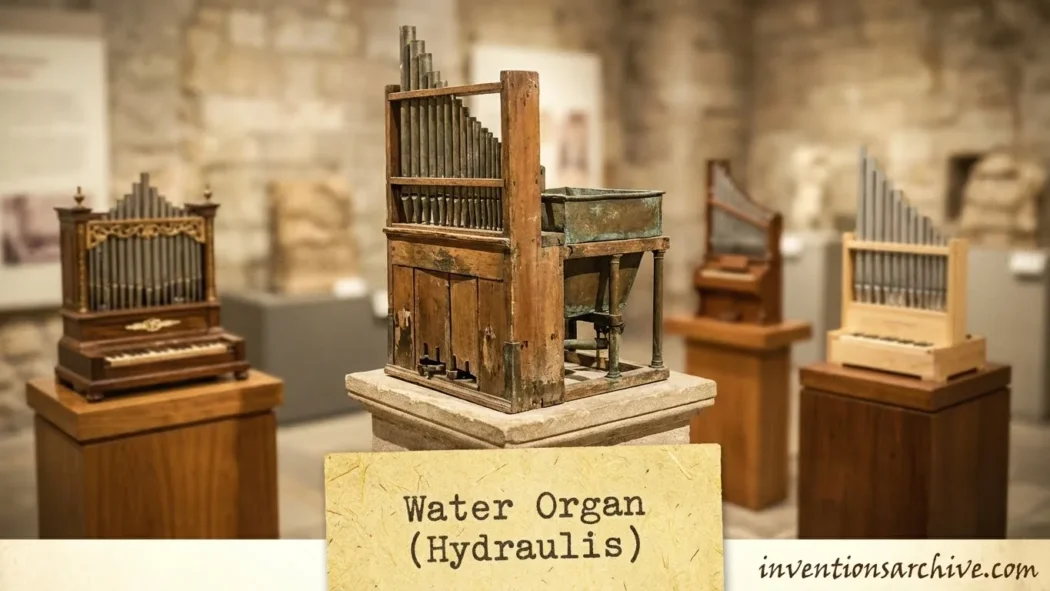
| Invention Name | Water Organ / Hydraulis |
|---|---|
| Short Definition | A mechanical pipe organ that used air pressure stabilized by water to sound a set of pipes. |
| Approximate Date / Period | 3rd century BCE Approximate |
| Geography | Alexandria, Hellenistic Egypt; later Greek and Roman worlds |
| Inventor / Source Culture | Attributed to Ctesibius of Alexandria; Hellenistic mechanical tradition Attribution varies |
| Category | Music technology; mechanical engineering; cultural technology |
| Evidence Status | Written ancient descriptions plus later archaeological finds Based on surviving evidence |
| Main Problem Solved | Supplying steady air to many pipes without relying on human breath alone |
| How It Worked | Pumps sent air into a pressure system; water helped regulate that pressure; keys or sliders opened air paths to pipes. |
| Main Materials | Bronze, wood, metal pipes, valves, sliders, water reservoir, wind chest |
| Early Use | Public entertainment, festivals, theatres, arenas, elite spaces |
| Surviving Evidence | Dion hydraulis remains; Aquincum organ fragments and inscription |
| Development Path | Panpipes and aulos → Hydraulis → Roman organs → bellows organs → modern pipe organ |
| Related Inventions | Panpipes, aulos, force pump, water clock, wind chest, pipe organ |
| Modern Descendants | Pipe organ, church organ, mechanical organ, keyboard wind instruments |
| Historical Importance | One of the earliest known keyboard instruments and a major step in mechanical sound production |
The Water Organ, better known by its Greek name Hydraulis, was an ancient mechanical instrument that joined music, air pressure and hydraulic control in one device. It did not make sound from water itself. The sound came from air vibrating inside pipes. Water mattered because it helped keep the air pressure steady, allowing the instrument to speak with a fuller and more controlled voice than breath-blown pipes could usually provide.
That single idea made the hydraulis a turning point in the history of instruments. It moved pipe music from the limits of the human breath toward mechanically supplied wind. In simple terms, it was an early ancestor of the pipe organ, and it helped create the long line of keyboard-controlled wind instruments that later became central to courts, theatres, churches and concert halls.
What the Hydraulis Was
The hydraulis was a pipe organ with a mechanical wind supply. A player used keys, levers or sliders to open air paths into selected pipes. The pipes produced different notes, much as organ pipes do today. Its name joins the Greek words linked with water and pipe, but the meaning can be misleading if read too literally.
The water was not the musical voice. It acted as a pressure regulator. Air was forced into a reservoir system, and water helped smooth the pressure so that the pipes could sound more evenly. Britannica describes the hydraulis as the earliest known mechanical pipe organ and attributes its invention to Ctesibius of Alexandria in the 3rd century BCE, while also noting the use of a wind chest, reservoir, pumps and keys or sliders in the mechanism. [a]
How Its Origin Is Traced
The origin of the hydraulis sits in the world of Hellenistic Alexandria, a city known for mathematics, engineering, mechanics, water devices and experimental machines. Ctesibius, the engineer most closely linked with the invention, was associated with air pressure, pumps and pneumatic devices. That context matters. The hydraulis was not just a musical object; it was also a product of applied mechanical knowledge.
The strongest ancient technical account comes from Vitruvius, who devoted a section of De Architectura to the water organ. His description mentions a base, bronze box, pump cylinders, a regulator, wind chest, channels, sliders and keys. He also explains that touching the keys moved the sliders and opened or closed holes so the pipes could produce musical sounds. [b]
The Problem It Answered
Before the hydraulis, many wind instruments depended on the player’s breath. Panpipes, reed pipes and the Greek aulos could be expressive and powerful, but breath created limits. A performer had to supply air directly, and larger groups of pipes required more consistent pressure than a human player could easily provide.
The hydraulis answered that problem by separating playing from wind supply. The player could select notes, while the machine supplied air. That difference may sound small, but it changed the instrument’s role. It made possible a louder, more sustained and more mechanically controlled pipe instrument.
| Before the Invention | What Changed After It |
|---|---|
| Pipe sound depended mainly on human breath. | A mechanical system supplied air to the pipes. |
| Large pipe sets were difficult to keep evenly supplied with wind. | Water-regulated air pressure helped maintain steadier sound. |
| Performers controlled sound directly through blowing and fingering. | The player controlled valves, sliders or keys while the machine handled airflow. |
| Outdoor sound projection was limited by the instrument and performer. | The hydraulis could produce a strong tone suitable for public settings. |
| Wind instruments were separate from keyboard-style control. | The hydraulis helped establish the idea of a keyboard-operated pipe instrument. |
How It Worked in Simple Terms
The hydraulis joined three functions: air generation, pressure regulation and note selection. Air was pushed into the system by pumps. Water helped keep that air pressure from rising and falling too sharply. The wind chest then distributed air to the pipes when the player opened the right channels.
A useful way to picture it is this: the instrument was not “water-powered” in the modern turbine sense. It was a water-regulated air organ. The real musical action happened when air passed into pipes of different lengths. Longer pipes sounded lower. Shorter pipes sounded higher.
Earlier Ideas and Tools Behind It
The hydraulis did not appear from nowhere. It drew on older musical and mechanical ideas. The pipe side of the invention belongs to the world of panpipes, reed pipes and tuned tubes. The mechanical side belongs to pumps, valves, pressure vessels, water clocks and pneumatic experiments.
Its originality was the way these ideas were joined. A set of pipes became a single instrument. A pressure system supplied the wind. A player selected notes through a mechanical interface. This combination made the hydraulis more than a larger panpipe. It was an early example of machine-assisted musical control.
| Stage | Form | What Changed |
|---|---|---|
| Earlier Tool | Panpipes, reed pipes, aulos | Sound came from breath moving through individual pipes or reeds. |
| Mechanical Step | Pumps, valves, water-pressure devices | Air and water pressure could be controlled by engineered parts. |
| Invention | Hydraulis | Air supply, pressure regulation and pipe selection became one instrument. |
| Improved Form | Roman and late antique organs | Organs appeared in public, private and ceremonial settings. |
| Modern Descendant | Pipe organ | Water regulation was replaced by other wind systems, but the pipe-and-keyboard principle continued. |
Materials, Mechanism and Technical Principle
The exact form varied, but the main elements are clear enough to describe safely. A hydraulis needed pipes, a wind chest, moving controls, valves, air pumps and a water-based pressure system. Bronze and wood appear often in descriptions and surviving remains. Metal was suitable for pipes, plates, fittings and valves; wood could be used for structural parts and casings.
The technical principle was pressure management. Air had to reach the pipes evenly enough to make stable tones. If pressure moved too sharply, the sound would become uneven. The water reservoir helped absorb those changes. That is why the instrument belongs as much to the history of mechanics as to the history of music.
Surviving Evidence from Dion
The most important archaeological evidence is the hydraulis of Dion. The Archaeological Museum of Dion identifies it as a unique find displayed in a specially organized space and notes that it was found during the 1992 excavations. [c]
The European Cultural Centre of Delphi gives more detail about the reconstruction project. It states that the upper part of a hydraulis, dated to the 1st century BCE, was discovered at ancient Dion in 1992 and consisted of bronze pipes and a horizontal metal supporting plate with decorative elements. The reconstruction project began in 1995 and was completed in 1999. [d]
This matters because ancient technical descriptions can be difficult to visualize. The Dion find gives the invention a physical anchor. It shows that the hydraulis was not only a literary or theoretical device. It was a built instrument with metal parts, pipework and a real place in ancient musical life.
Early Uses and Sound Context
The hydraulis was suited to places where a strong, carrying sound was useful. Ancient and institutional sources connect it with festivals, games, amphitheatres, theatres, elite settings and later courtly contexts. Its tone was likely valued because it could project beyond the softer scale of many small indoor instruments.
The Acropolis Museum describes the hydraulis as an invention from ancient Alexandria, using flowing air pumped through a reservoir where water stabilized pressure. The same source notes that it became popular in temples, theatres, hippodromes and the Roman imperial court, and that the Dion example dates to the 1st century BCE. [e]
How It Spread and Changed Over Time
After its Hellenistic origin, the hydraulis spread through Greek and Roman cultural settings. Roman evidence shows that organs were not limited to theory or royal display. They could belong to civic and social life, including associations and local public culture.
The Aquincum organ is a strong example. The Aquincum Museum states that in AD 228, Gaius Julius Viatorinus presented a portable organ to the collegium of textile-dealers. The organ was later found in 1931, and nearly 400 intact and fragmentary pieces were recorded, though fewer survive today because some were lost during the Second World War. [f]
Over time, the water-regulated system gave way to bellows-based organs. That did not erase the hydraulis. It changed the engineering. The later organ kept the idea of controlled air moving through selected pipes, while the wind supply became easier to adapt to new buildings, rituals and musical needs.
Main Types and Variations
| Type or Version | Period or Context | Main Feature |
|---|---|---|
| Ctesibian Hydraulis | 3rd century BCE attribution | Water-regulated air supply for a set of pipes |
| Dion Hydraulis | 1st century BCE surviving evidence | Archaeological remains with bronze pipes and support plate |
| Roman Portable Organ | Imperial period | Organ technology used in civic, social and entertainment settings |
| Aquincum Organ | AD 228 inscription and fragments | Portable organ associated with a Roman collegium |
| Bellows Organ | Late antique and medieval development | Air supplied by bellows rather than water pressure regulation |
| Modern Reconstruction | 20th-century museum and research work | Educational rebuilding based on archaeological and textual evidence |
These forms should not be treated as one unchanged object. The hydraulis was a family of related solutions. Some evidence preserves pipes. Some preserves inscriptions. Some descriptions preserve the mechanism. Together, they show a changing tradition rather than a single fixed design.
Why the Hydraulis Matters
The hydraulis matters because it joined several ideas that later became normal in organ building: pipe ranks, wind supply, a wind chest, valves and keyboard-style control. It also shows that ancient engineering was not limited to construction, warfare or water lifting. It could shape music, performance and public sound.
For readers studying the history of inventions, the hydraulis is especially useful because it sits between categories. It is a musical instrument, a hydraulic device, a pneumatic machine and a cultural technology. Its story helps explain how practical mechanics could enter art without becoming less technical.
Common Misunderstandings
The Water Did Not Make the Musical Sound
The pipes sounded because air moved through them. Water helped control pressure. Calling it a water organ is accurate, but only if the role of water is understood correctly.
The Dion Find Is Not the Original Ctesibius Instrument
The Dion hydraulis is much later than the traditional 3rd-century BCE invention date. It is still very important because it is surviving archaeological evidence for the instrument type.
The Modern Church Organ Did Not Appear Fully Formed
The hydraulis was an ancestor, not a modern pipe organ in ancient clothing. Later organs changed their wind systems, settings, musical roles and construction methods.
“Invented by Ctesibius” Needs Care
Ctesibius is the standard attribution, but the evidence comes through later sources. A careful history separates traditional attribution from surviving physical proof.
Related Inventions
The hydraulis is easier to understand when placed beside nearby inventions and technologies:
- Panpipes — earlier grouped pipes that helped shape the idea of different pipe lengths producing different notes.
- Aulos — an ancient reed instrument that shows the older breath-powered wind tradition.
- Ctesibian Force Pump — a pressure device linked with the same mechanical culture that made the hydraulis possible.
- Water Clock — another ancient device showing controlled water flow in timekeeping and mechanics.
- Wind Chest — the organ part that distributes air to selected pipes.
- Pipe Organ — the later instrument family that carried forward the pipe-and-keyboard principle.
Frequently Asked Questions
Was the Hydraulis powered by water?
Water helped regulate the air pressure, but the musical sound came from air moving through pipes. It is better understood as a water-regulated pipe organ rather than an instrument where water itself made the tone.
Who invented the Water Organ?
The invention is traditionally attributed to Ctesibius of Alexandria in the 3rd century BCE. The attribution is widely repeated in reliable references, though the original instrument does not survive.
Is the Dion Hydraulis the oldest surviving example?
The Dion hydraulis is one of the most important surviving archaeological examples and is dated to the 1st century BCE. It is not the original Ctesibius instrument, but it is major physical evidence for the instrument type.
How is the Hydraulis related to the modern pipe organ?
The hydraulis is an early ancestor of the pipe organ because it used mechanically supplied air, pipes and a control interface for selecting notes. Later organs replaced the water-regulated wind system with other forms of air supply.
Why was the Hydraulis important in ancient public life?
Its strong sound and mechanical wind supply made it suitable for public entertainment, festivals, theatres, arenas and elite ceremonial settings. It could project sound in ways smaller breath-powered instruments could not easily match.
Sources and Verification
- [a] Hydraulis | Ancient Greek, Water-Powered, Organ | Britannica — Used to verify the traditional attribution to Ctesibius, the 3rd-century BCE dating, and the basic pressure-regulated pipe organ mechanism. (Reliable because it is an edited institutional reference source.)
- [b] Vitruvius Pollio, The Ten Books on Architecture, BOOK X — Used to verify the ancient technical description of the water organ’s pumps, regulator, wind chest, sliders, keys and pipe action. (Reliable because it is a university-hosted classical text collection.)
- [c] Archaeological Museum – Ancient Dion — Used to verify the museum display context and the 1992 excavation reference for the Dion hydraulis. (Reliable because it is the official site for the archaeological museum and site.)
- [d] Ancient Hydraulis – European Cultural Centre of Delphi — Used to verify the Dion find details, the 1st-century BCE dating, the reconstruction project dates and the surviving bronze pipes and support plate. (Reliable because it is an institutional cultural source tied to the reconstruction project.)
- [e] A Music Trip Through Time with the Sounds of the Ancient Hydraulis | Acropolis Museum — Used to verify the public-use context, the Alexandrian origin tradition, water-stabilized pressure explanation and the Dion dating. (Reliable because it is an official museum source.)
- [f] The Aquincum organ – Aquincum Museum — Used to verify the AD 228 Aquincum organ, its donor inscription context, the 1931 discovery and the surviving fragment record. (Reliable because it is the official museum page for the archaeological object.)