
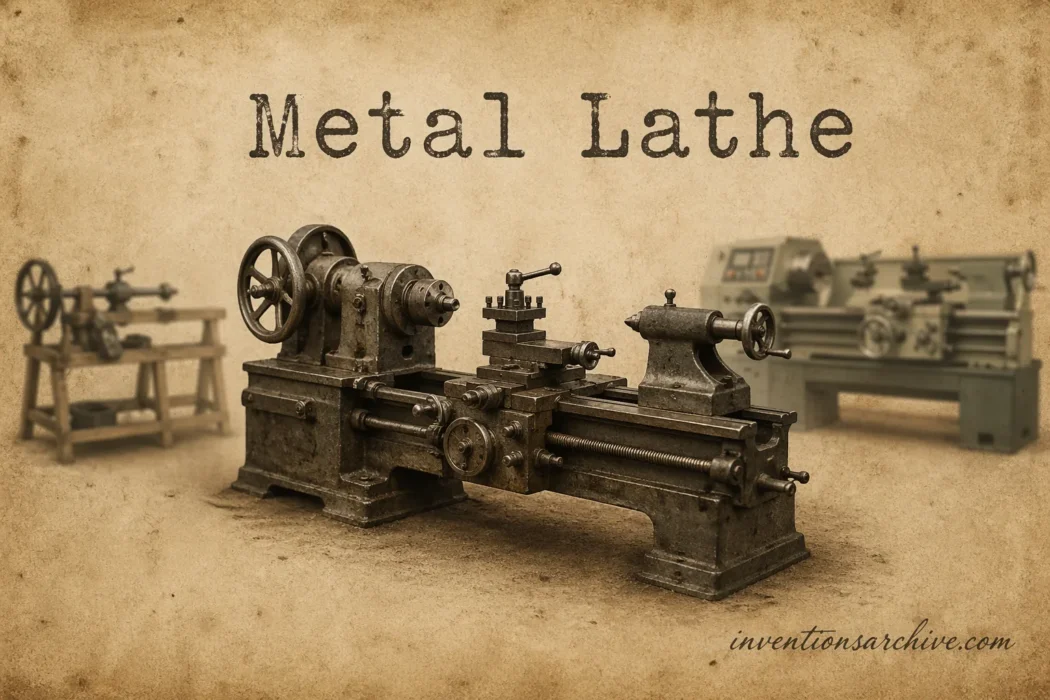
| Invention Detail | Verified Information |
|---|---|
| Invention Name | Metal lathe |
| Short Definition | Machine tool that rotates a metal workpiece while a cutting tool removes material into a controlled round form |
| Approximate Date / Period | c. 1797–1800 Approximate |
| Geography | London, England; British precision workshop culture |
| Inventor / Source Culture | Henry Maudslay for the practical industrial screw-cutting metal lathe; earlier lathe ideas were collective and gradual |
| Category | Machine tool; manufacturing; precision engineering |
| Need Behind the Invention | Accurate round metal parts; repeatable screw threads; less hand fitting |
| How It Works | Rotating workpiece + guided cutting tool + measured feed movement |
| Technology Basis | Slide rest; lead screw; change wheels; spindle; tool holder; cast iron and steel structure |
| Early Use | Screw threads; mechanical parts; tools; engine and instrument components |
| Main Importance | Repeatable precision; stronger path toward interchangeable parts; machine tools that could make better machine tools |
| Spread Route | British workshops → European and American machine-tool shops → factory production |
| Derived Developments | Engine lathe; toolroom lathe; turret lathe; automatic screw machine; CNC turning center; Swiss-type lathe |
| Impact Areas | Manufacturing; transport machinery; scientific instruments; measuring tools; engineering education |
| Different Views | Maudslay is widely credited, but earlier and parallel screw-cutting lathe work matters |
| Predecessors and Successors | Predecessors: wood lathes, hand-guided turning, early screw-cutting devices. Successors: powered engine lathes, automatic lathes, CNC lathes |
| Related Invention Types | Screw-cutting lathe; centre lathe; capstan lathe; turret lathe; vertical lathe; CNC lathe |
A metal lathe looks plain until its job is understood. A piece of metal spins, a cutting tool moves with measured control, and a rough bar becomes a shaft, screw, pulley, cylinder, bushing, or threaded part. That simple motion helped workshops leave behind guesswork. Round metal parts could be made with a level of repeatability that hand filing and hand-guided cutting could not easily match.
The metal lathe was not born in one neat moment. Earlier lathes existed for wood, ornamental work, instrument making, and screw cutting. The lasting shift came when slide-rest control, lead-screw motion, and change gears came together in a practical industrial machine.
Article Sections
What the Metal Lathe Is
A metal lathe is a machine tool for turning. In turning, the workpiece rotates and the cutting tool removes unwanted material. Britannica defines the lathe as a machine tool that performs turning operations by removing material from a rotated workpiece (Details-1).
That definition sounds tidy. The machine itself is more interesting. A lathe can make a round part smaller, flatten the end of a cylinder, bore a hole, cut a taper, form a groove, or create a screw thread. It does not “shape metal” in a loose artistic sense. It controls diameter, length, surface, angle, and thread pitch.
Its special strength is rotational accuracy. Any part that needs to be round, coaxial, straight along an axis, or threaded belongs naturally to lathe work. Shafts, pins, bushings, rollers, screws, nozzles, pulleys, and instrument parts all fit that pattern.
Why It Is Called a Machine Tool
A tool cuts. A machine tool guides a tool with a controlled mechanical system. That difference matters. A hand tool depends mostly on the worker’s touch. A machine tool adds fixed geometry, rigid support, repeatable feed, and measured adjustment.
In plain terms: the machine holds the line.
What Makes It a Metal Lathe
A metal lathe must be rigid enough to cut harder material than wood. The frame, spindle, bearings, slides, and tool holder need enough strength to resist vibration and bending. A small error at the tool tip can become a visible error on the finished part, so stiffness is not a nice extra. It is part of the invention’s logic.
- Rigid bed: keeps the spindle and carriage aligned.
- Workholding system: grips the rotating part.
- Guided tool movement: moves the cutter along fixed paths.
- Measured feed: controls how far the tool travels per turn or per unit of time.
- Cutting-tool support: holds the cutting edge steady against force.
Early History and Credit
The lathe itself is much older than the metal lathe. Wood lathes and hand-guided turning came first. The leap toward the industrial metal lathe came when turning stopped being mostly hand-guided and became mechanically guided.
Henry Maudslay is the name most often attached to the practical metal lathe because his screw-cutting lathe joined several working ideas into a machine that could make accurate, repeatable threads. The Science Museum Group records Maudslay’s original screw-cutting lathe as made around 1800 in London and describes its slide rest, screw feed, micrometer dial, lead screw, and change wheels (Details-2).
Why Maudslay’s Version Mattered
Before accurate screw cutting, threaded parts often had a workshop-by-workshop character. A screw and nut might fit each other but not another pair made elsewhere. That sounds small. It was not small at all.
Maudslay’s practical achievement lay in bringing the cutting tool under firm mechanical guidance. The cutter no longer had to follow the worker’s hand alone. It could move in a fixed relation to the rotating metal. Pitch became repeatable. Thread after thread could be made to the same form.
Linda Hall Library describes how Maudslay’s lathe used a slide rest, a long lead screw, and replaceable change gears to produce desired thread pitch, turning a difficult hand process into repeatable workshop practice (Details-3).
Not a Single-Person Story
Careful wording is needed here. Maudslay did not create every idea from nothing. Earlier screw-cutting devices, slide-rest concepts, instrument-making machines, and parallel American work all belong in the story.
David Wilkinson, for example, designed a screw-cutting lathe with a slide rest in 1794 and received a patent in 1798. The American Precision Museum’s Manufacturing Ledger also notes that Maudslay’s 1800 lathe had many features found in Wilkinson’s 1798 patent (Details-4).
So the fair statement is this: Maudslay is widely credited with the practical industrial metal/screw-cutting lathe, while the broader invention grew through many hands, shops, and earlier devices. A little messy, yes. That is how machine history often works.
How the Metal Lathe Works
The metal lathe works by giving the workpiece the main motion and the tool the cutting motion. The metal turns. The cutting edge advances. Chips come away from the surface. The part becomes round, flat-ended, bored, tapered, grooved, or threaded depending on tool path and setup.
The Basic Motion
The central idea is rotation around an axis. A workpiece mounted in a chuck or between centers spins around the spindle axis. A tool approaches the surface and removes material. When the tool moves parallel to the axis, it reduces or shapes the outside diameter. When it moves across the end, it faces the part.
One motion spins. One motion cuts. The finished shape comes from the relation between the two.
Feed and Depth of Cut
Two simple ideas explain much of lathe work:
- Feed: how steadily the tool moves along or across the workpiece.
- Depth of cut: how deeply the cutting edge enters the material.
A light feed can leave a smoother surface. A heavier cut can remove more metal. The machine’s strength, the tool material, the workpiece metal, and the desired finish all affect the result. The invention is not only a rotating machine; it is a measuring machine in disguise.
How Thread Cutting Changed the Story
Screw cutting made the metal lathe far more than a round-part maker. With a lead screw and gears, the carriage can move in a fixed ratio to spindle rotation. If the spindle turns once and the tool advances a controlled distance, a thread begins. Keep that relation steady and the thread pitch stays steady.
This solved a workshop problem that bothered makers for generations: how to make screws and nuts match without hand-fitting every pair.
Main Parts of a Metal Lathe
A metal lathe is easier to understand when the parts are read as a chain of control. Each part keeps the cutting action from wandering.
Bed
The bed is the long base of the machine. It supports and aligns the headstock, tailstock, and carriage. A poor bed ruins accuracy because the tool and workpiece no longer keep a dependable relationship.
Headstock and Spindle
The headstock holds the spindle and drive system. The spindle rotates the workholding device. In older machines this power could come from hand drive, treadle, belt, or line shaft. Later lathes used individual motors and gearboxes.
Chuck, Centers, and Workholding
The workpiece must be held securely and centered. Common workholding methods include chucks, collets, faceplates, and centers. In lathe work, weak holding does not merely slow the job; it changes the geometry of the finished part.
Carriage, Cross Slide, and Compound Slide
The carriage carries the cutting tool along the bed. The cross slide moves the tool toward or away from the workpiece. A compound slide can add angled movement. Together they turn hand movement into controlled tool travel.
Tool Post
The tool post holds the cutting tool. A metal lathe needs a firm tool post because cutting forces push hard against the edge. Tool height also matters. When the tool sits too high or too low, the cut can rub, chatter, dig in, or leave poor shape.
Lead Screw, Feed Screw, and Gearing
The lead screw is the historical star of screw-cutting lathes. It ties carriage movement to spindle rotation. Change gears or gearboxes let the machine cut different thread pitches. This is where the lathe becomes a device for repeatable geometry, not just removal of metal.
Metal Lathe Types and Variations
The metal lathe family widened as workshops asked for more speed, more accuracy, more automation, or more specialized part shapes. The names can overlap, but the purpose of each type is fairly clear.
| Lathe Type | Main Character | Typical Use |
|---|---|---|
| Engine Lathe | General-purpose, manual or partly powered | Repair, prototypes, shafts, bushings, threaded parts |
| Screw-Cutting Lathe | Lead-screw controlled thread making | Accurate screws, nuts, threaded rods, machine parts |
| Bench Lathe | Small lathe mounted on a bench | Instrument parts, model engineering, small precision pieces |
| Toolroom Lathe | High-accuracy manual machine | Dies, gauges, fixtures, one-off precision work |
| Turret or Capstan Lathe | Multiple tools held ready in an indexing head | Repeated batches of similar parts |
| Automatic Screw Machine | Production machine for repeated turned parts | Screws, fittings, pins, small metal components |
| CNC Lathe | Computer-controlled tool motion | Repeat production, complex profiles, tight tolerance parts |
| Swiss-Type Lathe | Guide-bushing support near the cutting point | Long, slender, small-diameter parts |
| Vertical Turret Lathe | Workpiece rotates on a vertical axis | Large rings, disks, wheels, heavy round parts |
Engine Lathe
The engine lathe became the classic workshop lathe. It handles turning, facing, boring, drilling along the axis, threading, and taper work. It is flexible rather than specialized. That flexibility explains why so many training shops, repair rooms, and toolrooms relied on it.
Screw-Cutting Lathe
The screw-cutting lathe deserves special attention because it changed how workshops thought about fit. When threads could be made with repeatable pitch, the same size screw and nut could be planned before they met. That sounds obvious now. It was not obvious then.
Turret and Capstan Lathes
Turret and capstan lathes reduce tool-changing time. Several tools sit ready in a rotating or sliding head. One part can receive a sequence of operations without resetting every tool by hand. These machines suit repeated parts where time lost between cuts matters.
CNC Turning Centers
A CNC turning center keeps the lathe principle but replaces manual tool motion with programmed movement. It may include tool turrets, automatic tool changing, live tooling, bar feeders, sub-spindles, and digital measurement. Still, the old idea remains: rotate the work, guide the tool, control the cut.
What the Metal Lathe Made Possible
The metal lathe helped workshops make parts that could be measured, repeated, repaired, and combined. The Henry Ford describes a Maudslay production lathe from around 1800 as the oldest industrial capacity precision machine tool in the world and notes that it could machine to an accuracy of several thousandths of an inch (Details-5).
Related articles: Bow Drill Tool [Ancient Inventions Series], Screw [Ancient Inventions Series]
This is the reason the lathe is often treated as one of the central inventions of industrial precision. It did not only make parts. It made better tools, and those tools made better machines. A quiet chain reaction.
Repeatable Screw Threads
Threads connect parts. They clamp, adjust, seal, measure, and transmit motion. A good thread is not just a spiral ridge; it is a controlled form. Pitch, depth, angle, and diameter all matter.
The metal screw-cutting lathe helped turn threaded parts into planned components rather than individually fitted pairs. That shift supported repair work, assembly, and later standardization.
Interchangeable Parts
Interchangeability needs more than one invention. It requires measurement, gauges, standards, skilled workers, stable materials, and machine tools. The metal lathe supplied one of the needed steps: it made accurate round and threaded parts more repeatable.
Interchangeable parts do not mean every part fits perfectly without inspection. Real workshops still measure. But the lathe made the target more realistic by reducing dependence on hand matching.
Precision Measurement
Lathe work sharpened the need for micrometers, gauges, surface plates, thread gauges, calipers, and later inspection systems. Cutting and measuring grew together. A machine that can make a part slightly smaller must also answer a simple question: smaller by how much?
That question changed workshop culture. Numbers entered the bench.
Machine Tools Making Machine Tools
The metal lathe belongs to a special class of inventions because it can help make parts for other machine tools. A better lathe can make a better lead screw, spindle, bushing, shaft, or fixture. Those parts then improve another machine.
Here the invention becomes self-improving in a practical sense. Not magical. Mechanical.
Common Lathe Operations
A metal lathe can perform many operations, but the main ones follow from the same geometry: a rotating workpiece and a controlled tool path.
Turning
Turning reduces the outside diameter of a rotating workpiece. Straight turning makes a cylinder. Taper turning makes a cone-like surface. Contour turning creates a curved profile.
Facing
Facing cuts the end of a workpiece flat. It creates a clean surface at right angles to the axis. Many lathe jobs begin with facing because length and squareness depend on it.
Boring
Boring enlarges or improves an existing hole. It can make the hole more accurate, straighter, smoother, or better aligned with the part’s outer diameter.
Drilling and Reaming
On a lathe, a drill can be held in the tailstock and fed along the axis of the rotating work. Reaming can refine the hole size and finish after drilling. It is a neat use of the machine’s axial alignment.
Threading
Threading cuts a helical form on the outside or inside of a part. This is where lead-screw control shows its value most clearly. The tool must advance at a controlled rate as the work turns.
Parting, Grooving, and Knurling
Parting cuts a piece off. Grooving creates a narrow recess. Knurling presses a patterned surface into metal for grip. Each operation looks different, but each depends on the same disciplined relation between tool and rotation.
Materials Cut on Metal Lathes
Despite the name, metal lathes often cut more than metal. They may machine plastics and some composites when the machine, tool, and workholding suit the job. The classic role, though, remains metal cutting.
- Steel: strong and widely used, but tool choice and cutting conditions matter.
- Cast iron: stable and machinable, often used for machine structures and parts.
- Brass and bronze: common in bushings, fittings, and instrument parts.
- Aluminum alloys: lighter metals used in many mechanical components.
- Tool steels and harder alloys: cut with suitable tools, slower speeds, and careful control.
The invention’s value is not tied to one metal. It lies in controlled rotation and guided cutting.
Limits and Safe Context
The metal lathe is a knowledge-heavy invention. It is also a powerful rotating machine, so a historical article should not turn into an operating manual. The useful public lesson is about principle, history, parts, and impact, not step-by-step machine use.
Limits of the Early Metal Lathe
Early metal lathes were slower, less rigid, and less standardized than later machines. Some were hand-driven. Some depended on missing or changeable gear sets. Accuracy also depended on the maker’s skill, the quality of the lead screw, and the straightness of the bed.
Still, they moved workshop practice in the right direction: more control, less guesswork.
Why Accuracy Was Never Only the Machine
No lathe works alone. Accuracy also depends on cutting tools, material behavior, temperature, measurement, workholding, bearing condition, and operator judgment. That is why the metal lathe grew alongside gauges, micrometers, surface plates, and training systems.
Useful distinction: the invention made repeatable precision more reachable, but it did not remove skill. It changed the kind of skill needed.
Metal Lathe and Modern Manufacturing
Modern manufacturing uses milling machines, grinders, machining centers, lasers, electrical discharge machines, additive systems, and robots. The lathe still holds its place because round parts have not gone away.
Electric motors need shafts. Pumps need sleeves. Valves need seats. Instruments need threaded and cylindrical elements. Vehicles, appliances, turbines, watches, laboratory devices, and factory machines all use parts shaped by turning or by processes descended from lathe thinking.
Manual Skill to Digital Control
The path from Maudslay’s screw-cutting lathe to CNC turning is not a straight line, but the connection is clear. The aim stayed the same: control the tool path against a rotating workpiece. Digital control changed how the movement is commanded, stored, repeated, and inspected.
The old machine asked the worker to manage handwheels, gears, and feel. The CNC lathe asks for programming, setup, tooling knowledge, and measurement control. Different hands, same geometry.
Why the Metal Lathe Still Teaches Engineering
Students and apprentices still learn from lathes because the machine makes basic engineering ideas visible:
- Axis: the part turns around a defined centerline.
- Tolerance: small differences change fit.
- Surface finish: tool motion leaves a physical trace.
- Rigidity: weak setups show up as chatter or poor shape.
- Measurement: cutting and checking belong together.
Few machines explain so much with so little drama.
Metal Lathe FAQ
Who invented the metal lathe?
Henry Maudslay is widely credited with the practical industrial metal lathe, especially the screw-cutting lathe developed around 1797–1800. The broader history includes earlier wood lathes, instrument-making machines, screw-cutting devices, and parallel work by other makers such as David Wilkinson.
What was the metal lathe used for first?
Its early value came from accurate screw threads, round metal parts, machine components, and workshop tools. Screw cutting mattered because it made matching threaded parts more repeatable.
Why was the metal lathe important?
It helped workshops make round and threaded parts with better repeatability. That supported machine building, repair, measurement, interchangeable parts, and later factory production.
What is the difference between a lathe and a metal lathe?
A lathe is the wider machine category. A metal lathe is built with the rigidity, tool holding, feed control, and cutting strength needed for metalworking.
What is a screw-cutting lathe?
A screw-cutting lathe uses controlled carriage movement, often through a lead screw and gearing, to cut repeatable screw threads on a rotating workpiece.
Is a CNC lathe still a metal lathe?
Yes. A CNC lathe uses computer control, but it still follows the lathe principle: the workpiece rotates while the cutting tool follows a controlled path.