
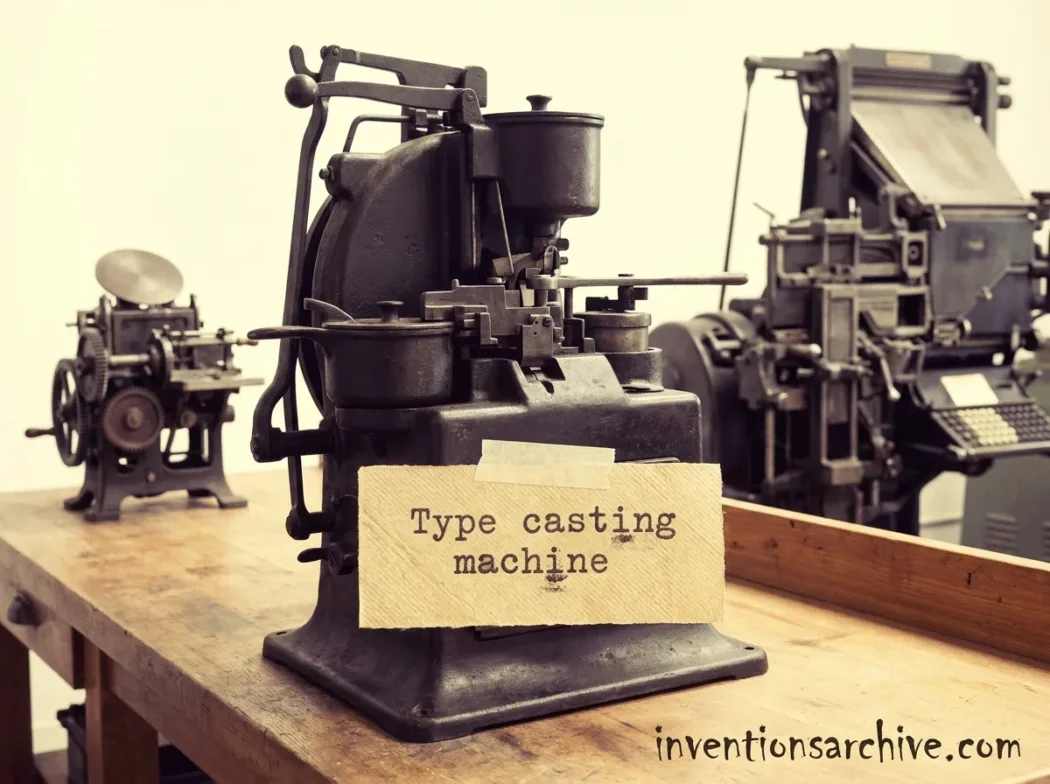
| Invention Name | Type Casting Machine |
|---|---|
| Short Definition | A machine used to cast metal printing type from a mold or matrix for letterpress printing. |
| Approximate Date / Period | 1838 patent model for David Bruce Jr.’s machine Based on surviving evidence |
| Geography | United States; later adapted and used in Britain, Europe, and commercial printing centers. |
| Inventor / Source Culture | David Bruce Jr. for the early patented pivotal typecasting machine; later systems were developed by several firms and inventors. |
| Category | Manufacturing; communication; printing technology. |
| Main Problem Solved | Slow, labor-heavy casting and preparation of individual metal printing types. |
| How It Worked | A mold and matrix shaped molten type metal into repeatable pieces of printing type or, in later systems, complete lines of type. |
| Material / Technical Base | Type metal, molds, matrices, pumps, mechanical motion, and later keyboard-controlled casting systems. |
| Evidence Status | Patent models, museum objects, patent records, and surviving industrial machines Confirmed |
| Surviving Evidence | Smithsonian patent model for patent number 632, dated March 17, 1838 [a] |
| Development Path | Hand mold → pivotal type caster → Monotype caster → Linotype linecasting → phototypesetting and digital type. |
| Early Use | Type founding, newspaper printing, book printing, job printing, and letterpress shops. |
| Related Inventions | Movable metal type; hand mold; punch and matrix; printing press; Monotype; Linotype; phototypesetting. |
| Modern Descendants | Digital typography, font design software, automated typesetting systems, and desktop publishing. |
| Why It Matters | It made the production of metal type faster, more regular, and better suited to industrial-scale printing. |
A type casting machine belongs to the history of metal type, letterpress printing, and industrial publishing. It did not invent writing, printing, or movable type by itself. Its importance is more specific: it mechanized part of the demanding work of making the small metal letters that printers needed again and again. Before machines entered the process, casting type required skilled hand work, close attention to molds, and long hours of repeated motion. The machine brought that work closer to regular manufacture.
What the Type Casting Machine Is
A type casting machine is a mechanical device for producing pieces of metal type. In letterpress printing, each raised letter, number, punctuation mark, or spacing piece must have a precise height, width, and face. If those pieces vary too much, the printed page becomes uneven.
The machine answered a practical need in printing workshops: more type, more quickly, with better repeatability. It helped type founders and printers keep up with expanding demand for books, newspapers, forms, advertisements, labels, and other printed matter.
The word typecasting can refer to several related machines. Some cast individual pieces of type. Others, such as Linotype, cast a full line of type as one metal slug. Monotype systems combined keyboard input, perforated paper control, and casting of individual characters. These are not identical inventions, but they share the same historical problem: turning letterforms into usable metal printing surfaces.
The Problem It Answered
Movable metal type changed European bookmaking in the fifteenth century, but it also created a lasting production problem. Printers needed large supplies of type. A single page could require hundreds or thousands of pieces. A busy shop needed repeated letters in many sizes and styles.
Hand casting could produce excellent type, but it depended on skill, rhythm, and physical labor. The process had limits:
- Each type piece had to be formed with care.
- Damaged or worn type had to be replaced.
- Popular letters were needed in larger numbers than rare letters.
- Newspapers and commercial printing increased the need for speed.
- Consistency mattered because type had to lock together on a printing form.
The type casting machine did not remove craftsmanship from printing. It shifted part of the work from repeated hand motion to controlled mechanical casting. That change mattered because printing was becoming more than a small workshop trade. It was becoming an industrial communication system.
Earlier Ideas Before the Machine
The type casting machine grew from earlier printing tools rather than appearing as a sudden invention. The most important predecessor was movable metal type, associated in Western Europe with Johannes Gutenberg’s printing system. The Library of Congress describes the Gutenberg Bible as the first great book printed in Western Europe from movable metal type, probably completed in Mainz in 1455, and notes that Gutenberg is generally credited with solving the process of making uniform and interchangeable metal types [d].
That earlier achievement created the basic technical idea: each letter could be a separate reusable object. The later type casting machine focused on producing those objects more efficiently.
Main Predecessors
- Hand mold: a manual tool for casting individual pieces of type.
- Punch: a hard metal tool used to create the letterform impression.
- Matrix: the receiving die that carried the letterform shape.
- Type metal: a metal alloy used for durable, printable type.
- Printing press: the machine that made repeated impressions from arranged type.
The type casting machine sits between those older hand tools and later automated typesetting systems. It belongs to the workshop world of molds and metal, but it points toward the factory world of timed motion, repeatable output, and mechanical composition.
How It Worked in Simple Terms
In simple terms, a type casting machine used a mold and a matrix to shape molten metal into printable type. The matrix carried the reversed form of the character. The mold controlled the body of the type. When the metal cooled and the mold opened, a new piece of type could be released.
David Bruce Jr.’s 1845 patent for improvements in machines for casting types describes a machine that tried to imitate the hand-casting process by mechanical means. The patent refers to a mold, matrix, pump, kettle, furnace, crankshaft, cams, and a moving “crane” mechanism that brought the mold into position and helped coordinate movement during casting [b].
Main Technical Principles
- Mold control: the body of the type had to be shaped to a consistent size.
- Matrix contact: the letterform had to be formed sharply enough to print cleanly.
- Metal delivery: molten type metal had to enter the mold at the right moment.
- Release: the new type had to leave the mold without damaging the face or body.
- Repeatability: the machine was valuable only if it could repeat the action reliably.
Development Path
| Stage | Form | What Changed |
|---|---|---|
| Earlier Tool | Hand mold and matrix | Individual type could be cast, but the process depended heavily on manual skill and repeated motion. |
| Early Machine | Bruce pivotal typecaster | Mechanical motion helped automate parts of type casting and provided a model for later pivotal casters. |
| Adapted Form | Bannerman pivotal typecaster | A later museum example shows the Bruce pivotal action adapted in a nineteenth-century British machine [c]. |
| Composition System | Monotype | Keyboard input and a caster system allowed printers to cast individual types from machine-controlled instructions. |
| Linecasting System | Linotype | Instead of single loose letters, the machine cast a full line as one slug for faster newspaper composition. |
| Modern Descendant | Phototypesetting and digital typography | Metal casting was gradually replaced by photographic and software-based composition. |
The Parts That Made It Useful
The machine’s value came from the way several small systems worked together. None of them alone explains the invention. The mold, matrix, metal supply, moving mechanism, and release action all had to serve one goal: making repeatable printing type.
Mold
The mold shaped the body of the type. This mattered because printing type had to align with other pieces inside a locked printing form. A letter with a poor body could disturb the entire page.
Matrix
The matrix carried the letterform. In Monotype practice, a matrix was a bronze die from which type characters were cast, with the letter impression sunk into the bronze. Science Museum Group records also explain that the matrix case could be positioned over the mold so molten metal formed the printing surface of a piece of type [e].
Type Metal
Printing type needed to be firm enough to print clearly and practical enough to cast. Museum records for Monotype casting equipment identify type metal as a lead, antimony, and tin alloy in connection with hot-metal typesetting machines [f].
Mechanical Timing
The machine had to close the mold, bring metal into the casting space, release the new type, and reset for the next action. This is where the invention moved beyond a simple mold. It used mechanical coordination to make repeated casting more practical.
Before and After
| Before the Invention | What Changed After It |
|---|---|
| Type was mainly cast by hand using molds and matrices. | Mechanical motion could carry out parts of the casting cycle more consistently. |
| Type founding required long periods of repeated skilled labor. | Workshops could increase output and reduce some repetitive manual effort. |
| Printers depended on slow replacement of worn or missing type. | Fresh type could be produced more readily in specialized foundries and later in composing systems. |
| Expanding newspapers and commercial printing strained older methods. | Later typecasting and linecasting machines helped match the speed of industrial publishing. |
| Manual composition and casting were separate, labor-heavy skills. | Systems such as Monotype and Linotype linked composition with casting in new ways. |
Early Uses in Printing and Type Founding
The early type casting machine was most useful in type foundries, where metal type was produced for printers. It supported a trade that already had strict expectations. Type had to be even, durable, properly spaced, and compatible with the rest of a printer’s equipment.
As printing expanded, the need was not just for letters. Printers needed spaces, rules, borders, ornaments, display type, book type, newspaper type, and replacement sorts. A type casting machine helped turn type production into a more regular manufacturing process.
The invention also supported a wider division of labor. A printer no longer had to think only in terms of presses and ink. The supply chain of printing included punchcutters, matrix makers, type founders, machine makers, compositors, proofreaders, and press operators.
How It Spread and Changed Over Time
Typecasting technology spread through patents, machine shops, type foundries, printing houses, and industrial manufacturers. It changed most clearly when casting was connected to composition. The Monotype system is one example: the Science Museum notes that the Monotype Corporation mechanized the process of casting and composing metal type, with a system patented in 1887 and used for books, newspapers, and advertising work during the twentieth century [h].
Related articles: Anchor [Ancient Inventions Series], Linotype machine [Industrial Age Inventions Series]
Linotype changed the pattern again. It was not simply a better individual type caster. It was a linecasting machine. Science Museum Group describes the Linotype as a hot-metal typesetting system developed by Ottmar Mergenthaler in 1886, able to set complete lines of type quickly for printing presses; it also notes that Linotype machines became dominant for newspapers and magazines until they were replaced by photosetting and later electronic software [g].
This is why the type casting machine should not be seen as one fixed object. It is better understood as a family of machines that moved printing from hand-prepared metal letters toward mechanized type production.
Main Types and Variations
| Type or Variation | What It Cast | Historical Role |
|---|---|---|
| Hand Mold Casting | Individual pieces of type | The older craft method that provided the technical base for machine casting. |
| Pivotal Typecaster | Individual type | Early mechanical form associated with David Bruce Jr. and later adaptations. |
| Monotype Composition Caster | Individual characters and spaces | Allowed machine-controlled casting of separate type pieces, useful for correction and high-quality composition. |
| Super Caster | Type, rules, borders, and larger material | Expanded the casting role beyond ordinary text characters. |
| Linotype | Full lines of type as slugs | Changed newspaper and magazine composition by casting complete lines instead of loose type. |
| Intertype and Similar Linecasters | Line slugs | Continued the hot-metal linecasting tradition with competing or improved machines. |
| Phototypesetting | No metal type | Replaced hot-metal casting in many settings by using photographic composition. |
| Digital Typography | Software-based type | Moved type design and composition into digital systems rather than cast metal objects. |
What Changed Because of the Type Casting Machine
The type casting machine changed printing in practical, measurable ways. It did not make printing instant. It did not remove the need for trained workers. It did make the supply of type more compatible with faster presses, larger newspapers, and more varied printed matter.
More Regular Type Production
Printers needed type that behaved predictably. A type casting machine supported better repeatability because the same mechanical cycle could be used many times. That helped make type founding more industrial.
Better Support for Large Printing Work
Newspapers, catalogs, and commercial forms demanded speed. The machine helped provide the material base for that speed. Later hot-metal systems went further by combining composition and casting.
More Flexibility in Typography
Monotype and related systems made it easier to cast fresh type when needed. That mattered for books, technical works, advertisements, and printers that needed different faces and sizes.
A Path Toward Automated Composition
Once casting became mechanical, the next question was clear: could composition also be mechanized? Linotype and Monotype answered that question differently. One cast lines. The other cast individual characters from machine instructions. Both grew from the same pressure in printing: faster production without losing readable type.
Common Misunderstandings
It Was Not the Same as the Printing Press
A printing press makes impressions on paper or another surface. A type casting machine makes the metal type used in letterpress printing.
It Did Not Invent Movable Type
Movable type came much earlier. The machine helped produce metal type more efficiently after the idea of reusable type already existed.
There Was Not Only One Machine
The phrase can describe several machines, from pivotal typecasters to Monotype casters and linecasting machines such as Linotype.
The First Evidence Is Not the Whole Story
Surviving patent models show what can be verified. They do not erase earlier workshop experiments that may not have survived in clear records.
Why the Invention Appeared When It Did
The nineteenth century was a favorable period for type casting machines because printing demand, machine tools, metalworking skill, and patent culture were all growing. Newspapers needed faster composition. Book and job printers needed reliable supplies of type. Industrial workshops had the tools to make more precise machines.
The invention was not just a clever machine in isolation. It belonged to a broader shift in manufacturing. Similar pressures affected paper making, press design, stereotyping, electrotyping, and later typesetting. Printing was becoming a system of connected machines.
Related Inventions
- Movable metal type: the reusable letter system that made type casting necessary.
- Hand mold: the older tool that shaped individual type before mechanical casting.
- Punch and matrix: the letterform-making system behind repeatable type faces.
- Letterpress printing press: the press technology that used raised metal type for printing.
- Stereotype plate: a cast plate made from a composed page, useful for repeated printing.
- Monotype system: a hot-metal composition and casting system for individual type.
- Linotype machine: a linecasting system that cast complete lines of type.
- Phototypesetting: a later non-metal method that helped replace hot-metal composition.
Frequently Asked Questions
Who invented the type casting machine?
David Bruce Jr. is strongly associated with an early patented typecasting machine, especially through his 1838 patent model. Later typecasting and typesetting machines were developed by other inventors and companies, so the broader technology should not be credited to only one person.
What did a type casting machine make?
It made metal printing type. Some machines cast individual letters and spaces, while later linecasting machines cast a complete line of type as one metal slug.
Is a type casting machine the same as a Linotype machine?
No. Linotype is a later linecasting machine that cast full lines of type. It belongs to the wider hot-metal typesetting family, but it is not the same as earlier machines that cast individual pieces of type.
Why was the type casting machine important?
It helped make metal type production faster and more regular. That supported larger-scale printing, easier replacement of worn type, and the later development of machine composition systems.
Did type casting machines disappear?
They lost their central role as phototypesetting and digital publishing replaced hot-metal composition. Some machines survive in museums, specialist workshops, educational collections, and letterpress printing circles.
Sources and Verification
- [a] Patent Model of a Typecasting Machine | National Museum of American History — Used to verify the 1838 patent model, David Bruce Jr. attribution, patent number 632, and surviving object evidence. (Reliable because it is an official Smithsonian museum collection record.)
- [b] US4072A – Improvement in machines for casting types – Google Patents — Used to verify Bruce’s 1845 patent language and the mechanical elements described in the improved type casting machine. (Reliable because it reproduces a historical patent record with patent metadata and specification text.)
- [c] Pivotal Type Caster, 1805-1875 | Science Museum Group Collection — Used to verify the Bannerman pivotal typecaster, the Bruce machine connection, materials, and museum classification as a typecasting machine. (Reliable because it is an official Science Museum Group collection record.)
- [d] The Gutenberg Bible – Library of Congress Bible Collection | Exhibitions – Library of Congress — Used to verify the earlier context of movable metal type, Gutenberg’s role, and the 1455 Gutenberg Bible evidence. (Reliable because it is an official Library of Congress exhibition source.)
- [e] Matrix for Imprint (Typeface Series number: 101) | Science Museum Group Collection — Used to verify the function of Monotype matrices, bronze die material, and how the matrix shaped molten metal during casting. (Reliable because it is an official Science Museum Group collection record.)
- [f] Monotype Composition Casting Machine, 1930-1940 | Science Museum Group Collection — Used to verify Monotype composition casting equipment and the listed type metal alloy of lead, antimony, and tin. (Reliable because it is an official Science Museum Group collection record.)
- [g] Eleven matrices for Linotype machine | Science Museum Group Collection — Used to verify the Linotype connection, Ottmar Mergenthaler’s 1886 linecasting machine, and its later replacement by photosetting and electronic software. (Reliable because it is an official Science Museum Group collection record.)
- [h] The Monotype Collection | Science Museum — Used to verify the Monotype system’s role in mechanizing the casting and composing of metal type and its patent-era historical context. (Reliable because it is an official Science Museum institutional source.)