
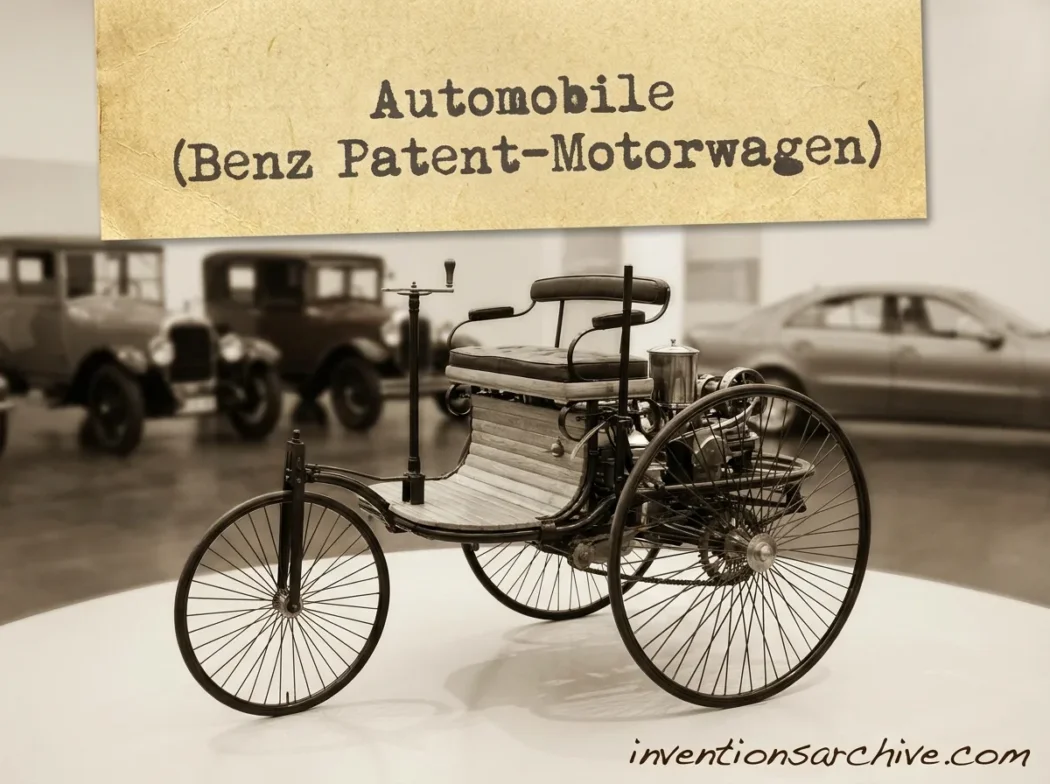
| Invention Name | Benz Patent-Motorwagen, also called the Benz Patent Motor Car |
|---|---|
| Short Definition | A three-wheeled, gasoline-powered motor vehicle designed as an integrated self-propelled automobile. |
| Date / Period | Completed in 1885; patent filed on January 29, 1886 Confirmed |
| Patent Record | German Patent No. 37,435, “Vehicle with gas engine operation” [a] |
| Geography | Mannheim, German Empire; present-day Germany |
| Inventor / Source Culture | Carl Benz; German mechanical engineering and engine-building culture |
| Category | Transport; energy; manufacturing; mechanical engineering |
| Main Problem Solved | Independent road travel without animal power, fixed rails, or steam vehicle handling limits |
| How It Worked | Single-cylinder four-stroke gasoline engine; rear placement; belt and chain drive; three-wheel layout |
| Material / Technical Base | Tubular steel frame, wire-spoked wheels, mechanical valve control, electrical ignition, evaporative cooling |
| First Public Use | Public outing reported in Mannheim in July 1886 Based on surviving evidence |
| Surviving Evidence | Patent documents and museum-held vehicle evidence; Deutsches Museum lists a Benz-Patent-Motorwagen Nr. 1 object from Mannheim with 1886 manufacture [b] |
| Development Path | Gas engines and bicycle-like parts → Patent-Motorwagen → improved Model 3 → early production cars |
| Related Inventions | Four-stroke engine; carburetor; differential gear; electric ignition; wire-spoked wheel; early motor carriage |
| Modern Descendants | Passenger cars, road vehicles, automotive drivetrains, car manufacturing, fuel and service networks |
| Evidence Status | Confirmed for the 1886 patent; Attribution varies when compared with earlier steam, electric, and experimental road vehicles |
The Benz Patent-Motorwagen was not simply a carriage with an engine attached. It was a compact road vehicle built around a small gasoline engine, a light frame, a drive system, steering, braking, and seating for two. That is why it holds such a strong place in invention history: it joined the engine, the vehicle structure, and the road-use idea into one machine.
What the Benz Patent-Motorwagen Was
The Patent-Motorwagen was a three-wheeled automobile created by Carl Benz in Mannheim. It used a rear-mounted, single-cylinder four-stroke engine and a light frame rather than a heavy horse-carriage body. Mercedes-Benz Group describes the completed 1885 vehicle as a two-seater with a tubular steel frame, differential, three wire-spoked wheels, and a 0.75 hp engine. The same official history records the January 29, 1886 patent application, the July 1886 public outing, and Bertha Benz’s 1888 long-distance journey from Mannheim to Pforzheim and back [d].
Its historical value comes from the way it treated the automobile as a new kind of machine. Many earlier road vehicles borrowed the form of carts, wagons, or carriages. Benz’s vehicle still looked light and open, but its working logic came from engine design, bicycle technology, gearing, steering, and road transport needs.
The Problem It Answered
Before the Patent-Motorwagen, most personal road travel relied on horses. Railways moved people and goods over long distances, but only along fixed routes. Steam road vehicles existed, yet they could be heavy, slow to prepare, and difficult to operate in ordinary streets. Early electric vehicles were also emerging, but batteries limited range and weight.
The Patent-Motorwagen answered a narrower but very important question: could a light road vehicle carry people using its own compact engine, without rails or animal power? Benz’s answer was not polished by modern standards. It was open, noisy, slow, and mechanically exposed. Yet it showed that a small internal-combustion engine could move a personal vehicle on public roads.
| Before the Invention | What Changed After It |
|---|---|
| Short personal road travel depended mainly on horses, walking, bicycles, or hired carriages. | A self-propelled road vehicle could carry people without animal power. |
| Rail travel was powerful but fixed to stations, schedules, and tracks. | Road mobility became a mechanical design problem rather than only an animal or rail system. |
| Steam road vehicles proved self-propulsion was possible but were often heavy and less convenient for small personal travel. | A compact gasoline engine offered a lighter route toward personal motor vehicles. |
| Vehicle makers mainly improved carriage, bicycle, and engine parts as separate traditions. | The automobile began to develop as a combined system: frame, engine, transmission, steering, fuel, cooling, and controls. |
| There was no practical service culture for private motor travel. | Later motor travel encouraged fuel supply, roadside repair, driver skills, vehicle registration, and car manufacturing. |
Earlier Ideas Behind the Automobile
The Patent-Motorwagen did not appear from an empty space. It depended on several earlier lines of invention: stationary gas engines, the four-stroke cycle, lightweight metal frames, bicycle-style wheels, fuel vaporization, ignition systems, and gear transmission. These parts were not new in exactly the same way, but Benz brought them together for one purpose: a usable road vehicle.
The four-stroke engine was especially important. DEUTZ records Nicolaus August Otto’s 1876 four-stroke engine as a functional and viable engine form that helped launch wider motorization. Benz’s automobile used this general engine principle in a smaller, vehicle-focused design, rather than as a large stationary machine [e].
How It Worked in Simple Terms
The Patent-Motorwagen used a small four-stroke gasoline engine mounted at the rear. The engine produced power through repeated intake, compression, ignition, and exhaust phases. That power moved through a drivetrain to the rear wheels. Steering was handled through the single front wheel, and the vehicle used a light frame rather than a carriage body.
The Model 1 technical record in the Mercedes-Benz Public Archive lists a rear, horizontal single-cylinder layout, 954 cc displacement, 0.75 hp at 400 rpm, an intake slide, an exhaust valve, and related valve operation. These details show how early the vehicle was: it already contained recognizable automobile ideas, but in a simple and exposed form [f].
Main Mechanism and Design Choices
- Three wheels: Benz chose a tricycle form partly because steering a light motor vehicle was still a hard design problem.
- Rear engine: The engine sat behind the seat area, close to the driven rear wheels.
- Four-stroke combustion: The engine used internal combustion rather than steam pressure.
- Light frame: The vehicle drew from bicycle and light metal construction more than from heavy carriage building.
- Mechanical transmission: Power had to be carried from the engine to the wheels in a controlled way.
- Cooling and ignition: The vehicle needed systems to manage heat and spark timing, even in early form.
Development Path From Earlier Tools to Later Forms
The Patent-Motorwagen is best understood as one point in a development line. It drew from earlier gas engines and light vehicle parts, then led toward improved motor cars with better steering, more power, more practical bodies, and wider production.
| Stage | Form | What Changed |
|---|---|---|
| Earlier Tool | Stationary gas engines | Proved that internal combustion could produce useful mechanical power. |
| Earlier Vehicle Ideas | Horse carriages, bicycles, steam road vehicles | Provided road-use forms, wheels, frames, and proof that vehicles could move without rails. |
| Invention | Benz Patent-Motorwagen, Model 1 | Joined a gasoline engine and vehicle chassis into a single road vehicle system. |
| Improved Form | Benz Patent Motor Car, Model 3 | Moved toward more practical use, stronger output, and customer-oriented body options. |
| Modern Descendant | Production automobiles | Led toward standardized vehicle manufacturing, improved steering, transmissions, braking, fuel supply, and service networks. |
Early Use and Public Acceptance
The early automobile did not become trusted simply because it was patented. People had to see that it could move beyond short demonstrations. The public outing in Mannheim helped, but the more convincing proof came in 1888, when Bertha Benz and her sons used an improved vehicle on a long-distance journey. That trip showed the machine as a practical object, not just an inventor’s experiment.
This matters because many inventions fail between demonstration and use. The Patent-Motorwagen crossed that gap slowly. It needed public attention, technical revisions, fuel access, repair knowledge, and customer confidence. The automobile was not born as a mature industry. It became one through repeated improvements.
Main Versions and Variations
The name “Benz Patent-Motorwagen” can refer to more than one early form. The first model established the idea. Later versions, especially Model 3, moved closer to regular use. The Mercedes-Benz Public Archive notes Model 3 examples with 1.5 hp, 2.5 hp, and 3 hp engines, built from 1886 to 1894 [g].
| Version | Form | What Changed |
|---|---|---|
| Model 1 | First patented three-wheeled motor car | Established the integrated gasoline automobile concept. |
| Model 2 | Intermediate improved form | Used as a development step as Benz refined control, reliability, and road behavior. |
| Model 3 | More practical early production form | Offered stronger versions and improved everyday usefulness compared with the first model. |
| Later Benz Cars | Victoria, Velo, and other improved models | Moved the automobile toward better steering, wider production, and clearer customer use. |
What Changed Because of It
The Benz Patent-Motorwagen changed the direction of road transport by making the small motor vehicle a practical engineering target. After it, inventors and manufacturers had a clearer object to improve: not a horse carriage with an engine, but a road machine with its own technical identity.
Its influence can be seen in several later developments:
- Vehicle design: Engine placement, frame strength, steering, cooling, braking, and drivetrain layout became central design questions.
- Manufacturing: The automobile encouraged specialized production of engines, bodies, gears, wheels, and later tires.
- Road culture: Drivers, repairers, fuel sellers, and road authorities became part of the automobile’s growth.
- Personal mobility: The idea of travel by private powered road vehicle became technically believable.
- Later transport systems: Buses, delivery vehicles, taxis, private cars, service garages, and fuel stations all grew from the same transport shift.
Common Misunderstandings
It Was Not the First Self-Propelled Road Vehicle of Any Kind
Steam road vehicles came earlier. The Benz claim is more specific: the Patent-Motorwagen is treated as the first practical automobile built around a gasoline internal-combustion engine and an integrated vehicle design.
It Was Not Just a Motorized Carriage
The vehicle looked light and carriage-like to modern eyes, but its structure was not simply a carriage conversion. Benz designed the engine, frame, drive, and controls to work together.
The Patent Date Is Not the Same as Everyday Adoption
The 1886 patent is a documentary milestone. Public trust, production, repair knowledge, fuel access, and regular use took more time.
Bertha Benz Was Part of the Invention’s Practical History
Carl Benz designed and patented the vehicle, but Bertha Benz’s 1888 journey helped show that the automobile could work outside a workshop or short test route.
Related Inventions and Later Developments
These related inventions and systems help place the Benz Patent-Motorwagen in the wider history of transport technology:
- Four-stroke internal-combustion engine: The engine principle that made compact gasoline power practical for later vehicles.
- Electrical ignition: A necessary system for controlled combustion in gasoline engines.
- Carburetor and fuel vaporization: Early ways to prepare fuel for combustion inside the engine.
- Differential gear: A drivetrain feature that helped wheels turn at different speeds when cornering.
- Bicycle wire-spoked wheels: A lightweight wheel tradition that influenced the early automobile’s form.
- Daimler motor carriage: Another early motor vehicle path, using a different design tradition.
- Benz Velo: A later Benz vehicle associated with wider production and more regular customer use.
- Modern passenger car: The long-term descendant of early experiments in powered road mobility.
Frequently Asked Questions
Who invented the Benz Patent-Motorwagen?
Carl Benz designed and patented the Benz Patent-Motorwagen. The invention is tied to Mannheim, Germany, and to Benz’s work as an engine designer and vehicle builder.
Why is the 1886 patent so important?
The 1886 patent gives the invention a clear documentary record. It shows that Benz claimed a self-propelled vehicle powered by a gas engine, rather than only a loose experiment or later tradition.
Was it the first car in the world?
It is widely treated as the first practical gasoline-powered automobile designed as a unified motor vehicle. Earlier self-propelled vehicles existed, especially steam vehicles, so the wording should be precise.
How fast was the Benz Patent-Motorwagen?
The earliest model was slow by modern standards, with archive records commonly giving a top speed around 16 km/h. Its importance was not speed, but the proof that a compact gasoline motor vehicle could work on roads.
Why did the Patent-Motorwagen have three wheels?
The three-wheel layout helped Benz avoid some steering problems found in carriage-style designs of the period. It also kept the vehicle light while he tested the idea of a gasoline-powered road vehicle.
Sources and Verification
- [a] Benz & Co. Patentschrift 37435 — Used to verify the patent record and the role of Patent No. 37,435 in the documented origin of the motor car. (Reliable because it is an official Mercedes-Benz Public Archive record.)
- [b] Benz-Patent-Motorwagen Nr. 1 — Used to verify museum-held object evidence, manufacture attribution, Mannheim origin, material, dimensions, and mass. (Reliable because it is the official digital catalogue of the Deutsches Museum.)
- [c] Patent DRP 37435 “Vehicle with gas engine operation” submitted by Carl Benz, 1886 – Memory of the World — Used to verify the documentary significance of DRP 37435 and its Memory of the World context. (Reliable because it is an official UNESCO register entry.)
- [d] [e] DEUTZ History: We keep the world moving – since 1864 — Used to verify the earlier four-stroke engine context connected with Nicolaus August Otto and engine development before the automobile. (Reliable because it is an official corporate history page from DEUTZ, the company rooted in Otto’s engine work.)
- [f] Benz patent motor car (Model 1) — Used to verify Model 1 technical details such as engine layout, displacement, output, and valve arrangement. (Reliable because it is an official Mercedes-Benz Public Archive technical record.)
- [g] Benz Patent Motor Car — Used to verify the Model 3 range, engine-output versions, and 1886–1894 production context. (Reliable because it is an official Mercedes-Benz Public Archive record.)