
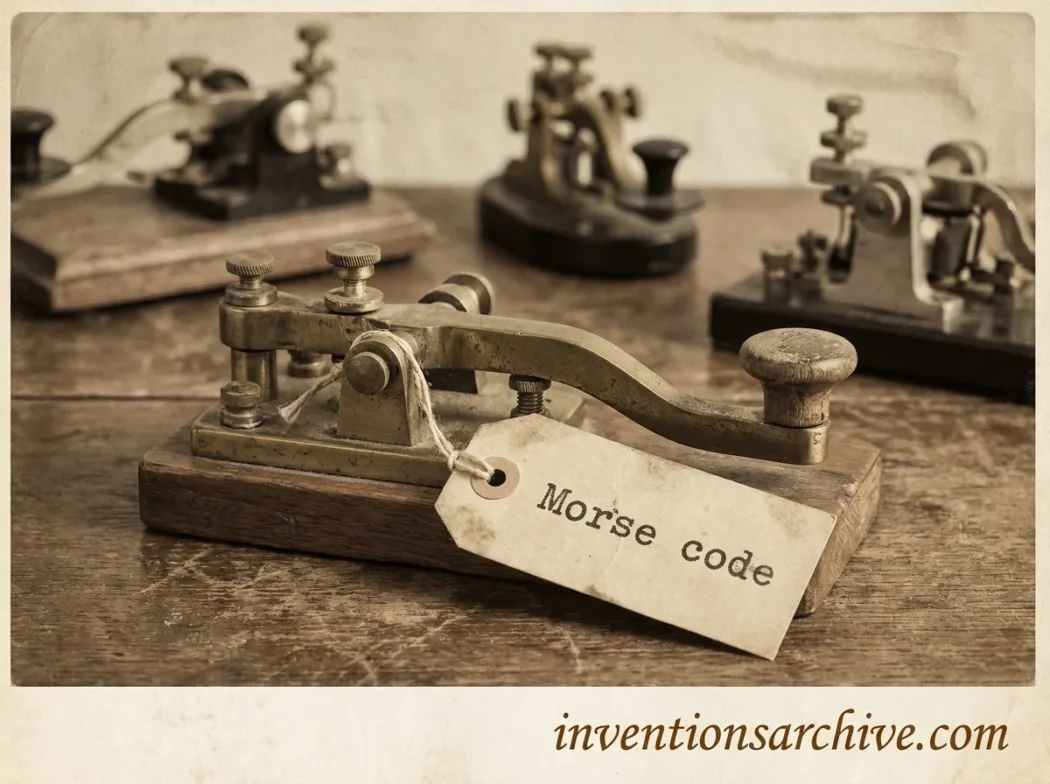
| Invention Name | Morse code |
|---|---|
| Short Definition | A signal code that represents letters, numbers, and signs through short and long signals. |
| Approximate Date / Period | Early versions: ca. 1837 Based on surviving evidence; practical public demonstration: 1844 Confirmed |
| Geography | United States origin; later adapted in Europe for wider international use |
| Inventor / Source Culture | Samuel F. B. Morse and Alfred Vail; attribution varies because the code developed inside a working telegraph partnership |
| Category | Communication; telegraphy; signal encoding |
| Evidence Status | Early code: Based on surviving evidence; 1844 message: Confirmed; exact personal contribution: Attribution varies |
| Main Problem Solved | How to send readable text over an electrical telegraph line using simple on-off signals |
| How It Works | Short signal = dot; longer signal = dash; pauses separate parts of characters, letters, and words |
| Material / Technical Basis | Electrical pulses, telegraph key, wire circuit, electromagnet, register or sounder |
| Early Use | Electric telegraph messages between offices, railroads, newspapers, businesses, and public institutions |
| Development Path | Optical signaling → electric telegraph → American Morse → International Morse → radio and emergency signaling |
| Related Inventions | Electric telegraph, telegraph key, telegraph register, sounder, wireless telegraphy, radio |
| Surviving Evidence | Paper tape message, manuscript records, telegraph instruments, museum objects, institutional collections |
| Modern Descendants | Radio telegraphy, signal lamps, aviation and maritime signaling traditions, assistive input systems, digital text encoding concepts |
| Why It Matters |
|
What Morse Code Is
Morse code is a way of turning written characters into timed signals. A short signal is called a dot. A longer signal is called a dash. The spaces between signals are just as important as the sounds, marks, clicks, or flashes themselves.
The invention was useful because it matched the limits of early electrical communication. A telegraph line could easily send an electrical current on and off. It could not send a handwritten sentence directly. Morse code solved that gap by turning language into a sequence that a simple machine could transmit.
This is why Morse code belongs to the history of both communication and information encoding. It was not only a telegraph habit. It was a practical method for making letters travel through a wire as controlled signals.
How Its Origin Is Traced
The origin of Morse code sits inside the wider development of the electric telegraph. Samuel F. B. Morse worked on a telegraph system in the 1830s, but he did not work alone. Leonard Gale helped with electrical knowledge, and Alfred Vail helped make the system more practical.
The most careful wording is that Morse and Vail developed the early code within the Morse telegraph project. Morse gave the system its public name and legal identity. Vail’s role was important in the working instruments and in the refinement of coded signaling.
The Problem It Answered
Before Morse code, long-distance messages moved by physical transport, optical signaling, or earlier telegraph systems that could be harder to scale. A letter could travel by messenger, ship, rail, or horse. A visual signal could travel faster, but only when weather, distance, towers, and line of sight allowed it.
The electric telegraph created a new possibility: a message could move through a wire. Yet the sender still needed a simple way to turn text into electrical actions. Morse code answered that practical problem with a small set of signals that operators could learn and repeat.
| Before the Invention | What Changed After It |
|---|---|
| Messages often depended on physical transport or visual signaling. | Text could be sent electrically over a telegraph line. |
| Speed was limited by travel time, weather, or visibility. | Short messages could move between telegraph offices in minutes. |
| Earlier systems often needed special equipment, many wires, or line-of-sight stations. | A simple on-off signal could carry letters and numbers through a wire circuit. |
| News, prices, and official messages moved unevenly across distance. | Newspapers, railroads, businesses, and public offices gained faster text communication. |
| Operators needed to interpret marks, flags, arms, or visual positions. | Telegraph operators could read recorded marks and later recognize signals by sound. |
How Morse Code Worked in Simple Terms
Morse code worked because an electrical circuit could be opened and closed. When the operator pressed a telegraph key, current moved through the line. When the operator released the key, the current stopped. That simple action created a timed pattern.
At the receiving end, a telegraph register could record the pattern. Smithsonian’s description of an early telegraph register explains the core mechanism: electrical pulses energized electromagnets, moved a lever arm, and let a pen or stylus mark a moving paper strip. Short pulses made dots, while longer pulses made dashes.[c]
Later, many operators learned to read the clicks by ear. That shift mattered. It moved Morse code from paper reading toward skilled listening, which made telegraph offices faster and more efficient.
Main Technical Principles
- Timing: the length of a signal distinguishes a dot from a dash.
- Spacing: pauses separate parts of a letter, different letters, and words.
- Electrical switching: a key turns the circuit on and off.
- Electromagnetism: current moves a receiver mechanism or sounder.
- Operator skill: trained people send and read the rhythm accurately.
Earlier Ideas and Tools Before Morse Code
Morse code did not appear in an empty field. It followed older methods for sending information at a distance. Some were visual. Some were electrical. None had the same balance of simplicity, distance, and text handling that Morse telegraphy later offered.
Important Predecessors
- Messenger systems: reliable for documents, but limited by travel speed.
- Semaphore and optical telegraphs: faster than messengers, but dependent on visibility and station networks.
- Needle telegraphs: electrical systems that showed signals through moving needles.
- Early electromagnetic experiments: scientific work that made practical electric signaling possible.
The useful step was not only the use of electricity. It was the pairing of electricity with a compact written code that could be sent through very simple signal changes.
The Development Path
The development path of Morse code is best read as a chain, not a single leap. Earlier signaling methods created the need. The electric telegraph gave the channel. Morse code gave that channel a language.
| Stage | Form | What Changed |
|---|---|---|
| Earlier Tool | Messengers, semaphore, optical telegraphy | Information could travel, but speed and reliability depended on people, weather, or visibility. |
| Technical Base | Electric telegraph experiments | Electrical signals made long-distance transmission possible through a circuit. |
| Invention | Early Morse code / American Morse | Letters and numbers were represented by timed dots, dashes, and spaces. |
| Improved Form | International Morse code | The code became better suited for cross-border and multilingual communication. |
| Modern Descendant | Radio telegraphy and signal-based communication | Morse patterns could travel by radio, light, sound, or other simple signal channels. |
Early Use and Public Demonstration
The public story of Morse code is closely tied to the Washington-to-Baltimore telegraph line. In 1844, Morse sent the message commonly remembered as “What hath God wrought?” from the U.S. Capitol to Alfred Vail in Baltimore. The moment matters because it shows the code as part of a working telegraph system, not only as a private experiment.
The telegraph key also shows how the system became practical. A Smithsonian object record for the Morse-Vail Telegraph Key describes it as an improvement on Morse’s original transmitter and states that Alfred Vail helped Morse develop a practical system for sending and receiving coded electrical signals over a wire, successfully demonstrated in 1844.[d]
In daily use, Morse code served clerks, railroads, news services, shipping offices, businesses, and public institutions. It was especially useful where a short, accurate message mattered more than a long document.
Related articles: QWERTY Keyboard Invention: Who Invented QWERTY and Why? [Industrial Age Inventions Series], Typewriter [Industrial Age Inventions Series]
Typical Early Uses
- Sending urgent business messages between cities.
- Sharing newspaper reports and market information.
- Coordinating railroad operations and schedules.
- Transmitting official notices and public messages.
- Linking local telegraph offices into larger communication networks.
Main Types and Variations
People often say “Morse code” as if there were only one form. Historically, that is not exact. The early American system and the later International system are related, but they are not identical.
| Type or Variation | Main Context | Important Difference |
|---|---|---|
| Early Morse Code | Experimental telegraph development in the 1830s | Still changing; known through surviving records rather than one final published form. |
| American Morse | 19th-century North American landline telegraphy | Used dots, dashes, and distinctive spacing patterns; not the same as modern International Morse. |
| International Morse | European and later global telecommunication practice | Better suited to international use and later standardized for radiocommunication. |
| Radio Morse | Wireless telegraphy and amateur radio | Sent as keyed radio signals rather than through a landline telegraph circuit. |
| Visual Morse | Signal lamps and visual signaling | Uses flashes instead of electrical clicks or printed marks. |
| Sound-Based Practice | Telegraph offices and radio operation | Operators read rhythm by ear rather than from a printed strip. |
The National Park Service notes that American Morse continued in the United States into the 20th century, while International Morse was introduced in 1851 for communication within Europe. The same source also explains that American Morse used more complex dash lengths than the simpler pattern most people now associate with International Morse.[e]
How It Spread and Changed Over Time
Morse code spread because telegraph networks spread. Once businesses, railroads, newspapers, and governments had telegraph lines, they needed trained operators and shared practices. A code that could be taught, written, heard, and repeated had clear value.
Its spread was not uniform. American landline telegraphers often kept using American Morse. International systems favored the later form that handled cross-border communication more cleanly. As submarine cables, radio, and global communication grew, standardization became more important.
The modern International Morse standard is maintained through institutional telecommunication practice. ITU Recommendation M.1677-1 confirms International Morse code characters and operational provisions for radiocommunication services, and lists the standard as in force in its official recommendation record.[f]
What Changed Because of Morse Code
Morse code changed the practical meaning of distance. A short written message no longer had to wait for a person, animal, train, ship, or carriage to carry it across the whole route. It could be converted into signals and reconstructed at the receiving end.
The effect was strongest where speed and accuracy mattered. Railroads could coordinate movement. Newspapers could receive reports faster. Businesses could compare prices across cities. Public offices could send urgent notices without waiting for a physical letter.
Fields Affected by Morse Code
- Communication: faster written messages over long distances.
- Transport: better coordination for railroads and shipping-related offices.
- Commerce: quicker movement of market prices, orders, and financial information.
- News: faster reporting between cities and newspapers.
- Science and measurement: time signals, observations, and coordinated records could move more quickly.
- Radio: early wireless telegraphy used Morse before routine voice broadcasting.
Common Misunderstandings
Morse Code Was Not Invented in Its Modern Form
The familiar modern code is mainly International Morse. Early American Morse had different features, including spacing habits and forms that later users would not read the same way.
The Earliest Evidence Is Not the Same as the First Idea
A surviving paper, drawing, or museum object shows what is currently documented. It does not always prove the first private thought, sketch, or trial.
The Name Does Not Remove Vail’s Role
The code carries Morse’s name, but Alfred Vail’s contribution to the practical telegraph system and coded signaling is part of the historical record.
Dots and Dashes Are Only Part of the Code
Spacing is not empty decoration. Without pauses between signals, letters, and words, the code becomes difficult or impossible to read correctly.
Related Inventions
Morse code sits inside a larger family of communication inventions. These related tools and systems help place it in technology history:
- Electric telegraph: the communication system that gave Morse code its first major use.
- Telegraph key: the hand-operated switch used to send timed signals.
- Telegraph register: the receiving instrument that recorded dots and dashes on paper.
- Telegraph sounder: the receiver that helped operators read signals by sound.
- Semaphore telegraph: an earlier visual signaling system that showed the demand for faster long-distance messages.
- Wireless telegraphy: radio signaling that carried Morse code without a physical wire.
- Signal lamp: a visual method that can transmit Morse patterns with light.
- Teletype: a later text communication technology that reduced the need for manual code reading.
Frequently Asked Questions
Who invented Morse code?
Morse code is usually associated with Samuel F. B. Morse, but Alfred Vail played an important role in developing the practical coded telegraph system. A careful answer names both Morse and Vail, while noting that exact attribution varies by source and by which part of the system is being discussed.
When was Morse code invented?
Early versions are traced to the late 1830s, with surviving evidence around 1837. The famous public telegraph demonstration between Washington and Baltimore took place on 24 May 1844.
Is American Morse the same as International Morse?
No. American Morse was the earlier landline telegraph code used widely in North America. International Morse was a later standardized form that became more familiar in radio, maritime, and global communication contexts.
How did Morse code work on a telegraph line?
An operator used a telegraph key to open and close an electrical circuit. The receiving instrument recorded or sounded short and long signals. Those patterns represented letters, numbers, and signs.
Why did Morse code remain useful after the telegraph?
Morse code remained useful because it can be sent through many simple channels: sound, light, radio signals, electrical pulses, or touch-based input. That flexibility helped it survive beyond its original landline telegraph setting.
Sources and Verification
- [a] Invention of the Telegraph — Used to verify the early Morse papers, the Morse-Vail collaboration, the ca. 1837 code evidence, and the shift from paper marks to acoustic reading. (Reliable because it is a Library of Congress collection essay tied to the Samuel F. B. Morse Papers.)
- [b] First telegraphic message—24 May 1844 — Used to verify the surviving paper tape, the date of the historic message, and the Washington-to-Baltimore transmission context. (Reliable because it is a direct Library of Congress item record.)
- [c] Telegraph Register — Used to verify how a telegraph register received Morse code through electrical pulses, electromagnets, a lever arm, and a paper strip. (Reliable because it is an official Smithsonian National Museum of American History object record.)
- [d] Morse-Vail Telegraph Key — Used to verify Alfred Vail’s role in improving Morse’s transmitter and the 1844 practical telegraph demonstration. (Reliable because it is an official Smithsonian National Museum of American History object record.)
- [e] The Transcontinental Telegraph — Used to verify the distinction between American Morse and International Morse, the 1851 introduction of International Morse in Europe, and later telegraph and radio context. (Reliable because it is a U.S. National Park Service educational article.)
- [f] M.1677 : International Morse code — Used to verify the modern ITU Recommendation record for International Morse code and its status as an in-force radiocommunication recommendation. (Reliable because it is an official International Telecommunication Union recommendation page.)