
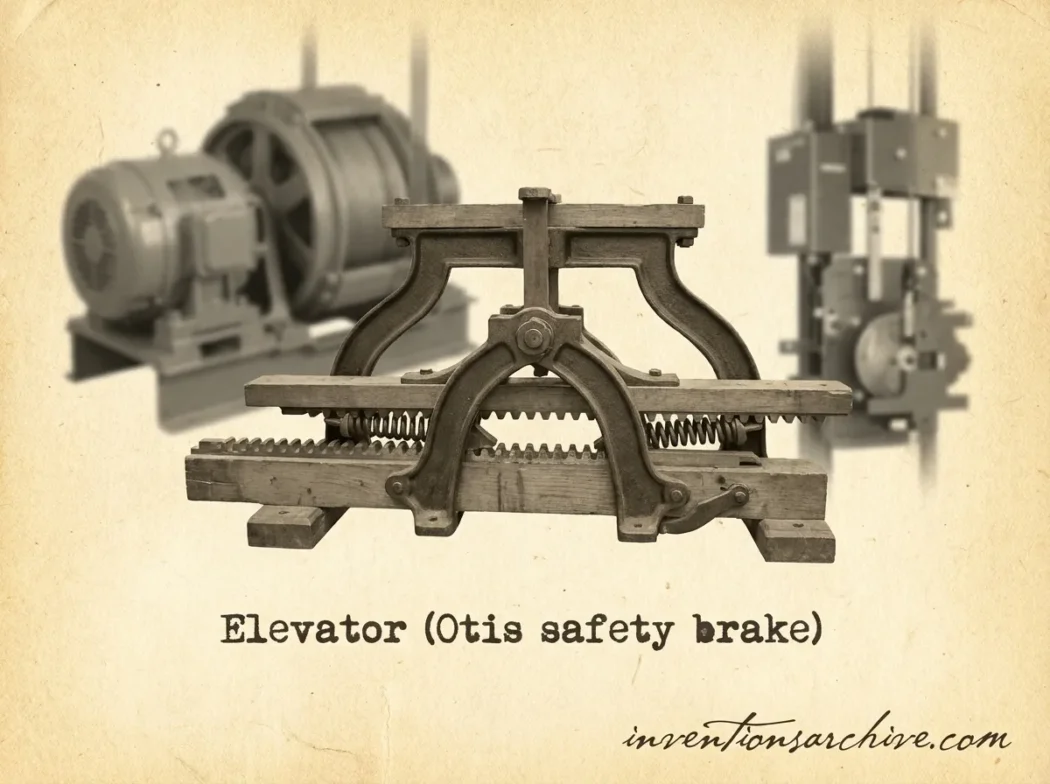
| Invention Name | Otis elevator safety brake |
|---|---|
| Short Definition | A mechanical safety device designed to stop a hoist or elevator platform if the lifting rope failed. |
| Approximate Date / Period | Designed and tested around 1852; first elevator sale in 1853; public demonstration in 1854; U.S. patent issued in 1861 Based on surviving evidence |
| Geography | Yonkers and New York City, New York, United States |
| Inventor / Source Culture | Elisha Graves Otis; built on earlier hoists, ropes, pulleys, brakes, and factory lifting systems |
| Category | Transport, mechanical safety, building technology, industrial machinery |
| Evidence Status | Confirmed for the 1861 patent; Approximate for workshop development before the patent |
| Main Problem Solved | Unsafe lifting platforms that could fall if the hoisting rope or cable broke |
| How It Worked | Loss of rope tension released a spring-linked catch that engaged toothed guide racks and held the platform |
| Material / Technical Basis | Metal racks, pawls, springs, guide rails, lifting rope, pulleys, platform frame |
| First Use Context | Industrial hoists and freight lifting; later passenger elevators |
| Surviving Evidence | 1861 U.S. patent specification and National Archives patent drawing |
| Development Path | Factory hoist → Otis safety hoist → passenger safety elevator → modern elevator safety gear |
| Related Inventions | Hoist, elevator, overspeed governor, traction elevator, hydraulic elevator, elevator safety code |
| Modern Descendants | Elevator safety gear, rail-gripping safeties, governors, automatic braking systems, regulated elevator safety standards |
| Why It Matters | It helped make passenger elevators socially acceptable and technically safer for taller buildings |
The Otis safety brake was not the first elevator, and it was not a whole passenger lift by itself. Its importance lies in a narrower but more powerful idea: a lifted platform should not depend only on an intact rope. Elisha Graves Otis applied that idea to hoists in the early 1850s, then turned it into a public demonstration and a patented elevator safety mechanism. The result helped shift elevators from risky freight devices into trusted vertical transport for people.
What the Otis Safety Brake Was
The Otis safety brake was a fail-safe catch mechanism for a hoist or elevator platform. In normal movement, rope tension kept the safety parts from locking. If the rope lost tension, the spring and pawl arrangement moved into action and caught on toothed guide racks.
This mattered because early hoists were already useful in factories, warehouses, mines, and commercial buildings. The problem was trust. A rope-and-platform lift could carry freight, but people had reason to fear a platform that depended on one rope. Otis’s invention addressed that fear with a visible mechanical answer.
The device did not remove every possible risk from elevators. It made one feared failure mode easier to control: the platform falling after a rope failure. Later elevator safety developed through many additional parts, including governors, guide rails, door interlocks, emergency brakes, inspection rules, and formal safety codes.
How Its Origin Is Traced
Elisha Graves Otis was working in Yonkers, New York, in the early 1850s when a factory conversion required machinery and materials to be lifted to an upper floor. Workers were reluctant to use hoists because broken ropes could send loads crashing downward. ASME’s biography of Otis describes this setting as the practical problem that led him to design and test a safety device for hoists and elevators. [b]
The public story then moved from workshop use to display. In 1854, Otis demonstrated the device at New York’s Crystal Palace Exhibition. The well-known demonstration involved a raised platform and a cut rope. The point was simple and memorable: the platform dropped only a short distance before the safety device stopped it.
The patent record came later. The patent was issued in 1861, near the end of Otis’s life. That gap is important. It means the invention was being used and promoted before the surviving patent became the strongest technical document for the mechanism.
The Problem It Answered
Before the safety brake, lifting platforms were already part of industrial life. They moved goods between floors and helped factories use vertical space. But a basic hoist had a serious weakness: if the lifting rope failed, the platform could fall.
That weakness shaped how people used buildings. Heavy goods could be lifted with caution, but regular passenger use was harder to accept. Upper floors were often less convenient and less desirable because stairs remained the dependable route for people.
| Before the Invention | What Changed After It |
|---|---|
| Hoists relied heavily on rope condition and operator care. | A separate safety mechanism could react if rope tension was lost. |
| Freight lifting was useful but widely viewed as risky. | Safer hoists became easier to sell for factories, stores, and public buildings. |
| Passenger elevators faced a trust barrier. | The safety brake gave passengers and building owners a clear reason to trust vertical travel. |
| Upper floors were less convenient for shoppers and tenants. | Passenger elevators helped make higher floors more accessible in multi-story buildings. |
| Safety depended mainly on avoiding failure. | The design added a response to failure, which became a central idea in elevator safety. |
How It Worked in Simple Terms
The early Otis mechanism used a platform guided between upright members. Along the sides were toothed racks. The moving platform carried pawls, or catch pieces, connected to a spring and linkage. While the lifting rope held tension, the catch pieces stayed out of locking position.
If the rope broke or lost tension, the spring action pushed the pawls into the toothed racks. The platform’s downward motion then forced the pawls to grip rather than slide. In simple terms, the loss of rope tension became the trigger for the brake.
The 1861 patent describes the aim of stopping the load and applying a brake automatically, while also sustaining the load if the lifting rope broke. It also describes racks, pawls, springs, pulleys, a counterpoise, and brake parts as elements of the hoisting apparatus. [c]
Earlier Ideas and the Development Path
Otis’s invention did not appear in isolation. It belonged to a longer line of lifting technology: ropes, pulleys, winches, cranes, mine hoists, warehouse lifts, and factory platforms. What changed was the addition of a mechanical response to rope failure.
| Stage | Form | What Changed |
|---|---|---|
| Earlier Tool | Rope, pulley, winch, and freight hoist | Made vertical lifting useful but depended strongly on rope strength and careful operation. |
| Industrial Need | Factory and warehouse hoists | Created demand for safer movement of goods between floors. |
| Otis Invention | Safety brake with spring-linked pawls and toothed racks | Added a catch mechanism that reacted when rope tension failed. |
| Improved Form | Passenger safety elevator | Helped make vertical movement acceptable for shoppers, tenants, workers, and visitors. |
| Modern Descendant | Elevator safety gear, governor systems, code-regulated braking | Safety became a layered system rather than a single visible device. |
Early Uses and Public Acceptance
The safety brake first answered an industrial problem, but its public meaning was larger. Otis used demonstration as proof. A safety device hidden inside a machine can be hard to trust. A platform that stops after its rope is cut is much easier for a crowd to understand.
The first widely credited commercial passenger installation came at the E. V. Haughwout & Co. Store in New York. Historic American Buildings Survey documentation states that notes from Otis ledgers and notebooks indicate the elevator was shipped on March 23, 1857, and installation was completed on April 6, 1857. The same record says the building is generally credited as the first commercial building in the United States with a passenger elevator equipped with safety devices. [d]
This installation is often treated as a turning point because it moved the safety elevator from demonstration and industrial usefulness into public commercial space. A department store was not just a place to lift goods. It was a place where customers had to feel safe entering a moving platform.
Main Types and Later Versions
The Otis safety brake belongs to a wider family of elevator safety and lifting systems. Some are direct descendants. Others solved nearby problems, such as speed control, ride comfort, power source, or safe operation in taller buildings.
| Type or Version | Main Form | What Changed |
|---|---|---|
| Safety Hoist | Industrial platform with catch mechanism | Focused on freight and machinery movement in factories or workshops. |
| Passenger Safety Elevator | Enclosed or semi-enclosed lift for people | Applied the safety idea to public movement inside buildings. |
| Hydraulic Elevator | Water or fluid-powered lifting system | Improved lifting force and speed for certain building types. |
| Traction Elevator | Rope-and-sheave system with counterweight | Became central to taller building elevator design. |
| Governor-Linked Safety Gear | Speed-sensing safety system | Responded not only to rope failure but also to unsafe overspeed conditions. |
| Code-Regulated Elevator System | Integrated design, inspection, testing, and maintenance rules | Turned elevator safety into a regulated engineering practice. |
How the Invention Spread and Changed
Otis’s early success came through a mix of engineering, public proof, and commercial timing. The company history records the first sale in 1853, the Crystal Palace demonstration in 1854, and the first passenger elevator in the E. V. Haughwout Building in 1857. It also places later developments in a wider elevator timeline, including hydraulic systems, installations in major public buildings, and international projects. [e]
The invention spread because it answered several needs at once:
- Factory owners needed safer movement of goods and machinery.
- Store owners wanted customers to reach upper floors without long stair climbs.
- Architects and builders gained more confidence in taller, more useful buildings.
- Passengers needed a simple reason to believe the machine would not fall.
Later elevators changed in power source, speed, cab design, controls, and safety logic. The early brake was only one part of that story, but it gave the elevator industry a principle that never disappeared: safe vertical transport needs a backup response when normal lifting fails.
What Changed Because of It
The safety brake changed the elevator’s public role. A hoist could already lift. The Otis device helped a lift become something people would ride. That difference affected building use, retail design, office access, hotel circulation, and the later economics of upper floors.
The change was not instant. Early elevators still needed better power systems, better controls, stronger materials, and clearer inspection practices. But the safety brake made elevator adoption easier because it addressed the fear that stopped many people from trusting vertical travel.
From Invention to Safety Codes
The Otis brake is part of the older story of elevator safety, but modern elevator safety depends on formal standards, inspection rules, and many interacting components. ASME notes that public fear of elevators remained an issue as buildings grew taller, and that elevator safety codes later became a major part of organized engineering safety work. [f]
Today, elevator safety is not judged by one famous device. It is shaped by design requirements, construction rules, testing, inspection, maintenance, alteration, and repair practices. ASME’s A17.1/CSA B44 handbook describes the safety code as covering elevators, escalators, dumbwaiters, moving walks, and material lifts, with requirements across those areas. [g]
Common Misunderstandings
Otis Did Not Invent the Elevator Itself
Elevators, hoists, and lifting platforms existed before Otis. His famous contribution was the safety brake that helped make elevator travel safer and more acceptable for passengers.
The Patent Date Is Not the Same as the First Use
The patent was issued in 1861, but Otis had already sold and demonstrated safety elevators earlier. The patent is the strongest surviving technical record, not the beginning of the whole story.
The Famous Demonstration Was a Trust Event
The Crystal Palace demonstration did not invent the device on the spot. It made the safety idea visible. That public proof helped turn a mechanical feature into a commercial advantage.
Modern Elevators Use More Than One Safety Layer
The Otis brake was an early safety mechanism. Modern elevator safety uses multiple systems, standards, inspections, and maintenance practices rather than relying on a single catch device.
Related Inventions
These related inventions and systems help place the Otis safety brake inside the wider history of vertical transport and building technology:
- Hoist: The older lifting machine that created the need for safer vertical movement.
- Passenger elevator: The public-facing application that benefited most from safer lifting.
- Overspeed governor: A later safety system that detects excessive elevator speed.
- Hydraulic elevator: A later elevator type that used fluid pressure for lifting.
- Traction elevator: A rope-and-sheave elevator type linked to taller building service.
- Elevator safety code: The formal rule system that turned elevator safety into regulated practice.
Frequently Asked Questions
Did Elisha Otis invent the elevator?
Elisha Otis did not invent the elevator as a general lifting machine. Elevators and hoists existed before him. His important contribution was the safety brake that helped prevent a platform from falling if the lifting rope failed.
When was the Otis safety brake invented?
The working safety device is usually traced to the early 1850s, with a first elevator sale in 1853 and a public demonstration in 1854. The strongest surviving technical record is the U.S. patent issued in 1861.
How did the Otis safety brake work?
In simple terms, rope tension kept the safety catch inactive during normal lifting. If the rope broke or lost tension, spring-linked pawls moved into toothed racks beside the platform and stopped the fall.
Why was the Otis safety brake important?
It made elevator travel easier to trust. By addressing the danger of a falling platform after rope failure, the safety brake helped passenger elevators become practical in stores, public buildings, offices, and later taller buildings.
Is the Otis safety brake still used today?
Modern elevators do not rely on the exact early Otis mechanism as a standalone device. The same safety idea continues through safety gear, guide-rail systems, governors, automatic brakes, inspections, and elevator safety codes.
Sources and Verification
- [a] Elisha Otis’s Elevator Patent Drawing, 01/15/1861 — Used to verify the surviving patent drawing and archival evidence for the 1861 elevator patent. (Reliable because it is an official U.S. National Archives collection record.)
- [b] Elisha Graves Otis – ASME — Used to verify the Yonkers workshop context, the unsafe hoist problem, the spring-and-rack safety principle, and the 1854 public demonstration. (Reliable because it is published by the American Society of Mechanical Engineers.)
- [c] US31128A – Improvement in hoisting apparatus — Used to verify the patent date, inventor name, and technical description of the hoisting apparatus safety mechanism. (Reliable because it reproduces the U.S. patent specification and patent metadata.)
- [d] E. V. Haughwout & Co. Store, HABS No. NY-5459 — Used to verify the 1857 shipment and installation dates and the building’s credited role as an early U.S. commercial passenger elevator site with safety devices. (Reliable because it is a Historic American Buildings Survey record hosted by the Library of Congress.)
- [e] Otis History | Elevator history timeline — Used to verify the company timeline for the 1853 first sale, 1854 Crystal Palace demonstration, 1857 passenger elevator installation, and later elevator developments. (Reliable because it is the official history timeline of Otis Elevator Company.)
- [f] Heavy Lifting: The History of the Elevator Code – ASME — Used to verify the later safety-code context and the public concern about elevator safety as buildings became taller. (Reliable because it is published by ASME, a major engineering standards organization.)
- [g] Handbook on Safety Code for Elevators and Escalators | 2022 – ASME — Used to verify the modern scope of elevator and escalator safety-code coverage. (Reliable because it is an ASME codes and standards publication page.)