
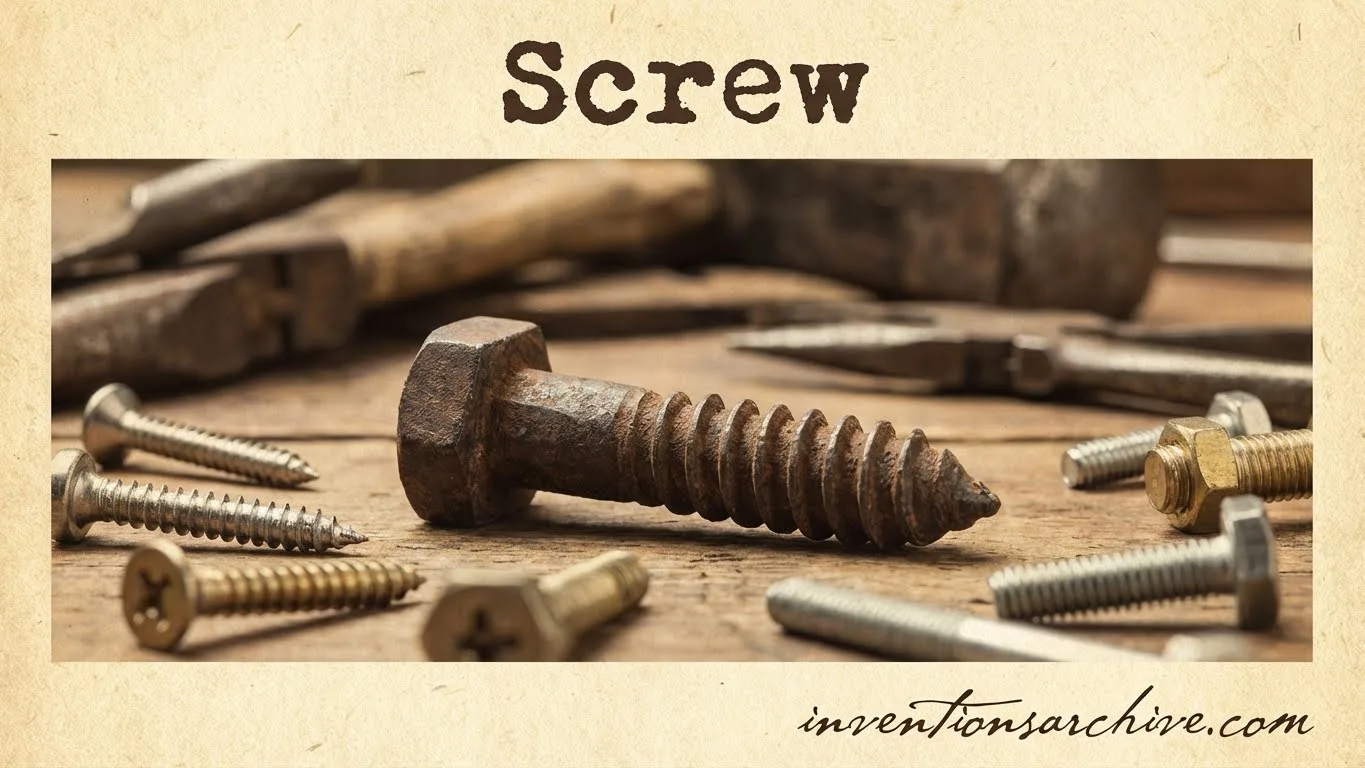
| Invention Name | Screw |
|---|---|
| Short Definition | A helical form used to fasten, lift, press, move, or measure by turning. |
| Approximate Date or Period | Water screw: 3rd century BCE tradition; screw press: 1st–2nd century BCE; metal fasteners much later Approximate [a] |
| Geography | Hellenistic Mediterranean, Egypt, Greek and Roman engineering worlds Based on surviving evidence |
| Inventor or Source Culture | Anonymous and collective; water screw traditionally linked with Archimedes Attribution varies |
| Category | Manufacturing, measurement, agriculture, water management, mechanical engineering |
| Main Problem Solved | Turning motion into controlled force or linear movement |
| How It Works | A helix around a cylinder acts like an inclined plane wrapped in a spiral. |
| Material or Technical Basis | Wood, bronze, iron, steel, later alloy steels and standardized thread forms |
| Early Uses | Water lifting, pressing oil or wine, clamping, later fastening and precision machinery |
| Evidence Status | Early water screw evidence is partly textual and debated; later machines and patents are documented Mixed evidence |
| Surviving Evidence | Ancient texts, archaeological interpretation, museum machine tools, patent records, thread standards |
| Development Path | Inclined plane → helical screw → screw press and water screw → threaded fastener → precision screw thread |
| Related Inventions | Inclined plane, lever, press, Archimedes screw, lathe, nut and bolt, screwdriver |
| Modern Descendants | Machine screws, wood screws, lead screws, micrometers, screw pumps, threaded standards |
| Why It Matters | It made repeatable holding, controlled motion, lifting, pressing, and precision adjustment possible. |
A screw looks simple because its visible form is familiar: a spiral ridge, a slot or recess, and a turning action. Its history is not that simple. The screw is both a simple machine and a family of tools. It can fasten two pieces of wood, lift water, press olives, guide a machine tool, move a measuring instrument by tiny amounts, or hold a metal assembly under tension.
What the Screw Is
A screw is a device built around a helix. In mechanical terms, it can be understood as an inclined plane wrapped around a cylinder. When the screw turns, the spiral surface changes rotary motion into forward movement, lifting force, clamping force, or measured adjustment. Britannica describes the screw in this mechanical family when explaining simple machines and the wedge-like action of a screw form. [b]
This is why the same idea appears in several different forms:
- A screw fastener pulls materials together as it turns into wood, metal, or another receiving material.
- A screw press uses rotation to push a plate downward with strong controlled pressure.
- An Archimedes screw lifts water or loose material along a rotating helix.
- A lead screw moves a machine part along a straight path with measured control.
- A micrometer screw turns small rotations into very fine measurement changes.
The screw’s importance comes from this shared principle. A person or machine can apply modest turning force and receive a controlled result. The result may be pressure, movement, alignment, fastening, or measurement.
How Its Origin Is Traced
The origin of the screw is traced through textual evidence, surviving mechanical descriptions, archaeological interpretation, museum objects, machine-tool history, and patents. The early story belongs more to engineering practice than to named inventors.
The Water Screw and Archimedes
The best-known early form is the Archimedes screw, a water-lifting device that uses a helix inside a pipe or trough. Its purpose was practical: raise water from a lower level to a higher level. Britannica describes it as a machine for raising water, traditionally or allegedly linked with Archimedes, with rotation causing water to rise inside the inclined structure.
That wording matters. “Traditionally linked” is not the same as proven first invention. Ancient technologies often moved through workshops, farms, mines, ships, and irrigation systems before writers named them. The oldest written references may record a known device rather than the first moment it was created.
The Screw Press
A second early branch was the screw press. In Mediterranean and Roman settings, screw-driven presses helped apply pressure to agricultural products such as olives and grapes. This form did not act like a modern fastener. It used the screw’s ability to create steady pressure.
This is one reason the screw became valuable in production. It could press with more control than weight alone, and it could hold pressure while work continued.
The Threaded Fastener Came Later
The screw that many readers imagine first—a pointed metal fastener driven with a screwdriver—belongs to a later stage. Early metal screws were difficult to make because each thread had to match a receiving thread or cut reliably into material. Before accurate screw-cutting tools, many screw threads were shaped by hand and were not easily interchangeable.
The Problem It Answered
Before screws were common, people relied on simpler methods of joining, lifting, pressing, and holding. They used pegs, wedges, lashings, nails, clamps, weights, levers, and hand pressure. These methods worked, but they had limits.
| Before the Screw | What Changed After It |
|---|---|
| Pegs, lashings, and wedges could hold parts, but adjustment was limited. | Threaded forms allowed tighter, more controlled fastening and later easier removal. |
| Pressing depended on weights, levers, or repeated manual force. | Screw presses created steady pressure through controlled turning. |
| Water lifting relied on buckets, shadoofs, wheels, or repeated manual movement. | The water screw moved water continuously along a helical path. |
| Machine movement was hard to repeat precisely. | Lead screws helped turn rotation into measured straight-line motion. |
| Workshop parts often had to be fitted individually. | Standardized screw threads later supported interchangeability and repair. |
The change was practical, not dramatic. The screw made certain jobs slower to start but more controlled once in motion. It turned repeated force into predictable movement.
How It Worked in Simple Terms
The screw’s working principle is easy to see if the thread is imagined as a ramp. A straight ramp lets a load move upward over distance. A screw wraps that ramp around a cylinder. Turning the cylinder moves the ramped surface through the material or against another thread.
Rotation Becomes Linear Motion
When a screw turns, the thread advances along its axis. In a fastener, the screw moves into material or pulls two parts together. In a press, the rotating screw pushes a plate downward. In a lathe or measuring tool, a screw moves a carriage or spindle forward by a set amount.
Pitch, Lead, and Thread Form
The screw depends on a few terms:
- Thread: the raised helical ridge.
- Pitch: the distance from one thread crest to the next.
- Lead: how far the screw advances in one full turn.
- Thread angle: the angle formed by the sides of the thread.
- Major and minor diameter: the outside and inside thread diameters.
These details explain why screws can be strong, fine, coarse, slow, fast, self-tapping, removable, or highly precise. A wood screw and a micrometer screw both use a helix, but they are designed for very different jobs.
Earlier Ideas and Tools Before the Screw
The screw did not appear from nowhere. It grew from older mechanical ideas that were already known in practical work.
- Inclined plane: a sloped surface that reduces the force needed to lift or move a load.
- Wedge: a shaped tool that concentrates force for splitting or tightening.
- Lever: a bar used to multiply force around a pivot.
- Pressing stones and weights: older ways to apply pressure in food production and craft work.
- Rotary tools: drills, wheels, and turning devices that made rotation useful in craft.
The screw’s distinct step was joining rotation with a continuous spiral. That made movement repeatable. Each turn could produce a known advance, a known pressure change, or a known adjustment.
Development Path
| Stage | Form | What Changed |
|---|---|---|
| Earlier Tool | Inclined plane, wedge, lever, pressing weight | Force could be redirected or multiplied, but control was limited. |
| Early Screw Principle | Helical form used for water lifting or pressing | Rotation created continuous movement or pressure. |
| Workshop Form | Wooden screws, screw presses, clamps | Craft and agricultural work gained steadier pressure and holding force. |
| Metal Fastener | Handmade metal screws and matching internal threads | Joining became more removable and adjustable than many nails or rivets. |
| Precision Form | Screw-cutting lathe and lead screw | Threads could be made more accurately and repeated across parts. |
| Modern Descendant | Standardized metric and inch threads | Parts made in different places could fit common specifications. |
Main Materials and Technical Principles
The screw changed as materials and tools changed. A wooden screw for a press had different needs from a steel machine screw. A water screw had to resist moisture and carry fluid; a precision screw had to keep shape under repeated movement.
Wood
Wood was suitable for early large screws in presses and some water-lifting devices. It could be shaped by hand, repaired in workshops, and used at sizes where fine precision was not required.
Bronze and Iron
Bronze and iron allowed stronger parts, though early metal threading was slow and costly. Metal screws became more useful when tools could cut threads more accurately.
Steel and Alloy Steel
Steel made smaller, stronger, repeatable fasteners practical. In modern manufacturing, the choice of steel, coating, thread form, head type, and drive recess depends on the job. A screw used in furniture does not need the same properties as one used in machinery.
The Thread as a Technical Surface
The thread is not just decoration. Its shape controls grip, friction, load distribution, and compatibility. The later history of the screw is therefore also a history of measurement, gauging, and standardized geometry.
Early Uses in Work and Daily Life
The screw entered daily life through work rather than display. It helped people move water, press food products, clamp materials, and later assemble objects with parts that could be removed or replaced.
Water Management
The Archimedes screw and related water screws could lift water from a lower level to a higher one. That made the principle useful in irrigation, drainage, and ship-related pumping contexts. The device did not need to lift water very high in one step; its value was steady movement along an inclined helix.
Agriculture and Food Production
Screw presses helped produce pressure for olives, grapes, and other materials. Compared with simple weights, a screw press could be adjusted more gradually and held under pressure.
Craft and Workshop Holding
Woodworkers, metalworkers, and printers later used screw clamps and presses. The screw gave them a way to hold work firmly while still being able to release it without destroying the joined pieces.
Mechanical Measurement
Once screws became precise, they became measuring tools. Fine-thread screws made it possible to move parts by very small amounts. This helped lathes, micrometers, scientific instruments, and machine tools.
Related articles: Crank Handle [Medieval Inventions Series], Spring Scissors [Ancient Inventions Series]
How the Screw Changed Over Time
The screw changed most when workshops learned to make threads repeatably. That shift moved the screw from a useful mechanical idea to a foundation of machine production.
Henry Maudslay’s screw-cutting lathe, made around 1800, is a major surviving museum example. The Science Museum Group describes it as the machine Maudslay used to pioneer highly accurate screw-thread manufacture; before that work, screw threads were often made crudely by hand. [d]
This matters because a threaded fastener is only as useful as its fit. If every screw and nut must be custom matched, repair and mass production are slow. If threads are cut accurately and shared by standard, parts can be replaced.
From Workshop Skill to Standard Threads
Joseph Whitworth helped turn screw threads into a standard engineering language. The Powerhouse Collection notes that Whitworth compared screws from workshops across England and in 1841 proposed a constant 55-degree thread angle with thread counts for different diameters. [e]
Later standards did not make older screws disappear. They gave factories, railways, ships, machines, instruments, and repair shops a more common set of expectations. In a machine age, the screw became a shared measurement system as much as a fastener.
Modern Metric Profiles
Modern screw threads are governed by formal standards. ISO 68-1, for example, specifies the basic and design profiles for ISO general purpose metric screw threads. [f] That kind of standard does not tell the whole history of the screw, but it shows how far the invention moved from hand-shaped threads to exact geometry.
Main Types and Variations
| Type or Variation | Main Use | What Makes It Different |
|---|---|---|
| Water Screw | Lifting water or loose material | Uses a large helix inside a pipe or trough. |
| Screw Press | Applying pressure | Turns rotation into a strong downward or inward force. |
| Wood Screw | Joining wood | Often has coarse threads designed to grip fibrous material. |
| Machine Screw | Joining metal parts | Uses standardized threads and often fits a tapped hole or nut. |
| Self-Tapping Screw | Cutting or forming its own receiving thread | Designed for certain materials where a pre-cut internal thread may not be needed. |
| Lead Screw | Moving machine parts | Controls straight-line movement in lathes, vises, presses, and instruments. |
| Set Screw | Holding one part against another | Often used without a traditional head to secure collars, pulleys, or knobs. |
| Cross-Recess Screw | Mass assembly and guided driving | A shaped recess helps the driver center more easily than a plain slot. |
Drive types also became a large branch of screw history. Slotted, square, hex socket, cross-recess, Pozidriv, Torx, and other forms all answer a practical question: how should a tool transfer turning force into the screw head?
One important 20th-century step was the patented cross-recess screw. John P. Thompson’s 1933 U.S. patent described a screw with a punched, winged tool-receiving aperture that could be made by automatic machinery and driven with a matching tool. [g]
What Changed Because of the Screw
The screw affected more than furniture and hardware. It shaped how people built machines, measured small distances, moved water, controlled pressure, and repaired objects.
Fastening Became Adjustable
Nails, rivets, and pegs can hold well, but they often damage parts during removal. Screws made many joined objects easier to open, tighten, adjust, and repair. This mattered for furniture, tools, instruments, vehicles, and machines.
Pressure Became More Controlled
Screw presses gave workshops and food producers a way to apply pressure with control. Printing presses, bookbinding presses, wine and oil presses, and clamps all used this advantage in different ways.
Motion Became Measurable
The lead screw was central to precision machines. A small turn could move a tool or measuring point by a known distance. This made the screw part of the story of precision engineering, not only fastening.
Repair Became Easier to Organize
Standardized screw threads helped repair culture. A machine could be serviced with replacement fasteners rather than fully custom parts. This affected factories, railways, ships, household tools, scientific instruments, and later consumer products.
Common Misunderstandings
The Screw Was Not First a Modern Metal Fastener
The early screw story is mainly about the screw principle in water lifting and pressing. Small metal screws for assembly became important much later, especially after better tools could cut repeatable threads.
Archimedes Is Not a Simple Final Answer
Archimedes is strongly associated with the water screw in tradition, but the attribution is not the same as direct proof of first invention. The device belongs to a wider setting of Hellenistic and Near Eastern water technology.
A Screw Is More Than a Fastener
The screw is also a pump, press, clamp, measuring device, and motion-control element. Treating it only as hardware misses much of its technical history.
Standard Threads Were a Later Achievement
Early screws did not automatically fit parts made in another workshop. Interchangeability depended on accurate tools, gauges, and agreed thread standards.
Related Inventions
The screw sits between several older and later inventions. These related technologies help place it within a wider history of practical mechanics:
- Inclined Plane: the basic mechanical idea behind the helical thread.
- Wedge: a close simple-machine relative that redirects force through a sloped surface.
- Archimedes Screw: a water-lifting form of the screw principle.
- Screw Press: a pressure device used in agriculture, printing, binding, and workshops.
- Lathe: a machine tool that became vital for cutting accurate screw threads.
- Nut and Bolt: a paired fastening system based on matching internal and external threads.
- Screwdriver: the driving tool that developed alongside screw head shapes.
- Micrometer: a precision measuring tool that depends on fine screw movement.
Frequently Asked Questions
Who invented the screw?
The screw is best understood as a collective invention with several early forms. Archimedes is traditionally linked with the water screw, but the wider screw principle developed through ancient engineering practice and later workshop improvements.
Was the first screw the same as a modern screw fastener?
No. Early screw forms were mainly used for lifting water, pressing, and applying controlled force. The modern metal screw fastener became more important after better metalworking, screw-cutting tools, and thread standards developed.
Why is the screw called a simple machine?
A screw is called a simple machine because it uses a basic mechanical principle: a helical inclined plane. Turning the screw changes rotary motion into controlled linear movement or pressure.
What made modern screws more useful than early handmade screws?
Modern screws became more useful because threads could be cut accurately, measured, and standardized. This allowed screws and nuts made in different places to fit more reliably.
What are the main uses of the screw principle?
The screw principle is used for fastening, lifting water, pressing, clamping, guiding machine movement, and measuring small distances. Its value comes from controlled movement and force through rotation.
Sources and Verification
- [a] Archimedes screw | Water Pump, Irrigation & Hydraulics | Britannica — Used to verify the traditional Archimedes attribution, water-lifting function, and basic form of the Archimedes screw. (Reliable because it is an edited institutional reference source.)
- [b] Simple machine | Definition, Types, Examples, List, & Facts | Britannica — Used to verify the screw as a simple machine related to an inclined plane or wedge form. (Reliable because it is an edited institutional reference source.)
- [c] Sennacherib, Archimedes, and the Water Screw: The Context of Invention in the Ancient World on JSTOR — Used to verify that the water screw’s origin and attribution are historically debated. (Reliable because it is an academic journal article indexed by JSTOR.)
- [d] Henry Maudslay’s original screw-cutting lathe, c.1800 | Science Museum Group Collection — Used to verify Maudslay’s role in accurate screw-thread manufacture and the surviving machine-tool evidence. (Reliable because it is an official museum collection record.)
- [e] Lathe made by Joseph Whitworth | Powerhouse Collection — Used to verify Whitworth’s 1841 thread standard proposal and its role in screw-thread standardization. (Reliable because it is an official museum collection record.)
- [f] ISO 68-1:2023(en), ISO general purpose screw threads — Used to verify the modern ISO metric screw-thread profile standard. (Reliable because it is an official standards organization page.)
- [g] US1908080A – Screw – Google Patents — Used to verify John P. Thompson’s patented cross-recess screw design and its machine-production purpose. (Reliable because it is a patent record database reproducing the patent text.)