
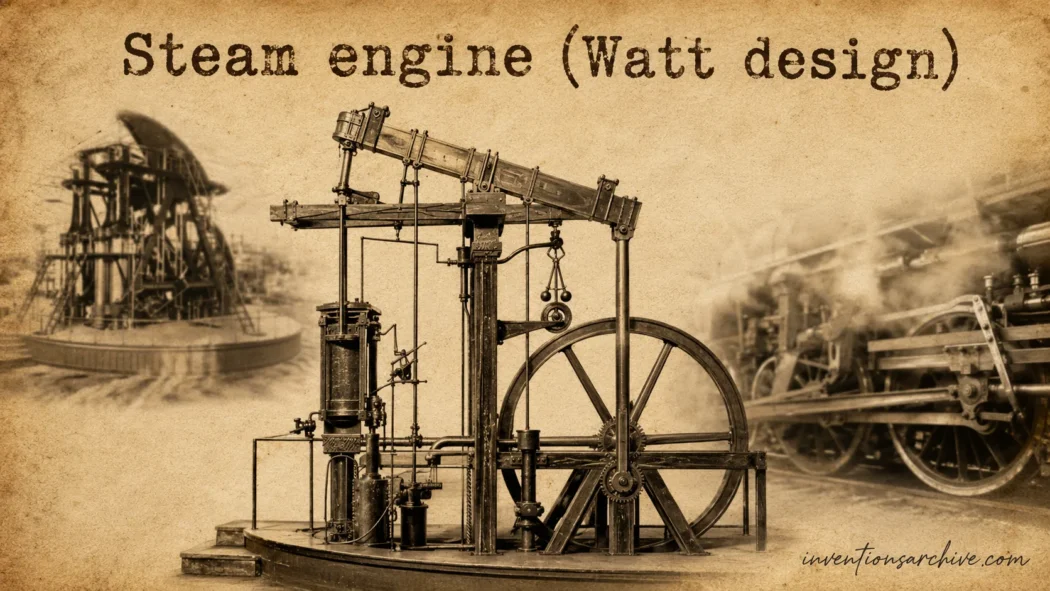
| Invention Name | Watt steam engine, especially the separate-condenser and later rotative designs |
|---|---|
| Short Definition | A more fuel-efficient steam engine design that kept the working cylinder hot while condensing steam in a separate chamber. |
| Approximate Date / Period | Concept developed in 1765; patent dated 1769 Confirmed |
| Geography | Glasgow, Scotland; later developed commercially in Birmingham, England |
| Inventor / Developer | James Watt, with later commercial development through Matthew Boulton and Boulton & Watt |
| Category | Energy; manufacturing; mechanical power; industrial technology |
| Evidence Status | Patent specification, surviving models, museum engines, institutional records Based on surviving evidence |
| Main Problem Solved | High fuel waste caused by repeatedly heating and cooling the cylinder in earlier atmospheric engines |
| How It Worked | Steam acted in a cylinder; condensation happened separately, helping preserve heat in the main working cylinder |
| Technical Base | Steam pressure, condensation, vacuum, piston motion, beam motion, rotary conversion |
| Earlier Forms | Savery pump; Newcomen atmospheric engine; experimental steam devices |
| Main Variations | Separate-condenser engine; double-acting engine; rotative beam engine; engines using sun-and-planet gear |
| Early Uses | Mine pumping, water pumping, mills, breweries, workshops, metal polishing, factory machinery |
| Development Path | Newcomen atmospheric engine → Watt separate condenser → Boulton & Watt rotative engines → factory power and later steam systems |
| Related Inventions | Newcomen engine; steam condenser; beam engine; flyball governor; locomotive; steamship |
| Modern Descendants | Steam turbines, thermal power plants, mechanical control systems, industrial power engineering |
| Why It Matters | It made steam power more economical and helped move mechanical power beyond mine drainage into regular industrial work. |
The Watt steam engine was not the first steam engine. Its importance lies in a more specific achievement: it made steam power more practical by reducing wasted heat. James Watt’s central idea was simple in principle but powerful in effect. Instead of cooling the working cylinder during every stroke, the engine sent steam to a separate condenser, so the cylinder could stay hot while condensation happened elsewhere.
This change mattered because early engines already proved that steam and atmospheric pressure could move heavy machinery. The problem was cost. An engine that consumed too much fuel could pump water from a mine, but it was harder to justify for broader manufacturing work. Watt’s design helped steam power become a more flexible source of industrial mechanical power.
What the Watt Steam Engine Was
The Watt steam engine was a family of improved steam-engine designs associated with James Watt and later with the firm Boulton & Watt. The best-known feature was the separate condenser. Later forms also used arrangements such as double action, parallel motion, sun-and-planet gear, rotary output, and governing devices.
The phrase “Watt design” should therefore be read carefully. It does not mean one single finished machine that appeared all at once. It refers to a line of improvements that began with Watt’s answer to a wasteful flaw in the Newcomen engine and then grew into engines suited to mines, mills, breweries, workshops, and factories.
How Its Origin Is Traced
Watt’s route into steam power passed through the University of Glasgow. He worked there as a mathematical instrument maker and encountered a model Newcomen engine used for teaching and demonstration. University records describe how his work on that model led him to think about the heat wasted when the cylinder was repeatedly cooled and reheated. [c]
The first secure point is not a dramatic single moment, but a chain of evidence: the Glasgow model context, Watt’s experimental work, the 1765 separate-condenser model, the 1769 patent specification, and later engines built through commercial partnership. That evidence supports Watt’s role as a major improver of the steam engine, not as the first person ever to use steam for mechanical work.
The Problem It Answered
The earlier Newcomen engine solved a real industrial problem: mine flooding. It used steam and atmospheric pressure to move a piston and operate pumps. The Science Museum’s record of the Newcomen atmospheric engine explains how steam was condensed inside the cylinder, creating a partial vacuum, after which atmospheric pressure drove the piston down. [d]
That arrangement worked, but it wasted heat. The same cylinder had to be hot enough to admit steam and cold enough to condense it. Every cycle fought against the last one. Watt’s improvement separated those jobs. The cylinder could remain hot; the condenser could remain cold.
| Before the Watt Design | What Changed After It |
|---|---|
| The Newcomen cylinder was cooled during condensation. | The main cylinder could stay hot while steam condensed in a separate vessel. |
| Fuel use was high, especially where coal was costly. | Steam power became more economical in more locations and trades. |
| Early steam engines were mostly tied to pumping work. | Rotative versions helped drive shafts, mills, and factory machinery. |
| Motion was mainly up-and-down beam action for pumps. | Later Watt engines could turn a flywheel and power rotating machinery. |
| Steam power was useful but limited by waste and cost. | Steam became a more practical source of regular industrial power. |
How It Worked in Simple Terms
A Watt engine used steam to move a piston, but its main advance was thermal discipline. The cylinder needed heat. The condenser needed cold. Watt’s design kept those two zones apart.
A surviving Science Museum model of Watt’s second separate condenser, dated 1765, describes the problem clearly: early Newcomen engines wasted fuel because the working cycle repeatedly heated and cooled the cylinder. The separate condenser allowed steam to condense in another chamber while the cylinder stayed hot. [b]
Main Working Ideas
- Separate condensation: steam was condensed away from the main cylinder.
- Heat conservation: keeping the cylinder hot reduced waste.
- Piston and beam motion: pressure differences moved a piston connected to a beam.
- Rotary conversion: later designs turned reciprocating motion into rotation for machinery.
- Control and regularity: later improvements helped engines work more steadily under industrial loads.
Earlier Ideas and Tools Before It
The Watt design grew from older steam experiments and early practical engines. Steam had been explored as a source of motion long before Watt, but the practical industrial line ran most directly through pumping engines.
Thomas Savery’s pump, Newcomen’s atmospheric engine, piston-and-cylinder mechanisms, cast-metal cylinders, valves, beams, pumps, and workshop instrument-making all formed part of the background. Watt’s contribution was not a detached miracle. It was an answer to a known weakness in an existing machine.
Development Path From Earlier Engines to Later Forms
| Stage | Form | What Changed |
|---|---|---|
| Earlier Idea | Experimental steam devices and pressure-vacuum concepts | Steam was known as a force, but not yet a broad industrial power source. |
| Earlier Tool | Savery pump and Newcomen atmospheric engine | Steam power became useful for pumping water, especially in mines. |
| Watt Improvement | Separate condenser | The working cylinder could remain hot, reducing wasted fuel. |
| Improved Form | Double-acting and rotative Watt engines | Engines became better suited to turning shafts and driving machinery. |
| Modern Descendant | Steam turbines and thermal power systems | Steam became part of large-scale power engineering rather than only beam-engine machinery. |
Main Materials, Mechanism, and Technical Principle
Early Watt engines belonged to a world of iron, brass, copper, timber beams, leather or other seals, valves, pumps, and carefully made cylinders. Their value did not come from one exotic material. It came from arranging familiar parts around a better thermal idea.
The main principle was the separation of functions: keep the cylinder hot, keep the condenser cool, and use the pressure difference created by steam and condensation to move the piston. Later industrial forms added mechanisms that made the engine more useful for rotary work.
Early Uses
The first broad use of improved steam engines was still close to the older problem of water pumping. Mines needed drainage. Waterworks needed power. Industrial sites needed motion that did not depend only on wind, water, animals, or human labor.
As the design developed, it became more valuable in settings where steady rotary motion mattered. Mills, breweries, workshops, and metalworking sites could use an engine to drive shafts, wheels, and machines. The 1788 Boulton and Watt rotative beam engine preserved by the Science Museum was used at Matthew Boulton’s Soho Manufactory to drive metal polishing machines for decades. [g]
How the Design Spread and Changed
Watt’s design spread through business as much as through invention. Matthew Boulton helped turn Watt’s engineering improvement into a commercial engine-making enterprise. This matters because useful inventions often need financing, workshops, metalworking skill, customers, maintenance knowledge, and trust.
A Science Museum record for a Boulton and Watt condensing-engine model states that by 1800, when the Boulton and Watt partnership ended, 451 engines had been built, including 268 rotative engines. That figure helps show the move from an improved pumping engine toward wider industrial power. [f]
Main Types and Variations
| Type or Variation | Main Feature | Typical Importance |
|---|---|---|
| Separate-Condenser Engine | Condensation moved away from the main cylinder | Reduced heat waste and fuel use |
| Single-Acting Beam Engine | Power stroke mainly acted in one direction | Useful for pumping and early industrial applications |
| Double-Acting Engine | Steam acted on both sides of the piston at different parts of the cycle | Produced smoother and more useful power for machinery |
| Rotative Beam Engine | Converted beam motion into rotation | Helped power mills, workshops, and factory shafts |
| Sun-and-Planet Gear Form | Turned reciprocating movement into rotary motion | Linked steam power to flywheels and driven machinery |
| Governor-Controlled Forms | Used speed-regulating control mechanisms in later installations | Helped keep motion steadier under changing loads |
What Changed Because of It
The Watt steam engine changed the economics of power. It did not instantly replace every waterwheel, windmill, horse gin, or Newcomen engine. Adoption took time. Yet it made steam a more attractive choice wherever reliable fuel and skilled maintenance were available.
The greatest practical change was that steam power became less tied to one narrow task. Earlier engines had proved useful for pumping. Watt’s improved engines helped steam become a power source for rotating machinery. That shift mattered for textiles, metalworking, brewing, water supply, canal works, and later mechanical engineering.
Common Misunderstandings
Misunderstanding: James Watt Invented the First Steam Engine
Watt did not invent the first steam engine. Earlier practical engines, especially Newcomen’s atmospheric engine, were already in use. Watt’s historical role was to improve the engine by reducing heat waste and later helping adapt steam power to rotary industrial work.
Misunderstanding: The Separate Condenser Was the Whole Story
The separate condenser was the central improvement, but later Watt engines also involved linked mechanical changes. Parallel motion, double action, sun-and-planet gearing, air pumps, valves, flywheels, and governors all helped the design become more useful in real workshops.
Misunderstanding: The Watt Engine Was Mainly a Railway Engine
The Watt engine was mainly a stationary industrial engine. Locomotives and many later transport engines developed through other lines of steam engineering, especially high-pressure and mobile designs. Watt’s work belongs first to mines, factories, waterworks, and fixed machinery.
Misunderstanding: One Person Alone Made the Industrial Steam Age
Watt’s design was highly important, but the steam age depended on many people and trades: instrument makers, iron founders, miners, mechanics, financiers, workshop owners, draughtsmen, and later engineers who extended steam power into transport and large-scale power generation.
Why the Design Appeared When It Did
The Watt design appeared at a moment when several conditions met. Mines needed pumping. Coal and metal industries were growing. Scientific ideas about heat were becoming more precise. Instrument making gave Watt experience with exact mechanisms. Glasgow also placed him near teachers and experimenters who cared about measurement, demonstration, and practical science.
That setting explains why the improvement was not just a clever thought about steam. It was a response to a working machine, a fuel problem, and a world ready to pay for better power.
Related Inventions
These related inventions help place the Watt steam engine within a broader history of mechanical power:
- Newcomen atmospheric engine — the practical predecessor Watt studied and improved.
- Steam condenser — the thermal improvement at the center of Watt’s early design.
- Beam engine — the large rocking-beam engine form used in pumping and factories.
- Sun-and-planet gear — a mechanism used to produce rotary motion in some Watt engines.
- Centrifugal governor — a speed-control device linked with later steam-engine regulation.
- Steam locomotive — a later mobile steam technology shaped by different design pressures.
- Steam turbine — a later steam-power form used in large-scale electricity generation.
Frequently Asked Questions
Did James Watt invent the steam engine?
No. Earlier steam engines existed, especially the Newcomen atmospheric engine. Watt improved steam-engine design by introducing the separate condenser and later helped develop more useful industrial versions.
What was the most important Watt steam engine improvement?
The separate condenser was the central improvement. It allowed steam to condense away from the working cylinder, reducing heat loss and improving fuel economy.
When was the Watt steam engine patented?
Watt’s patent for reducing steam and fuel consumption in fire engines was dated 1769. His separate-condenser concept was developed earlier, commonly traced to 1765.
What were Watt engines used for?
They were used for pumping, waterworks, mills, breweries, workshops, and factory machinery. Rotative versions made steam power more useful for driving shafts and machines.
Was the Watt steam engine the same as a locomotive engine?
No. Watt engines were mainly stationary industrial engines. Steam locomotives were later mobile engines shaped by different needs, including compactness, traction, and higher-pressure operation.
Sources and Verification
- [a] Powerhouse Collection – Specification of James Watt’s separate condenser patent — Used to verify the 1769 patent specification, its title, and the principles listed in the document. (Reliable because it is an official museum collection record for a historical patent document.)
- [b] Watt’s second separate condenser, 1765. | Science Museum Group Collection — Used to verify the 1765 separate-condenser model and the heat-saving purpose of condensing steam away from the cylinder. (Reliable because it is an official Science Museum Group collection record.)
- [c] University of Glasgow – James Watt and the University of Glasgow — Used to verify Watt’s University of Glasgow context, his work with the Newcomen model, and the role of the separate condenser in reducing heat waste. (Reliable because it is an institutional university source about its own historical collection and history.)
- [d] Newcomen Atmospheric Engine | Science Museum Group Collection — Used to verify the Newcomen engine’s atmospheric working principle and its role as the practical predecessor to Watt’s improvement. (Reliable because it is an official museum collection record.)
- [e] #111 Boulton & Watt Rotative Steam Engine – ASME — Used to verify Boulton & Watt rotative-engine features such as separate condenser, parallel motion, centrifugal governor, sun-and-planet motion, and double action. (Reliable because it is an engineering-history landmark record from ASME.)
- [f] Model Boulton and Watt condensing engine, c 1800. | Science Museum Group Collection — Used to verify the c.1800 model, separate condenser, sun-and-planet gear, and the recorded total of Boulton & Watt engines by 1800. (Reliable because it is an official Science Museum Group collection record.)
- [g] Rotative Steam Engine by Boulton and Watt, 1788 | Science Museum Group Collection — Used to verify the 1788 Boulton and Watt rotative beam engine and its use at Soho Manufactory for metal polishing machines. (Reliable because it is an official museum collection record for a surviving historical engine.)