
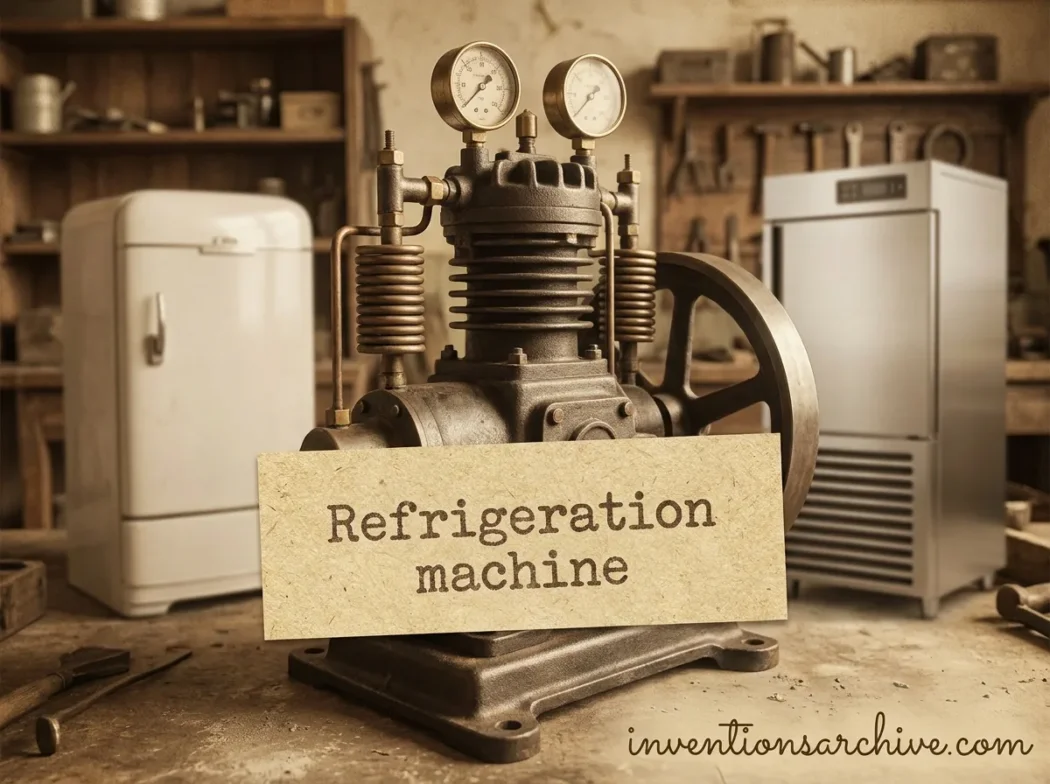
| Invention Name | Refrigeration Machine / Mechanical Refrigeration Machine |
|---|---|
| Short Definition | A machine that moves heat from a colder space or liquid to a warmer surroundings by using mechanical work, a refrigerant, or another cooling cycle. |
| Approximate Date / Period | 1748 laboratory artificial refrigeration Based on surviving records; 1805 vapor-compression design Not built; 1834 Perkins patent and early working vapor-compression machine Confirmed [a] [b] |
| Geography | Scotland, United States, England; later industrial growth in Britain, Australia, Europe and North America |
| Inventor / Source Culture | William Cullen for early artificial refrigeration experiment; Oliver Evans for an unbuilt vapor-compression concept; Jacob Perkins for the 1834 patent; John Hague for construction and demonstration Attribution varies |
| Category | Energy, manufacturing, food preservation, medicine, transport, domestic technology, industrial systems |
| Main Problem Solved | Dependence on natural ice, seasonal cold, cellars, salting, drying and other preservation methods that could not provide controlled cooling everywhere. |
| How It Works | It removes heat from a target space or liquid and rejects that heat elsewhere, usually through compression, condensation, expansion and evaporation. |
| Material / Technology Base | Metal pressure vessels, pumps or compressors, heat exchangers, tubing, refrigerants, brine loops, insulation and later electric motors. |
| First Use Context | Ice making, cooling liquids, experimental physics, industrial cooling, medical cooling attempts and later food storage. |
| Development Path | Evaporative cooling and natural ice → laboratory artificial refrigeration → vapor-compression concept → Perkins machine → industrial refrigeration → domestic refrigerators and cold chains |
| Surviving Evidence | Patent descriptions, museum collection records, later historical engineering reports and surviving machine models, including a Smithsonian record for a Jacob Perkins ice machine model dated 1834 Based on surviving evidence [c] |
| Related Inventions | Icebox, compressor, heat exchanger, vapor-compression cycle, absorption refrigerator, electric refrigerator, refrigerated transport |
| Modern Descendants | Household refrigerator, freezer, chiller, air conditioner, heat pump, refrigerated truck, cold-storage warehouse, cryogenic refrigeration system |
| Importance | Controlled cooling on demand; year-round preservation of perishable goods; safer storage of many medicines and foods; support for modern industry and transport. |
What the Refrigeration Machine Is
A refrigeration machine is a controlled cooling device. It does not “make cold” in a literal sense. It moves heat away from a cabinet, tank, room, coil, liquid or product and releases that heat somewhere else.
The early machine was mainly an ice-making and liquid-cooling apparatus. The later refrigerator in a kitchen is only one descendant. The same invention family also includes industrial chillers, refrigerated railcars, cold-storage plants, supermarket cases, laboratory coolers and air-conditioning systems.
The lasting idea was controlled cooling independent of season. Once cooling could be produced by a machine rather than by winter ice, refrigeration became useful in places and months where natural ice was scarce, costly or unreliable.
How Its Origin Is Traced
The origin of the refrigeration machine is traced through several kinds of evidence: university records, engineering histories, patent descriptions, machine models, museum catalog entries and later technical standards. These sources do not all describe the same object.
Three stages matter most:
- Scientific demonstration: Cullen showed that evaporation under reduced pressure could produce artificial cooling.
- Mechanical concept: Evans described a closed-cycle vapor-compression cooling machine but did not leave evidence of a working build.
- Patented working machine: Perkins patented a continuous vapor-compression machine in 1834, and Hague constructed and demonstrated it.
This layered record is useful because it avoids a common mistake: treating the first experiment, the first design and the first working machine as if they were the same event.
The Problem It Answered
Before mechanical refrigeration, people used cold where they could find it. Ice was cut from lakes and ponds, stored in icehouses, packed in straw or sawdust, moved by wagon or ship, and later placed in insulated iceboxes. The system worked, but only under the right conditions.
Natural ice had limits. It depended on winter weather, transport routes and storage losses. In warm regions it could be expensive or unavailable. In homes, an icebox needed fresh ice, drainage for meltwater and careful handling. The Smithsonian notes that American households were still using large ice blocks in iceboxes well into the 1930s, while electric refrigeration gave more consistent temperature control and longer storage for food [d].
The refrigeration machine answered a practical need: cooling that could be produced where people worked, stored food, treated temperature-sensitive goods, brewed, shipped, studied or lived.
Before and After Mechanical Refrigeration
| Before the Invention | What Changed After It |
|---|---|
| Cooling depended on winter ice, snow, cellars, icehouses, evaporative cooling, salting, drying or canning. | Cooling could be produced by a machine in warmer seasons, warmer regions and controlled industrial spaces. |
| Ice supply was seasonal and tied to local climate or long-distance delivery. | Ice making became possible in factories, ships, breweries, medical settings and later homes. |
| Food storage often changed the texture, flavor or appearance of food through salting, drying or heavy preservation. | Fresh foods, leftovers, dairy, meat and produce could be stored for longer periods under colder, more stable conditions. |
| Warm climates faced high costs and limited access to reliable ice. | Mechanical cooling allowed local production of ice and later direct cooling of rooms, cabinets, liquids and transport containers. |
| Industrial processes had fewer ways to control temperature precisely. | Brewing, food processing, cold storage, medicine, chemical handling, laboratories and shipping gained more reliable temperature control. |
How the Machine Worked in Simple Terms
The classic refrigeration machine used a cycle. A working fluid, later called a refrigerant, moved through the system. Its pressure and temperature changed as it passed through major parts of the machine.
In a vapor-compression system, the main parts are the compressor, condenser, expansion device and evaporator. ASHRAE describes the basic chiller cycle as a process in which liquid refrigerant evaporates at a lower temperature, the vapor is drawn into a compressor, the compressor raises its pressure and temperature, and the refrigerant later returns through an expansion device to repeat the cycle [e].
In plain language, the machine works because evaporation absorbs heat and condensation releases heat. The compressor makes the refrigerant suitable for rejecting heat outside the cooled space. The expansion step lowers pressure so the refrigerant can become cold enough to absorb heat again.
Main Parts of a Vapor-Compression Refrigeration Machine
- Compressor: Raises the pressure and temperature of refrigerant vapor.
- Condenser: Releases heat to air, water or another cooling medium and condenses vapor into liquid.
- Expansion device: Lowers pressure before the refrigerant enters the cold side of the system.
- Evaporator: Absorbs heat from the space, liquid or product being cooled.
- Refrigerant: The working fluid that changes condition as heat is moved through the cycle.
Earlier Cooling Methods Before It
Mechanical refrigeration did not replace a world with no cooling. It replaced a world full of older cooling methods that were useful but limited.
Earlier methods included:
- Natural ice storage: Ice cut in winter and stored in insulated pits, wells or icehouses.
- Iceboxes: Insulated cabinets cooled by a block of ice.
- Evaporative cooling: Cooling by water evaporation from porous containers or wet surfaces.
- Cold cellars and shaded storage: Use of naturally cooler spaces below ground.
- Preservation without cold: Salting, drying, smoking, pickling and canning.
The refrigeration machine mattered because it separated cooling from local weather. A factory, ship, hospital, laboratory or home could later use a machine instead of waiting for winter ice.
Development Path from Earlier Cooling to Modern Systems
| Stage | Form | What Changed |
|---|---|---|
| Earlier Method | Icehouses, snow storage, evaporative cooling and insulated containers | Cooling was possible, but it depended on season, location and stored natural cold. |
| Laboratory Demonstration | Artificial refrigeration experiments using evaporation and reduced pressure | Cooling became a scientific effect that could be produced under controlled conditions. |
| Mechanical Concept | Closed-cycle vapor-compression idea | The system could, in theory, repeat cooling continuously instead of using a one-time cooling material. |
| Patented Machine | Perkins vapor-compression refrigeration machine | A working machine could cool fluids and make ice through a repeating mechanical cycle. |
| Improved Form | Industrial ice plants, brewery cooling, cold storage and refrigerated transport | Cooling moved from experiment to production, trade and storage. |
| Modern Descendant | Electric refrigerator, chiller, heat pump, air conditioner and cold-chain system | Temperature control became part of daily life, medicine, food logistics and building services. |
Main Materials, Mechanisms and Working Fluids
Early refrigeration machines depended on metalwork, pumps, sealed vessels and heat-transfer surfaces. The principle was simple to state but difficult to build well. The machine needed to contain a working fluid, move it through pressure changes and transfer heat without excessive leakage or mechanical failure.
The working fluid changed over time. Early systems used substances such as ether in experimental vapor-compression machines. Later industrial systems used other refrigerants, including ammonia and carbon dioxide in certain applications. In the twentieth century, synthetic refrigerants became common in many systems, and in recent decades the safety and environmental effects of refrigerants have become a major engineering concern. NIST describes current research into lower-impact refrigerants, including HFOs and renewed attention to ammonia, carbon dioxide, propane and isobutane, while noting safety and thermodynamic tradeoffs [f].
That material history matters. A refrigeration machine is not only a compressor and a coil. It is also a story of seals, pipes, pressure control, heat exchangers, lubricants, insulation, motors and safe working fluids.
Main Types and Variations
| Type or Variation | Basic Principle | Typical Use Context |
|---|---|---|
| Vapor-Compression Refrigeration | Uses a compressor, condenser, expansion device and evaporator to move heat through a refrigerant cycle. | Household refrigerators, freezers, chillers, air conditioners, heat pumps and most modern cooling equipment. |
| Absorption Refrigeration | Uses heat and an absorbent-refrigerant pair rather than a mechanical compressor as the main driving method. | Gas-fired refrigerators, some industrial systems, waste-heat cooling and specialized applications. |
| Air-Cycle Refrigeration | Uses compressed air and expansion to produce cooling. | Historical ice machines, aircraft environmental systems and special engineering uses. |
| Thermoelectric Refrigeration | Uses the Peltier effect to move heat across a solid-state junction when electric current passes through it. | Small coolers, electronics cooling and compact systems where quiet operation matters more than high efficiency. |
| Cryogenic Refrigeration | Uses advanced cycles to reach very low temperatures far below ordinary food refrigeration. | Scientific instruments, superconducting equipment, laboratory research and low-temperature physics. |
| Refrigerated Transport Systems | Uses refrigeration machinery inside vehicles, containers or railcars to maintain cargo temperature. | Food distribution, medicines, flowers, seafood, dairy, frozen goods and temperature-controlled logistics. |
Early Uses and Spread
The earliest practical goal was not the neat kitchen refrigerator. It was ice. Ice could cool rooms, preserve food, chill drinks, support medical care and make warm-climate storage easier. That made the refrigeration machine valuable before it became a domestic appliance.
Industrial uses came first because early machines were large, expensive and technically demanding. Breweries, meat processors, dairies, ships, warehouses and ice plants had stronger reasons to pay for controlled cooling. The spread into homes required smaller compressors, safer refrigerants, reliable motors, cheaper electricity, better insulation and public trust.
Domestic refrigeration arrived gradually. Early electric devices were costly and not always reliable. As manufacturing improved, the household refrigerator moved from novelty to ordinary kitchen equipment. The change was not only mechanical. It altered shopping habits, food storage, leftovers, meal planning and the distance between producers and consumers.
Related articles: Air Pump [Renaissance Inventions Series]
What Changed After Mechanical Refrigeration
Mechanical refrigeration changed several fields at once, but not in a single step. Its influence grew as machines became safer, cheaper and more dependable.
- Food preservation: Dairy, meat, fish, fruit and prepared foods could be stored and moved with less dependence on immediate sale or heavy preservation.
- Trade: Cold storage and refrigerated transport helped perishable goods travel farther.
- Medicine: Many temperature-sensitive products could be stored more reliably.
- Industry: Cooling supported brewing, chemical processing, manufacturing, ice plants and laboratory work.
- Buildings: The same cooling principles supported air conditioning and later heat-pump systems.
The International Institute of Refrigeration describes the modern refrigeration sector as including cold chains for food and health products, air conditioning, cryogenics and heat pumps, with refrigeration tied to food availability, health products, industry and energy use [g].
Common Misunderstandings
“The Refrigerator and the Refrigeration Machine Are the Same Thing”
A refrigerator is one later form of refrigeration machine. The broader invention includes ice-making machines, chillers, industrial cooling plants, refrigerated transport and heat-pump equipment.
“One Person Invented Refrigeration All at Once”
The evidence points to a sequence. Cullen demonstrated artificial refrigeration, Evans described a vapor-compression concept, Perkins patented a working machine, and Hague built and demonstrated it.
“The Oldest Record Proves the Absolute First Use”
The oldest surviving record only shows the earliest evidence currently known. Older experiments, sketches or workshop trials may have existed without surviving documentation.
“Mechanical Refrigeration Was Immediately a Home Appliance”
Early machines were closer to industrial equipment than household appliances. Home refrigeration required later advances in motors, insulation, manufacturing, cost and safety.
Related Inventions
These related inventions and systems help place the refrigeration machine in a wider technology history:
- Icebox: The insulated cabinet that used delivered ice before electric refrigerators became common.
- Compressor: The mechanical device that made vapor-compression refrigeration practical.
- Heat Exchanger: The coil or vessel that allowed heat to move between refrigerant and air, water, brine or cargo.
- Absorption Refrigerator: A related cooling system driven mainly by heat rather than a mechanical compressor.
- Electric Refrigerator: The domestic descendant that brought mechanical cooling into many homes.
- Refrigerated Railcar and Truck: Transport inventions that extended controlled cooling beyond a single building.
- Air Conditioner: A related machine that applies refrigeration principles to indoor comfort and humidity control.
- Heat Pump: A modern descendant that can move heat for heating as well as cooling.
Frequently Asked Questions
Who invented the refrigeration machine?
The answer depends on the type of credit being discussed. William Cullen demonstrated artificial refrigeration in 1748. Oliver Evans described a vapor-compression design in 1805 but did not build it. Jacob Perkins patented a working vapor-compression refrigeration machine in 1834, and John Hague built and demonstrated the device.
Was the refrigeration machine invented before the household refrigerator?
Yes. Mechanical refrigeration began with experimental and industrial machines before it became a common household appliance. Early machines were used for ice making, cooling liquids and industrial temperature control.
How did people keep food cold before refrigeration machines?
People used natural ice, icehouses, cellars, insulated iceboxes, evaporative cooling and preservation methods such as salting, drying, smoking, pickling and canning. These methods worked, but they were less flexible than machine-made cooling.
What made vapor-compression refrigeration important?
Vapor-compression refrigeration allowed cooling to repeat in a closed cycle. A compressor, condenser, expansion device and evaporator could move heat continuously, making the principle useful for ice plants, cold storage, refrigerators, freezers, chillers and air conditioners.
Did early refrigeration machines use the same refrigerants as modern systems?
No. Early machines used working fluids and methods that differ from many modern systems. Refrigerants changed as engineers looked for better performance, safer handling, lower leakage risk and lower environmental impact.
Sources and Verification
- [a] William Cullen | University Story — Used to verify William Cullen’s 1748 artificial refrigeration demonstration at the University of Glasgow and its non-practical early status. (Reliable because it is an institutional University of Glasgow historical record.)
- [b] The Perkins Vapor-Compression Cycle – ASME — Used to verify Oliver Evans’s 1805 vapor-compression concept, Jacob Perkins’s 1834 patent, and John Hague’s construction and demonstration of the early machine. (Reliable because ASME is a professional engineering institution with an engineering history landmark program.)
- [c] Jacob Perkins Ice Machine, 1834, Model | National Museum of American History — Used to verify the surviving museum record for a Jacob Perkins ice machine model dated 1834. (Reliable because it is a Smithsonian museum collection record.)
- [d] Keeping your (food) cool: From ice harvesting to electric refrigeration | National Museum of American History — Used to verify the role of natural ice, iceboxes, ice delivery and the later shift toward electric refrigeration. (Reliable because it is a Smithsonian National Museum of American History educational article.)
- [e] CHAPTER 43 LIQUID-CHILLING SYSTEMS — Used to verify the major vapor-compression refrigeration components and the basic operating sequence of a chiller cycle. (Reliable because ASHRAE is a recognized technical authority for heating, ventilation, air conditioning and refrigeration.)
- [f] New refrigerants and system configurations for vapor compression refrigeration | NIST — Used to verify modern refrigerant development, environmental constraints and safety tradeoffs in vapor-compression systems. (Reliable because NIST is an official U.S. government scientific and standards institution.)
- [g] The Role of Refrigeration in the Global Economy 3rd edition, 60th IIR Technical Brief on Refrigeration Technologies — Used to verify the modern scope of refrigeration across food, health products, air conditioning, cryogenics, heat pumps and economic activity. (Reliable because it is a technical brief from the International Institute of Refrigeration.)