
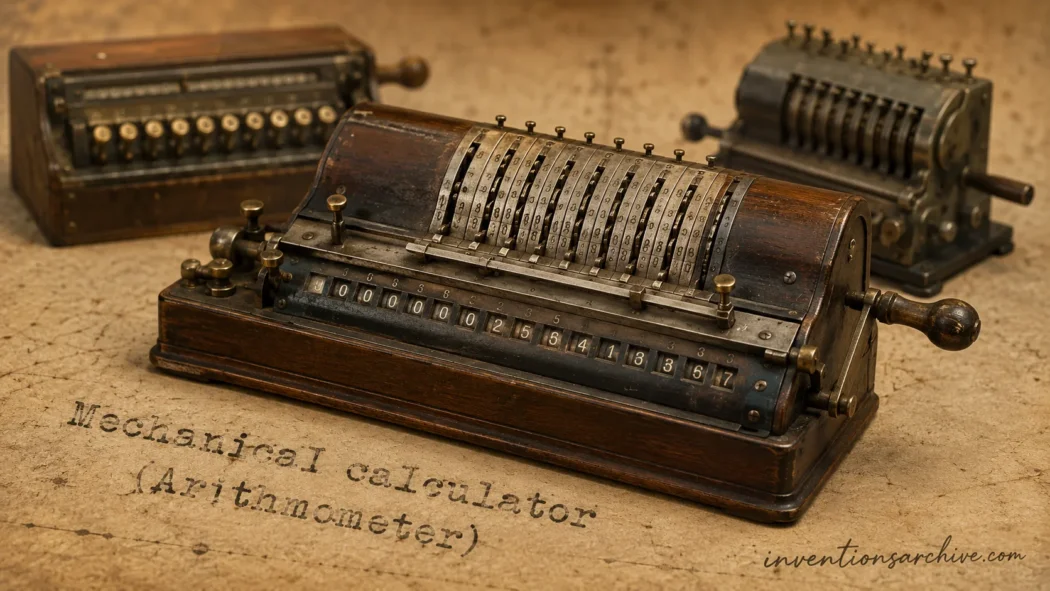
| Invention Name | Mechanical calculator, specifically the Arithmometer |
|---|---|
| Short Definition | A hand-operated calculating machine designed to perform the four basic arithmetic operations through a geared mechanism. |
| Approximate Date / Period | 1820 patent period Based on surviving evidence |
| Geography | Paris, France; associated with Charles Xavier Thomas of Colmar |
| Inventor / Source Culture | Charles Xavier Thomas, also known as Thomas de Colmar Confirmed |
| Category | Measurement, science, business calculation, office technology |
| Main Problem Solved | Reducing slow, error-prone hand arithmetic in offices, trade, insurance, accounting, and technical calculation |
| How It Worked | Input sliders, stepped drums, result dials, a movable carriage, and a crank-like operating action |
| Technical Principle | Leibniz-style stepped drum mechanism, geared transmission, place-value carriage |
| Early Use Area | Office arithmetic, commercial calculation, insurance work, scientific and administrative computation |
| Evidence Status | Surviving museum objects, patent references, 19th-century reports, later collection records |
| Surviving Evidence | Smithsonian example dated around 1820; Science Museum and Computer History Museum collection examples |
| Development Path | Pascaline and stepped reckoner ideas → Arithmometer → improved arithmometers → office calculating machines |
| Modern Descendants | Desktop mechanical calculators, adding machines, electromechanical calculators, electronic calculators |
| Related Inventions | Pascaline, Leibniz stepped reckoner, Comptometer, adding machine, pinwheel calculator, electronic calculator |
| Importance |
|
What the Arithmometer Was
The Arithmometer was a mechanical calculator built for arithmetic rather than symbolic mathematics. It could support addition, subtraction, multiplication, and division through controlled movement of gears and number dials. In plain terms, it helped numbers move through a machine instead of being carried only in a person’s head or written column by column.
Its place in invention history is strongest when described with care. It was not the first machine ever imagined for calculation, and it was not a programmable computer. Its importance lies in a more practical area: it became a commercially successful calculating machine at a time when most earlier devices remained rare, fragile, expensive, or experimental. The Science Museum Group describes Thomas’s Arithmometer as invented in 1820, commercially produced later, capable of the four basic operations, and based on the stepped reckoner principle associated with Leibniz.[b]
The machine looked more like a precision instrument than a modern calculator. Typical later examples had sliders for entering numbers, dials for results, a carriage for place value, and a crank or handle action for driving the calculation. It required human control, yet it reduced part of the mental load of repeated arithmetic.
The Problem It Answered
Before reliable office calculators, many calculations were done by written arithmetic, counting tables, abacuses, reckoning boards, slide rules, or specialized tables. These tools could be effective, but each had limits. Written arithmetic depended heavily on attention. Tables required lookup skill. Slide rules were better for approximate scientific work than exact accounting. Manual column arithmetic became tiring when the same kinds of sums had to be repeated all day.
The Arithmometer answered a specific need: repeatable exact calculation in a business and technical setting. Insurance, banking, engineering, surveying, government offices, and trade all needed arithmetic that was faster and less vulnerable to copying or carrying errors.
How the Mechanism Worked in Simple Terms
The mature Arithmometer used a fixed setting plate, number sliders, a result carriage, and stepped cylinders. A user set a number with sliders. When the handle turned, the machine transferred that value into result dials through geared motion. The stepped drum was the central idea: different tooth lengths engaged different amounts of rotation, so the value entered by a slider became mechanical movement.
Multiplication worked as repeated addition, with the carriage shifting place value. Division worked through repeated subtraction, with counters helping track the quotient. A reversing control changed the direction of the transmitted motion, so the machine could move from adding to subtracting. Stephen Johnston’s study for the Museum of the History of Science explains the mature machine’s setting plate, carriage, stepped cylinders, reversing switch, quotient dials, and zeroing mechanisms in detail.[c]
This description is enough to understand the principle without turning the article into a repair or construction manual. The Arithmometer was a precision device. Its value came from controlled mechanical transfer of numbers, not from a simple single gear.
Earlier Ideas and Tools Before the Arithmometer
The Arithmometer grew from older ways of handling number. Reckoning boards and abacuses gave people movable counters. Napier’s bones helped with multiplication by turning arithmetic into arranged partial products. The slide rule helped with approximate calculation through logarithmic scales. Pascal’s 17th-century calculator showed that wheels and carry mechanisms could automate addition and subtraction.
Pascal’s calculator is especially useful for comparison. A Science Museum Group collection record describes Pascal’s first calculating machine of 1642 as a device made for addition and subtraction with number wheels, created to help his father in business, while also noting that it could not be mass produced.[d]
Leibniz added another major idea: the stepped reckoner principle. The Arithmometer did not copy a modern calculator because no such thing existed. It combined older mechanical calculation ideas with 19th-century instrument making, metalworking, office demand, and commercial ambition.
Development Path From Earlier Tools to Later Forms
| Stage | Form | What Changed |
|---|---|---|
| Earlier Aids | Abacus, reckoning board, counting tables | Numbers were organized by the user, but the tool did not mechanically perform full operations. |
| Early Mechanical Calculators | Pascaline and related wheel-based devices | Mechanical addition and subtraction became possible, but production and general use remained limited. |
| Stepped-Drum Principle | Leibniz-style stepped reckoner concept | Variable tooth engagement offered a way to transmit different digit values mechanically. |
| Arithmometer | Thomas de Colmar’s practical stepped-drum calculator | The machine moved toward repeated manufacture and use in business and institutional settings. |
| Improved Office Machines | Later arithmometers, pinwheel machines, adding machines, Comptometers | Designs became faster, more specialized, more keyboard-like, or better suited to office workflows. |
| Modern Descendant | Electromechanical and electronic calculators | Calculation moved from visible mechanical motion to electrical switching and electronic circuits. |
How the Arithmometer Changed Over Time
The Arithmometer’s history is not a straight line from a finished invention to instant success. Early versions were smaller and less familiar in form. Later versions changed the drive, input layout, result display, zeroing systems, quotient tracking, and internal carry mechanisms. Some features were added, removed, or redesigned because the machine had to become sturdier and easier to use.
The Arithmeum at the University of Bonn records a Thomas Arithmomètre made in 1875, describes it as a four-species stepped-drum machine, lists the 1820 invention date, notes a production period of 1850–1878 for that line, and records later production and export figures from the 19th century.[e]
This slow development matters. Many short histories call the Arithmometer “the first successful calculator” and stop there. A better reading is more precise: it became successful after long redesign, promotion, workshop production, and gradual trust from users. The invention was both a machine and a manufacturing story.
Main Types, Versions, and Variations
| Type or Version | Period or Context | Main Features |
|---|---|---|
| Early Thomas Prototype Forms | 1820s | Smaller capacity, experimental features, changing layout, early patent-era design |
| Mid-Century Redesigned Arithmometers | 1840s–1850s | Greater capacity, revised operation, stronger path toward public demonstration and sale |
| Classic Thomas de Colmar Type | 1860s onward | More recognizable office form with sliders, crank operation, carriage, and result windows |
| Workshop and Successor Machines | Late 19th century | Machines built after Thomas’s main period, often following the same stepped-drum tradition |
| Arithmometer-Type Clones | Late 19th and early 20th centuries | German, British, and other machines influenced by the Thomas pattern |
| Later Office Calculators | 20th century | Pinwheel calculators, adding machines, keyboard calculators, and electromechanical models |
Early Use in Offices and Institutions
The Arithmometer fit a world where arithmetic was not just schoolwork. It was part of finance, insurance, tax work, engineering, astronomy, navigation tables, railway administration, and public offices. Its users were not pressing buttons on a pocket device. They were handling a serious desk instrument, often in a setting where a wrong figure could affect money, measurements, or records.
The machine’s early audience was shaped by trust. A calculating instrument had to prove that it could carry digits reliably, survive repeated use, and produce results a clerk or engineer could verify. That is why the Arithmometer’s spread was gradual. It had to become not only clever, but dependable.
Surviving collection examples also show that the Arithmometer was not just a printed idea. The Computer History Museum records a Thomas Arithmometer as a physical object dated 1850, manufactured by Chevalier Charles Xavier Thomas / M. Thomas de Colmar in France, with identifying numbers and collection details.[f]
Before and After the Arithmometer
| Before the Invention | What Changed After It |
|---|---|
| Large calculations depended heavily on written arithmetic, tables, or skilled mental checking. | A machine could carry part of the arithmetic process through geared movement and displayed results. |
| Earlier mechanical calculators often remained rare, delicate, or difficult to reproduce. | The Arithmometer moved mechanical calculation toward repeated manufacture and office use. |
| Multiplication and division required repeated written procedures or table work. | Repeated addition and subtraction could be organized mechanically through the carriage and counters. |
| Errors could arise from copying, carrying digits, fatigue, or misreading long columns. | The machine reduced some routine carrying and repetition, though users still needed to check the setup and result. |
| Calculation tools were often separated by use: abacus, table, slide rule, written method. | The Arithmometer gathered several exact arithmetic tasks into one desk instrument. |
| Mechanical calculation was often seen as a curiosity or demonstration of ingenuity. | It became more closely linked to business, administration, and the later office-machine industry. |
Materials, Craft, and Technical Character
Arithmometers were precision objects. They used metal gears, dials, plates, sliders, screws, and fitted cases. Some examples had wooden cases or lids, and many surviving machines show the mixed character of the device: part mathematical instrument, part office tool, part workshop product.
The material story is important because a calculator like this could not become useful through theory alone. It needed accurate metal parts, repeatable assembly, durable carries, readable dials, and a body that could tolerate regular handling. The invention depended on craft as much as mathematics.
Common Misunderstandings
It Was Not the First Calculator Ever
Earlier mechanical calculators existed. The Arithmometer’s stronger claim is commercial and practical: it helped mechanical calculation enter repeated office use.
The 1820 Date Needs Care
The 1820 patent period marks the invention’s early public and legal record, not the final commercial form most people picture today.
It Was Not a Computer in the Modern Sense
The Arithmometer calculated. It did not store programs, branch through instructions, or process general symbolic logic like later computers.
Success Was Gradual
The machine’s reputation grew through redesign, public demonstration, manufacture, and adoption. It was not an instant office standard.
What Changed Because of the Arithmometer
The Arithmometer made a practical argument: exact arithmetic could be delegated partly to a machine. That may sound ordinary now, but in the 19th century it changed expectations. A calculating machine no longer had to be only a rare showpiece for scientists or patrons. It could become an instrument for clerks, offices, and institutions.
Its influence can be seen in three linked changes:
- Office calculation became more mechanized. Arithmetic started to move toward desk instruments and later office machines.
- Mechanical design became more standardized. Makers could study, copy, alter, or improve a working model.
- Users began to trust machine arithmetic. This trust later helped adding machines, keyboard calculators, and electronic calculators feel normal rather than strange.
The Arithmometer did not create modern computing by itself. Its legacy is narrower and more concrete: it helped connect mechanical engineering with everyday numerical work.
Related Inventions and Later Developments
- Pascaline — an earlier wheel-based adding and subtracting machine linked to Blaise Pascal.
- Leibniz Stepped Reckoner — an earlier calculating machine concept using a stepped-drum principle.
- Napier’s Bones — a calculation aid that helped organize multiplication before mechanical office calculators.
- Pinwheel Calculator — a later mechanical calculator type that became common in office and technical work.
- Comptometer — a keyboard-driven calculating machine used widely in business settings.
- Adding Machine — a more specialized office machine for sums, accounts, and printed totals.
- Electromechanical Calculator — a later bridge between hand-driven mechanical calculators and electronic devices.
- Electronic Calculator — the modern descendant that replaced visible gears with electronic circuits.
Frequently Asked Questions
Who invented the Arithmometer?
The Arithmometer is credited to Charles Xavier Thomas, known as Thomas de Colmar. The invention is tied to his 1820 French patent period, though later commercial machines developed through many revisions.
Was the Arithmometer the first mechanical calculator?
No. Earlier mechanical calculators existed, including Pascal’s calculator and Leibniz’s stepped reckoner. The Arithmometer is better known as an early commercially successful mechanical calculator.
What operations could the Arithmometer perform?
The Arithmometer was designed for addition, subtraction, multiplication, and division. Multiplication and division were handled through repeated addition or subtraction combined with place-value movement.
Why was the Arithmometer important for office work?
It helped make exact arithmetic more repeatable in offices, trade, insurance, accounting, and technical work. It reduced some routine carrying and repetition, while still requiring trained human oversight.
Is the Arithmometer a computer?
It is a mechanical calculator, not a computer in the modern programmable sense. It processed arithmetic through mechanical parts, but it did not store programs or make conditional decisions.
Sources and Verification
- [a] Thomas Arithmometer | Smithsonian Institution — Used to verify the ca. 1820 surviving object, Thomas attribution, Paris context, physical materials, and the note that the surviving machine differs from the patent drawings. (Reliable because it is an official Smithsonian collection record.)
- [b] Thomas De Colmar’s Arithmometer, with mahogany case lid | Science Museum Group Collection — Used to verify the 1820 invention attribution, later commercial production, four-operation capability, and stepped-reckoner connection. (Reliable because it is an official Science Museum Group collection record.)
- [c] Making the arithmometer count — Used to verify the mechanism, including sliders, carriage, stepped cylinders, reversing action, quotient dials, and design development. (Reliable because it is a University of Oxford museum-hosted version of a published scholarly article.)
- [d] Replica of Pascal’s calculator | Science Museum Group Collection — Used to verify Pascal’s 1642 calculator as an earlier addition and subtraction machine and to clarify the pre-Arithmometer lineage. (Reliable because it is an official Science Museum Group collection record.)
- [e] Thomas Arithmomètre 1203 — Used to verify the 1875 Arithmometer example, production period, four-species stepped-drum classification, capacity data, and later production notes. (Reliable because it is an institutional museum collection page from the University of Bonn’s Arithmeum.)
- [f] Thomas Arithmometer | XB3.76 | Computer History Museum — Used to verify a dated 1850 Thomas Arithmometer physical object, manufacturer attribution, French manufacture, and collection context. (Reliable because it is an official Computer History Museum collection record.)