
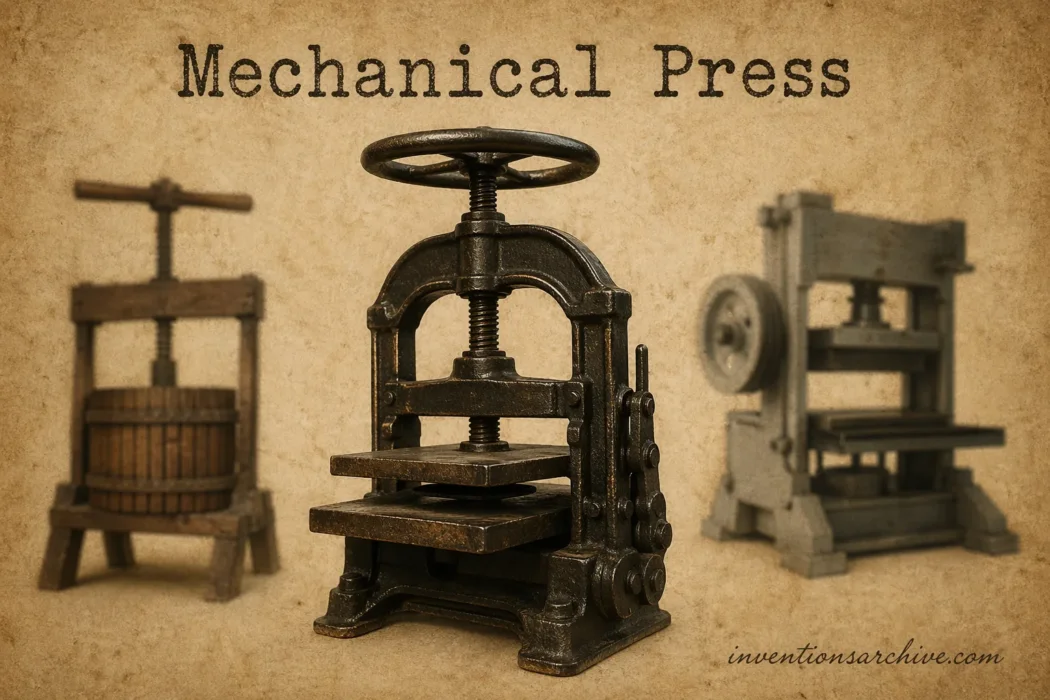
| Invention Detail | Information |
|---|---|
| Invention Name | Mechanical press |
| Short Definition | A force-applying machine that uses a screw, lever, crank, flywheel, ram, platen, or slide to print, cut, form, press, or assemble material. |
| Approximate Date / Period | 1450s for the European movable-type printing press; 19th century onward for powered industrial press families. Approximate; branch-dependent |
| Geography | Mainz, German lands for Gutenberg’s press branch; Europe and North America for later industrial machine-tool presses. |
| Inventor / Source Culture | Johann Gutenberg for the European movable-type press branch; anonymous and collective machine-tool development for industrial mechanical presses. |
| Category | Communication technology; manufacturing; machine tools; metal forming; print technology. |
| Importance | Repeatable pressure; faster copying of text; more uniform manufactured parts; lower labor per impression or stroke. |
| Need / Reason for Emergence | Faster text reproduction; cleaner ink transfer; more reliable forming, punching, stamping, embossing, and assembly. |
| How It Works | A mechanism directs force through a platen, ram, or slide toward a fixed bed, forme, or die. |
| Material / Technology Basis | Wood and iron frames; screw threads; levers; cast type; ink; paper; later steel frames, flywheels, crankshafts, clutches, brakes, and dies. |
| First Use Area | Book and document printing in Europe; later sheet-metal forming, product stamping, embossing, and press-fit assembly. |
| Spread Route | Mainz print shops to wider Europe; industrial press designs through foundries, machine shops, factories, and standard machine-tool trade. |
| Derived Developments | Hand press, iron press, platen press, steam-powered printing press, crank press, eccentric press, knuckle-joint press, servo-mechanical press. |
| Impact Areas | Publishing; education; administration; packaging; metal goods; transport parts; appliance and electronics production. |
| Different Views | Gutenberg did not invent printing itself; Asian movable type came earlier. The exact form of his first press is not fully preserved. |
| Precursors and Successors | Precursors: screw presses, wine and oil presses, block printing, scribal copying. Successors: rotary presses, offset printing, automated stamping lines, servo presses. |
| Related People and Civilizations | Song China; Goryeo Korea; Johann Gutenberg; Johann Fust; Peter Schöffer; later press builders and machine-tool makers. |
| Invention Variants Influenced | Screw press, fly press, toggle press, platen press, crank press, eccentric press, stamping press, press brake, coining press. |
A mechanical press looks simple only from a distance. One part moves, one part stays still, pressure lands between them, and the work changes shape or receives an impression. Look closer and the idea becomes much richer: controlled force, repeatable motion, and accurate alignment turned pressure into a tool for printing books, shaping metal, embossing paper, stamping marks, and forming everyday parts.
Contents
What a Mechanical Press Is
A mechanical press is any press that applies force through a mechanical system rather than direct hand pressure alone, fluid pressure alone, or air pressure alone. The motion may come from a screw, a lever, a toggle linkage, a crankshaft, a flywheel, or a motor-driven drive train.
That makes the term wider than many people expect. A printing press is a mechanical press when it uses a screw or platen to press inked type onto paper. A power press in a metal shop is also a mechanical press when it uses a flywheel and crank system to move a slide or ram. Different jobs, same central idea: force becomes useful when it is guided.
Plain meaning: the invention is not just “a heavy machine.” It is a method for making pressure repeatable, directional, and timed. That is why the same family of ideas appears in book printing, coin striking, paper embossing, metal stamping, and many press-based production lines.
Mechanical Press and Printing Press Are Related, Not Identical
The phrase mechanical press often leads to two valid meanings. In invention history, readers usually look for the printing press associated with Gutenberg. In engineering, the phrase often means a machine-tool press used to shear, punch, form, or assemble material. The overlap matters. Gutenberg’s press used mechanical pressure for communication. Industrial presses use mechanical pressure for production.
So, one article about the mechanical press should not stop at a single machine. That would miss the invention’s strange little trick: it moved from pages to parts.
Early Roots and Timeline
Mechanical pressing did not appear as one neat event. People already knew that a screw, wedge, lever, or weight could multiply force. The invention became more visible when that force was paired with repeatable surfaces: a page of type, a plate, a die, or a shaped tool.
Asian printing history also needs a fair place here. During the Song dynasty, Bi Sheng developed movable type using earthenware type between 1041 and 1048, according to the Library of Congress Asian Collections (Details-1). Korea then developed cast-metal movable type in the early thirteenth century, with a 1377 Korean Buddhist text often cited as the oldest surviving book printed with metal movable type (Details-2).
Gutenberg’s European breakthrough sat on another line of development. Harvard Library describes the Gutenberg Bible as the first major work printed in Europe with movable metal type; it also notes Gutenberg’s Mainz press activity in the mid-fifteenth century and the estimated print run of about 70 to 270 copies (Details-3). That was not the birth of all printing. It was a new European system that joined pressure, metal type, ink, paper, and shop practice into a repeatable production process.
| Period | Development | Why It Matters |
|---|---|---|
| Before movable type | Block printing, manuscript copying, seals, and screw-based pressing traditions. | Pressure and surface transfer already existed, but output remained slower or less flexible. |
| 1041–1048 | Bi Sheng’s earthenware movable type in Song China. | Movable characters showed that text could be rearranged rather than carved as one block. |
| Early 1200s | Cast-metal movable type in Goryeo Korea. | Metal type proved that durable reusable characters could support printed texts. |
| 1450s | Gutenberg’s European movable-type printing press in Mainz. | Mechanical pressure joined metal type and ink for repeatable page production. |
| 1700s–1800s | Iron hand presses, powered printing machines, and heavier industrial press designs. | Presses became stronger, faster, and better suited to larger runs. |
| 1900s | Motor-driven mechanical power presses with flywheels, clutches, brakes, slides, and dies. | Factory presses supported high-volume forming, punching, blanking, and assembly. |
| Late 1900s–2000s | Servo-mechanical presses and automated press lines. | Electronic control refined stroke timing, speed profiles, and repeatability. |
How the Mechanical Press Works
A press needs two things: a moving force member and a fixed resisting surface. In a printing press, the moving member may be a platen pressing paper against inked type. In a power press, it may be a slide or ram carrying a tool toward a die. Either way, the machine turns motion into a short, controlled stroke.
OSHA describes a mechanical power press as a machine that shears, punches, forms, or assembles metal or other materials by using tools or dies attached to slides or rams; it also explains the motor, flywheel, gear transmission, crankshaft, and connecting-rod path used in many such presses (Details-4).
The Basic Motion
The mechanical press takes an input motion and compresses it into a useful stroke. That input may be slow and manual, as in a screw press. It may be stored first in a spinning flywheel, then released through a crankshaft. In both cases, the final contact area must stay aligned. No alignment, no useful pressing.
- Input energy: hand force, lever force, screw rotation, motor power, or flywheel energy.
- Motion conversion: screw threads, toggles, eccentric shafts, cranks, or linkages change the direction and timing of movement.
- Working member: a platen, ram, slide, punch, or upper die carries the force.
- Opposing surface: a bed, lower die, anvil, forme, or plate holds the material in place.
- Return motion: springs, counterweights, linkages, or drive systems reset the machine for another stroke.
Why the Stroke Matters
The stroke is the press’s short working movement. It may seem like a tiny event, but the whole invention depends on it. Too little force and nothing prints or forms cleanly. Too much movement, poor alignment, or weak framing can ruin the work. Precision matters more than size.
A small press can leave a clean impression on paper. A large industrial press can form sheet metal only if the die set, slide path, and frame stiffness support the required work. That is the quiet genius of the press: force is not merely applied; it is disciplined.
Main Types and Variations
The mechanical press family grew in several directions because different materials resist pressure in different ways. Paper needs even impression. Metal may need a short hard strike, a longer forming stroke, or a high-force squeeze near the bottom of travel. The machine changes with the job.
| Press Type | Main Mechanism | Common Use | Notable Trait |
|---|---|---|---|
| Screw Press | Threaded screw moves a platen or ram. | Early printing, bookbinding, embossing, small forming jobs. | Slow but forceful; good control over pressure. |
| Fly Press | Screw with weighted arms or flywheel-like momentum. | Light forming, punching, workshop pressing. | Stores human-applied energy in rotation. |
| Toggle Press | Linked arms multiply force near the end of travel. | Small assembly, riveting, pressing, light forming. | Strong final squeeze from compact movement. |
| Platen Press | Flat platen presses paper against inked type or a plate. | Letterpress printing, cards, labels, small printed work. | Flat-to-flat impression; tied closely to print history. |
| Crank Press | Crankshaft and connecting rod move the slide. | Blanking, punching, stamping, forming. | Fast, repeatable strokes for production runs. |
| Eccentric Press | Eccentric shaft creates reciprocating motion. | Sheet-metal stamping and punching. | Compact drive with predictable slide motion. |
| Knuckle-Joint Press | Knuckle linkage boosts force near bottom dead center. | Coining, sizing, embossing, precision squeezing. | High force late in the stroke. |
| Servo-Mechanical Press | Mechanical drive with programmable servo motor control. | Controlled forming, variable stroke profiles, automated lines. | Mechanical stiffness with refined motion control. |
Screw Press
The screw press is the older-looking branch: a screw turns, the platen descends, and pressure spreads across a surface. It suits printing because a page needs even force, not a violent blow. In its simplest form, it feels almost stubborn. Turn, press, release, repeat.
Screw-based pressure also helped bridge older craft traditions and early mechanized printing. Gutenberg’s press branch made that familiar pressure system do a new cultural job: produce many near-identical pages from reusable type.
Crank and Eccentric Presses
Crank and eccentric presses belong more to factories than print rooms. A motor turns a flywheel, the flywheel helps store energy, and a crank or eccentric shaft moves the slide down and back. The motion repeats with rhythm. That rhythm made the press a production machine.
These presses suit operations where material must be cut or shaped again and again: punching holes, blanking flat pieces, forming shallow shapes, embossing patterns, or pressing assemblies. The machine does not “think”; it repeats a controlled stroke.
Toggle and Knuckle-Joint Presses
A toggle press uses linkage geometry to multiply force near the end of movement. A knuckle-joint press uses related logic for a strong squeeze close to the bottom of the stroke. These designs matter when the final pressure must be high and controlled, such as in coining, sizing, or embossing.
It is a clever trade. The machine does not need full maximum force for the whole stroke; it concentrates force where the work needs it most.
The Printing Press Branch
The printing press branch gave the mechanical press its best-known public face. Gutenberg’s achievement did not rest on pressure alone. His system joined movable metal type, a press mechanism, ink suited to type, page layout practice, and shop labor. The parts worked together.
This is where many short explanations get a little sloppy. Printing existed before Gutenberg. Movable type existed before Gutenberg. The European press associated with Gutenberg mattered because it turned several pieces of craft knowledge into a working production system for alphabetic texts in Europe.
What Changed with Gutenberg’s Press
Before mechanical page printing spread in Europe, manuscripts required long copying labor, and block printing demanded a carved surface for each page or image. Movable type changed the economics of text. Once type existed, printers could arrange, ink, press, redistribute, and reuse characters.
- Reusable type: letters could be set again for another page.
- Repeatable pressure: each impression followed the same mechanical action.
- Page consistency: copies could match one another far more closely than hand copies.
- Faster shop output: a press team could produce many sheets compared with hand copying.
- Wider circulation: books, pamphlets, forms, maps, and technical texts could travel through trade networks.
The press also changed the meaning of a page. A page became not just a handwritten object, but a repeatable manufactured unit. Small shift, huge consequence.
Why Asian Movable Type Belongs in the Story
The mechanical press story becomes clearer when it does not flatten earlier Asian printing into a footnote. China’s earthenware movable type and Korea’s cast-metal movable type show that the idea of rearrangeable characters was older than Gutenberg’s European press branch. The difference lay in writing systems, materials, economics, and local printing needs.
Alphabetic scripts need fewer characters than Chinese writing. That made movable type especially suited to European printing once a workable metal type system, press action, and shop process came together. The invention was not a single spark in an empty room. It was a technical convergence.
The Industrial Power Press Branch
The industrial branch of the mechanical press took the same logic—guided force against a fixed surface—and aimed it at materials rather than text. In this branch, the press became part of machine-tool culture. It formed, cut, punched, sized, embossed, and assembled objects with a repeatable stroke.
Here, the vocabulary changes. Instead of type, forme, ink, and tympan, the industrial press uses words like bed, bolster, slide, ram, crankshaft, clutch, brake, and die set. It sounds dry, maybe. It is not. Those parts decide whether the machine can make thousands of matching pieces.
Related articles: Dry Dock (Song Dynasty Design) [Medieval Inventions Series], Pound Lock [Medieval Inventions Series]
Main Parts of an Industrial Mechanical Press
- Frame: holds the machine’s structure and resists deflection.
- Bed or bolster: supports the lower die or work surface.
- Slide or ram: moves in a guided path and carries the upper tool.
- Die set: shaped tooling that cuts, forms, coins, or marks the material.
- Flywheel: stores rotating energy for repeated strokes.
- Crankshaft or eccentric shaft: converts rotation into reciprocating slide motion.
- Clutch and brake: manage the transfer and stopping of motion in powered presses.
- Guarding and controls: keep access, timing, and machine state controlled under applicable rules.
Work the Industrial Press Made Easier
Industrial presses became useful wherever a material had to receive the same force again and again. They supported the rise of stamped metal goods, shaped containers, tags, nameplates, lids, brackets, appliance parts, and many small components that people barely notice.
Cutting and separating: blanking, punching, trimming, piercing.
Shaping and forming: bending, drawing, embossing, sizing.
Joining and marking: press-fit assembly, coining, stamping, numbering.
The press helped factories move away from one-off hand shaping. It did not remove skill; it shifted skill into tooling, setup, alignment, maintenance, material choice, and process control.
Materials and Mechanical Ideas Behind It
The mechanical press is a material story as much as a motion story. Wood made early presses possible. Iron made presses stiffer. Steel made high-force machine tools more dependable. Type metal, paper, ink, and die steel each shaped what a press could do.
Stiffness, Alignment, and Pressure
Presses reveal a simple engineering truth: force spreads through structure. If the frame bends, the work changes. If the slide tilts, the die may not meet the material evenly. If the platen presses unevenly, the printed page may show weak or dark areas.
Good pressing depends on three linked ideas:
- Stiffness: the frame must resist unwanted bending.
- Alignment: the moving and fixed surfaces must meet in the intended path.
- Controlled timing: the stroke must occur at the right speed and point of travel.
That is why the mechanical press became more than a bigger version of a hand tool. It became a system of force, surfaces, timing, and material behavior.
Why the Flywheel Became So Useful
A flywheel stores rotating energy. In a mechanical power press, that stored energy helps deliver repeated strokes without asking the motor to supply peak forming force at every instant. The idea is plain, but effective: store motion first, use it in a short stroke.
This is why many industrial presses can run in a steady rhythm. The flywheel smooths the energy demand, while the crank or eccentric drive gives the slide its motion. Different press designs change the speed curve, available force, and best working zone.
What the Mechanical Press Changed
The mechanical press changed two large human habits: how people copied information and how people made repeatable objects.
In Communication
Printing presses made it easier to produce multiple copies of the same text. That mattered for books, religious texts, legal forms, calendars, maps, school materials, scientific diagrams, and commercial notices. The press did not guarantee accuracy by itself, of course. Printers still made choices, errors, corrections, and editions. But repeatability changed the scale of reading and record keeping.
A printed page could travel. Another copy could follow. Then another.
In Manufacturing
Industrial mechanical presses made repeatable shaping practical at scale. The value was not only speed. It was sameness. A bracket, lid, washer, label blank, tag, housing part, or punched sheet could be made to match a pattern across a run.
Tooling turned design into repeatable motion. A die carried the intended shape; the press supplied the force; the material responded. When the machine, material, and die matched well, the output stayed consistent.
In Design Thinking
The press encouraged people to design around repeatable actions. In print, that meant type cases, page forms, imposition, editions, and proofing. In factories, it meant dies, tolerances, feeds, stock thickness, stroke length, and press capacity. The press did not just make things. It made people plan for repetition.
Limits and Safety Context
A mechanical press concentrates force. That is useful, but it also means the machine must be treated as controlled equipment rather than ordinary furniture. Industrial presses require suitable guarding, controls, maintenance, and trained supervision under the rules that apply where the machine is used.
There are also technical limits. A mechanical press usually follows a set motion curve, especially in crank-driven forms. Hydraulic presses can hold pressure differently. Pneumatic presses suit lighter work. Servo-mechanical presses offer more control, but they still depend on tooling and machine capacity. No single press type fits every job.
Careful distinction: this article explains what the invention is and how its main forms developed. It does not provide construction, operating, or setup instructions for press machinery.
Mechanical Press Compared with Other Presses
People often use the word “press” for several machine families. The differences sit in how the machine creates and controls force.
| Press Family | Force Source | Typical Strength | Common Limitation |
|---|---|---|---|
| Mechanical Press | Mechanical drive: screw, crank, eccentric, toggle, flywheel. | Fast repeated strokes; clean timing; strong production rhythm. | Stroke and force curve can be less flexible in traditional designs. |
| Hydraulic Press | Fluid pressure acting through cylinders. | High controllable force through a longer stroke. | Often slower than high-speed mechanical presses. |
| Pneumatic Press | Compressed air. | Simple motion for lighter pressing and assembly tasks. | Lower force range than many mechanical or hydraulic systems. |
| Servo-Mechanical Press | Mechanical structure with servo motor control. | Adjustable motion profile with mechanical rigidity. | More complex control and higher equipment cost. |
FAQ About the Mechanical Press
Who invented the mechanical press?
No single person invented every mechanical press. Johann Gutenberg is linked to the European movable-type printing press of the 1450s. Industrial mechanical presses developed later through many machine-tool makers, foundries, and engineers.
Is a mechanical press the same as a printing press?
Not always. A printing press is one branch of mechanical press history when it uses mechanical pressure to transfer ink. Industrial mechanical presses use similar pressure logic to cut, form, stamp, or assemble material.
Did movable type exist before Gutenberg?
Yes. Bi Sheng developed earthenware movable type in Song China, and Korea used cast-metal movable type before Gutenberg’s European press branch. Gutenberg’s work mattered because it joined movable metal type with a practical European press-and-shop system.
How does a mechanical power press work?
In many industrial forms, a motor turns a flywheel, and a crankshaft or eccentric mechanism moves a slide or ram toward a die. The machine uses controlled motion to cut, form, punch, or assemble material.
What are the main types of mechanical press?
Main types include screw presses, fly presses, toggle presses, platen presses, crank presses, eccentric presses, knuckle-joint presses, and servo-mechanical presses. The best-known historical branch is the printing press; the factory branch includes stamping and forming presses.
Why was the mechanical press important?
It made pressure repeatable. That one idea supported faster book production, more consistent printed pages, cleaner markings, and later the mass production of shaped parts in metal, paper, and other materials.