
| Invention Detail | Information |
|---|---|
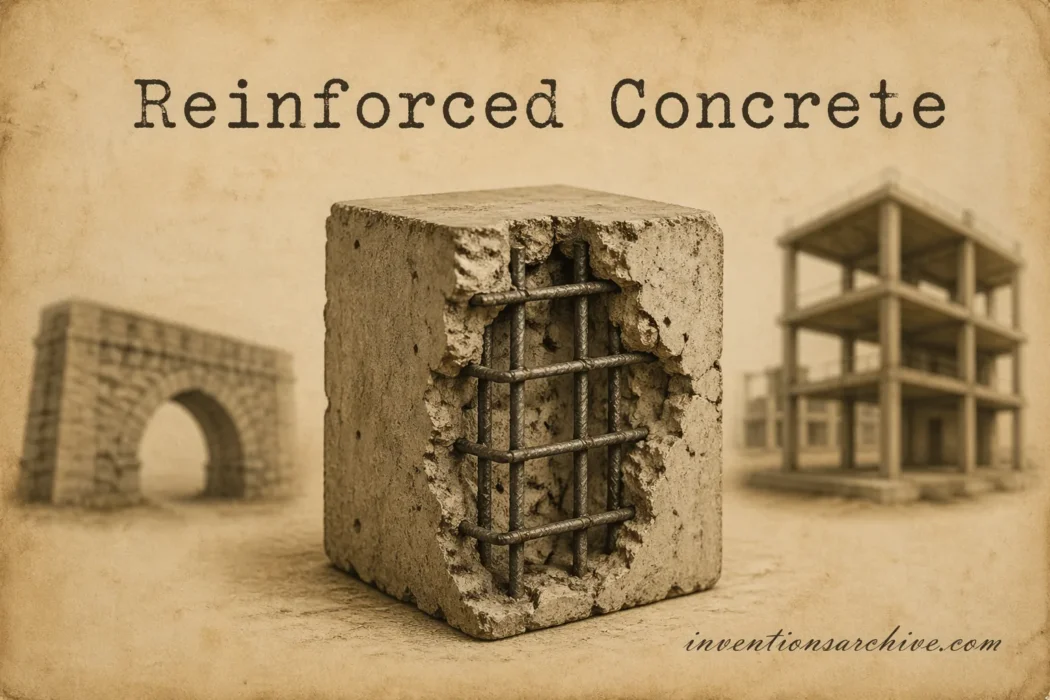
| Invention Name | Reinforced concrete, also called ferroconcrete |
| Short Definition | Concrete strengthened with embedded steel, iron, mesh, bars, or tendons so the two materials share structural loads. |
| Approximate Date / Period | 1850s–1890s development period; 1867 Joseph Monier patent milestone Approximate for invention period; firm for Monier’s 1867 patent record |
| Geography | France and Britain; later rapid use across Europe and the United States |
| Inventor / Source Culture | Not a single-person invention; Joseph Monier is the name most often attached to practical reinforced concrete, while William Wilkinson, Joseph-Louis Lambot, François Coignet, Thaddeus Hyatt, Ernest Ransome, and François Hennebique shaped its spread. |
| Category | Structural material; civil engineering, architecture, transport infrastructure, water systems |
| Need Behind It | Plain concrete handles compression well but handles tension poorly; builders needed wider spans, thinner slabs, fire-resistant floors, durable tanks, and stronger bridges. |
| How It Works | Concrete carries compression; steel reinforcement carries tension and shear forces; bond between the two lets them act as one structural member. |
| Material / Technology Base | Portland cement, aggregates, water, steel rebar, wire mesh, stirrups, tendons; modern variants may use fibers or FRP reinforcement. |
| Early Use Area | Garden tubs, basins, tanks, pipes, floors, bridges, and industrial buildings |
| Why It Matters | • Made concrete useful in bending members • Enabled bridges, high-rise frames, dams, tunnels, factories, parking structures, and urban housing at large scale |
| Spread Route | France → Britain, Germany, Austria, United States; patents, exhibitions, engineering firms, building codes, and cement production pushed adoption. |
| Developments It Led To | Precast concrete, prestressed concrete, post-tensioning, reinforced concrete frames, thin shells, ferrocement, shotcrete, fiber-reinforced concrete |
| Areas Affected | Construction, architecture, transport, sanitation, water supply, factories, housing, ports, dams, public buildings |
| Disputes / Different Views | “First inventor” depends on the question: earliest patent, earliest structure, practical use, or first commercial building system. |
| Predecessors and Successors | Before: stone, brick, timber, cast iron, plain concrete, Roman concrete, hydraulic lime After: reinforced frames, prestressed beams, composite decks, FRP-strengthened members |
| Main People and Systems | Joseph Aspdin, John Smeaton, William Wilkinson, Joseph-Louis Lambot, François Coignet, Joseph Monier, Thaddeus Hyatt, Ernest Ransome, François Hennebique |
| Types Influenced by This Invention | Cast-in-place reinforced concrete, precast reinforced concrete, prestressed concrete, post-tensioned concrete, ferrocement, fiber-reinforced concrete, FRP-reinforced concrete |
A cracked flowerpot is an odd place for a structural revolution to begin, yet reinforced concrete grew from exactly that kind of practical problem: brittle mineral material needed hidden strength. The idea looks simple now. Put metal inside concrete. Let each material do the work it handles best. Behind that plain sentence sits a long chain of experiments, patents, exhibitions, failures, and engineering calculations that changed bridges, factories, apartments, sewers, tunnels, dams, and city skylines.
Reinforced concrete was not born in one clean moment. It came from a cluster of 19th-century experiments in cement, iron, steel, structural floors, tanks, pipes, boats, and bridges. Joseph Monier receives much of the credit because his 1867 patent and later applications made the material visible and useful; still, the full story includes several inventors working around the same problem from different directions.
Contents
What Reinforced Concrete Is
Reinforced concrete is a composite structural material. It combines concrete with embedded reinforcement, usually steel bars, steel mesh, stirrups, or tendons. The concrete and reinforcement do not merely sit together. They work together.
Plain concrete resists squeezing forces very well. Engineers call that compression. A column under vertical weight uses this strength. A bridge beam or floor slab faces a different problem: it bends. One side compresses; the other side stretches. That stretching side needs help. Steel supplies it.
That is the whole trick, almost. Concrete handles the push. Steel handles the pull. The bond between them keeps the member from acting like two separate pieces. Britannica describes reinforced concrete as concrete in which steel is embedded so both materials act together against forces such as tension, shear, and compression (Details-1).
Why the Material Feels So Ordinary Now
Reinforced concrete hides in plain sight. It may be under a polished floor, behind plaster, inside a bridge deck, below a dam spillway, or deep in a subway wall. The public often sees only a gray surface. The invention, though, is not just “concrete.” The invention is the controlled partnership between concrete and reinforcement.
That partnership made concrete bend without giving up its main advantage: it could be poured into forms, shaped around openings, cast into columns and beams, and produced from widely available mineral materials. Not glamorous. Useful, very.
Why Reinforced Concrete Was Invented
The problem was not that builders lacked stone, brick, timber, or iron. They had all of them. The problem was that each material forced a trade-off.
- Stone and brick were strong in compression but heavy and slow to shape into wide spans.
- Timber was flexible and light, yet it burned, rotted, and changed with moisture.
- Cast iron and steel could span longer distances, but exposed metal needed protection and careful fabrication.
- Plain concrete could be molded and resisted compression, but it cracked when stretched.
Urban building in the 19th century pushed these materials hard. Cities needed factories with fire-resistant floors, bridges with longer spans, water tanks, sewers, ports, retaining walls, railway structures, and multi-story buildings. Concrete alone was not enough.
Structural Need
Beams, slabs, arches, and bridges needed a material that could resist both compression and bending.
Urban Need
Growing cities needed durable floors, sewers, reservoirs, tunnels, and fire-resistant public works.
Industrial Need
Factories and mills needed wide rooms, heavier loads, and less dependence on timber.
Early History and Inventors
Reinforced concrete is often linked to Joseph Monier, the French gardener who patented iron-reinforced concrete containers in 1867 and showed his invention at the Paris Exposition. That attribution is fair, but only if the word “inventor” means practical promoter, patent holder, and repeat experimenter. Earlier and parallel work matters too.
Before Reinforcement: Modern Concrete Needed Portland Cement
Reinforced concrete could not become a modern building material until cement technology improved. Portland cement, patented by Joseph Aspdin in 1824, gave builders a more reliable binder for modern concrete. The Science Museum notes that Aspdin’s Portland cement set the standard for modern concrete production, and later became widely used in building and construction (Details-2).
John Smeaton’s hydraulic lime work for the Eddystone Lighthouse in the 1750s also sits in the background. That story belongs more to the history of cement and concrete than to reinforced concrete itself, but it matters. Without dependable binders, there would be no reliable composite material.
William Wilkinson and Early Patents
One early patent belongs to William Wilkinson, a Newcastle plasterer who patented the use of iron bars in concrete in 1854. This matters because it shows that the main idea—metal inside concrete to improve structural use—was already being explored before Monier’s flowerpots entered the record.
Still, a patent is not the same as a mature structural system. Wilkinson’s work did not create the broad engineering culture that later formed around reinforced concrete. It was an early door opening. Others walked through it.
Joseph-Louis Lambot and Ferrocement Boats
Joseph-Louis Lambot experimented with wire-reinforced cement for boats in the 1850s. This branch is often called ferrocement, a close cousin of reinforced concrete that uses thin mortar or concrete with mesh reinforcement. Boats may seem far away from buildings, but they showed the same logic: mineral material gains useful tensile behavior when a metal network holds it together.
François Coignet and Concrete Buildings
François Coignet, a French industrialist and builder, helped move concrete toward architectural and structural use. He worked with concrete houses and structural members in the 1850s and 1860s. His contribution sits in a slightly tricky place. Some of his work used iron elements with concrete, but historians debate how directly those elements performed as reinforcement in the modern engineering sense.
That detail matters. A building can include iron and concrete without using reinforced concrete as engineers later defined it. The true invention was not simply putting metal near concrete. It was making the metal and concrete act together under load.
Joseph Monier and the 1867 Milestone
Joseph Monier was a gardener, not a trained structural engineer. That may be the most human part of the story. His clay and timber garden containers broke, weathered, or failed under use. Concrete containers were stronger, but they still cracked. Monier embedded iron wire into cement and concrete vessels, then expanded the idea to pipes, panels, bridges, floors, and other structural forms.
His 1867 patent is why many references attach the invention of reinforced concrete to his name. A later U.S. patent record for Monier’s construction of tanks, reservoirs, silos, vats, cisterns, pipes, and conduits shows the same practical direction: reinforced concrete was moving from garden ware toward infrastructure (Details-3).
Thaddeus Hyatt, Ernest Ransome, and Engineering Calculation
Practical invention needed calculation. Thaddeus Hyatt, an American engineer, tested iron-and-concrete beams and helped explain how the two materials shared stress. Ernest L. Ransome later used twisted steel bars, improving the bond between steel and concrete. These steps moved reinforced concrete away from clever craft and toward predictable engineering.
Slow work, but necessary. Without testing and stress analysis, reinforced concrete would have remained a useful trick rather than a trusted structural material.
François Hennebique and the Commercial System
François Hennebique turned reinforced concrete into a widely used building system. His 1892 patent and business network helped spread beams, slabs, columns, and frames under a repeatable method. The Science Museum notes that Hennebique’s system was used in Weaver’s Mill in Swansea, completed in 1898, and that his system spread quickly in Britain and Europe (Details-4).
This is why the “who invented reinforced concrete?” question needs care. Monier made the practical principle famous. Hennebique made it commercially repeatable. Hyatt and Ransome helped make it calculable. Wilkinson, Lambot, and Coignet belong to the early experimental ground.
How Reinforced Concrete Works
Concrete and steel solve different parts of the same structural problem.
Compression and Tension
Concrete resists compression. A concrete block under straight downward pressure can carry heavy loads. Tension is different. When concrete stretches, small cracks form easily. A beam stretched at the bottom face may crack even while the top face remains compressed.
Steel reinforcement takes the tensile stress. In a simple reinforced concrete beam, steel bars usually sit near the tension zone. When the beam bends, the steel carries the pull, while concrete carries the push.
Bond Between Concrete and Steel
The material works only when concrete grips the steel. That grip comes from surface friction, chemical adhesion, and mechanical interlock. Modern ribbed rebar improves this bond. Older smooth bars and wires could work, but ribbed bars made force transfer more reliable.
Bond is the quiet part of the invention. Without it, steel would slide inside the concrete, and the two materials would not act as a single member.
Similar Thermal Movement
Steel and concrete expand and contract at roughly compatible rates under normal building conditions. This helps the composite stay together as temperatures change. If one material expanded far more than the other, cracks and internal stress would become much harder to control.
Cracking Is Managed, Not Magically Removed
Reinforced concrete still cracks. That is normal. The aim is to control crack width, location, and load path. Reinforcement keeps cracks from opening too far and lets the member continue carrying load after small cracks appear.
In real structures, engineers manage cracking through reinforcement layout, cover depth, concrete strength, curing, member shape, load assumptions, deflection limits, and exposure conditions. The article does not describe construction steps, because safe reinforced concrete design belongs to trained professionals and regulated codes.
Materials Inside the System
Concrete
Concrete is a mixture of cement, water, fine aggregate, coarse aggregate, and sometimes admixtures. Hydration turns cement and water into a hardened binder that locks aggregates together. The resulting material is dense, moldable before hardening, and strong in compression.
Portland cement became central because it gave modern concrete more predictable performance than many earlier binders. Cement chemistry, aggregate grading, water ratio, curing, and exposure all affect the final material.
Steel Reinforcement
Steel reinforcement appears in several forms:
- Rebar for beams, columns, slabs, walls, foundations, and bridge decks.
- Wire mesh for slabs, shells, and thin sections.
- Stirrups and ties for shear resistance and confinement.
- Prestressing strands for prestressed and post-tensioned concrete.
Steel works well because it has high tensile strength, it bonds with concrete, and concrete’s alkaline environment can protect embedded steel from corrosion. That protection is not permanent in every environment. Moisture, chloride salts, carbonation, poor cover, or cracks can expose steel to corrosion over time.
Modern Additions
Modern reinforced concrete may include fly ash, slag cement, silica fume, plasticizers, corrosion inhibitors, stainless steel, epoxy-coated rebar, glass fiber-reinforced polymer bars, carbon fiber strengthening, or synthetic and steel fibers. These changes serve different needs: durability, lower heat of hydration, lower permeability, crack control, or less corrosion risk.
Related articles: Dry Dock (Song Dynasty Design) [Medieval Inventions Series], Cement Mixer [Industrial Age Inventions Series]
Not every variant suits every structure. A bridge deck near deicing salts faces different exposure than an indoor floor slab. A marine pier faces a different reality again. Salt, water, oxygen, heat, and time have a say.
Types and Variations
Cast-in-Place Reinforced Concrete
Cast-in-place concrete is poured into formwork at the building site around reinforcement already arranged inside the form. It suits columns, walls, slabs, foundations, shear walls, basements, and custom shapes.
Its advantage is continuity. Beams, slabs, and columns can connect into one monolithic frame. That continuity helps buildings resist gravity loads and lateral forces when properly designed.
Precast Reinforced Concrete
Precast concrete is made in a controlled factory or yard, then transported to the site. Beams, panels, piles, pipes, sleepers, façade panels, bridge girders, and hollow-core slabs can all be precast.
Factory control can improve consistency. The trade-off is transport, lifting, joints, and connection design. The joints matter more than they look like they do.
Prestressed Concrete
Prestressed concrete uses steel tendons placed under tension so the concrete starts with built-in compression. This helps long beams and slabs resist bending cracks under service loads.
There are two common branches:
- Pre-tensioned concrete: steel tendons are tensioned before concrete hardens, often in a factory setting.
- Post-tensioned concrete: tendons are tensioned after concrete hardens, often through ducts or sleeves.
This development opened longer spans and thinner members in bridges, parking structures, floors, stadiums, and large roofs.
Ferrocement
Ferrocement uses thin mortar or concrete reinforced with closely spaced wire mesh. It can form curved shells, tanks, boats, and lightweight panels. It sits historically near Lambot’s early boat experiments and technically near modern thin reinforced composites.
Fiber-Reinforced Concrete
Fiber-reinforced concrete contains short fibers distributed through the mix. The fibers may be steel, glass, synthetic, basalt, or natural fibers, depending on the use. Fibers help control cracking and improve toughness, but they do not automatically replace structural rebar in load-bearing members.
FRP-Reinforced and FRP-Strengthened Concrete
FRP means fiber-reinforced polymer. Glass, carbon, or basalt fibers sit inside a resin matrix. FRP bars resist corrosion better than ordinary steel in many environments, and FRP sheets can strengthen existing members. Their behavior differs from steel, especially in stiffness and failure mode, so engineers treat them as a separate design material, not just a steel substitute.
Timeline of Development
| Date / Period | Person or Event | Why It Matters |
|---|---|---|
| 1750s | John Smeaton | Improved hydraulic lime for the Eddystone Lighthouse, an early step toward reliable modern concrete binders. |
| 1824 | Joseph Aspdin | Patented Portland cement, later central to modern concrete. |
| 1850s | Lambot, Wilkinson, Coignet | Explored iron, wire, or bars with cement and concrete for boats, floors, houses, and early structural forms. |
| 1867 | Joseph Monier | Patented iron-reinforced cement/concrete containers and exhibited the idea in Paris. |
| 1870s | Monier, Hyatt, Ransome, Ward | Reinforced concrete moved into bridges, floors, testing, and early American structures. |
| 1892 | François Hennebique | Patented a widely adopted reinforced concrete building system. |
| Early 1900s | Codes, firms, cement industry | Reinforced concrete became a standard material for buildings, bridges, pipes, tanks, and public works. |
Impact on Buildings and Cities
Wider Spans and New Floor Systems
Reinforced concrete changed the floor. That sounds small, but floors define buildings. Stronger slabs and beams allowed wider rooms, fewer supports, heavier machines, and more flexible layouts. Factories, warehouses, schools, hospitals, and offices all benefited.
Fire resistance also mattered. A timber-framed industrial floor could burn quickly. Reinforced concrete offered a safer alternative for many urban and industrial structures, provided the reinforcement had proper cover and the structure followed sound design.
Bridges, Dams, and Transport Infrastructure
Bridges used reinforced concrete for decks, arches, beams, piers, and later prestressed girders. Railways used it for sleepers, culverts, retaining walls, and station structures. Roads used it for bridges, pavements, overpasses, sound walls, and drainage works.
Once engineers trusted the material, it spread into places where stone or iron had been costly, slow, or awkward. It gave infrastructure a new grammar: cast, repeat, reinforce, connect.
Water, Sewers, and Sanitation
Reinforced concrete suited tanks, reservoirs, pipes, conduits, culverts, and sewer works. These uses connect directly to Monier’s early containers and later patent records. Water infrastructure needed material that could be shaped, sealed, and made strong enough for soil pressure and internal loads.
Architecture and Form
Architects used reinforced concrete for flat slabs, cantilevers, curved shells, exposed frames, roof forms, and façade systems. In the 20th century, it shaped everything from apartment blocks to civic halls and stadiums.
The material allowed blunt forms and delicate ones. It could look heavy, yes, but it could also form thin shells and long spans with surprising grace. Robert Maillart’s bridges and later concrete shell structures showed that reinforced concrete was not only a cheap substitute for masonry or steel. In skilled hands, it became its own design language.
Limits and Long-Term Issues
Reinforced concrete is useful, but it is not magic stone. Its long-term behavior depends on design, materials, workmanship, exposure, maintenance, and time.
Corrosion of Reinforcement
Concrete usually protects steel because fresh concrete is alkaline. The problem begins when carbonation lowers alkalinity or chloride salts reach the steel. Moisture and oxygen then support corrosion. Rust expands, cracks the surrounding concrete, and can lead to spalling.
The University of New South Wales explains this durability issue plainly: steel reinforcement can rust when hidden inside concrete, and that corrosion can damage structures in ways that are hard to see early (Details-5).
Carbon Footprint
Cement production uses high-temperature kilns and releases carbon dioxide during both fuel use and limestone chemistry. Reinforced concrete’s scale is the issue. The material became common because it works and can be made almost everywhere. That same scale gives it a large environmental footprint.
Modern research focuses on lower-carbon cement blends, better durability, longer service life, recycled aggregates where suitable, optimized structural design, and repair methods that extend the life of existing structures. The goal is not to pretend the material has no cost. It is to use it with sharper judgment.
Design and Workmanship
Reinforced concrete can fail when design assumptions, reinforcement placement, cover depth, curing, concrete quality, or exposure control go wrong. A small error may sit hidden for years. Then water finds it. Salt follows. A crack grows.
Good reinforced concrete depends on invisible accuracy. Bar spacing, cover, anchorage, lap length, concrete compaction, curing, and inspection all affect the final structure. For readers, the main point is simple: reinforced concrete is a professionally designed structural system, not merely concrete with metal inside.
Why the Invention Was Hard To Replace
Reinforced concrete took hold because it matched several needs at once. It was moldable, strong, familiar to contractors, adaptable to many shapes, and often cheaper than fully steel or stone alternatives. Cement and aggregate could be sourced locally in many regions. Steel reinforcement used less metal than a full steel frame in some applications.
That mix of advantages made it hard to dislodge. Even when better choices exist for certain uses, reinforced concrete remains a default material because the industry knows it well. Engineers know how to model it. Building codes cover it. Contractors know how to place it. Suppliers can deliver it. This practical ecosystem is part of the invention’s legacy.
Common Misunderstandings About Reinforced Concrete
It Is Not the Same as Plain Concrete
Plain concrete and reinforced concrete are related, but they do different jobs. Plain concrete works well in compression-heavy elements such as mass foundations, gravity dams, and pavements under some conditions. Reinforced concrete handles bending, tension, shear, and structural continuity far better.
Steel Does Not Make Concrete “Unbreakable”
Reinforcement controls cracking and adds tensile capacity. It does not remove every weakness. Loads, corrosion, fire exposure, freeze-thaw cycles, poor workmanship, and chemical attack can still harm a structure.
The First Inventor Question Has No Single Clean Answer
Ask “who patented an early form?” and Wilkinson enters. Ask “who made early iron-reinforced concrete structures?” and Coignet appears. Ask “who made the practical principle famous?” and Monier stands near the center. Ask “who made it a repeatable building system?” and Hennebique deserves attention.
The honest answer is a chain, not a lone statue.
FAQ About Reinforced Concrete
Who invented reinforced concrete?
Joseph Monier is the person most commonly credited with the practical invention of reinforced concrete because of his 1867 patent for iron-reinforced concrete garden containers and his later applications. The wider history also includes William Wilkinson, Joseph-Louis Lambot, François Coignet, Thaddeus Hyatt, Ernest Ransome, and François Hennebique.
When was reinforced concrete invented?
The invention developed through the 1850s, 1860s, and 1890s. Monier’s 1867 patent is a major date, while Hennebique’s 1892 system helped reinforced concrete become widely used in buildings.
Why is steel used in reinforced concrete?
Steel has high tensile strength. Concrete resists compression well but cracks more easily under tension. When steel is embedded and bonded inside concrete, the combined material can resist bending and stretching far better than plain concrete.
What is the difference between reinforced concrete and prestressed concrete?
Reinforced concrete uses passive reinforcement that carries tension after loads act on the member. Prestressed concrete uses tensioned steel tendons to place the concrete into compression before or after hardening, which helps control cracking and allows longer spans.
Is reinforced concrete still used today?
Yes. Reinforced concrete remains widely used in buildings, bridges, tunnels, foundations, dams, sewers, tanks, roads, and marine structures. Modern use focuses more strongly on durability, corrosion control, lower-carbon binders, and longer service life.
What are the main types of reinforced concrete?
Main types include cast-in-place reinforced concrete, precast reinforced concrete, prestressed concrete, post-tensioned concrete, ferrocement, fiber-reinforced concrete, and FRP-reinforced or FRP-strengthened concrete.