
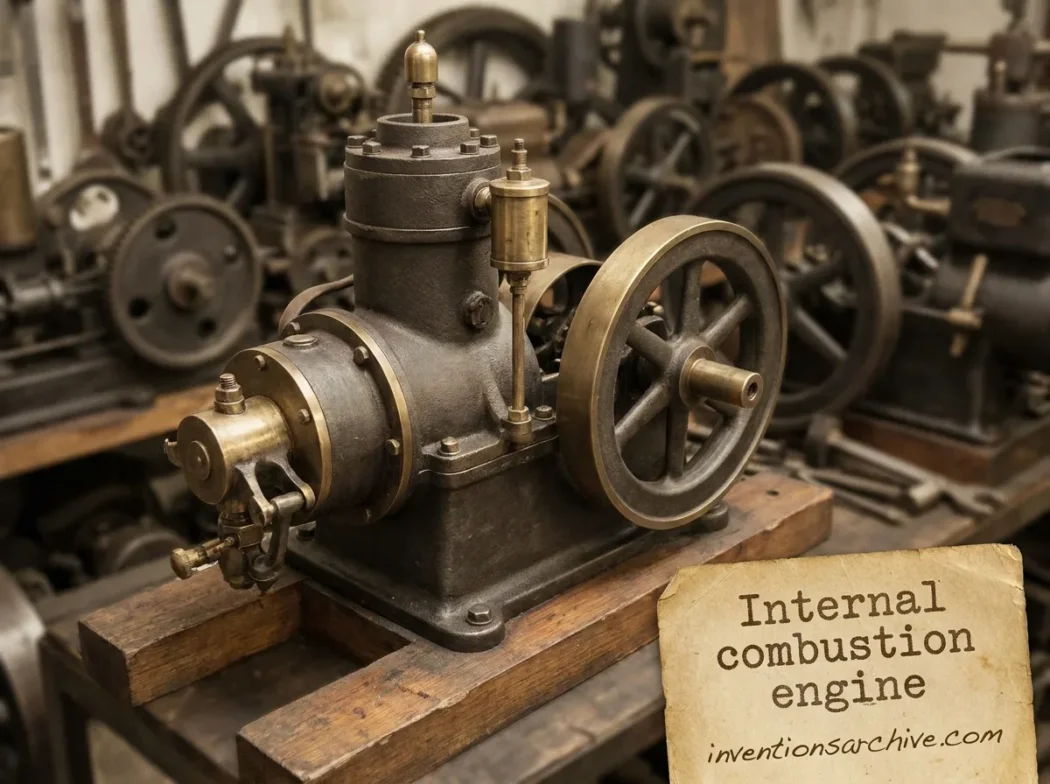
| Invention Name | Internal combustion engine |
|---|---|
| Short Definition | A heat engine that burns fuel inside the engine so expanding gases can produce mechanical work. |
| Approximate Date / Period | Practical gas engines: 1860s; commercially successful atmospheric engines: late 1860s; practical four-stroke engine: 1876 Attribution varies |
| Geography | France, Germany, Britain and wider industrial Europe |
| Inventor / Source Culture | Collective development; closely linked with Étienne Lenoir, Pierre Hugon, Nikolaus Otto, Eugen Langen, Crossley Brothers, Carl Benz, Gottlieb Daimler, Wilhelm Maybach and Rudolf Diesel |
| Category | Energy, transport, manufacturing, power machinery |
| Main Problem Solved | Provided a smaller, more direct power source than many steam systems for workshops, vehicles, pumps and later mobile machines. |
| How It Works | Fuel and air burn inside a cylinder or chamber; expanding gases push a piston, turbine blade, rotor or nozzle. |
| Material / Technical Base | Cast iron, steel, cylinders, pistons, crankshafts, valves, ignition systems, fuel-air control and later fuel injection |
| Early Uses | Stationary workshop power, small industrial machinery, pumps, bakery and factory equipment, then road vehicles |
| Evidence Status | Based on surviving evidence Early drawings, patents, museum objects and later collection records support different stages, not one single birth date. |
| Development Path | Gunpowder/vacuum experiments → gas engines → atmospheric engines → four-stroke Otto engine → gasoline vehicles → diesel and modern engine systems |
| Related Inventions | Steam engine, spark plug, carburetor, fuel injection, automobile, diesel engine, gas turbine |
| Modern Descendants | Gasoline engines, diesel engines, marine engines, aircraft piston engines, gas turbines, hybrid powertrains and generator engines |
| Main Impact | Changed small-scale power, road transport, agricultural machinery, shipping, aviation and mobile electricity generation. |
What the Internal Combustion Engine Is
An internal combustion engine is a machine that turns the energy released by burning fuel into motion. The burning happens inside the engine itself, not in a separate boiler. In a piston engine, the pressure from hot expanding gases pushes a piston, and the piston turns a crankshaft through a connecting rod.
This is the main difference between internal combustion and external combustion. A steam engine usually burns fuel outside the cylinder to heat water into steam. An internal combustion engine burns the fuel-air mixture inside the working space of the engine.
The U.S. Department of Energy describes the basic process in clear terms: combustion happens within the engine, expanding gases push a piston, and that motion can turn a crankshaft and drive a vehicle through a powertrain. It also distinguishes spark-ignition gasoline engines from compression-ignition diesel engines.[a]
How the Origin Is Traced
The earliest line of evidence is not a car engine. It is a much older idea: using combustion inside a closed space to produce motion. A Royal Society record preserves a 1688 manuscript drawing by Denis Papin of a machine to raise weights by gunpowder, with a description linking it to earlier trials of Christiaan Huygens’s similar engine in Paris.[b]
These early machines matter because they show the idea of using combustion inside a chamber. Yet they were not practical modern engines. They used explosive powder and vacuum effects, not a repeatable fuel-air cycle suitable for ordinary work.
The practical nineteenth-century story begins with gas engines. The Science Museum Group’s record for the 1867 Hugon gas engine notes that the Lenoir engine was known as the first practically successful gas engine, while Hugon’s design differed mainly in its flame ignition rather than electric ignition.[c]
The Problem It Answered
Before practical internal combustion engines, many workshops and factories relied on steam engines, water power, animal power, human labor or line-shaft systems driven from a central source. These worked, but they had limits.
- Steam engines needed boilers, water, time to raise steam and safety oversight.
- Water wheels depended on location and water flow.
- Animal and human power could not supply steady mechanical power at industrial scale.
- Early electric motors required electrical infrastructure that was not yet widely available.
The internal combustion engine offered a different kind of power: smaller, more local and easier to adapt to moving machines. It did not immediately replace every steam engine. Large steam systems remained valuable. But for small workshops, road vehicles, pumps, boats and later aircraft, internal combustion opened a new path.
| Before the Invention | What Changed After It |
|---|---|
| Power often came from steam, water, animals or hand labor. | Small engines could provide local mechanical power without a large boiler system. |
| Many machines were fixed near power sources or line shafts. | Engines could be placed in workshops, vehicles, boats and portable equipment. |
| Steam road transport was heavy and slow to prepare. | Gasoline engines made lighter self-propelled vehicles more practical. |
| Early gas engines were noisy, inefficient or hard to control. | The four-stroke cycle made compression, ignition and exhaust more orderly. |
| Industrial power was often centralized. | Power could be distributed through many smaller engines in different places. |
How It Worked in Simple Terms
In a common piston internal combustion engine, the cylinder is the working chamber. A piston moves inside it. A controlled fuel-air charge enters, burns, expands and pushes the piston. That push becomes rotary motion through the crankshaft.
The classic four-stroke pattern is easy to describe without turning it into a build instruction:
- Intake: the engine receives air, or an air-fuel mixture.
- Compression: the piston compresses the charge or the air.
- Power: combustion creates pressure that pushes the piston.
- Exhaust: spent gases leave the cylinder.
That pattern is linked to the Otto cycle in spark-ignition engines. Diesel engines follow a different ignition method: the air is compressed strongly enough to become hot, and fuel then ignites in that hot compressed air.
Earlier Ideas and Tools Before It
The internal combustion engine did not appear from nowhere. It borrowed from older mechanical and scientific traditions.
- Pistons and cylinders were already familiar through pumps and steam engines.
- Cranks and connecting rods gave engineers a way to turn back-and-forth motion into rotary motion.
- Gas lighting networks helped make fuel gas available in cities before gasoline engines spread widely.
- Ignition experiments showed different ways to start combustion, including electric spark and flame systems.
- Machine-tool improvement made tighter metal parts more realistic than in earlier centuries.
The real advance was not one part alone. It was the controlled joining of fuel, air, ignition, pressure, motion and timing into an engine that could repeat its cycle.
Development Path
The invention is best read as a chain. Each stage answered a problem left by the earlier stage.
| Stage | Form | What Changed |
|---|---|---|
| Early Idea | Gunpowder and vacuum experiments | Showed that combustion inside a chamber could move a piston or raise a load, but not yet in a practical engine cycle. |
| Practical Gas Engine | Lenoir and related gas engines | Used fuel gas and ignition in a working mechanical engine, though efficiency and control remained limited. |
| Commercial Gas Engine | Otto and Langen atmospheric engine | Made internal combustion commercially usable for stationary work. |
| Four-Stroke Form | Otto four-stroke gas engine | Added a more orderly cycle of intake, compression, power and exhaust. |
| Vehicle Use | Gasoline-powered road vehicles | Connected compact engines with lightweight vehicle frames, ignition systems and power transmission. |
| Compression Ignition | Diesel engine line | Used high compression and fuel injection instead of spark ignition. |
| Modern Descendants | Gasoline, diesel, gas turbine, rotary and hybrid engine systems | Extended internal combustion into road transport, aviation, marine power, industry and electricity generation. |
From Gas Engines to Commercial Power
One reason short summaries can mislead readers is that “first engine” and “first successful engine” are not the same thing. A device may prove an idea, yet still fail as a useful machine.
Otto and Langen’s atmospheric gas engine is a major step because it was commercially successful. The Science Museum Group records that Crossley Brothers built engines under Otto and Langen’s patent, held manufacturing rights outside Germany, and made about 1,300 atmospheric engines from 1869 onward.[d]
Those engines were not modern car engines. They were large stationary machines. Their importance was practical: they showed that internal combustion could move from experimental machinery into real work settings such as bakeries, workshops and small factories.
The Otto Four-Stroke Breakthrough
Nikolaus Otto’s four-stroke engine is often treated as the center of the story because it shaped the later piston engine. Its value was not only that it burned fuel inside a cylinder. Earlier gas engines had already done that. The important change was the controlled cycle, especially compression before ignition.
The Science Museum Group describes Otto’s 1876 four-stroke engine as the first four-stroke engine and notes that the principle of compressing fuel and air before ignition is still used in present-day internal combustion engines.[e]
This helped make the engine more useful, more efficient and more adaptable. The four-stroke cycle also gave later engineers a clearer pattern for designing valves, ignition timing, crankshaft motion and fuel control.
The Otto Four-Stroke Engine at 150 Years
In 2026, 150 years had passed since the 1876 patent milestone associated with Nikolaus August Otto’s four-stroke principle. The anniversary belongs to the practical development of the compressed-charge four-stroke cycle, not to the entire history of internal combustion. Earlier gas engines, atmospheric engines, and combustion experiments had already established other parts of the development line.
A surviving Crossley engine in the Science Museum Group collection shows how the principle moved into ordinary industrial service. The museum identifies the engine type as an early machine working on Otto’s four-stroke principle and describes that principle as a direct ancestor of later piston internal-combustion engines. [h]
The early Otto-cycle engines were commonly stationary gas engines used in workshops and industrial sites. Their historical value lies in making a repeatable four-stroke sequence practical: intake, compression, power, and exhaust. Later engineers changed the fuel, ignition system, speed, size, cooling, materials, and intended use.
From Stationary Engine to Road Vehicle
The internal combustion engine became more visible when it entered road transport. Carl Benz’s Patent Motor Car showed how a gasoline engine, chassis, ignition, cooling and transmission could be designed as one vehicle system rather than as a horse carriage with a motor attached.
Related articles: Crank Handle [Medieval Inventions Series], Chimney [Medieval Inventions Series]
Mercedes-Benz’s historical record states that Benz applied for the patent for his “vehicle powered by a gas engine” on January 29, 1886, that the patent number was 37435, and that newspapers reported the first public outing of the three-wheeled Benz Patent Motor Car in July 1886.[f]
Gottlieb Daimler and Wilhelm Maybach worked on high-speed engines for mobile use around the same period. Their work matters because vehicle engines needed to be smaller, faster-running and lighter than many stationary engines.
Main Types and Variations
“Internal combustion engine” is a broad term. It includes several engine families that share the same basic idea but differ in fuel, ignition, motion and use.
| Type or Variation | Basic Principle | Common Uses |
|---|---|---|
| Spark-Ignition Piston Engine | Fuel-air mixture is ignited by a spark. | Cars, motorcycles, small machines, light aircraft |
| Compression-Ignition Diesel Engine | Air is compressed until hot; injected fuel ignites in the hot air. | Trucks, ships, trains, generators, heavy machinery |
| Four-Stroke Engine | Intake, compression, power and exhaust happen in four piston strokes. | Most modern road-vehicle piston engines |
| Two-Stroke Engine | Power cycle is completed in fewer piston movements. | Small engines, some motorcycles, marine and industrial uses |
| Gas Turbine | Combustion gases turn turbine blades rather than pushing a piston. | Aircraft, power generation, some marine and industrial systems |
| Rotary Engine | A rotor moves inside a shaped chamber instead of a reciprocating piston. | Limited automotive and specialist uses |
| Gas Engine | Burns gaseous fuel such as coal gas, natural gas or producer gas. | Early stationary engines, industrial power, generators |
Diesel and the Next Stage
Rudolf Diesel’s work created a separate internal-combustion line based on compression ignition. The German Historical Museum’s record of Diesel’s patent writing identifies the title as “Arbeitsverfahren und Ausführungsart für Verbrennungskraftmaschinen,” patented from February 28, 1892 and issued on February 23, 1893 as Patent No. 67207.[g]
The diesel engine did not replace the Otto-type gasoline engine. It served different needs. Because compression-ignition engines became useful for heavy work, they found long-term roles in trucks, locomotives, ships, industrial machinery and generators.
Real Use Context
The internal combustion engine first mattered where a compact source of mechanical power was useful. Early gas engines were often stationary. They powered machines in workshops, small factories, bakeries and industrial rooms where a steam plant might be too large or inconvenient.
Once gasoline engines became lighter and faster, the setting changed. Engines moved into:
- Road transport: cars, motorcycles, buses and trucks
- Agriculture: tractors, pumps and portable machinery
- Marine power: small boats, later larger diesel-powered vessels
- Aviation: piston aircraft engines and later gas turbines
- Electricity generation: standby generators and remote power systems
- Industry: compressors, pumps and machine drives
This broad spread explains why the invention shaped more than transport. It changed where power could be placed.
What Changed Because of It
The internal combustion engine made useful power more mobile. That is its central historical effect. It allowed engines to be placed inside vehicles, boats, aircraft and portable equipment, rather than tied to a fixed boiler room or water source.
Its long-term effects included:
- More flexible manufacturing: smaller engines could run individual machines or local equipment.
- Road mobility: the engine helped create practical automobiles, trucks and motorcycles.
- Farm mechanization: tractors and powered equipment changed agricultural work.
- Faster goods movement: trucks and diesel locomotives changed distribution and freight.
- New engineering fields: engine design led to advances in fuels, lubrication, ignition, cooling, metallurgy, emissions control and testing.
The effects were not only technical. Roads, repair trades, fuel supply, driver training, traffic rules and vehicle manufacturing all grew around this engine family.
Common Misunderstandings
“Otto Invented the Whole Engine”
Otto’s four-stroke engine was deeply influential, but internal combustion had earlier gas-engine and experimental roots. His role is strongest in the practical four-stroke piston-engine line.
“The First Evidence Means the First Use”
Surviving drawings, patents and museum objects show what is currently documented. They do not always prove the first moment anyone tried an idea.
“Internal Combustion Means Only Car Engines”
Car engines are the most familiar example, but the category also includes stationary gas engines, diesel engines, marine engines, aircraft engines, gas turbines and generator engines.
“Diesel Engines Are a Separate Kind of Machine”
Diesel engines are internal combustion engines. Their difference is the ignition method: they use compression heat instead of a spark to ignite fuel.
Related Inventions
The internal combustion engine sits inside a wider chain of inventions. These related technologies help explain why it could develop and why it became useful.
- Steam engine: the older heat-engine tradition that shaped pistons, cylinders and industrial power.
- Gas lighting and fuel-gas systems: helped make early gas engines practical in urban settings.
- Spark plug and electric ignition: supported controlled ignition in moving engines.
- Carburetor: helped early gasoline engines prepare a fuel-air mixture.
- Fuel injection: became central to diesel engines and later modern engine control.
- Automobile: turned the engine into a transport technology.
- Diesel engine: extended internal combustion into heavy-duty compression-ignition power.
- Gas turbine: moved internal combustion into high-speed turbine systems, especially aviation and power generation.
Frequently Asked Questions
Who invented the internal combustion engine?
No single person invented the entire category. The history includes early combustion experiments, Lenoir’s practical gas engine, Otto and Langen’s commercial atmospheric engine, Otto’s four-stroke engine, Benz and Daimler’s vehicle work, and Diesel’s compression-ignition engine.
Why was the Otto four-stroke engine important?
The Otto four-stroke engine gave the piston engine a more effective cycle: intake, compression, power and exhaust. Compression before ignition helped make later gasoline engines more efficient and practical.
Is a diesel engine an internal combustion engine?
Yes. A diesel engine is an internal combustion engine. It differs from a spark-ignition gasoline engine because fuel ignites from the heat of highly compressed air rather than from a spark plug.
What came before internal combustion engines?
Before practical internal combustion engines, people used steam engines, water wheels, animal power, human labor and centralized mechanical drive systems. These remained useful, but they were less suited to many small or mobile machines.
Why did internal combustion engines spread so widely?
They spread because they offered compact, repeatable power that could be placed inside vehicles, boats, tractors, pumps, generators and many other machines. Their usefulness grew as fuels, ignition, cooling, lubrication and manufacturing improved.
Sources and Verification
- [a] Internal Combustion Engine Basics | Department of Energy — Used to verify the basic definition, piston-and-crankshaft explanation, and the distinction between spark-ignition and compression-ignition engines. (Reliable because it is an official U.S. Department of Energy educational source.)
- [b] Machine to raise weights by gunpowder | Royal Society Picture Library — Used to verify the surviving Royal Society record for Papin’s drawing and its connection to Huygens’s earlier gunpowder-engine trials. (Reliable because it is an official Royal Society archive record.)
- [c] Hugon Gas Engine, 1867 | Science Museum Group Collection — Used to verify the Lenoir/Hugon gas-engine context and the difference between electric and flame ignition systems. (Reliable because it is an official Science Museum Group collection record.)
- [d] Crossley Brothers Atmospheric Gas Engine | Science Museum Group Collection — Used to verify Otto and Langen’s atmospheric gas engine, Crossley Brothers’ manufacturing role, and early commercial diffusion. (Reliable because it is an official museum collection record.)
- [e] Replica Otto Four-Stroke Engine | Science Museum Group Collection — Used to verify Otto’s 1876 four-stroke engine and the importance of compression before ignition. (Reliable because it is an official Science Museum Group collection record.)
- [f] [g] Patentschrift eines Arbeitsverfahrens und einer Ausführungsart für Verbrennungskraftmaschinen — Used to verify Rudolf Diesel’s 1892/1893 patent writing and Patent No. 67207. (Reliable because it is a museum object record from LeMO / Deutsches Historisches Museum.)
- [h] Crossley Horizontal Single-cylinder Engine — Used to verify the 1876 patent context of Otto’s four-stroke principle and its place in the development of later piston internal-combustion engines. (Reliable because it is an official Science Museum Group collection record for a surviving historical engine.)