
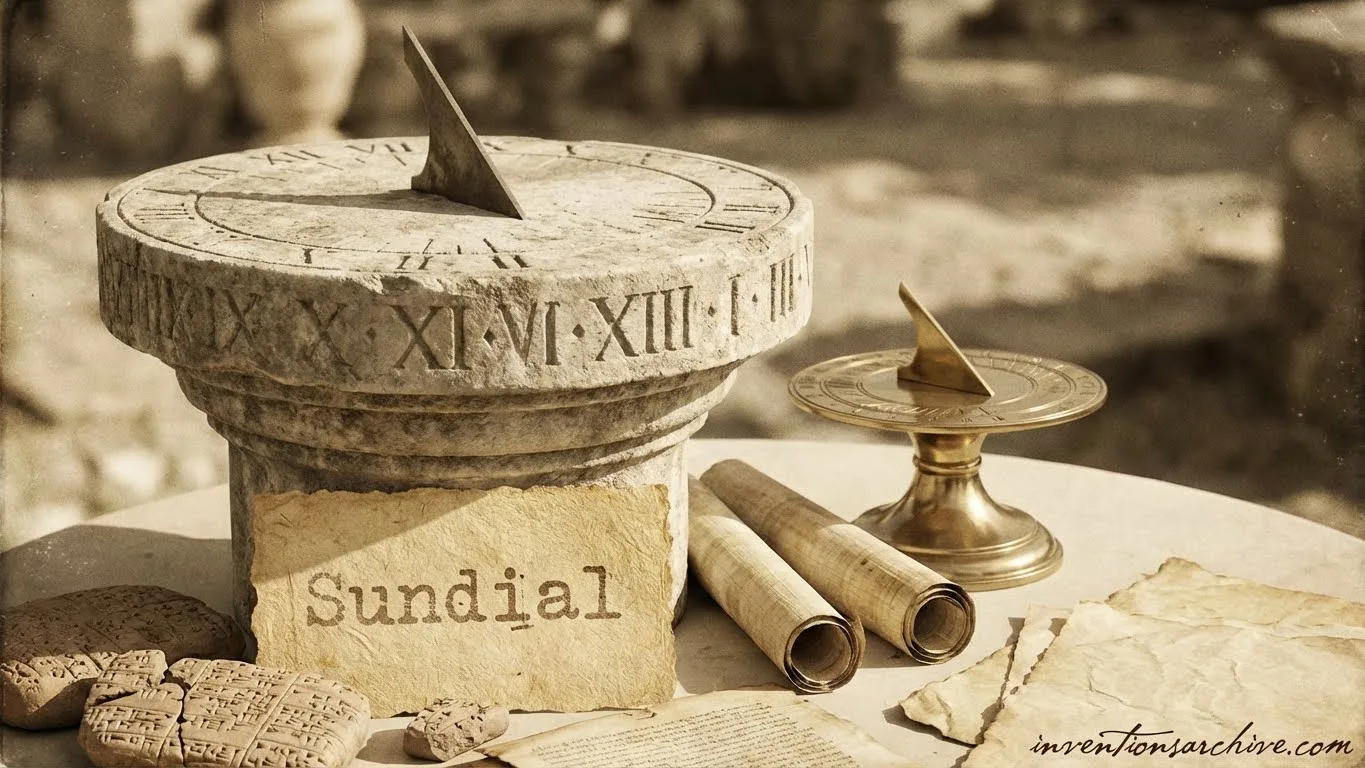
| Invention Name | Sundial |
|---|---|
| Short Definition | A time-measuring instrument that uses the Sun’s apparent movement and the shadow of a gnomon to show local solar time. |
| Approximate Date / Period | Early evidence around 1500 BCE Based on surviving evidence |
| Geography | Ancient Egypt; later used in Babylonia, Greece, Rome, the Islamic world, Europe, and many other regions |
| Inventor / Source Culture | Anonymous / collective development Attribution varies |
| Category | Measurement, astronomy, science, daily timekeeping |
| Evidence Status | Earliest known examples are archaeological and museum-based, not tied to one named inventor |
| Main Problem Solved | Dividing daylight into usable parts for work, ritual, observation, administration, and daily coordination |
| How It Works | A gnomon casts a moving shadow across marked hour lines as the Sun appears to move across the sky |
| Material / Technical Base | Stone, metal, wood, ivory, marble, brass; geometry, shadow, latitude, solar motion |
| Early Use Areas | Daylight timekeeping, temple routines, civic spaces, gardens, observatories, travel, clock setting |
| Development Path | Shadow stick → marked shadow clock → fixed sundial → portable sundial → clock-regulating instrument |
| Related Inventions | Water clock, obelisk, astrolabe, mechanical clock, compass dial, astronomical instruments |
| Surviving Evidence | Stone dials, museum objects, Roman portable dials, Renaissance diptych dials, technical records |
| Modern Descendants | Mechanical clocks, public timekeeping systems, solar time studies, garden dials, educational astronomy tools |
| Why It Matters | It made daylight measurable in a repeatable way and linked ordinary timekeeping to astronomy |
A sundial is one of the earliest known instruments for turning the movement of the Sun into readable time. Its principle is simple, but the history behind it is careful and layered. A raised part called the gnomon casts a shadow onto a marked surface. As the Sun appears to move across the sky, that shadow shifts across the lines of the dial. The result is not modern clock time. It is local solar time, tied to the position of the Sun at a particular place.
The strength of the sundial came from its use of a natural pattern. People did not need gears, fuel, writing systems, or electricity to notice the movement of shadows. What made the sundial an invention was the act of fixing that observation into a reliable object: a surface, a shadow-caster, and a set of marks that could be read again and again.
What a Sundial Is
A sundial is a timekeeping instrument that measures the passing of daylight by the position of a shadow. In its most familiar form, it has two main parts:
- The gnomon: the raised edge, rod, triangle, or pointer that casts the shadow.
- The dial plate: the marked surface where the shadow falls.
The shadow does not move by accident. It moves because Earth rotates, making the Sun appear to travel across the sky. In accurate sundials, the gnomon is often aligned with Earth’s rotational axis, which helps the shadow follow a repeatable daily pattern through the seasons.[b]
This is why a sundial is both a practical object and an astronomical instrument. It connects an ordinary task, telling time, to the larger geometry of Earth, Sun, latitude, and season.
How Its Origin Is Traced
The origin of the sundial is traced through a mix of archaeology, surviving objects, museum collections, written references, and later scientific interpretation. The earliest simple shadow devices may not have survived. A stick in the ground, a marked floor, or a temporary line scratched into soil would leave little or no archaeological record.
More durable objects do survive. Egyptian stone dials, later Greek and Roman sundials, and Renaissance portable instruments show that the idea was reshaped many times. Some objects were fixed in one place. Others were small enough to carry. Some were made for ordinary daylight division; others were made for educated users who understood latitude, date, and local solar correction.
A British Museum object from Ptolemaic Egypt, for example, preserves part of a black granite sundial with a square gnomon and inscriptions. It is not the earliest sundial, but it shows that sundials could be made as carefully worked objects, with religious, decorative, and technical features combined in one instrument.[c]
The Problem It Answered
Before formal timekeeping instruments, people could judge the day by sunrise, noon, sunset, hunger, work rhythm, or the changing height of the Sun. Those clues were useful, but they were not precise enough for many shared activities.
The sundial answered a practical need: it gave daylight a visible structure. It helped people divide the day into parts that could be named, repeated, and compared.
What Needed to Be Measured
- Work periods in daylight
- Market and civic routines
- Religious or temple schedules
- Observation times for astronomy
- Public and private daily coordination
- Later, the setting and checking of mechanical clocks
This did not make time perfectly uniform. Early sundials often measured daylight hours that changed with the seasons. A summer daylight hour could be longer than a winter daylight hour. That seems strange beside modern clocks, but it matched the lived rhythm of daylight-based societies.
How a Sundial Worked in Simple Terms
A sundial works by making a shadow readable. When sunlight strikes the gnomon, the gnomon blocks part of the light and creates a shadow. The shadow falls on a marked surface. As the Sun’s apparent position changes, the shadow moves.
The basic reading process was simple: the user looked at where the shadow touched the hour lines. The deeper geometry was less simple. A sundial had to account for the place where it was used. A dial made for one latitude might not work correctly somewhere else unless it was designed to be adjustable.
The Main Technical Principle
The most accurate common sundials use an angled gnomon aligned with Earth’s axis. This alignment lets the shadow follow hour lines more consistently across the year. A flat vertical stick can show noon well, but it does not automatically produce accurate hour readings in all seasons.
This difference matters. A sundial is not just a pole and a shadow. A reliable sundial is a geometric instrument.
| Shadow Observation | Sundial |
|---|---|
| Uses a changing shadow as a rough sign of time | Uses a marked surface to make shadow movement readable |
| May not have fixed hour divisions | Includes planned hour lines or marked intervals |
| Works as a general daily clue | Works as a repeatable timekeeping instrument |
| Often temporary or informal | Often built from stone, metal, wood, ivory, or marble |
Earlier Ideas and Tools Before It
The sundial grew from older and simpler observations. People watched shadows long before they built formal timekeeping instruments. A tree, a standing stone, an obelisk, a post, or a building edge could all show the movement of the Sun.
Earlier Forms That Helped Make It Possible
- Shadow sticks: simple upright markers used to observe changing shadow length and direction.
- Obelisks and standing markers: large fixed objects that could mark noon or seasonal shadow patterns.
- Marked ground or stone surfaces: early attempts to make shadow positions repeatable.
- Astronomical observation: knowledge of the Sun’s daily and seasonal movement.
- Water clocks: another early timekeeping system, useful when sunlight was not available.
The sundial did not replace every older method at once. It joined a wider set of timekeeping tools. Water clocks were useful indoors, at night, or when the sky was cloudy. Sundials were especially useful when sunlight was strong and the instrument was correctly placed.
Before and After the Sundial
The sundial changed timekeeping by making daylight time visible and shareable. The change was practical rather than dramatic. It did not create modern punctuality. It gave communities a more reliable way to divide the visible day.
| Before the Invention | What Changed After It |
|---|---|
| People judged time from sunrise, sunset, shadow length, and daily routine. | Daylight could be divided into marked intervals on a physical instrument. |
| Shadow observation was often informal. | Hour lines made readings more repeatable and easier to share. |
| Public coordination depended on broad parts of the day. | Civic, religious, work, and observation schedules could use clearer daylight divisions. |
| Portable timekeeping was limited. | Later portable sundials allowed travelers and scholars to carry solar time instruments. |
| Mechanical clocks had no easy natural check in early use. | Sundials later helped set and regulate clocks that were still inaccurate. |
Main Materials and Technical Features
Sundials were made from materials that matched their setting. Public dials were often stone or marble. Portable dials used lighter materials such as wood, ivory, brass, or other metals. The material mattered, but the geometry mattered more.
Related articles: Mechanical Bell Tower [Medieval Inventions Series], Hourglass [Medieval Inventions Series]
Common Parts
- Gnomon: the shadow-casting element.
- Style: the exact edge or line of the gnomon used to read the time.
- Dial plate: the surface marked with hour lines.
- Hour lines: marks that correspond to the shadow’s expected position.
- Latitude setting: needed for many accurate and portable designs.
- Date or seasonal adjustment: present in some more advanced dials.
The most refined sundials were not casual objects. They belonged to the same family as mathematical instruments, astronomical tools, and surveying devices. Their makers needed practical geometry, not just craft skill.
Early Uses
Early sundials helped people organize daylight. They were useful wherever sunlight and regular scheduling mattered. In Egypt and other ancient cultures, shadow-based timekeeping supported daily order, religious timing, work periods, and observation.
NIST describes early timekeeping as a response to ordinary social needs: agriculture, rituals, markets, workdays, schedules, and the growing need for coordination. It also notes that ancient Egyptians used the regular movement of the Sun’s shadows to track the day, while night timekeeping remained harder.[d]
Where Sundials Were Used
- Temple and ceremonial spaces
- Public squares and civic settings
- Gardens and architectural spaces
- Schools, observatories, and scholarly settings
- Private homes of wealthy or educated users
- Travel, in the form of portable dials
How It Spread and Changed Over Time
The sundial spread because the principle was simple, but each region could adapt it. A dial had to fit local sunlight, latitude, architecture, and customs of counting hours. This made sundial history a history of repeated redesign.
Greek and Roman users built fixed public and private sundials. Roman examples show how deeply the instrument entered civic and portable life. A Roman vertical disc sundial held by the History of Science Museum, found near Bratislava and dated to around 250 CE, includes a latitude table for thirty provinces of the Roman Empire. It was small enough to carry and could be adjusted for place and date before reading the time.[e]
By the Renaissance, sundials had become part of a wider culture of mathematical and timekeeping instruments. Portable diptych dials, especially from Nuremberg, were made in compact folding forms. The Metropolitan Museum of Art notes that a diptych sundial by Hans Tröschel the Elder was made for Nuremberg’s latitude, while other portable examples could be adjusted for several latitudes.[f]
| Stage | Form | What Changed |
|---|---|---|
| Earlier Tool | Shadow stick, obelisk, marked ground | People observed shadow movement but did not always formalize hour divisions. |
| Early Sundial | Marked stone or L-shaped dial | Shadow positions became readable as parts of daylight. |
| Classical Forms | Greek and Roman fixed dials | Dials became civic, architectural, and mathematical objects. |
| Portable Forms | Roman disc dials, diptych dials, compass dials | Some dials could be carried and adjusted for latitude or date. |
| Later Use | Clock-setting and garden sundials | Sundials helped compare mechanical clock time with solar time. |
| Modern Descendant | Scientific timekeeping, educational astronomy, public dials | The instrument became less necessary for daily time but remained useful for teaching solar motion. |
Main Types and Variations
Sundials developed into many forms because the same principle could be adapted to walls, floors, gardens, buildings, portable boxes, and scientific instruments. The type depended on the surface, the gnomon, the user, and the place.
| Type or Variation | Main Form | Use or Distinct Feature |
|---|---|---|
| Horizontal Sundial | Flat dial plate with angled gnomon | Common in gardens, courtyards, and public outdoor settings. |
| Vertical Sundial | Dial placed on a wall | Useful on buildings, especially when oriented correctly. |
| Equatorial Sundial | Dial plane parallel to Earth’s equator | Hour lines can be evenly spaced because of its geometry. |
| Portable Sundial | Small dial made for travel | Often required latitude adjustment or a compass. |
| Diptych Sundial | Folding two-part dial, often ivory or wood | Popular in Renaissance Europe, especially among skilled instrument makers. |
| Shepherd’s Dial | Cylindrical portable dial | Reads time from shadow length rather than only shadow direction. |
| Analemmatic Sundial | Usually horizontal with a movable human or marker gnomon | Uses date position and shadow direction to show time. |
What Changed Because of the Sundial
The sundial gave people a way to connect daily life to repeatable measurement. It did not create exact modern time, but it made time more visible, teachable, and shareable.
Practical Changes
- Daily routines became more structured: daylight could be divided into named parts.
- Public time became easier to display: a sundial could serve many people in one place.
- Astronomy became more practical: solar motion could be read through a simple instrument.
- Instrument making advanced: sundials encouraged precision in geometry, engraving, latitude, and alignment.
- Mechanical clocks gained a reference point: early clocks could be compared with solar time.
There was also a limit. A sundial reads solar time, not the uniform time kept by modern clocks. The Bureau of Standards explained that sundials indicate true local sun time, which differs from mean solar time and may need correction for the equation of time and longitude within a time zone.[g]
Common Misunderstandings
A Sundial Does Not Show Modern Clock Time Directly
Most sundials show local solar time. Standard time, time zones, daylight saving time, and the equation of time belong to later systems of correction.
The Earliest Surviving Example Is Not Always the First Ever Made
Stone and museum objects survive better than simple wood, soil, or temporary markers. Earlier shadow devices may have existed without leaving clear evidence.
It Was Not the Work of One Named Inventor
The sundial belongs to a long chain of observation and redesign. Different cultures used and improved shadow-based timekeeping in different ways.
A Stick in the Ground Is Not Always a Full Sundial
A simple marker can show shadow movement, but a true sundial usually needs planned marks, orientation, and a readable relationship between shadow and time.
Related Inventions
Frequently Asked Questions
Who invented the sundial?
The sundial is not safely attributed to one inventor. It developed from early shadow observation, with some of the oldest surviving evidence linked to ancient Egypt. Later cultures changed its form, accuracy, and portability.
What does a sundial measure?
A sundial measures local solar time by using the changing position of a shadow cast by a gnomon. This is not always the same as modern standard clock time.
Why are sundials not accurate everywhere?
Many sundials are designed for a particular latitude and orientation. If moved to another place or set incorrectly, the hour lines and shadow may no longer match the local solar path.
Did sundials become useless after clocks appeared?
No. Sundials remained useful for checking and setting early clocks, teaching solar motion, decorating public spaces, and preserving older forms of scientific instrument making.
Sources and Verification
- [a] The oldest sundials — Used to verify the earliest known Egyptian sundial, its approximate date, and its L-shaped form. (Reliable because it is an institutional educational source from Oxford’s Cabinet project, drawing on museum-based science history material.)
- [b] Explaining the Sundial — Used to verify the role of the gnomon, shadow geometry, and alignment with Earth’s axis. (Reliable because it is an educational NASA Goddard Space Flight Center resource.)
- [c] sundial | British Museum — Used to verify a surviving Ptolemaic Egyptian sundial object, its material, gnomon, inscription, and museum record. (Reliable because it is an official British Museum collection page.)
- [d] A Brief History of Atomic Time | NIST — Used to verify broader timekeeping needs and the use of Sun shadows by ancient Egyptians to track the day. (Reliable because it is a National Institute of Standards and Technology publication.)
- [e] Roman vertical disc sundial | History of Science Museum — Used to verify the Roman portable disc sundial, its approximate date, latitude table, and use across different locations. (Reliable because it is an official History of Science Museum, Oxford, object page.)
- [f] Hans Tröschel the Elder – Portable diptych sundial – German, Nuremberg – The Metropolitan Museum of Art — Used to verify Renaissance portable diptych sundials, Nuremberg production, and latitude-specific design. (Reliable because it is an official Metropolitan Museum of Art collection page.)
- [g] Circular of the Bureau of Standards no. 402: sundials — Used to verify that sundials indicate true local sun time and require correction against mean solar time and longitude. (Reliable because it is an official Bureau of Standards / NIST technical publication.)