
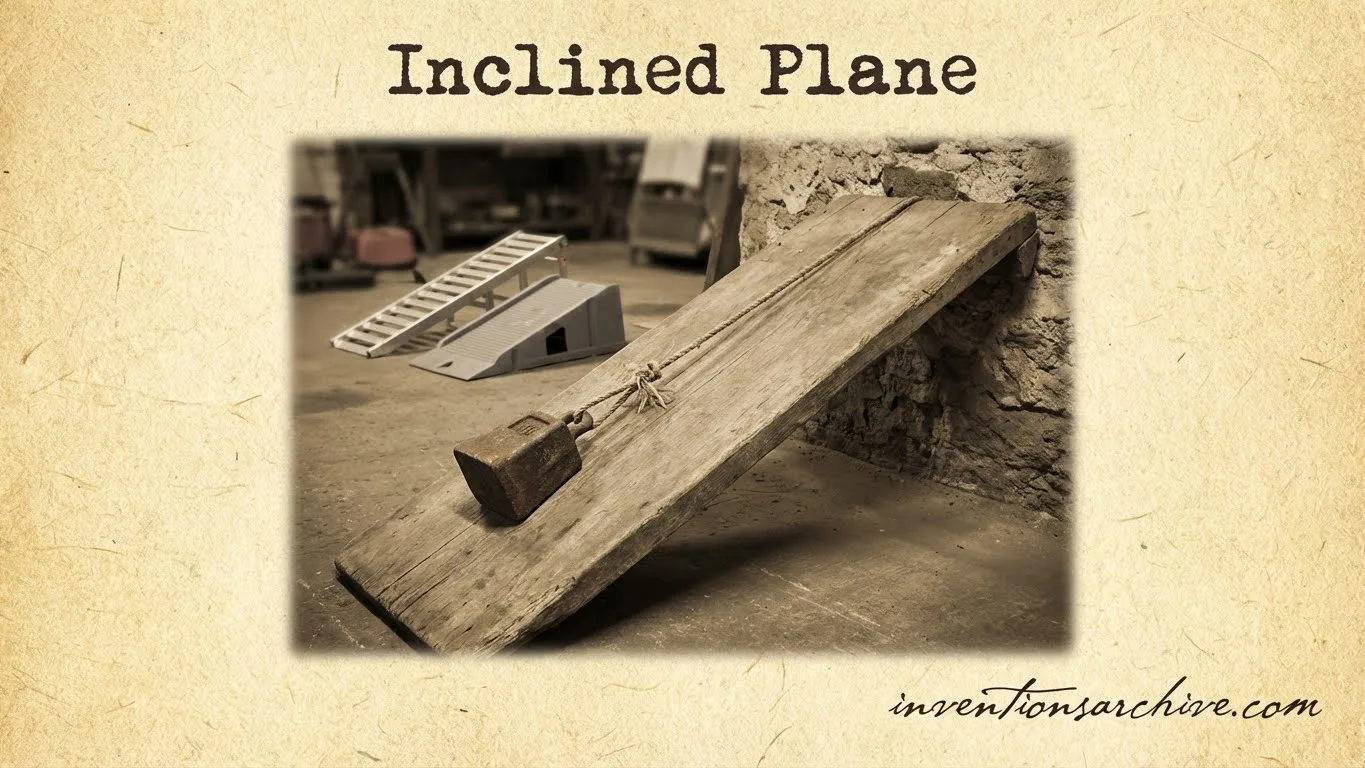
| Invention Name | Inclined Plane |
|---|---|
| Short Definition | A sloping surface used to raise, lower, or guide a load with less direct force. |
| Approximate Date / Period | Prehistoric practical use; well-documented ancient use by the 3rd millennium BCE Approximate |
| Geography | Known in many regions; strong early evidence from ancient Egypt and later Greek, Roman, and Renaissance mechanics. |
| Inventor / Source Culture | Anonymous / collective; no single inventor is known Attribution varies |
| Category | Measurement, transport, construction, manufacturing, education, and mechanical science. |
| Main Problem Solved | Moving loads between different heights without lifting the full weight straight upward. |
| How It Works | It trades distance for lower force; a longer slope usually needs less force than a short steep lift. |
| Material / Technical Basis | Earth ramps, stone ramps, timber planks, roads, tracks, stairs, rails, and later engineered surfaces. |
| Early Use Areas | Stone hauling, building works, carts, roads, ramps, loading, quarrying, and scientific demonstration. |
| Evidence Status | Practical use is ancient; exact first invention is unknown Based on surviving evidence |
| Surviving Evidence | Archaeological ramp systems, quarry roads, industrial landscapes, historical texts, and later scientific instruments. |
| Development Path | Natural slope → made ramp → engineered inclined plane → screw, wedge, road grade, rail incline. |
| Related Inventions | Wedge, screw, lever, pulley, wheel and axle, ramp road, stairs, inclined railway. |
| Modern Descendants | Loading ramps, accessibility ramps, conveyor inclines, screws, threaded fasteners, stairs, road grades, rail inclines. |
| Why It Matters |
|
What the Inclined Plane Is
An inclined plane is a flat or nearly flat surface set at an angle. It connects a lower level to a higher level. In everyday language, the most familiar version is a ramp.
The invention is simple, but not minor. It changes the way force is applied. Instead of lifting a load straight up, a person, animal, cart, sled, or machine moves the load along a longer sloped path. The total work is not magically removed. The work is spread over more distance.
That tradeoff explains why the inclined plane appears in many places:
- ramps for moving goods into buildings or vehicles,
- sloped roads on hills,
- quarry roads for dragging stone,
- stairs as stepped inclined routes,
- screws and wedges as related forms,
- laboratory apparatus used to study motion.
In physics, the inclined plane is counted among the classical simple machines. A simple machine does not create energy. It changes the relation between force, distance, and direction. OpenStax explains the ideal mechanical advantage of an inclined plane as length divided by height, and also notes that wedges and screws are closely related forms of the same principle.[c]
The Problem It Answered
Before a made inclined plane, a load had to be lifted, carried, dragged over rough ground, or moved only where the terrain allowed. That made heavy work slow and hard to control.
The inclined plane answered a practical question: how can a load move upward without lifting its full weight in one vertical motion?
The answer was not a new material or a hidden mechanism. It was geometry. A lower slope reduced the immediate force needed, though it required a longer path. This mattered in construction, transport, storage, farming, mining, and later industrial work.
| Before the Invention | What Changed After It |
|---|---|
| Heavy objects often had to be lifted, carried, or dragged over uneven ground. | Loads could be moved along a controlled slope using lower immediate force. |
| Height differences limited where carts, sleds, animals, and workers could move safely. | Ramps, graded roads, and quarry paths made height changes easier to manage. |
| Short vertical lifting demanded high force at one moment. | The same height gain could be spread over a longer distance. |
| Construction and loading depended heavily on direct lifting or many workers. | Hauling, loading, and building tasks gained a more predictable route of movement. |
| Mechanical theory had fewer clear examples of force-distance tradeoff. | The inclined plane became a clear model for mechanics, motion, friction, screws, and wedges. |
How It Worked in Simple Terms
An inclined plane works by changing a steep vertical lift into a longer diagonal movement. A box moved up a ramp rises to the same height as a box lifted straight upward, but it travels farther.
The useful point is direct: less force is needed at any one moment, assuming the surface and movement are controlled. The cost is extra distance. Friction also matters. A rough ramp, a heavy sled, or a steep slope can reduce the benefit.
Main Parts of the Principle
- Height: the vertical rise from the lower level to the higher level.
- Length: the distance traveled along the sloped surface.
- Slope: the steepness of the plane.
- Load: the object being moved.
- Friction: resistance between the load and the surface.
- Mechanical advantage: the reduction in force gained by using a longer path.
Earlier Ideas and Tools Before It
The inclined plane grew out of ordinary experience with landforms. People could see that it was easier to move along a gentle hill than up a vertical face. That natural observation became a tool when slopes were shaped, built, paved, reinforced, or placed where work needed them.
Earlier or related forms included:
- natural slopes and riverbanks,
- packed-earth paths,
- dragging tracks for sledges,
- logs, rollers, and levers used with ramps,
- quarry roads connecting extraction sites to transport routes,
- stepped paths that later became formal stairs.
The important shift was intentional shaping. A natural slope is geography. A ramp built for hauling, loading, or access is a designed tool.
Early Evidence and Ancient Use
Ancient ramp use is strongly associated with construction and quarrying, especially where large stone blocks had to move through a changing landscape. Egypt offers some of the clearest evidence because stone-working landscapes, inscriptions, roads, and quarry remains have survived in unusually visible form.
The Egyptian Exploration Society describes Hatnub as an ancient Egyptian quarry region in the Eastern Desert, near Amarna, with ancient roads, industrial structures, and in-situ texts left by quarrymen. The site helps show that ramps were part of broader systems of labor, transport, route planning, and stone extraction rather than isolated objects.[d]
This matters because short descriptions often say, “Egyptians used ramps,” then stop. A more careful view is richer. Ramps were not just slopes. They could be part of a planned haulage system involving roads, ropes, sleds, workers, posts, quarry faces, and prepared surfaces.
What Surviving Evidence Can and Cannot Prove
Surviving ramp evidence can show that inclined surfaces were used in a known place and period. It does not prove the first use of the idea. The first ramp may have been made from earth or timber and left no trace.
For that reason, the origin of the inclined plane should be described as collective and practical, not as the work of one named inventor.
Development Path From Slope to Machine
The development of the inclined plane is not a straight line from one inventor to one finished device. It is a long path from natural slopes to engineered surfaces, then to mathematical understanding.
| Stage | Form | What Changed |
|---|---|---|
| Natural Predecessor | Hill, bank, slope, river edge | People used natural gradients to move across height differences. |
| Early Made Form | Earth ramp, timber plank, quarry road | The slope was placed or shaped for a task. |
| Ancient Work System | Haulage ramp with sleds, ropes, workers, prepared ground | The ramp became part of organized construction and extraction. |
| Classical and Medieval Theory | Inclined surface discussed in mechanics and geometry | Thinkers tried to explain why less force was needed. |
| Renaissance Analysis | Stevin’s statics and Galileo’s motion studies | The inclined plane became a scientific object, not only a work surface. |
| Later Forms | Wedge, screw, road grade, rail incline, loading ramp | The same principle appeared in compact, moving, or specialized designs. |
Materials, Mechanisms, and Technical Principle
The inclined plane can be made from many materials because its function depends more on shape than on one substance. Early versions could be earth, packed clay, stone, timber, or a mix of built and natural surfaces. Later forms used brick, metal, concrete, rails, planks, and engineered roadbeds.
Materials Used in Different Contexts
- Earth and clay: useful for temporary construction ramps and filled slopes.
- Stone: durable for paths, stairs, causeways, and building approaches.
- Wood: useful for temporary ramps, loading planks, and workshop surfaces.
- Metal: common in modern industrial ramps, rails, loading docks, and transport equipment.
- Concrete and asphalt: common for roads, access ramps, sidewalks, and infrastructure.
The mechanism is always the same in principle. The plane supports part of the load’s weight, while the applied force moves the load along the slope. The gentler the slope, the more the movement is spread out.
Early Uses in Daily Work
The inclined plane was useful because it worked in ordinary settings. It did not require a complex machine shop. It could be shaped into a worksite, road, doorway, storage area, dock, or quarry path.
Common Early Use Contexts
- Construction: moving stone, timber, earth, and building materials to higher levels.
- Quarrying: bringing blocks out of pits or down from extraction sites.
- Transport: connecting different ground levels for carts, sleds, animals, and people.
- Storage and trade: loading goods into raised buildings, ships, wagons, or later vehicles.
- Learning and science: demonstrating force, motion, acceleration, and friction.
In workshops and building sites, a ramp could make a task more repeatable. That was one of its quiet strengths. A worker did not need to solve the height problem again each time; the prepared slope became part of the place.
How It Spread and Changed Over Time
The inclined plane did not spread like a named invention with a patent or a single origin story. It spread because the same problem appeared everywhere: moving things between levels.
Wherever people built with stone, moved grain, hauled timber, loaded carts, shaped roads, or worked in quarries, they had reason to use some form of sloped surface. The details changed by region and material.
Related articles: Pound Lock [Medieval Inventions Series], Screw Press [Ancient Inventions Series]
In some places, ramps were temporary. In others, they became permanent parts of roads, temples, storehouses, docks, mines, or city streets. Later, the same principle moved into more technical forms: the screw, the wedge, the inclined railway, and scientific apparatus for studying motion.
Main Types and Variations
Not every inclined plane looks like a plain ramp. Some forms are fixed surfaces. Others move, cut, press, or wrap around a cylinder.
| Type or Variation | How It Uses the Principle |
|---|---|
| Ramp | A fixed sloped surface for moving people, animals, carts, or loads between levels. |
| Road Grade | A long engineered slope that lets vehicles climb or descend gradually. |
| Stairs | A stepped form of inclined route, easier for feet than a smooth steep plane. |
| Wedge | Two inclined planes back to back; the tool moves into the material instead of moving the load up a fixed ramp. |
| Screw | An inclined plane wrapped around a cylinder; useful for fastening, pressing, or lifting in controlled motion. |
| Inclined Railway | A rail route on a slope, often using traction, counterweight, cable, or powered haulage. |
| Loading Dock Ramp | A modern work ramp used to bridge height differences between ground, platform, and vehicle. |
| Laboratory Inclined Plane | A controlled slope used to study acceleration, falling bodies, friction, and motion. |
The Inclined Plane in Scientific Study
The inclined plane became more than a work surface when scholars used it to study force and motion. It allowed difficult questions to be slowed down and observed.
Galileo’s name is often connected with inclined-plane experiments because a sloped surface can make falling motion easier to measure. Museo Galileo preserves inclined-plane apparatus connected with demonstrations of the Galilean law of falling bodies. Its catalogue notes that one such apparatus used bells and a pendulum to make the increasing distances traveled by a falling body easier to perceive.[e]
This scientific use is different from the ancient work ramp. A quarry ramp was made to move material. A laboratory inclined plane was made to reveal a rule. Both use the same geometry, but their purposes are different.
What Changed Because of the Inclined Plane
The inclined plane changed work by making height less of a sudden barrier. It allowed people to plan movement across levels instead of treating each height difference as a separate lifting problem.
Work Became More Controlled
A ramp gave workers a prepared route. Loads could be moved in stages. The motion could be guided, slowed, pulled, pushed, or supported. This was valuable in construction, storage, and transport.
Transport Routes Became More Useful
Roads, paths, and later rail systems depended on controlled slopes. A steep cliff stops a cart. A graded path gives it a chance to move.
Other Inventions Became Easier to Understand
The inclined plane also became a teaching model. It helped explain why a screw can press or lift, why a wedge can split or separate, and why a long ramp can reduce direct force.
The invention’s influence is best seen in this practical chain: ramp → controlled lifting → mechanical analysis → wedge and screw theory → engineered transport and access systems.
Common Misunderstandings
It Was Not Invented by One Known Person
The inclined plane is older than written invention records. It was likely developed many times wherever people shaped slopes for work.
The Oldest Surviving Evidence Is Not the First Use
Archaeological evidence shows known use, not absolute origin. Earlier earth or timber ramps may have disappeared.
A Ramp Does Not Remove Work
It reduces the force needed at one time by increasing the distance traveled. Friction can reduce the benefit.
A Screw Is Related to an Inclined Plane
A screw may look very different, but its thread works like a sloped path wrapped around a cylinder.
Related Inventions
The inclined plane sits inside a wider history of simple machines, transport, construction, and mechanical science.
- Wedge — a moving inclined plane used to split, separate, cut, or press.
- Screw — an inclined plane wrapped around a cylinder for fastening, lifting, or pressing.
- Lever — often used with ramps in lifting, shifting, and construction work.
- Pulley — used with ropes and ramps to redirect force during lifting or hauling.
- Wheel and Axle — often paired with ramps in carts, wagons, and loading systems.
- Stairs — a stepped route that solves the same height-change problem for walking.
- Inclined Railway — a later transport system built around controlled movement on a slope.
- Loading Dock — a modern workplace system that uses ramps and platforms to manage height differences.
Frequently Asked Questions
Who invented the inclined plane?
No single inventor is known. The inclined plane is best understood as a collective practical invention that developed wherever people shaped slopes to move loads between different heights.
Is a ramp the same as an inclined plane?
A ramp is the most familiar form of an inclined plane. The term inclined plane is broader and can also describe related mechanical forms such as wedges and the sloped thread of a screw.
Does an inclined plane make work disappear?
No. It lowers the force needed at one moment by increasing the distance over which the load moves. Real surfaces also lose some energy to friction.
Why is the inclined plane called a simple machine?
It is called a simple machine because it changes how force is applied. It has no necessary moving parts, but it can reduce the force needed to raise or lower a load.
What inventions are based on the inclined plane?
The wedge and screw are the closest related inventions. Stairs, road grades, loading ramps, inclined railways, and many industrial conveying systems also use the same basic principle.
Sources and Verification
- [a] Ancient quarry ramp system may have helped workers build Egypt’s Great Pyramids – News – University of Liverpool — Used to verify the Hatnub ramp system, its archaeological context, the Khufu-period dating, and its use in hauling alabaster blocks. (Reliable because it is a university research news page connected to the archaeological team.)
- [b] Scientist of the Day – Simon Stevin, Dutch Mathematician – Linda Hall Library — Used to verify Simon Stevin’s 1586 inclined-plane thought experiment and its role in the history of mechanics. (Reliable because Linda Hall Library is a research library with historical science collections.)
- [c] 9.3 Simple Machines – Physics | OpenStax — Used to verify the inclined plane’s simple-machine principle, ideal mechanical advantage, and its relation to wedges and screws. (Reliable because OpenStax is an institutional educational publisher from Rice University.)
- [d] Hatnub | EES — Used to verify Hatnub’s quarry landscape, ancient roads, industrial structures, in-situ texts, and long-term archaeological study. (Reliable because it is a specialist institutional archaeology source.)
- [e] Museo Galileo – Inclined plane — Used to verify the inclined-plane apparatus, its connection with demonstrations of Galilean falling-body motion, bells, pendulum timing, and surviving museum object details. (Reliable because it is an official museum catalogue entry.)