
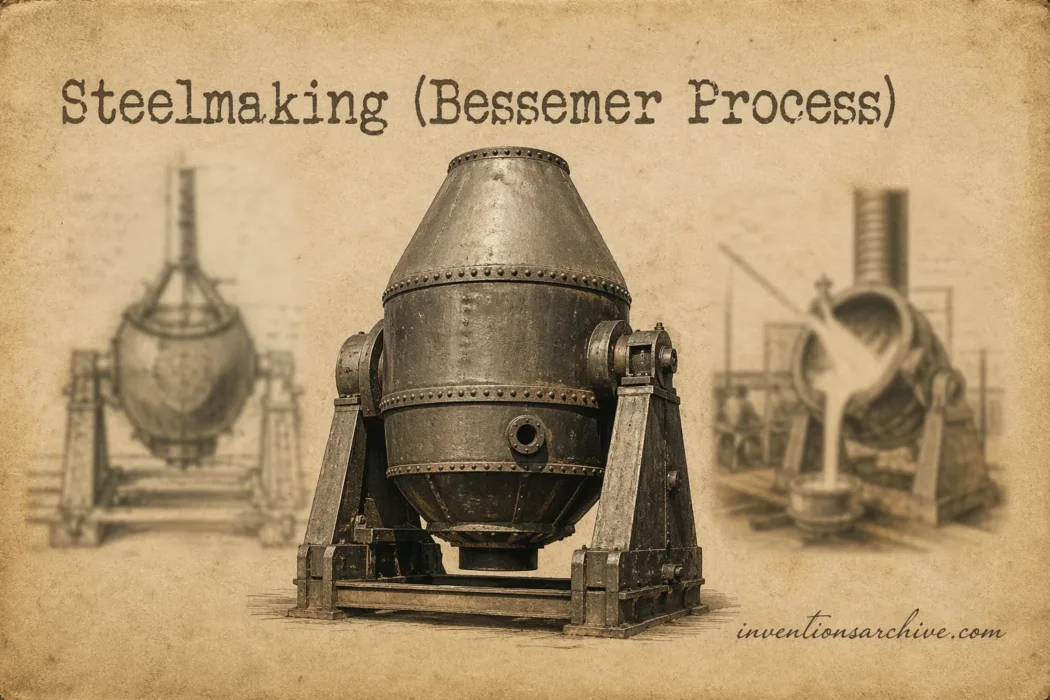
Reference Table for the Bessemer Process
| Aspect | Details |
|---|---|
| Invention Name | Steelmaking by the Bessemer process |
| Short Definition | Industrial process that converts molten pig iron into steel by forcing air through it. |
| Date / Period | Mid-1850s; U.S. patent dated November 11, 1856 (Details-1) |
| Date Certainty | Patent record: certain; development path: shared and debated |
| Main Geography | Sheffield, England; later Barrow-in-Furness, Sweden, and the United States |
| Inventor / Source Culture | Sir Henry Bessemer; related work by William Kelly and later refinements by several metallurgists |
| Category | Metallurgy; steelmaking; industrial materials production |
| Main Need | Faster, cheaper steel than crucible steel, cementation steel, and puddled iron routes |
| How It Works | Air blast oxidizes excess carbon and other impurities in molten pig iron. |
| Material Base | Pig iron, atmospheric air, refractory lining, slag-forming oxides, spiegeleisen or other recarburizing additions |
| Early Industrial Use | Rails, plates, machinery parts, and large steel castings where suitable iron chemistry was available |
| Known Early Converter | Original pilot converter used at Barrow Haematite Steel Company; first cast there in May 1865 (Details-2) |
| Main Strength | Large batches of steel in minutes rather than slow small-batch production |
| Main Limitation | Poor control of phosphorus in the original acid process; limited chemical adjustment during the blow |
| Important Variants | Acid Bessemer; basic Bessemer / Thomas-Gilchrist process; later oxygen converter lineage |
| Impact Areas | Rail transport, bridges, shipbuilding, machinery, urban construction, steel metallurgy |
| Later Successors | Open-hearth steelmaking, basic oxygen steelmaking, electric arc furnace steelmaking |
| Historical Debate | Priority and credit involve Bessemer, William Kelly, Robert Mushet, Göran Göransson, and later converter designers. |
Molten iron did not calmly turn into modern steel. It hissed, flared, spat slag, and changed color while air rushed through it from below. That violent moment is the center of the Bessemer process, one of the inventions that moved steel from a costly specialist material into an everyday industrial metal. Not perfect steel, not for every use, but steel made fast enough to change railways, bridges, ships, factories, and the basic shape of industrial life.
Contents
What the Bessemer Process Is
The Bessemer process is a steelmaking method that refines molten pig iron inside a refractory-lined vessel called a converter. Air enters through small openings near the bottom. Oxygen in that air reacts with carbon, silicon, manganese, and other elements in the liquid iron.
The result is not magic. It is oxidation, heat, and timing. The process removes too much carbon at first, so the steelmaker usually adds carbon and manganese back in controlled form afterward. In many works, that corrective addition came through spiegeleisen, a ferromanganese alloy that helped restore workable steel chemistry.
Short version, in plain terms: the converter used air as both a chemical tool and a heat source. That was the trick. Once the reactions started, the carbon inside the molten iron helped keep the metal hot.
Core idea: molten pig iron + forced air + controlled oxidation = steel made in large batches far faster than older small-batch methods.
Why Steel Needed a New Process
Before Bessemer steel, high-quality steel existed, but it was slow and costly to make. Crucible steel could produce fine material, yet the batch size stayed small. Wrought iron was useful and familiar, but it did not offer the same balance of strength, elasticity, and hardenability as steel.
Railways created a hard problem. Iron rails wore out. Heavy locomotives punished them. Bridges, boilers, machines, ship plates, shafts, axles, and tools all asked for a metal that could be made in much greater volume.
Steel was wanted everywhere, but the old production routes could not feed that appetite at a low enough cost.
The Industrial Problem Behind the Invention
- Cost: Steel was too expensive for many large projects.
- Speed: Older routes needed repeated heating, handling, and skilled labor.
- Scale: Small batches could not match railway and engineering demand.
- Consistency: Industrial users needed repeatable material, not just excellent one-off batches.
- Raw material pressure: Pig iron was available in large amounts, but refining it into steel remained the bottleneck.
Invention Credit and Early Development
Henry Bessemer gave the process its name and turned it into a commercial steelmaking system. Still, the story has more than one name. William Kelly in the United States worked on a similar air-blown idea, and several later figures made the process more reliable, more usable, and more suited to real ironworks conditions.
That matters. Inventions like this rarely arrive as one neat flash. They arrive half-formed, fail in public, get patched by practical workers, and then harden into industry. A bit messy, yes. Very real.
Britannica notes that the process was associated with Bessemer, while similar work by Kelly and later contributions by Robert Forester Mushet and Göran Göransson shaped its broader success (Details-3).
People Linked to the Bessemer Process
| Name | Role | Why It Matters |
|---|---|---|
| Henry Bessemer | Inventor and process developer | Patented and commercialized the converter method. |
| William Kelly | American ironmaster and experimenter | Worked on air-blown refining of pig iron; priority remains debated. |
| Robert Forester Mushet | Metallurgist | Helped solve quality problems through carbon and manganese additions. |
| Göran Fredrik Göransson | Swedish ironmaster | Improved practical converter operation and helped prove the process with low-phosphorus iron. |
| Alexander Lyman Holley | American engineer | Redesigned and spread Bessemer works in the United States. |
| Sidney Gilchrist Thomas and Percy Gilchrist | Metallurgists | Linked to the basic process that helped remove phosphorus from some iron ores. |
How the Process Works
The Bessemer process starts with molten pig iron from a blast furnace or remelted pig iron. The metal contains more carbon than steel needs. It may also contain silicon, manganese, sulfur, phosphorus, and other elements depending on the ore and fuel.
Inside the converter, the air blast does the refining. The operator does not stir the metal with a tool. Air bubbles through it. The metal bath roars. Carbon burns to carbon monoxide and carbon dioxide. Silicon and manganese oxidize and join the slag. The heat from these reactions helps keep the metal liquid.
The Basic Reaction Path
- Charging: molten pig iron enters the tilted converter.
- Blowing: air passes through bottom tuyeres into the liquid iron.
- Oxidation: carbon and other elements react with oxygen.
- Slag formation: oxidized impurities separate from the metal.
- Flame observation: workers read the mouth flame to judge the blow.
- Recarburizing: carbon and manganese are added back to reach usable steel.
- Tapping: molten steel pours into a ladle and then into molds.
The flame told a story. Skilled workers watched its length, brightness, and color. The process was fast, so judgment mattered. Too short a blow left too much carbon. Too long a blow removed too much and could produce brittle or poorly balanced metal unless corrected.
Why the Process Generated Heat
The process worked because oxidation released heat inside the metal itself. This made it different from furnace methods where outside fuel did much of the work. In a Bessemer converter, the unwanted carbon and silicon helped drive their own removal. A clever chemical bargain, in a way.
Carbon removal was the main target, yet silicon oxidation helped early in the blow because it produced strong heat. Manganese also oxidized. These changes pushed pig iron toward steel, though the final quality still depended on raw material, lining type, and finishing additions.
Main Parts of the Converter
The Bessemer converter looked simple from a distance: a large pear-shaped vessel mounted so it could tilt. That simple shape hid careful choices in lining, air flow, charging, tapping, and heat resistance.
Converter Body
The vessel held molten iron while the air blast passed upward through it. Its rounded form helped the metal move during the blow, while the tilting mount allowed workers to charge, blow, and pour without dismantling the vessel.
Tuyeres and Air Blast
Tuyeres were small openings that carried air into the converter. Their position and durability mattered because they sat near extreme heat and contact with molten metal. If they clogged or failed, production stopped.
Refractory Lining
The lining protected the converter shell and shaped the chemistry of the process. In the original acid Bessemer route, silica-rich lining worked only when phosphorus in the pig iron stayed low. With high-phosphorus iron, the original method struggled.
This is one reason the Bessemer story has two halves: a fast steelmaking idea, and the later chemistry needed to make it work with more kinds of ore.
Ladle, Molds, and Finishing Additions
After the blow, the steel flowed into ladles and molds. At this stage, workers could add materials to adjust carbon and manganese. Those additions were not decorative details. They often decided whether the steel could roll, forge, or serve in rails without early failure.
Types and Variations
The term Bessemer process often gets used as if it means one fixed method. In practice, several related forms existed. They shared the air-blown converter idea, but they differed in lining, ore chemistry, and later treatment.
Acid Bessemer Process
The acid process used a silica-rich lining, often ganister. It worked best with low-phosphorus pig iron. When the raw iron was clean enough, the method could make steel very quickly. When phosphorus was high, it could not remove enough of it.
That limit was not small. Much of Europe had iron ores with more phosphorus than the acid process could handle well.
Basic Bessemer or Thomas-Gilchrist Process
The basic process changed the lining chemistry. Instead of an acid silica lining, it used basic materials such as dolomite or lime-based linings. This helped move phosphorus into the slag, making some high-phosphorus ores usable for steelmaking.
The method opened another path for regions whose ore chemistry did not suit the original Bessemer route. It also showed something important: steelmaking is chemistry before it is machinery.
Bessemer to Basic Oxygen Steelmaking
Modern basic oxygen steelmaking is not the same as the old Bessemer process, but it belongs to the same family of thought: gas blown into molten metal to refine it. The later oxygen process replaced air with high-purity oxygen, which improved control and avoided the nitrogen problems tied to atmospheric air.
Same broad idea, better tools.
What Made the Bessemer Process Important
The Bessemer process did not merely make steel. It changed steel’s place in the economy. Steel moved from a material chosen only when cost allowed into a material that could serve large public works, rail networks, and machine production.
The Library of Congress describes Bessemer’s mid-1850s process as a way to convert pig iron into steel cheaply and rapidly, and notes Alexander Lyman Holley’s later redesign work in the United States (Details-4).
Industries Shaped by Bessemer Steel
- Railways: steel rails lasted longer than iron rails under heavy traffic.
- Bridge engineering: steel widened the design choices for spans, beams, and trusses.
- Shipbuilding: steel plates and structural members helped large metal ships become more practical.
- Machine tools: wider steel supply supported shafts, gears, springs, dies, and industrial equipment.
- Urban construction: later steelmaking improvements fed the rise of tall steel-frame buildings.
- Military supply: steel aided armor, barrels, and transport equipment, though quality control remained vital.
Not every early Bessemer product suited every demanding use. That point gets missed sometimes. For rails, the process fit the market well. For some structural or high-specification uses, later steelmaking routes offered better control.
Limits and Replacement
The Bessemer process was fast. That was its gift and its headache. A blow could move so quickly that chemists had little time to test and correct the metal before tapping.
Phosphorus also caused trouble. In the acid Bessemer process, phosphorus stayed in the metal. Too much phosphorus could make steel brittle, especially under cold working or impact. The basic process helped, but steelmakers still wanted better control.
Main Technical Limits
- Phosphorus sensitivity: the acid process required low-phosphorus iron.
- Nitrogen pickup: atmospheric air introduced nitrogen, which could harm some steel qualities.
- Fast timing: speed left little room for chemical testing during the heat.
- Scrap limits: the process could not absorb scrap metal as flexibly as later furnaces.
- Product range: it suited many bulk uses, but not every high-grade steel application.
Open-hearth steelmaking gradually displaced Bessemer steelmaking because it gave plant chemists more time to analyze and control the metal, even though it was slower (Details-5).
Later, basic oxygen steelmaking and electric arc furnace steelmaking moved the industry again. Faster control, cleaner oxygen, better measurement, and wider scrap use mattered. Still, the old converter left a clear mark. Modern oxygen steelmaking owes part of its logic to Bessemer’s air-blown idea.
Bessemer Process Compared with Other Steelmaking Methods
| Method | Main Era of Use | Main Strength | Main Limit |
|---|---|---|---|
| Cementation Process | Before and during early industrial steelmaking | Could convert wrought iron into blister steel | Slow and not ideal for huge output |
| Crucible Steel | 18th and 19th centuries | High quality for tools and specialist uses | Small batch size and high cost |
| Puddling | 19th century iron production | Produced wrought iron for many uses | Labor-heavy and not true bulk steelmaking |
| Bessemer Process | Mid-19th to early 20th century dominance in many regions | Fast bulk steel production | Limited chemistry control and phosphorus problems |
| Open-Hearth Process | Late 19th to 20th century | Better testing and chemistry control | Slower than Bessemer conversion |
| Basic Oxygen Steelmaking | 20th century onward | Fast refining with pure oxygen and better control | Needs advanced oxygen supply and large plant systems |
| Electric Arc Furnace | 20th century onward | Strong scrap recycling route | Depends on electricity cost and charge quality |
Materials and Chemistry Behind the Process
The Bessemer process sits at the crossing point of ore chemistry, furnace practice, and industrial design. It cannot be understood only as a machine. The converter mattered, yes, but the composition of the pig iron often decided whether the process would produce usable steel.
Pig Iron
Pig iron contains much more carbon than steel. It may also contain silicon, manganese, phosphorus, and sulfur. The Bessemer process removed some of these elements through oxidation, but not all of them equally well.
Carbon
Steel needs carbon, but not too much. The converter removed most of it during the blow. Then workers restored a controlled amount. That back-and-forth sounds wasteful, yet it made sense in a fast converter where the air blast first stripped the iron down.
Manganese
Manganese helped counter harmful effects from sulfur and improved hot working. Its role made Mushet’s contribution especially important. A small chemistry fix could save a large batch.
Phosphorus
Phosphorus was the stubborn one. In acid-lined converters, it did not leave the metal well. Basic lining and slag chemistry later gave steelmakers a better route for phosphorus-rich ores.
Spread of the Process
The Bessemer process spread because it solved a production problem that many industrial countries shared. Britain had steel demand, ironworks skill, and railway pressure. Sweden had high-quality low-phosphorus iron that suited the early process. The United States had huge transport needs, large ore and coal resources, and engineers ready to redesign plants for scale.
Britain
Sheffield and other British ironworking centers gave Bessemer a skilled industrial setting. Barrow-in-Furness later became one of the places where converter work could be tested and expanded. The process did not succeed instantly everywhere. Early failures forced refinements.
Sweden
Swedish low-phosphorus iron helped the process show its strength. Göran Göransson’s work improved practical reliability and helped show that air-blown refining could deliver good steel if the raw material matched the process.
The United States
In the United States, Alexander Lyman Holley helped adapt Bessemer plant design. Large rail demand made the process attractive. Pittsburgh, Troy, and other industrial centers linked Bessemer steel to transport growth, heavy manufacturing, and large-scale steel business.
What the Bessemer Process Made Possible
Cheap bulk steel did not create railways or bridges by itself. People, capital, mining, furnaces, rolling mills, and transport systems all played roles. Still, the Bessemer process lowered one of the hardest barriers: steel supply.
Once steel became more available, engineers could choose it more often. Railways could replace iron rails. Machine builders could design around stronger material. Bridge builders could think in wider spans and heavier loads. Shipbuilders gained another route toward large metal hulls.
That was the real change: steel stopped being rare enough to ration. It became a working material for large systems.
Common Misunderstandings About the Bessemer Process
Bessemer Did Not Invent Steel
Steel existed long before Bessemer. The invention was a bulk production process, not steel itself. That distinction matters because older societies and earlier industries already knew many forms of steel.
The Process Did Not Work Equally with All Iron Ore
Raw material chemistry shaped success. Low-phosphorus iron worked far better in the original acid process. High-phosphorus iron required later basic lining chemistry.
Speed Was Not the Same as Perfect Control
Fast steelmaking helped industry, but it also made testing harder. Later methods won market share partly because they gave steelmakers more time and better control.
Modern Steelmaking Did Not Start from Zero
Basic oxygen steelmaking refined the old converter idea with better gas, better measurement, and better plant design. The line is not straight, but it is visible.
FAQ About the Bessemer Process
What is the Bessemer process?
The Bessemer process is a steelmaking method that turns molten pig iron into steel by blowing air through it in a refractory-lined converter. Oxygen in the air removes excess carbon and some other elements through oxidation.
Who invented the Bessemer process?
The process is named after Sir Henry Bessemer, who patented and commercialized it in the 1850s. William Kelly worked on a similar idea in the United States, and later refinements by Robert Mushet, Göran Göransson, Alexander Holley, Sidney Gilchrist Thomas, and Percy Gilchrist helped the process succeed more widely.
Why was the Bessemer process important?
It made steel production much faster and cheaper than many older methods. This helped steel become practical for railways, bridges, machinery, ships, and large industrial projects.
What was the main weakness of the Bessemer process?
The original acid Bessemer process could not remove phosphorus well. It also gave steelmakers little time for chemical testing because the blow was very fast.
What replaced the Bessemer process?
Open-hearth steelmaking gradually replaced it in many steelworks, followed later by basic oxygen steelmaking and electric arc furnace steelmaking.
Is the Bessemer process still used today?
It is no longer a main commercial steelmaking process. Its influence remains in later converter steelmaking, especially the idea of refining molten iron by blowing gas through or onto the metal.