
| Item | Value |
|---|---|
| Invention Name | Harpsichord Mechanism (plucked-string keyboard action) |
| Short Definition | A key-driven system that lifts a jack so a plectrum plucks a string, then damps it on release. |
| Approximate Era / Period |
Mentions: 1397 CE (Approximate) Surviving instruments: early 16th century (Broadly accepted) If a date varies by source, treat it as “Approximate.” |
| Geography | Europe (early development linked to Italy; later major schools in Flanders, France, England, Germany) |
| Inventor / Source Culture | Anonymous / collective (workshop evolution, not one named inventor) |
| Category | Music Technology • keyboard mechanics • acoustic engineering |
| Need That Sparked It | Reliable polyphony from a keyboard • repeatable articulation • stable pitch layout |
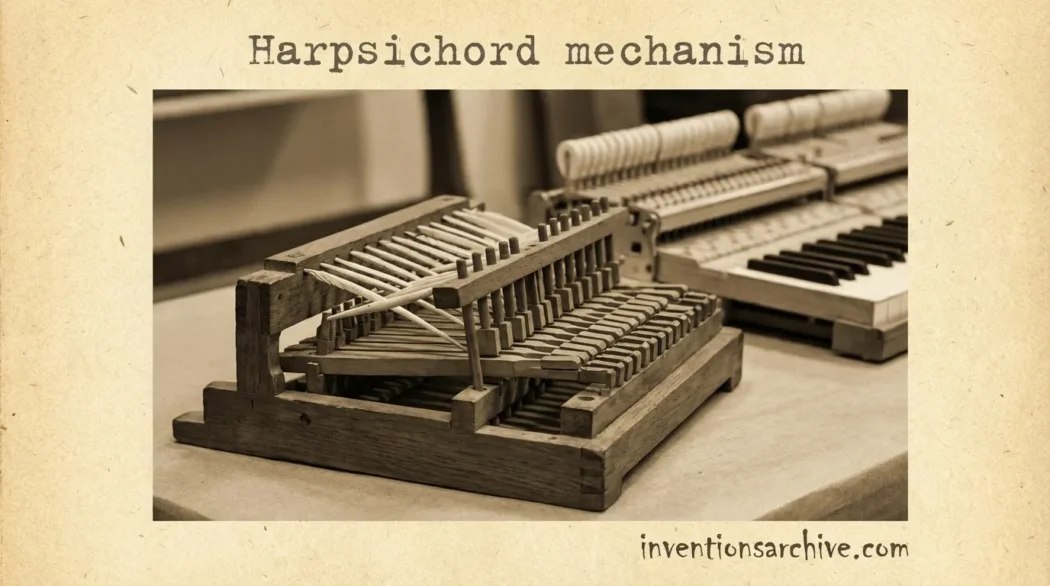
| How It Works | Key lever lifts jack → plectrum plucks → tongue “escapes” on return → damper stops vibration |
| Technology Base | Wood levers + wire strings + quill/leather plectra + sliding registers |
| Common Layout | 1–2 manuals • string choirs often 8′ and 4′ • stop controls for tone options |
| Importance |
• Made complex keyboard music practical for homes, courts, and ensembles • Shaped later keyboard design by proving a durable, serviceable action |
| Predecessors → Successors | Psaltery / plucked strings → keyed plucked actions → later hammer actions (early piano line) |
| Related Variants | Virginal • spinet • clavicytherium (upright form) • regional actions & stop systems |
| Reference Record | Met collection record with action details: (Details-1) |
A harpsichord key does not “hit” a string. It lifts a slim wooden jack, and that jack carries a tiny plucking point—often called a plectrum. One motion up, one pluck, then a neat little escape on the way down. Simple idea, clever execution.
Table of Contents
What the Mechanism Does
The harpsichord mechanism solves one job: turn finger motion into a clean pluck, then stop the sound quickly when the key returns. It does this with a small set of parts that repeat across the keyboard—one string course, one jack path, one damper point, again and again.
Mechanism In One Breath: the key lifts the jack, the plectrum plucks, the tongue “gives way” on the return trip, and a soft damper ends the note.
That “give way” detail matters. Without it, the jack would snag the string on the way back down and you’d get a second pluck you never asked for. Not ideal.
Parts Inside the Action
Names vary a little by workshop and language, but the working roles stay steady. The following parts form the everyday “action” people mean when they say harpsichord mechanism.
Key Side
- Key lever (a long wooden lever that rocks on a pivot)
- Balance point and guides (keeps motion straight and predictable)
- Capstan / contact point (where the key meets the jack, depending on build)
Jack Side
- Jack (the upright strip that rides up and down)
- Plectrum (quill/leather/plastic in later builds)
- Tongue and spring (the “escape” feature on the return)
- Damper (felt/cloth that touches the string at rest)
String Side
- Registers (guides that keep jacks aligned and can shift a choir on/off)
- Nut and bridge (define vibrating length; transmit energy to the soundboard)
- Soundboard (amplifies through its own vibration)
| Part | Job |
|---|---|
| Key lever | Turns finger motion into lift at the rear of the key. |
| Jack | Rises and falls in a straight path guided by the registers. |
| Plectrum | Plucks the string on the upward trip. |
| Tongue | Swivels so the plectrum slips past the string on the way down. |
| Damper | Touches the string at rest to stop vibration. |
| Registers | Hold jack position; can shift a choir so it plucks (or does not). |
What Happens When a Key Moves
The action is a loop with four clear moments. Some builders dress it up with extra refinements, but the loop stays the loop.
- Lift: the front of the key goes down; the back rises, carrying the jack upward.
- Pluck: the plectrum passes the string and releases it, setting it vibrating.
- Return: as the jack falls, the tongue rotates so the plectrum slides under the string without snagging it.
- Silence: the damper meets the string again, and the note ends.
That third step—the escape on the return—looks tiny on paper. In wood, it’s the whole trick. And yes, it feels a bit like a magic card move the first time someone points it out.
One well-documented modern, historically oriented example lists 183 strings arranged as two 8′ choirs (122 strings) and one 4′ choir (61 strings), with rows of jacks aligned to those choirs and stop controls that slide the jacks into plucking position (Details-2).
Registers, Stops, and Couplers
Since the fingers can’t “lean in” for a steady loudness change the way a piano can, harpsichords lean on choirs of strings and stop control. In plain terms: you choose which sets of jacks will pluck.
What “8′” and “4′” Mean
8′ is the normal pitch choir; 4′ sounds an octave higher. Harpsichords often carry more than one choir so the player can blend tone colors or change the octave mix (Details-3).
Stops can work in a few ways, but one classic method is sideways motion: a guide shifts so the plectra either meet the strings or just miss them. When a stop is “off,” some designs let those strings ring sympathetically because their dampers no longer touch—an airy side effect, a wee bit of extra shimmer (Details-4).
On two-manual instruments, coupling systems let one keyboard control another. Some use a shove coupler (the manual shifts slightly); others use special jacks so a chosen choir can be played from both manuals. It’s practical engineering, not mystery.
- Coupler: joins manuals so one hand can trigger a larger sound.
- Buff / lute stop: a soft material touches strings to create a drier, “plucked-guitar-ish” edge.
- Multiple choirs: two 8′ choirs can differ because plucking points vary along the string length.
Types and Family Variations
“Harpsichord” names a family. The mechanism stays recognizable, yet the casing shape, stop layout, and string plan can change the feel and the sound.
Wing-Shaped Harpsichord
Often the largest format. More room for multiple choirs and stop options. The action path is usually long enough to feel light and quick, even when the sound is full.
Virginal and Spinet
Smaller relatives with the same basic plucking logic, but a different string layout and case geometry. The mechanism is still jack-and-plectrum; the voice changes because the strings sit differently.
Related articles: Modern piano (Cristofori) [Renaissance Inventions Series]
Across regions, builders also played with where each choir is plucked—closer to the nut for a brighter bite, farther in for a rounder tone. Same idea, different “flavor.”
One historical museum record describes an Italian instrument with a compass noted as C/E–c3, two unison choirs (2×8′), and jacks described as likely pearwood with brass leaf springs and quill plectra—details that tie the abstract mechanism to real workshop choices (Details-1).
Materials, Wear, and Care
The mechanism’s personality comes from everyday materials. Wood flexes a little. Quill can be crisp. Leather can feel softer. Even when two instruments share the same stop labels, the action can feel slightly different under the fingers.
- Jacks: typically hardwood; they must stay straight so they don’t bind in the registers.
- Plectra: historically bird quill or leather; later builds may use stable plastics, chosen for consistency.
- Dampers: felt or cloth; their job is clean silence, not brute force.
- Registers and guides: alignment parts; small shifts change whether a choir speaks or stays quiet.
A Small Detail With a Big Effect
Plucking point matters. Move the plectrum’s contact spot along the string length, and the blend of partials shifts—brighter here, rounder there. That’s why two 8′ choirs can sound different even at the same pitch.
Maintenance exists in any mechanical instrument, but the point here is not “do this at home.” It’s simply that the action was designed to be serviceable: parts are small, repeatable, and accessible to trained technicians. That’s part of why the mechanism lasted.
Why It Mattered
The harpsichord mechanism is a neat example of invention-by-refinement. No single “launch day.” Instead, a set of workshop choices that clicked into a stable pattern: repeatable plucks, dependable damping, and stop systems that let the same keyboard speak in more than one voice.
Historically, the instrument’s rise also tracks a change in musical life: more printed music, more keyboard literacy, more demand for an instrument that can carry harmony and rhythm at once. A plucked action was perfect for that tight, articulate style—fast notes stay clear, chords don’t turn into mush.
And then, of course, the piano arrived with a different promise: louder/softer control through touch. The harpsichord mechanism couldn’t offer that same pressure-based scaling, but it held onto something else: a crisp attack, a clean decay, and a logic that still makes sense to engineers and musicians today (Details-3).
FAQ About the Harpsichord Mechanism
What is the “jack” in a harpsichord?
The jack is the upright strip that rides on the back of the key. It carries the plectrum and the damper, moving up to pluck and down to silence.
Why does the harpsichord not get steadily louder when you press harder?
The string is set in motion by a pluck, not a hammer strike with variable force. Changes in touch can color the attack a little, but the mechanism is not built for smooth pressure-driven loudness shaping.
What prevents the string from being plucked twice?
A pivoted tongue at the top of the jack lets the plectrum slip past the string on the return trip. That “escape” is the quiet hero of the action.
What do 8′ and 4′ stops mean?
They describe pitch level: 8′ is normal pitch, while 4′ sounds an octave higher. Harpsichords combine choirs to change color and octave mix.
What is a buff (lute) stop?
It is a muting system that lightly touches a set of strings, creating a drier tone. The mechanism is often a row of soft pads moved into contact with a choir.
How is the harpsichord mechanism different from a piano action?
The harpsichord plucks with a plectrum on a rising jack and damps on release. The piano uses hammers to strike strings, allowing stronger or softer sound depending on how the key is played.
Are virginals and spinets using a different mechanism?
They use the same core idea—jack and plectrum—while changing the case shape and string layout. That layout shift alters tone and feel, even when the action logic matches.