
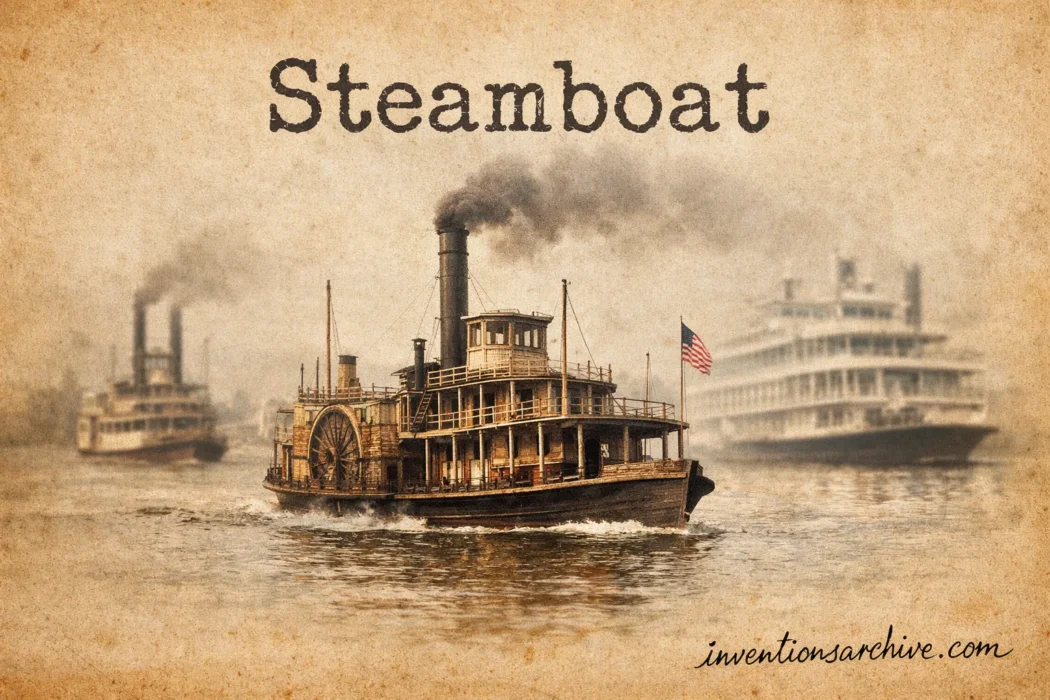
| Aspect | Details |
|---|---|
| Invention Name | Steamboat |
| Short Definition | A boat moved by a steam engine, usually through paddle wheels or, later, a propeller. |
| Approximate Date / Period | 1783–1807 (formative period) |
| Date Certainty | Contested; 1807 is the usual commercial milestone. |
| Geography | France, Britain/Scotland, and the United States; later major use on the Hudson, Mississippi, Ohio, Missouri, and Great Lakes. |
| Inventor / Source Culture | Collective development: Claude-François de Jouffroy d’Abbans, John Fitch, James Rumsey, William Symington, Robert Fulton, and Robert R. Livingston. |
| Category | Transportation, marine engineering, steam power. |
| Importance |
|
| Need / Why It Appeared | Rivers were cheap transport routes, but sail, poles, and drifting craft were too slow and unreliable for regular upstream service. |
| How It Works | Boiler makes steam; steam drives piston; piston turns shaft; shaft turns wheel or propeller. |
| Material / Technology Base | Wooden hulls at first, iron parts, boiler plate, pistons, crankshafts, paddle wheels, later screw propellers; wood then coal as fuel. |
| First Uses | River transport, ferry service, packet trade, passenger travel, freight movement. |
| Spread Route | Experimental Europe and the early U.S. → Hudson service → western rivers → lakes, bays, and coastal routes. |
| Derived Developments | Packet boats, ferry steamers, shallow-draft riverboats, towboats, excursion steamers, steamships. |
| Areas of Impact | Trade, travel, port growth, shipbuilding, river engineering, timekeeping in transport, tourism. |
| Debates / Alternate Claims | No single undisputed “first”; debate centers on earliest trial, first passenger use, first practical tug, and first profitable service. |
| Precursors / Successors | Precursors: sailboats, rowboats, barges, flatboats, keelboats. Successors: steamships, towboats, motor vessels, diesel river craft. |
| Key People / Cultures | French experimenters, Scottish canal engineers, early American mechanics, river builders, ferry operators. |
| Varieties Influenced | Sidewheel steamers, sternwheel riverboats, propeller steamers, ferries, packets, excursion boats. |
Steam power reached the water before it reached a clean public story. That is why the steamboat still deserves close attention: it was not one neat leap, but a chain of mechanical fixes, business choices, and river-tested design changes that turned steam propulsion into regular movement against wind and current.
Table of Contents
What the Steamboat Is
A steamboat is a vessel driven by a steam engine. In early practice, that engine usually turned paddle wheels. Later designs could also drive a propeller. The idea sounds simple. It was not.
Before steam, water transport had one obvious weakness: going downstream was easy enough, but returning upstream on time was slow, labor-heavy, and expensive. Oars, poles, towing, sails, and drifting craft all had limits. Steam changed the pattern because it supplied mechanical force on demand. That one shift altered river travel more than most people first expect.
- Boiler: heats water and produces steam
- Cylinder and piston: turn steam pressure into motion
- Crank and shaft: convert back-and-forth motion into rotation
- Paddle wheel or propeller: pushes water and moves the hull
- Hull and draft: decide where the boat can safely travel
A second distinction matters, too. A steamboat usually refers to a river, lake, bay, or inland craft, while steamship often points to larger sea-going vessels. The terms overlapped in real use, though, and period writing was not always tidy about it.
Early Experiments and Competing Claims
No careful history gives the whole invention to one person. French, Scottish, and American experimenters all appear in the story, and they solved different parts of the problem at different moments. Work by John Fitch and James Rumsey came well before Fulton’s public breakthrough, while earlier European trials had already shown that steam navigation was possible (Details-1).
- 1783: Jouffroy d’Abbans demonstrated a steam-driven boat in France.
- 1787: John Fitch launched a forty-five-foot steamboat on the Delaware River.
- 1791: Fitch and Rumsey each received a federal patent tied to steamboat claims.
- Early 1800s: canal and river builders kept refining engines, hulls, and propulsion layouts.
- 1807: Fulton’s Hudson service proved that the boat could earn money and keep a schedule.
That inventor question stays messy for a reason. One person may run an early trial. Another may improve the engine. Another may build the first boat that people actually trust with time, cargo, and tickets. With the steamboat, all three things happened.
On August 22, 1787, Fitch demonstrated a steamboat on the Delaware River, and in 1791 both Fitch and Rumsey were granted federal patents linked to rival claims (Details-2).
Why Robert Fulton Gets So Much Credit
Because he solved the public problem, not just the engineering one. Fulton and Robert R. Livingston helped turn steam navigation into a service people could use. That meant route planning, paying passengers, repeat trips, and a vessel people believed would actually arrive. Credit followed profit. It usually does.
How the Steamboat Works
The operating idea is mechanical, direct, and rather elegant. Fuel heats water in a boiler. The resulting steam pressure moves a piston. A linkage system then converts that straight-line motion into rotary motion, and that rotation turns either a paddle wheel or a propeller.
- Step 1: fuel burns under a boiler
- Step 2: steam enters a cylinder
- Step 3: piston moves back and forth
- Step 4: beam, rod, or crankshaft turns that motion into rotation
- Step 5: wheel or propeller pushes water backward, so the boat moves forward
Simple enough on paper. Harder on water.
Actual boats varied a lot. Some used Watt-style condensing systems. Others used lighter high-pressure engines. Some displayed a tall walking beam above deck; others kept more of the machinery lower or farther aft. Fuel changed too: early river craft often burned wood stacked openly on deck, while later vessels used more coal as supply systems matured.
The famous Clermont, for example, used a long narrow hull, two large paddle wheels, a James Watt engine, and a copper boiler; in other words, it combined known elements into a working commercial machine rather than inventing every part from scratch (Details-4).
Main Steamboat Types and Design Paths
The steamboat did not settle into one standard shape. Waterways were too different for that. A boat suited to a broad river, a canal, a harbor ferry route, or a lake crossing could share the same steam principle and still look like a cousin rather than a twin.
Sidewheel Steamboats
Sidewheel boats carried a paddle wheel on each side. They became visually iconic and worked well for ferries, packets, and many early passenger boats. The layout allowed broad superstructures and gave these vessels a very recognizable silhouette—tall stacks, wide guards, and a hull that often seemed narrower than the upper deck suggested.
Sternwheel Steamboats
Sternwheel boats placed one large wheel at the rear. That arrangement became closely associated with western river service because it fit shallow water, shifting channels, and long cargo decks rather well. River design, not romance, explains that shape.
Propeller Steamboats
By the mid-nineteenth century, many routes also used propeller-driven steam vessels. These boats were often better protected in rougher conditions, left more room for cargo, and fit lake and coastal service neatly. The classic paddle steamer never vanished overnight, yet the propeller changed the direction of marine design.
- Packets: scheduled passenger and freight service
- Ferries: short crossings with repeat runs
- Towboats: moving barges and heavy loads
- Excursion steamers: leisure travel and sightseeing
- Lake steamers: mixed passenger-cargo routes
Why River Steamboats Looked Different
The boat had to fit the river. That is the whole story, really.
Western rivers demanded shallow draft, lighter machinery, broad working decks, and a hull that could live with sandbars, changing channels, floating timber, and muddy landings. Designers responded with flatter bottoms, lighter structural choices, prominent pilot houses for visibility, and machinery placement that balanced weight against usable deck space. Those changes were not decorative. They were survival as design.
This is one place many short summaries miss. They tell the steamboat story as if it were only about the engine. It was also about draft, hull form, river depth, fuel storage, landing access, and steering visibility. A working riverboat was a complete transport system, not just a boiler floating on timber.
The 1807 Hudson Breakthrough
Fulton’s best-known achievement was not the first steam trial. It was the public proof of commercial steam navigation. In 1807, the Clermont traveled 150 miles from New York City to Albany in 32 hours, showing that regular scheduled upstream travel could work in practice (Details-3).
The boat carried about sixty passengers, used two twelve-foot paddle wheels, and proved profitable quickly enough to change public opinion. That mattered. Skepticism faded once steam began to pay.
Where Steamboats Spread and What Changed
Once the business case held, steamboat networks spread across major waterways. The results were practical, not abstract: faster return trips, more dependable freight movement, tighter route schedules, and stronger ties between inland producers and port cities.
- Hudson River: passenger service and proof of concept
- Ohio and Mississippi system: large-scale inland freight and packet movement
- Missouri River: shallow-draft adaptation and frontier supply routes
- Great Lakes: mixed passenger and cargo steam transport, then wider propeller use
- Bays and city waterfronts: ferry links and daily commuter traffic
By 1817, the first steamboat had reached St. Louis, and the city soon became a busy inland distribution point as river traffic expanded (Details-5).
Regularity may be the most overlooked change. A river still rose and fell, of course. Yet steam let operators promise something closer to a timetable. That altered trade habits, ticketing, warehousing, port labor, dock design, and public expectations. People began to think in scheduled movement, not only in seasonal luck.
What Replaced the Classic Steamboat
The classic paddlewheel steamboat did not disappear in one sudden turn. Railroads took away part of its inland transport role. Propeller-driven steam vessels gained ground on many routes. Hull materials improved. Engines changed. Later still, internal-combustion craft pushed steam aside on many working waterways.
Even so, the old forms held on where they still made sense—ferries, excursion boats, river packets, local services, tourist craft, and ceremonial vessels. A transport technology rarely leaves neatly. It lingers, adapts, and sheds functions one by one.
The Steamboat’s Legacy in Transport Design
The steamboat changed more than one mode of travel. It pushed builders to think about engine weight, hull efficiency, fuel logistics, route economics, and waterway-specific design as one connected problem. That habit carried forward into ferries, steamships, towboats, harbor craft, and later powered vessels of many kinds.
- It normalized scheduled water transport.
- It linked mechanical power with commercial routing.
- It encouraged specialized hull forms for specific waterways.
- It expanded inland port cities and waterfront industry.
- It helped turn navigation into a problem of engineering, not only seamanship.
That is the real legacy. Not a single famous boat, not a single famous inventor, but a lasting shift in how people expected water transport to work.
FAQ
Who invented the steamboat?
No single person can claim the entire invention without debate. Early work came from Jouffroy d’Abbans, John Fitch, James Rumsey, and William Symington, while Robert Fulton is usually linked to the first widely successful commercial service.
Was the Clermont the first steamboat?
Not in the strict experimental sense. Earlier steam-powered boats had already been tried. The Clermont became famous because it showed that a steamboat could run a repeatable commercial route and win public confidence.
How did a steamboat travel upstream?
The steam engine provided steady mechanical power, so the boat did not need to depend only on current, towing animals, sails, or human muscle. Speed still varied with hull design, fuel supply, river depth, and weather.
What is the difference between sidewheel and sternwheel steamboats?
A sidewheel steamboat has one paddle wheel on each side of the hull. A sternwheel steamboat has one large wheel at the rear. Sternwheel layouts became especially associated with shallow western rivers.
Why were many western river steamboats shallow-draft?
Because western rivers often had sandbars, shifting channels, and low-water stretches. A shallow-draft hull could reach more landings and move more safely through water that would trouble deeper vessels.