
| Topic | Information |
|---|---|
| Invention Name | Pocket Microscope |
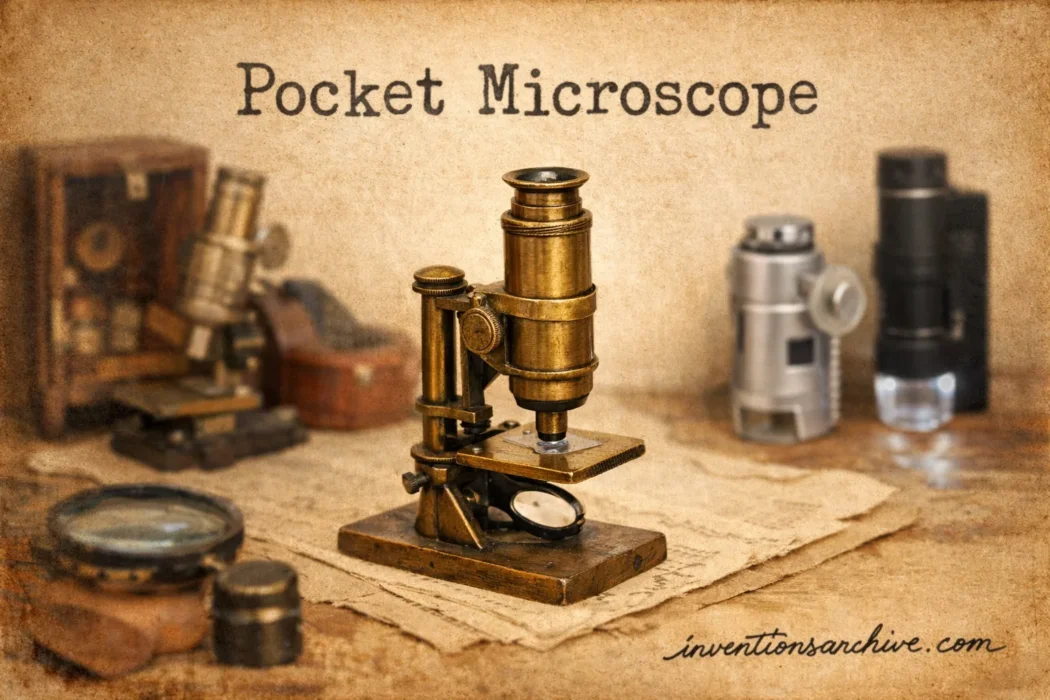
| Short Definition | A portable microscope small enough for a pocket or compact case, made for close observation away from a fixed bench setup. |
| Approximate Date / Period | Early 18th century onward; Approximate / debated |
| Geography | Britain first; later continental Europe and North America; now global |
| Inventor / Source Culture | Multiple early makers and users; James Wilson, George Lindsay, and Benjamin Martin often linked to major early forms |
| Category | Scientific instrument; optics; field observation; education |
| Why It Mattered |
Portable close study Helped move microscopy beyond the cabinet and lecture room |
| Need / Reason for Emergence | Smaller, easier observation of plants, insects, fibers, minerals, and water samples in the field or at home |
| How It Works | Simple or compound lenses magnify a specimen; focus by sliding tube, screw, or rack; light supplied by mirror, ambient light, or later built-in illumination |
| Material / Technical Basis | Glass lenses; pasteboard, wood, brass, rayskin, ivory sliders, mirrors; later plastics, LEDs, digital sensors, paper optics |
| Early Use Context | Natural history; botanical study; specimen viewing; teaching; domestic science; field collecting |
| Spread | Britain to Europe; adapted into drum, botanical, and field forms; later revived in digital and paper-based formats |
| Derived Developments | Field microscopes; botanical microscopes; compact educational microscopes; smartphone-linked and paper microscopes |
| Impact Areas | Science, education, collecting, natural history, inspection, public learning |
| Debates | The “first” pocket microscope depends on design type; single-lens, screw-barrel, portable compound, and drum forms overlap |
| Predecessors and Successors | Predecessors: simple microscopes, early compound microscopes, loupes Successors: field microscopes, pocket field viewers, digital handheld microscopes, Foldscope-style paper microscopes |
| Associated People / Cultures | British instrument makers, 18th-century naturalists, museum and educational traditions, modern low-cost optics designers |
| Affected Variants | Screw-barrel, drum, botanical, folding, portable field, paper, digital, smartphone-linked |
Contents
Long before the microscope settled into the laboratory as a fixed instrument, some versions traveled in a case small enough for a coat pocket. The pocket microscope gave observers portable magnification at a time when natural history, collecting, teaching, and close looking were all expanding. Small, yes. Yet often surprisingly clever.
What a Pocket Microscope Is
A pocket microscope is a portable optical instrument built for close observation away from a permanent stand. That broad idea matters, because the term never referred to just one exact blueprint. Some models were simple microscopes with a single lens. Others were compound microscopes with an objective and an eyepiece in a compact body.
It also helps to separate the pocket microscope from two look-alikes:
- A hand lens enlarges, but it usually lacks the stage, body geometry, and focusing arrangements that make microscopy more controlled.
- A bench microscope offers more stability, more room for illumination, and usually better support for prepared slides.
So the pocket microscope sits in the middle. More exact than a loupe, more mobile than a large stand microscope. That balance explains why the design stayed alive for centuries, even as its body, materials, and optics kept changing.
Early Evidence and Timeline
The history is not tidy. Several early designs can claim a place in the story, and the answer shifts depending on whether one means a single-lens portable microscope, a pocket-ready compound instrument, or the later drum-style form.
James Wilson introduced a single screw-barrel pocket microscope to the Royal Society in 1702, and that design reached high popularity by about 1740 before more open-stage arrangements began to displace it (Details-1).
George Lindsay pushed portability further. He published a pamphlet on his microscope in 1743, while also claiming he had devised it for personal use as early as 1728. His design was compact enough to fit in a very small case and used a substage mirror—an elegant improvement for a travel-sized instrument (Details-2).
Benjamin Martin then gave the portable microscope one of its most recognized 18th-century forms. His pocket microscope, later grouped with drum microscopes, used telescopic tubes, a mirror in the base, specimen sliders, and a very compact overall structure (Details-3).
By the 18th century, museums and instrument histories already describe the pocket microscope as one branch of a broader portable family, alongside botanical and other small field-ready forms (Details-4).
One point needs to stay clear: saying “the pocket microscope was invented by one person in one year” oversimplifies the record. The better reading is this: portable microscopy developed through several related designs, and a few makers gave the form its lasting identity.
A Short Timeline
- 1702: James Wilson presents a screw-barrel single pocket microscope.
- 1728 claimed / 1743 published: George Lindsay promotes a very compact portable microscope.
- Mid-18th century: Benjamin Martin popularizes the pocket/drum style.
- Late 18th to 19th century: botanical, folding, and portable field variants spread.
- 20th to 21st century: compact plastic, digital, smartphone-linked, and paper microscopes carry the same idea forward.
How a Pocket Microscope Works
The operating idea is simple enough. Light passes from or reflects off a specimen, the lens system enlarges the image, and the user adjusts focus by moving the optic tube, the stage, or the specimen carrier itself. Still, the design details make a real difference.
The Main Optical Parts
- Lens system: either a single magnifying lens or a compact compound arrangement with objective and eyepiece.
- Specimen support: slider, stage, clip, recess, or simple plate.
- Focus mechanism: sliding tube, threaded movement, rack, or micrometric control in better-made models.
- Illumination: daylight, reflecting mirror, white backing surface, or later built-in LED light.
Older instruments often demanded a steady hand and good light. That was the trade-off. A small microscope could travel almost anywhere, but a small body also meant less room for optics, less forgiving alignment, and tighter specimen handling.
Even so, many designs were smart in a very practical way. A mirror in the base, a slim specimen slider, or a case that became part of the stand could turn a tiny object into a usable scientific tool—not perfect, not lavish, but genuinely useful.
Pocket Microscope Types and Variations
The name covers several subtypes. That variety is one reason the pocket microscope stayed relevant for so long.
Screw-Barrel Pocket Microscope
This early form usually used a single lens and a barrel-like body. It was compact, direct, and quick to carry. The optical path was short, and the body itself acted as the housing and handling surface.
Drum Pocket Microscope
The drum type is the image many people picture first. It often used a cylindrical outer structure, a sliding inner tube, a mirror, and a specimen slider. In historical terms, this is the classic portable compound form most strongly tied to Benjamin Martin and later imitators.
Botanical and Folding Pocket Microscopes
These designs served plant study especially well. Some opened out from a small case; others used articulated arms or minimal stands. Their real charm was not ornament. It was access. A leaf edge, a seed surface, a stem hair—tiny features became easier to examine on site.
Pocket Field Microscopes
Later field models pushed usability further with more stable supports, easier focusing, and better illumination control. They were still compact, but they leaned more toward practical observation than cabinet elegance.
Digital and Paper Pocket Microscopes
Modern descendants keep the old goal while changing the hardware. Foldscope, for example, turned the idea into a paper-based microscope built for low cost, portability, and even phone-linked imaging; the platform lists magnification options from 50X to 340X and notes mobile-phone attachment as part of the system (Details-5).
Why the Pocket Microscope Mattered
Its value was not just size. Its value was mobility with enough optical control to matter.
For 18th- and 19th-century users, that mobility widened who could observe small structures and where they could do it. A specimen no longer had to wait for a large instrument in a fixed room. That changed the rhythm of looking. Observation could happen during collecting, teaching, travel, or informal study.
Where the Pocket Microscope Found Its Place
- Natural history: leaves, seeds, insect parts, shells, pond traces, mineral fragments.
- Botanical study: surface hairs, veins, pollen-bearing structures, plant textures.
- Education: easy demonstration of magnified detail without a large cabinet instrument.
- Domestic and practical inspection: fabrics, paper fibers, print patterns, grains, crystals, small workmanship details.
There is also a cultural point here. Pocket microscopes helped make microscopy feel personal. Not only institutional. They brought magnified seeing closer to ordinary practice—teachers, collectors, curious readers, field observers, even children in later simplified versions.
That shift was quiet, but far-reaching.
Materials, Optics, and Design Limits
Historical pocket microscopes often combined glass lenses with bodies made from pasteboard, wood, brass, and skin-covered surfaces. Martin’s well-known example used two bi-convex lenses in the body tube, cardboard covered with dyed rayskin, a concave mirror for illumination, and specimen sliders made from ivory or wood; some versions also included a built-in micrometer (Details-3).
Those materials were not chosen by accident. They balanced weight, cost, workability, and optical stability as well as makers could manage at the time.
What Small Size Could Not Solve
- Narrow field of view: small optics and tight geometry limited what could be seen at once.
- Light hunger: tiny instruments depend heavily on good illumination.
- Handling sensitivity: a slight movement can disturb focus or framing.
- Optical compromise: compactness can raise distortion, chromatic error, or softness, especially in older lenses.
- Specimen limits: very complex or highly prepared samples still favor larger laboratory microscopes.
So the pocket microscope never replaced the full bench microscope. It did something else. It made close observation portable, fast to access, and surprisingly adaptable.
Pocket Microscope vs. Hand Lens and Bench Microscope
| Instrument | Optical Setup | Portability | Best Use | Main Limitation |
|---|---|---|---|---|
| Hand Lens / Loupe | Single lens | Very high | Quick surface inspection | Limited control and lower detail depth |
| Pocket Microscope | Simple or compact compound | High | Field observation of small structures | Less stable, tighter light and focus conditions |
| Bench Microscope | Full compound system with fixed stand | Low | Prepared samples and sustained study | Bulk, weight, and reduced mobility |
Legacy in Portable Microscopy
The pocket microscope did not vanish; it changed shape. That is the real legacy.
Its old purpose—seeing tiny detail away from a fixed laboratory instrument—still drives modern designs. Pocket field microscopes, children’s microscopes, USB microscopes, smartphone clip-on systems, and paper microscopes all follow the same basic impulse: make magnified observation travel well.
What changed is the support system around the optics. Modern versions may use LEDs, molded plastics, phone cameras, digital capture, or folded paper structures. The historical problem stayed the same, oddly enough: how to fit useful microscopy into a form that can leave the bench without losing all practical value.
That is why the pocket microscope deserves a place in the history of inventions. It is not merely a small microscope. It is a design answer to a very old question—how to carry precision looking into ordinary life.
Pocket Microscope FAQ
Who invented the pocket microscope?
No single answer fits every version. James Wilson is linked to an early screw-barrel pocket microscope, George Lindsay to a compact portable design, and Benjamin Martin to the form that became widely associated with the pocket or drum microscope.
Is a pocket microscope the same as a magnifying glass?
No. A magnifying glass is usually a simple handheld lens. A pocket microscope usually adds better specimen control, closer working geometry, and some focusing system, even when the instrument itself stays very small.
Why did naturalists value pocket microscopes?
They made it easier to inspect plant surfaces, insect parts, fibers, and other small details during collecting or field study, without carrying a large bench instrument.
What could early pocket microscopes show well?
They worked best on relatively small, visible structures with enough light: plant hairs, seed surfaces, insect features, crystals, fibers, printed dots, and some simple aquatic or slide-mounted material.
Do modern digital and paper microscopes belong to the same invention line?
Yes, in purpose. Their materials and optics differ, yet they continue the same portable-microscopy idea: compact viewing of small details outside a fixed laboratory setting.