
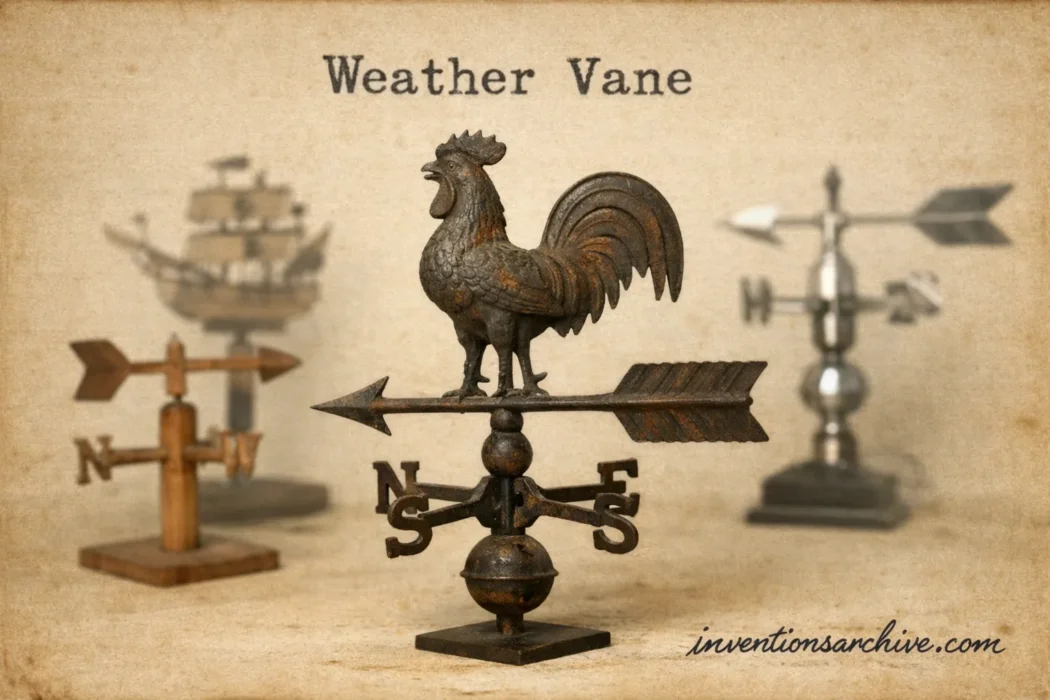
| Aspect | Value |
|---|---|
| Invention Name | Weather Vane (metal type) |
| Short Definition | Wind-direction indicator with a rotating metal vane on a vertical axis |
| Approximate Date / Period | Classical era to present (Origin: Approximate) |
| Geography | Mediterranean origins; later widespread in Europe and North America |
| Inventor / Source Culture | Anonymous / collective (early Greek engineering tradition) |
| Category | Measurement + architecture + craft metalwork |
| Need / Why It Appeared | Wind awareness for daily life: sailing, farming, city planning, weather sense |
| How It Works | Unequal drag around a pivot: larger tail is pushed downwind, pointer aims into the wind |
| Material / Technology Base | Copper alloys (brass/bronze), iron/steel, aluminum; forming, riveting, soldering/brazing, bearings |
| First Use Context | Public architecture + time/wind display; later rooftops, barns, civic buildings |
| Spread Route | Architectural copying + craft trade networks + industrial sheet-metal production |
| Derived Developments | Wind recording instruments; standardized compasses; weather stations; aeronautical wind indicators |
| Impact Areas |
|
| Debates / Different Views | Earliest “first” claims can be debated when evidence is indirect or later copies dominate |
| Precursors + Successors | Wind flags + smoke cues → metal vanes → electronic wind-direction sensors |
| Main Types Influenced | Silhouette vanes, full-bodied figures, gilded finials, functional wind vanes for stations |
Metal weather vanes sit in plain sight, yet they solve a real measurement problem with a surprisingly clean bit of physics. Air pushes harder on the larger surface, the vane rotates with low friction, and the pointer settles into a stable direction. Simple. Useful. Also quietly beautiful—because the same object can be both instrument and architectural marker without acting like it is trying too hard.
Table Of Contents
What A Metal Weather Vane Is
A weather vane (often called a wind vane) is a direction sensor you can read with your eyes. The classic metal version has three essentials: a pointer, a larger tail, and a vertical axis that lets the whole assembly rotate freely.
- It indicates direction, not speed. (Speed needs a different instrument.)
- It is passive. No power, no electronics, just air load and balance.
- In metal form, it doubles as an outdoor object that can handle sun, rain, and temperature swings with fewer surprises than many plastics.
Even “decorative” metal vanes still obey the same rule: the vane tries to align so aerodynamic forces stop producing a twisting moment. That stable point is the whole trick—calm, repeatable, and surprisingly sensitive when friction stays low.
Early Evidence and Timeline
One of the most cited early anchors for the device is ancient Athens: the Tower of the Winds was built around 100–50 BCE and was described as being topped by a bronze Triton that acted as a weather vane; it is also commonly used as evidence for the claim that the Greeks invented the weather vane (Details-1).
Craft Era
- Forged iron vanes on civic and rural buildings
- Sheet metal work grows: rivets, seams, soldered joints
- Compass letters become a familiar rooftop “language”
Industrial Era
- Repeatable parts: standardized arrows, spindles, and mounts
- More figure styles: animals, ships, tools, local trades
- Metal finishing options expand: paint, plating, gilding
Instrument Era
- Weather stations use direction sensors for logging and forecasting
- Decorative metal vanes remain common on roofs and cupolas
- Modern systems often pair direction with speed for aviation and wind-energy work
A small but real shift happened over time: the rooftop vane stayed familiar, while scientific measurement moved toward sensors that can produce a continuous electrical signal. Still, the visual vane keeps one advantage—instant human readability, even at a distance.
How Direction Gets Chosen
The Direction It Shows
In meteorology, winds are named for where they come from, not where they go. A “north wind” arrives from the north, and the vane’s head points toward that incoming direction (Details-2).
Now the mechanics. A vane rotates because wind pressure creates torque around the axis. The tail is made with more area (or more drag) than the pointer side, so the tail is pushed downwind and the pointer ends up facing upwind. No mystery—just a balance of forces and a search for the lowest-torque orientation.
Parts That Matter Most
- Axis and bearing: lower friction means quicker alignment in light winds.
- Vane geometry: surface area behind the axis raises the aligning torque.
- Mass distribution: heavy figures look nice, but higher inertia can make the vane respond more slowly to fast direction shifts.
- Fixed direction letters (N/E/S/W): these stay still; only the vane rotates.
Here is a detail people often miss: the best-behaving vanes are not only “balanced.” They are balanced and stable. Balance keeps the axis vertical and reduces extra load on bearings; stability comes from the aerodynamic shape that resists wobble.
Metals and Surface Finishes
Metal matters because rooftop objects live in an aggressive environment: UV, wet-dry cycles, salt air in some regions, soot in others, and a lot of thermal expansion. So makers choose materials that can be formed cleanly and that age in a predictable way. That “aging” often shows up as patina—a thin, chemically induced layer of relatively stable corrosion that can be decorative and protective (Details-3).
Copper and Copper Alloys
- Formability: sheet work allows crisp silhouettes and seams
- Surface change: browns, dark tones, then greens in some climates
- Works well with gilded accents (when used)
Iron, Steel, and Coatings
- Strength: thin sections can stay stiff
- Rust risk: coatings and paint quality shape lifespan
- Often used for direction letters and mounts
Aluminum and Stainless Steel
- Low maintenance look for many rooftops
- Weight control: helps reduce inertia in gusty sites
- Finish tends to stay clean rather than patinated
| Metal | Why It Is Used | Typical Surface Change | Common Trade-Off |
|---|---|---|---|
| Copper | Easy forming; classic look; solders well | Patina tones; can turn green in many settings | Cost; softness can dent in storms |
| Bronze / Brass | Tough copper alloys; good detail in cast parts | Darkening; stable oxide layers | Weight; can be overbuilt for fast response |
| Galvanized Steel | Strong; affordable; stiff for letters and mounts | Coating weathers; paint systems dominate appearance | Coating failure can lead to rust |
| Stainless Steel | Corrosion resistance; modern architectural fit | Often stays bright or dull gray | Harder to form intricate sheet figures |
| Aluminum | Lightweight; resists many forms of corrosion | Oxide film; usually subtle visual change | Can flex if thin; surface can scratch |
Under the finish, the same question always returns: will the surface form a stable protective layer, or will it keep reacting? That answer depends on alloy, air chemistry, salt exposure, and how water sits on the object—small details, big outcome.
Forms, Symbols, and Regional Styles
Metal weather vanes split into two broad families: readable arrows and figures. Arrows maximize clarity. Figures lean into identity—local animals, ships, tools, even playful rooftop mascots. Either way, the aerodynamic job stays the same, so the most successful designs hide that engineering inside a shape people actually want to see.
Common Metal Types
- Arrow-and-banner: clean reading; low visual clutter
- Silhouette figures: flat sheet metal shapes, often copper
- Full-bodied figures: formed sheet work or casting for depth
- Finial hybrids: vane plus decorative spire element
Material choices show up in real artifacts. For example, the Smithsonian American Art Museum documents a “Rooster Weathervane” from the late 19th–early 20th century made from carved pine and sheet copper, a combination that kept the profile light while still giving the outer skin durable weather resistance (Details-4).
Why Certain Shapes Keep Returning
- Long tail, short nose: stable alignment in variable winds
- Cutouts and openings: reduce weight while keeping area
- Raised details: visual depth without turning the whole vane into a heavy block
- Clear pointer tip: helps reading from ground level
Where It Sits and Why That Matters
Placement is not decoration alone. The vane needs clean airflow. Roof ridges, cupolas, and towers push the indicator above local turbulence created by chimneys, parapets, and nearby trees. When a vane is stuck low, it can still move, but it may be reporting the wind after it has been twisted and slowed by obstacles.
Reading It Correctly
- Look at the pointer, not the tail.
- Use the fixed letters as reference (N/E/S/W).
- Wind direction is best treated as local, not regional.
Why Letters Matter
The letters turn motion into information. Without them, the vane is just turning. With them, it becomes a small rooftop data display—quiet, but real.
And yes, orientation errors happen. Not often, but they do. A perfectly moving vane can still be misleading if the letters were mounted with the wrong north reference.
In modern settings, wind direction is also a safety variable. Airports, tall bridges, and large construction sites use dedicated instruments, yet the rooftop vane remains the most familiar public-facing symbol of that same idea: air has direction, and direction matters.
Care and Longevity in Plain Terms
Metal vanes last a long time when two conditions hold: the surface reactions stabilize, and moving parts stay free. Outdoors, those conditions are shaped by rain chemistry, airborne salts, and how moisture lingers around joints and bearings. Sometimes the changes look dramatic—especially on copper alloys—but the visual change can still be part of a stable surface state.
What Can Shorten Lifespan
- Persistent wetness in seams or around fasteners
- Chlorides from sea air or de-icing residues
- High humidity combined with chloride contamination on copper alloys
- Mechanical wear: grit, misalignment, or binding in the rotating assembly
Conservation research on copper alloys notes that a special form of active corrosion (“bronze disease”) is associated with chlorides and moisture, and it can become active when relative humidity rises above about 55%, producing light green powdery spots on affected surfaces (Details-5).
That museum-focused note translates into a simple outdoor reality: salt and trapped moisture are a rough pair for many metals. When designers keep water from pooling and keep the rotating joint protected, the vane’s behavior stays clean—no weird sticking, no lazy pointing, just steady alignment.