
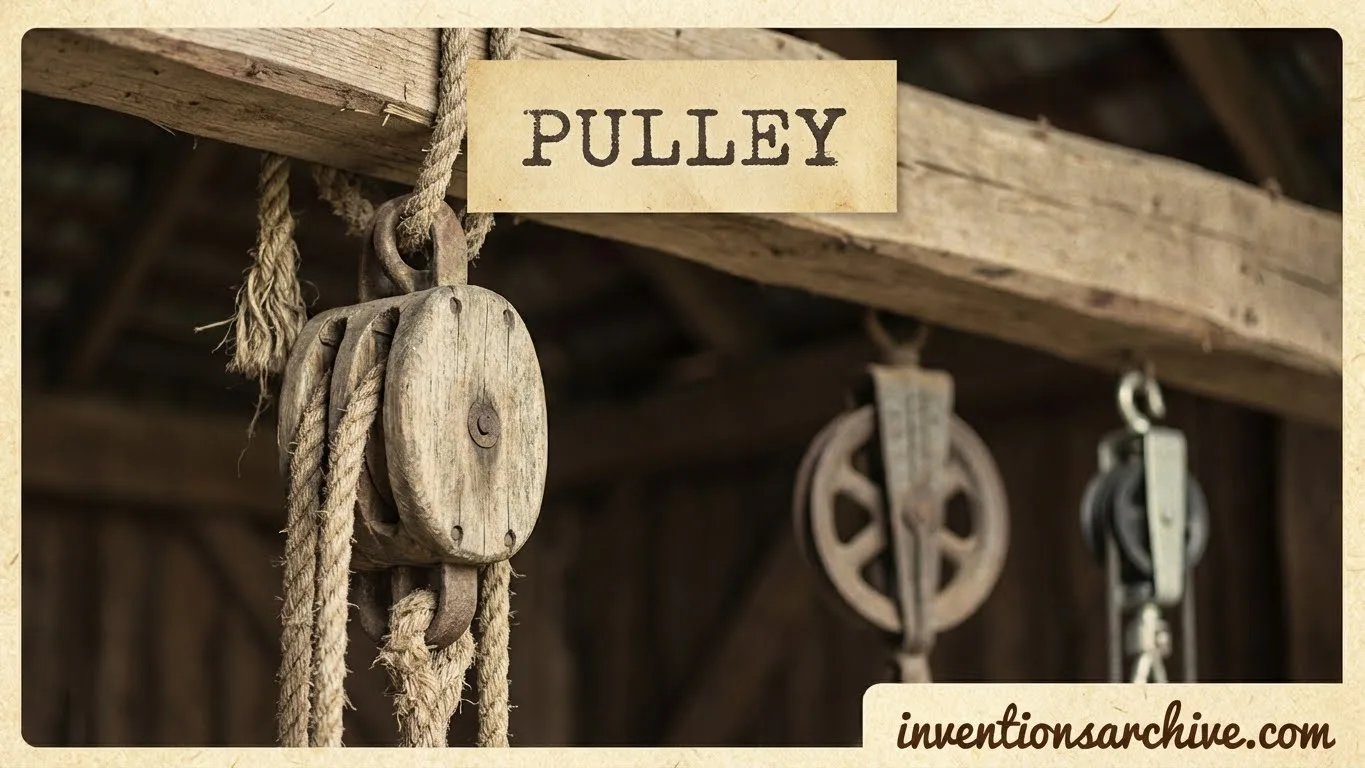
| Invention Name | Pulley |
|---|---|
| Short Definition | A wheel or sheave that guides a rope, cord, cable, chain, or belt to change force direction, lift loads, or transmit motion. |
| Approximate Date / Period | Before 875–860 BCE for clear surviving visual evidence Based on surviving evidence |
| Geography | Ancient Near East, with later Greek, Roman, maritime, workshop, and industrial development |
| Inventor / Source Culture | Anonymous / collective; not securely traceable to one person |
| Category | Mechanical, construction, water-lifting, transport, manufacturing, power transmission |
| Evidence Status | Early physical and visual evidence survives, but the first inventor is unknown Attribution varies |
| Main Problem Solved | Moving, raising, lowering, or redirecting loads that were difficult to handle by direct pulling alone |
| How It Works | A rope or belt runs over a rotating wheel; fixed pulleys change direction, while movable and compound systems reduce needed effort |
| Material / Technology Base | Wood, rope, leather, bronze, iron, later steel, wire rope, belts, bearings, and machined sheaves |
| Early Use Areas | Water lifting, lifting goods, building work, ships, workshops, wells, cranes, and hoisting systems |
| Development Path | Rope over support → grooved wheel → pulley block → block and tackle → cranes, elevators, belt drives |
| Surviving Evidence | Neo-Assyrian relief, museum pulley blocks, technical writings, workshop machines, later mechanical collections |
| Related Inventions | Wheel and axle, lever, windlass, crane, block and tackle, belt drive, elevator, hoist |
| Modern Descendants | Construction cranes, elevators, cableways, sail rigging, gym machines, conveyor drives, industrial belt systems |
| Why It Matters | It made force easier to manage and helped turn simple pulling into controlled lifting, motion transfer, and mechanical advantage |
What a Pulley Is
A pulley is a wheel on an axle that carries a flexible line around its rim. The line may be rope, cord, cable, chain, or belt. When the wheel has a groove, it is often called a sheave. A pulley may be used alone, or several pulleys may be joined in a block-and-tackle arrangement.
In simple lifting, a pulley changes the direction of a pull. Instead of lifting straight upward, a person can pull downward while the load rises. In a more complex system, several pulleys share the load across multiple rope sections. This does not remove the work. It changes the balance between force and distance.
Britannica describes the pulley as a wheel carrying a flexible rope, cord, cable, chain, or belt on its rim, used singly or in combination to transmit energy and motion. It also notes that grooved pulley rims are called sheaves and that block-and-tackle systems use pulley combinations for lifting weights.[b]
How Its Origin Is Traced
The origin of the pulley is traced through three kinds of evidence:
- Surviving visual evidence, such as reliefs that show a pulley in use.
- Mechanical writing, especially Greek and later Greco-Roman texts that discuss simple machines.
- Physical objects, such as pulley blocks preserved in museum collections.
The evidence is uneven. Rope decays. Wooden wheels decay. Early lifting frames may leave few recognizable traces. This makes the pulley different from stone tools or metal weapons, which often survive more clearly. A pulley could have been used long before a surviving object or drawing proves it.
The Problem It Answered
Before pulleys became common, people still moved loads. They used direct pulling, carrying, levers, rollers, sledges, ramps, animal power, counterweights, and simple rope arrangements. These methods worked, but each had limits.
Direct lifting is hard because the human body must oppose gravity in the most direct way. Pulling upward is often awkward. Pulling downward is usually easier. A fixed pulley solved this basic handling problem by redirecting force. A movable pulley went further by sharing the load across rope sections.
The pulley answered practical needs in several settings:
- Wells and water lifting: raising buckets from depth with better control.
- Building work: lifting stone, timber, tools, and construction materials.
- Ships: managing sails, rigging, cargo, and anchors.
- Workshops: moving parts, tools, raw materials, and finished goods.
- Power transmission: carrying rotation from one shaft to another through belts.
Before and After the Pulley
| Before the Pulley | What Changed After It |
|---|---|
| Loads were lifted by direct pulling, carrying, ramps, levers, sledges, or animal effort. | Rope could be routed through a wheel, making lifting more controlled and easier to direct. |
| Pulling upward was awkward and tiring, especially from wells, towers, ships, and scaffolds. | A fixed pulley allowed a downward pull to raise a load upward. |
| One rope line usually meant one main direction of force. | Compound arrangements could divide the load across several rope sections. |
| Large loads required more people, more animals, or larger ramps. | Block-and-tackle systems gave workers finer control over heavy lifting. |
| Rotary motion was harder to transfer between separated shafts. | Belt-and-pulley systems helped transmit power across machinery. |
| Ship rigging and workshop lifting depended heavily on direct rope handling. | Pulleys made rope systems more flexible, repeatable, and adaptable. |
How It Worked in Simple Terms
A pulley works because the rope or belt can move over a rotating wheel instead of scraping across a fixed edge. The wheel reduces rubbing and guides the line. The axle lets the wheel turn. The frame or block holds the wheel in place.
Fixed Pulley
A fixed pulley has its axle attached to a stable support. It changes the direction of pull. A person pulling down on the rope can raise a load upward. The main benefit is direction control, not a large reduction in total work.
Movable Pulley
A movable pulley travels with the load. In a simple ideal version, two rope sections support the load. The effort needed can be reduced, but more rope must be pulled. This is the part many short explanations skip: less force usually means more distance.
Compound Pulley and Block and Tackle
A compound pulley combines fixed and movable pulleys. In a block and tackle, several sheaves may sit in two blocks. The load is shared by multiple rope sections. This made the pulley especially valuable in cranes, ships, workshops, and later industrial hoists.
Belt-and-Pulley Systems
Not every pulley is mainly for lifting. In belt drives, pulleys transfer motion between shafts. Different pulley diameters can change speed and torque. This made pulleys part of machinery, mills, workshops, and later factory power systems.
Main Materials and Technical Principles
The earliest pulleys were probably simple and made from available materials: wood for the wheel or block, plant fiber or leather for the rope, and wooden or metal pins for the axle. Later systems used bronze, iron, steel, machined grooves, bearings, wire rope, and engineered belts.
The technical principle stayed simple:
- The wheel guides the line.
- The axle allows rotation.
- The rope, cable, chain, or belt carries force or motion.
- The block or frame holds the sheave in position.
- The arrangement decides whether the system mainly redirects force, reduces effort, or transmits power.
Earlier Ideas and Tools Before It
The pulley did not appear from nowhere. It sits in a family of older mechanical ideas.
- Rope: needed for pulling, tying, hoisting, and controlling loads.
- Wheel and axle: provided the rotating element that made guided movement easier.
- Lever: showed how force could be traded through distance and position.
- Windlass: used a rotating drum or axle to wind rope and raise loads.
- Shaduf: used a counterbalanced beam to lift water before or alongside later pulley systems.
Water-lifting history is especially useful here. A review in the journal Water describes the shaduf as a hand-operated water-lifting device known in several ancient civilizations, with Mesopotamian use around 3000 BCE and later spread across regions. It also notes later refinement with pulleys and animal traction for deeper water lifting.[c]
Development Path
| Stage | Form | What Changed |
|---|---|---|
| Earlier Tool | Rope, lever, roller, ramp, shaduf, windlass | People already understood pulling, lifting, counterweighting, and rotating supports. |
| Early Pulley | Rope over a wheel or grooved support | Force could be redirected with less rubbing than a rope over a fixed edge. |
| Pulley Block | Wheel enclosed in a block or frame | The mechanism became safer, stronger, and easier to attach to structures or loads. |
| Compound System | Block and tackle | Several rope sections could support one load, lowering the effort needed at the pulling end. |
| Crane and Hoist | Pulleys with frames, windlasses, capstans, or treadwheels | Heavy lifting became more organized in building, ports, ships, and workshops. |
| Industrial Form | Machined sheaves, belt drives, wire rope systems | Pulleys became part of power transmission, factory machinery, elevators, and transport systems. |
Greek and Roman Mechanical Writing
Ancient Greek and Greco-Roman writers did not necessarily invent every device they described. Their importance lies in something else: they helped turn working tools into explained mechanical systems.
Hero of Alexandria is central to this shift. Museo Galileo notes that Hero’s treatise on Mechanics, surviving through Arabic translation, presented a major ancient treatment of practical and theoretical mechanics and described five basic machines: the lever, winch, pulley, screw, and wedge.[d]
Vitruvius also described lifting machines in Book X of De Architectura. In one passage, a block containing three pulleys is called a trispastos, while a system with two pulleys below and three above is called a pentaspastos. These names show that pulley arrangements had become specific enough to classify by form and lifting arrangement.[e]
Early Uses in Daily Work
The pulley’s value came from ordinary work, not from theory alone. It helped people solve repeated physical problems.
Wells and Water
At wells, a pulley could guide a rope and bucket. The user did not have to drag the rope over a rough edge. The motion became smoother and easier to repeat. This mattered for households, gardens, animals, and small irrigation tasks.
Related articles: Elevator (Otis safety brake) [Industrial Age Inventions Series], Metal Lathe [Industrial Age Inventions Series]
Building and Stone Handling
In building work, pulleys helped raise materials to higher places. They could be combined with frames, cranes, windlasses, and human or animal power. The effect was practical: fewer sudden drops, better direction control, and safer positioning of loads.
Ships and Rigging
Ships used pulleys as blocks. Sail handling depends on rope direction, tension, and repeated adjustment. Pulleys made sails easier to raise, trim, lower, and secure. Maritime use also encouraged strong, repairable wooden blocks and rope systems.
Workshops and Production
Workshops used pulleys for raising materials, operating tools, transmitting motion, and supporting repeated tasks. A pulley could be part of a small hand-operated setup or part of a larger powered system.
Main Types and Variations
| Type or Variation | Main Form | Typical Use |
|---|---|---|
| Fixed Pulley | Wheel fixed to a support | Changes pulling direction, such as raising a bucket by pulling downward. |
| Movable Pulley | Wheel moves with the load | Reduces effort in ideal systems by sharing load across rope sections. |
| Compound Pulley | Fixed and movable pulleys combined | Used where heavier loads require better mechanical advantage. |
| Block and Tackle | One or more sheaves inside blocks | Common in ships, cranes, hoists, rescue systems, and workshops. |
| Sheave | Grooved pulley wheel | Guides rope, cable, or belt and helps prevent slipping off the rim. |
| Belt Pulley | Pulley used with a belt | Transmits rotary motion between shafts in machinery. |
| Step or Cone Pulley | Several pulley diameters in one unit | Changes speed ratios in machine tools and belt-driven systems. |
| Modern Cable Pulley | Engineered sheave for wire rope or cable | Used in elevators, cranes, cableways, exercise machines, and industrial equipment. |
How It Spread and Changed Over Time
The pulley spread because the need was universal. People everywhere needed to raise water, lift goods, build higher, move cargo, and control rope tension. The form changed with local materials and work settings.
In the ancient Near East, pulleys appear in water and lifting contexts. In Greek and Roman writing, they became part of named mechanical systems. In ships, they became blocks for rigging. In workshops, they became lifting aids. In mills and factories, pulleys carried belts that transmitted rotary power.
By the early modern and industrial periods, the pulley block itself became a target for better manufacturing. The Science Museum Group records an 1805 scoring machine associated with Henry Maudslay and Marc Isambard Brunel’s Portsmouth block-making system. The museum describes those machines as the first purpose-designed and integrated system for quantity production, created to make pulley blocks for the Royal Navy; it also notes that a single fighting ship such as Nelson’s Victory needed over a thousand pulley blocks and that the Navy purchased about 100,000 a year during the Napoleonic Wars.[f]
Surviving Objects and Later Examples
Later museum objects help show how the pulley became a teachable and collectible mechanical device. The Science Museum Group holds a triple pulley block made in 1752, associated with King George III’s scientific collection, made of brass and iron. Its survival shows how pulley blocks moved beyond rough practical gear and entered scientific demonstration, education, and precision mechanical collections.[g]
This matters because invention history is not only about first appearance. It is also about standardization. Once pulley blocks could be made in repeatable forms, they became easier to teach, repair, install, and scale.
What Changed Because of It
The pulley changed work by making force easier to manage. The change was not dramatic in one moment. It was cumulative. A fixed pulley helped with direction. A movable pulley helped with effort. A block and tackle made larger lifting systems more practical. Belt pulleys helped machines share power.
Several fields changed in visible ways:
- Construction: materials could be raised and positioned with more control.
- Maritime work: sails, cargo, and rigging became easier to manage.
- Water access: wells and water-lifting systems could use guided rope motion.
- Manufacturing: belts and pulleys helped distribute rotary power.
- Education: pulleys became a standard example for explaining force, motion, and mechanical advantage.
- Transport systems: cable-guided lifting and movement became part of cranes, elevators, and later cableways.
Common Misunderstandings
Archimedes Did Not Invent Every Pulley
Archimedes is linked with compound pulleys in later tradition, but the earliest pulley use was probably collective and practical. It is safer to say he helped explain or demonstrate advanced pulley systems, not that he created the first pulley.
The Earliest Evidence Is Not Always the First Use
A dated relief or museum object shows what has survived. It does not prove that no earlier pulleys existed. Rope and wood often disappear from the archaeological record.
A Pulley Does Not Remove Work
A pulley system can reduce the effort needed at one moment, but the rope usually travels farther. Friction also reduces real-world performance.
Not All Pulleys Are for Lifting
Many pulleys transmit rotary motion through belts. Factory line shafts, machine tools, conveyors, and engines used pulleys for motion and power, not only for hoisting loads.
Related Inventions
The pulley belongs to a wider history of mechanical tools. These related inventions help place it in context:
- Wheel and Axle: the rotating principle behind the pulley wheel.
- Lever: another simple machine based on force and distance trade-offs.
- Windlass: a rotating drum used to wind rope and raise loads.
- Shaduf: an earlier water-lifting device based on a counterbalanced beam.
- Crane: a larger lifting system that often uses pulleys, frames, and winches.
- Block and Tackle: a compound pulley arrangement for controlled heavy lifting.
- Belt Drive: a pulley-based system for transmitting rotary power.
- Elevator: a later lifting technology that uses pulleys, cables, counterweights, and control systems.
Frequently Asked Questions
Who invented the pulley?
The first inventor of the pulley is not known. The device was most likely developed collectively from older rope, wheel, axle, and lifting practices. Archimedes is often linked with compound pulley systems, but that is different from proving he invented the first pulley.
What is the earliest clear evidence of a pulley?
One strong early piece of evidence is a Neo-Assyrian relief in the British Museum dated to 875–860 BCE. It shows a pulley with ropes inside a fortress scene. This is evidence of use by that period, not proof of the first use.
How does a pulley make lifting easier?
A fixed pulley mainly changes the direction of a pull. A movable or compound pulley can reduce the force needed by sharing the load across more rope sections. The trade-off is that more rope must be pulled, and real systems lose energy through friction.
What is the difference between a pulley and a sheave?
A sheave is the grooved wheel inside a pulley or pulley block. In everyday language, people often call the whole device a pulley, but in technical use the sheave is the wheel that carries the rope, cable, or belt.
Are pulleys still used today?
Yes. Modern pulleys appear in cranes, elevators, cableways, sailboats, gym machines, industrial belts, conveyor systems, theatre rigging, and many machines that need controlled lifting or motion transfer.
Sources and Verification
- [a] wall panel; relief | British Museum — Used to verify the Neo-Assyrian wall panel, its 875–860 BCE date, museum number 118906, material, and the description of a pulley with two ropes in the relief. (Reliable because it is an official museum collection record.)
- [b] Simple machine – Pulley, Screw | Britannica — Used to verify the technical definition of a pulley, the term sheave, block-and-tackle use, and the reported Archimedes connection. (Reliable because it is a long-standing editorial reference source with topic-specific technical coverage.)
- [c] Evolution of Water Lifting Devices (Pumps) over the Centuries Worldwide | MDPI — Used to verify historical context for the shaduf, ancient water-lifting practices, and later refinement with pulleys and animal traction. (Reliable because it is a peer-reviewed journal article from an academic publisher.)
- [d] Museo Galileo – Hero of Alexandria — Used to verify Hero of Alexandria’s mechanics tradition and the listing of the pulley among the five basic machines in his mechanical writing. (Reliable because it is an institutional museum source focused on the history of science.)
- [e] LacusCurtius • Vitruvius on Architecture — Book X — Used to verify Vitruvius’s terminology for pulley blocks such as trispastos and pentaspastos. (Reliable because it provides a text-specific classical translation hosted on a university domain.)
- [f] Scoring machine | Science Museum Group Collection — Used to verify Brunel and Maudslay’s pulley-block manufacturing system, its circa 1805 date, and its role in quantity production for Royal Navy pulley blocks. (Reliable because it is an official museum collection record.)
- [g] Triple pulley block | Science Museum Group Collection — Used to verify the 1752 triple pulley block, its materials, object type, and association with King George III’s collection. (Reliable because it is an official museum collection record.)