
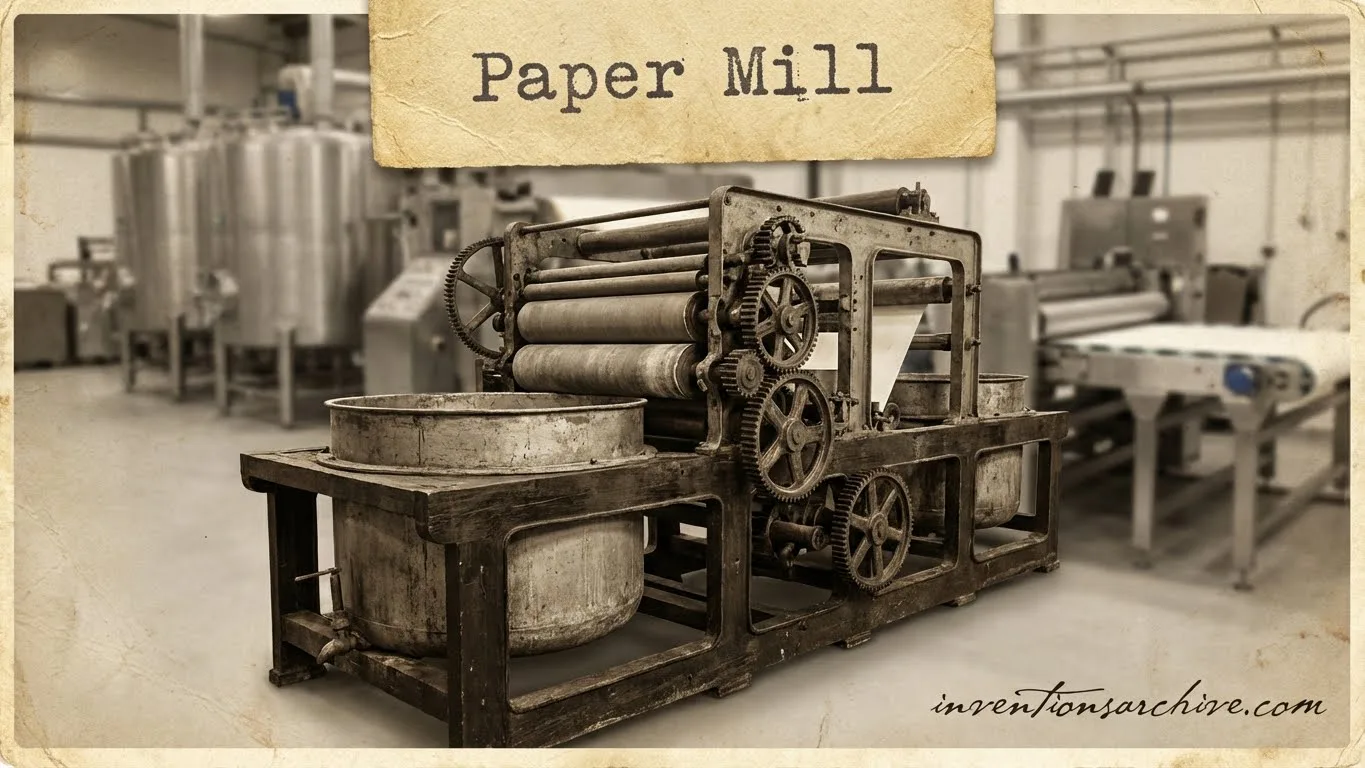
| Invention Name | European paper mill |
|---|---|
| Short Definition | A workshop or factory that turns prepared plant fibers or textile rags into paper, originally using water power for pulp preparation. |
| Approximate Date or Period | 11th–12th centuries in Islamic Iberia; a mill at Xàtiva is commonly dated to 1151 Based on surviving evidence [a] |
| Geography | Southern Europe, first associated with the Iberian Peninsula; later major centers in Italy, France, the German-speaking lands, and elsewhere |
| Inventor or Source Culture | Anonymous and collective; knowledge reached Europe through Islamic papermaking traditions and was adapted by European craftspeople |
| Category | Manufacturing, communication, education, and materials technology |
| Evidence Status | Approximate Attribution varies |
| Main Problem Solved | Produced writing and printing sheets in larger quantities than parchment preparation could usually supply |
| Earlier Materials and Methods | Parchment, papyrus, imported paper, manual fiber beating, and small-scale sheet forming |
| Simple Working Principle | Fibers are broken into pulp, suspended in water, lifted on a mould, pressed, dried, sized, and finished |
| Technical Base | Clean water, linen and hemp rags, waterwheel, camshaft, stamping hammers, vat, mould and deckle, felts, press, drying loft, and sizing |
| Early Uses | Administrative records, accounts, letters, manuscripts, legal documents, drawings, maps, and later printed books |
| Early European Centers | Xàtiva; Fabriano; Troyes and other French centers; Nuremberg; later mills across Central, Northern, and Western Europe |
| Major European Refinements | Water-powered stampers, wire moulds, watermarks, gelatin sizing, improved presses, drying systems, and later mechanical beaters |
| Development Path | Imported and local handmade paper → water-powered rag mill → improved Italian mill → regional mill networks → continuous paper machine → modern pulp and recycled-fiber mill |
| Main Types | Hand paper mill, stamp mill, Hollander-beater mill, cylinder-mould mill, Fourdrinier-type mill, wood-pulp mill, recycled-fiber mill |
| Surviving Evidence | Watermarked sheets, account records, mill buildings, moulds, presses, machinery, historical drawings, museum collections, and archival descriptions |
| Fields Affected | Communication, education, science, commerce, measurement, administration, art, printing, and packaging |
| Related Inventions | Waterwheel, fulling mill, printing press, watermark, Hollander beater, cylinder mould, continuous paper machine, wood-pulp process |
| Modern Descendants | High-speed paper machines, tissue lines, board mills, specialty-paper plants, recycled-paper systems, and digitally controlled pulp-and-paper mills |
| Why It Matters | Expanded the supply of affordable sheets; supported records, study, printing, trade, technical drawing, and mass communication |
What A European Paper Mill Was
A medieval or early modern paper mill was a coordinated production site, not merely a waterwheel beside a vat. It brought raw-material storage, rag sorting, washing, pulp preparation, sheet forming, pressing, sizing, drying, and finishing into one working system.
The word mill originally pointed to the use of mechanical power, especially water power, to prepare fibers. Sheet formation remained skilled handwork for centuries. A vatman lifted the watery pulp on a mould, a coucher transferred the wet sheet to felt, and press workers removed water before drying and sizing.
The invention was organizational as well as mechanical. It joined power, water management, trained labor, reusable tools, quality control, and supply networks for old textiles.
How The Origin Is Traced
European papermaking is best understood as a chain of transfer and adaptation. The craft did not appear independently in a single European town. Knowledge of fiber preparation and sheet forming had already moved westward from China and through Islamic production centers before workshops became established in the Iberian Peninsula.
Xàtiva, in present-day Spain, is commonly identified with one of Europe’s earliest paper-mill traditions. Fabriano, in central Italy, became a leading center during the 13th and 14th centuries. It is more accurate to describe these places as different stages in the European development of the mill than as rivals for one simple title.
Why Fabriano Became A Reference Point
Fabriano was not Europe’s first papermaking center, yet its workshops improved production in ways that suited European writing and printing. Library of Congress research identifies three closely linked advances: water-powered multi-headed stampers, animal-gelatin sizing, and watermarks formed in the wire mould. These changes improved pulp preparation, surface strength, ink behavior, and workshop identification. [c]
Water quality also mattered. Clear water reduced stains and unwanted particles, while the mineral character of local water could affect color and long-term stability.
The Problem The Mill Answered
Before local paper mills spread, European scribes and institutions depended heavily on parchment, imported paper, and uneven local supplies. Parchment could be durable, but each sheet required prepared animal skin. Production was tied to livestock, skilled preparation, and the usable area of each hide.
Paper mills created a different supply system. Old linen and hemp textiles could be collected, sorted, cleaned, and returned to use as fiber. The process demanded water, labor, and time, but it could feed a steadier stream of sheets into commercial and institutional markets.
The practical gain was repeatable output. Record keepers, merchants, schools, workshops, printers, mapmakers, and artists could obtain paper in known formats and grades rather than rely only on prepared skins or distant imports.
Before and After The Paper Mill
| Before The Paper Mill | What Changed After It |
|---|---|
| Writing surfaces often depended on parchment, papyrus in earlier Mediterranean settings, or imported paper. | Local mills supplied paper through regional trade networks and repeated production cycles. |
| Manual fiber preparation limited the amount and consistency of pulp. | Water-powered stampers processed larger batches with more regular mechanical action. |
| Sheet quality could vary without stable moulds, sizing, or finishing routines. | Wire moulds, presses, sizing, drying lofts, and finishing practices supported recognizable grades. |
| Institutions could face restricted or costly supplies for records and manuscripts. | Administrative writing, correspondence, accounts, study, drawing, and printing gained a wider material base. |
| Production knowledge could remain attached to small workshops and imported goods. | Specialist labor moved between regions, while merchants financed mills and distributed their output. |
How The Mill Worked
The historical process varied by region and century. A typical hand-paper mill followed a sequence built around fiber separation, water drainage, pressure, and drying.
Rag Sorting and Preparation
Linen and hemp rags were gathered through collectors and merchants. Workers removed seams, buttons, dirt, and unsuitable pieces, then sorted the textiles by color and quality. White writing paper required cleaner and lighter material than coarse wrapping grades.
Pulping With Water-Powered Hammers
A waterwheel turned a shaft fitted with cams. As the shaft rotated, the cams raised wooden hammers and released them into troughs containing wet rags. Repeated blows separated and shortened the fibers until they could form a pulp.
The mill did not grind paper into dust. Its purpose was to open and work the cellulose fibers so they could interlock when water drained away.
Forming, Couching, and Pressing
The pulp was diluted in a vat. A papermaker dipped a wire mould with a removable deckle into the suspension, lifted a thin layer of fibers, and moved the mould so the fibers settled across the surface. The wet sheet was then transferred onto felt. Sheet and felt layers formed a post that could be pressed.
Drying, Sizing, and Finishing
Pressed sheets were separated and hung in a ventilated loft. Writing paper was often sized so ink would remain near the surface instead of spreading through the fibers. Sheets could then be pressed again, smoothed, sorted, counted, and packed.
The University of Iowa’s study of European hand papermaking describes clear water, rag preparation, stamping, sheet forming, pressing, drying, sizing, and finishing, while also warning that surviving descriptions before the mid-18th century are sparse and that regional practice varied. [d]
Main Materials and Technical Principles
- Cellulose fiber: mainly worn linen and hemp textiles in many pre-industrial European mills.
- Water: both a process medium and, through the waterwheel, a source of mechanical motion.
- Cam-driven impact: converted wheel rotation into repeated hammer strokes.
- Filtration: the mould retained fibers while water drained through its wire surface.
- Fiber bonding: cellulose fibers locked together as the wet sheet was pressed and dried.
- Sizing: reduced absorbency and gave writing or printing ink a more controlled surface.
- Watermarking: raised wire designs changed sheet thickness and became visible when held to light.
A finished sheet recorded its method of manufacture. Laid lines, chain lines, mould dimensions, watermarks, fiber type, and surface treatment can all help conservators and historians study its origin.
Early Uses In Daily and Working Life
Paper from European mills entered ordinary work long before it became associated only with printed books. It served the needs of clerks, merchants, teachers, notaries, artists, surveyors, printers, and workshop owners.
- Merchants used it for accounts, orders, receipts, correspondence, and labels.
- Town and institutional offices used it for registers, copies, petitions, and routine records.
- Students and scholars used it for notes, diagrams, drafts, and copied texts.
- Artists used prepared sheets for drawing, printmaking, pattern transfer, and design work.
- Printers required dependable quantities with suitable strength, size, and ink response.
- Mapmakers and technical workers used larger sheets for plans, charts, and measured drawings.
Paper’s value came from repeat use across many fields. The same mill system could supply fine writing paper, printing grades, wrapping sheets, and lower-grade commercial paper.
How The Mill Spread Across Europe
The spread of paper mills followed waterways, trade routes, textile markets, skilled migration, and demand from towns. A mill needed dependable water, space for noisy and wet work, access to rags, and buyers able to absorb regular output.
Italy became an important source of both paper and technical knowledge. In 1390, Ulman Stromer adapted a watermill near Nuremberg for paper production and employed Italian craftspeople. Oxford’s account describes stamps, presses, vats, rag-sorting areas, and drying rooms, as well as the movement of mill knowledge from Italian centers into the German-speaking lands. [e]
Spread did not mean exact copying. Local mills changed their buildings, water systems, raw-material choices, workforce, and product grades to fit regional conditions.
Development Path
| Stage | Form | What Changed |
|---|---|---|
| Earlier Materials | Papyrus, parchment, imported handmade paper | Writing depended on plant strips, prepared skins, or distant paper supply. |
| Transferred Craft | Islamic papermaking traditions in the Iberian Peninsula | Fiber-sheet technology entered sustained production in southern Europe. |
| Water-Powered Mill | Rag paper mill with stamping hammers | Mechanical beating increased the amount and regularity of prepared pulp. |
| Italian Refinement | Fabriano-type workshop | Stamping systems, wire moulds, watermarks, gelatin sizing, and controlled finishing improved paper for European inks. |
| Regional Networks | Mills in France, the German-speaking lands, Central Europe, England, and other regions | Local production supported administration, trade, manuscript work, and printing. |
| Improved Pulp Preparation | Hollander-beater mill | Rotary beating gradually replaced many stamp systems and gave papermakers more control over fiber treatment. |
| Continuous Production | Robert and later Fourdrinier-type machines | A moving forming surface made a continuous wet web instead of separate hand-formed sheets. |
| Industrial Fiber Supply | Wood-pulp and chemical-pulp mills | Paper production moved beyond dependence on textile rags and reached far larger volumes. |
| Modern Descendant | Automated paper and board mill | Sensors, closed-loop controls, recycled furnish, coatings, and high-speed drying produce many specialized grades. |
From Handmade Sheets To Continuous Paper
For centuries, the size of a sheet was limited by the mould a worker could lift and control. Every sheet passed through a repeated hand cycle. The major break came when inventors sought a way to form a continuous wet web.
Nicolas-Louis Robert designed a paper-making machine in France in 1798. A scale model preserved by the Science Museum Group records the inventor, place, and date. Later engineering associated with the Fourdrinier brothers and other makers turned the continuous-web idea into a durable industrial system. [f]
The paper machine did not erase the mill. It changed the mill from a hand-production workshop into a linked industrial line with forming, pressing, drying, finishing, winding, and cutting sections.
Main Types and Variations
| Type | Production Method | Typical Role |
|---|---|---|
| Hand Paper Mill | Individual sheets formed with a mould and deckle | Writing paper, printing paper, drawing sheets, specialty grades |
| Stamp Mill | Water-powered hammers beat textile rags in troughs | Medieval and early modern rag-pulp preparation |
| Hollander-Beater Mill | Rotating roll works fibers in an oval trough | Faster and more adjustable pulp preparation |
| Cylinder-Mould Mill | A rotating mesh cylinder forms a wet layer from a vat | Paper, board, and selected specialty products |
| Fourdrinier-Type Mill | Pulp drains on a moving endless wire to form a continuous web | High-volume paper grades with controlled width and thickness |
| Wood-Pulp Mill | Mechanical or chemical processes separate fibers from wood | Newsprint, book paper, packaging, tissue, and industrial grades |
| Recycled-Fiber Mill | Recovered paper is sorted, repulped, cleaned, and remade | Packaging board, tissue, graphic paper, and other recycled products |
| Specialty-Paper Mill | Controlled fibers, additives, coatings, and finishing | Filter paper, security paper, electrical paper, art paper, and technical sheets |
What Changed Because Of The Mill
The effect of the paper mill was not a single sudden event. It accumulated as mills became more numerous, paper quality became more predictable, and transport linked producers with distant buyers.
Records and Commerce
Businesses and offices could keep more copies, issue more routine documents, and preserve longer sequences of accounts. Paper made ordinary documentation more practical, not only ceremonial or high-status writing.
Learning and Technical Work
Students, teachers, artists, architects, and craftspeople gained a surface suited to drafts, diagrams, calculations, patterns, and corrections. Paper supported work that was temporary, exploratory, or revised many times.
Printing and Distribution
European paper mills existed before movable-type printing became established in the West. Once printing expanded, mills supplied the large number of sheets needed for books, pamphlets, forms, music, maps, and images. The relationship was mutual: printing raised demand, while mill output made larger print runs more practical.
Material Knowledge
Papermakers learned to control fiber treatment, sheet thickness, absorbency, color, surface, strength, and drying. These skills later fed into industrial chemistry, machine design, quality testing, recycling, packaging, and specialty materials.
Common Misunderstandings
Surviving Mills and Physical Evidence
Historical paper mills survive unevenly because wet production, fire, rebuilding, changes in watercourses, and later industrial conversion altered many sites. Evidence may remain even when the original building does not.
- Paper sheets: fibers, watermarks, laid lines, chain lines, sizing, and sheet dimensions can identify a workshop tradition.
- Buildings: wheel channels, production cellars, press rooms, lofts, and water-management structures reveal the work sequence.
- Tools: moulds, deckles, presses, vats, stampers, beaters, and drying equipment preserve technical choices.
- Documents: account books, contracts, tax records, inventories, correspondence, and mill regulations show ownership and labor.
- Images: workshop drawings and printed views record arrangements that may no longer survive.
A mill building is evidence of a production system. A watermarked sheet is evidence of the product and often of workshop identity. Neither source alone answers every question.
Related Inventions
- Waterwheel: supplied rotary motion for stampers and other mill equipment.
- Fulling Mill: offered an earlier model for using water-powered hammers on textile materials.
- Wire Paper Mould: shaped the sheet and produced laid and chain-line patterns.
- Watermark: identified makers, formats, grades, or clients through a design formed in the sheet.
- Printing Press: created a large and sustained market for suitable paper.
- Hollander Beater: changed fiber preparation from repeated stamping to adjustable rotary treatment.
- Continuous Paper Machine: replaced separate sheet formation with a moving wet web.
- Wood-Pulp Process: expanded the fiber supply beyond collected textile rags.
Frequently Asked Questions
Where Was The First Paper Mill In Europe?
Xàtiva in the Iberian Peninsula is commonly linked with one of Europe’s earliest documented paper mills, often dated to the 12th century. Earlier 11th-century dates are also reported, so the safest wording is that established production existed in Islamic Iberia by the 11th–12th centuries.
Who Invented The European Paper Mill?
No single inventor can be named. The European paper mill grew from older Asian and Islamic papermaking knowledge, then changed through the work of papermakers, millwrights, merchants, and workshop owners in several regions.
What Was European Mill Paper Made From?
Many medieval and early modern European mills used worn linen and hemp textiles. The rags were sorted, cleaned, worked into pulp, formed into sheets, pressed, dried, sized, and finished. Wood became a major fiber source much later.
Why Did Paper Mills Need Rivers or Streams?
Water served two jobs. It carried and dispersed fibers during papermaking, and flowing water turned wheels that drove stamping hammers or other equipment. Clean process water also affected the color and quality of the paper.
Did The Printing Press Come Before The European Paper Mill?
No. Paper mills were operating in southern Europe centuries before movable-type printing became established in 15th-century Europe. Printing later raised demand for paper and encouraged the growth of mill networks.
How Is A Handmade Mill Sheet Different From Machine Paper?
A handmade sheet is formed separately on a mould and often shows deckled edges, laid lines, chain lines, and local variations. Machine paper begins as a continuous web and is later cut into sheets or wound into rolls.
Sources and Verification
- [a] Papermills | Papermaking in Europe and America — Used to verify the commonly cited early mill dates for Xàtiva and Fabriano. (Reliable because it is a university library exhibition devoted to papermaking history.)
- [b] European Paper Mills (From The Era Of Hand-Made Paper) — Used to verify the broad arrival, spread, physical layout, and surviving heritage of European handmade-paper mills. (Reliable because it is a UNESCO World Heritage Centre record submitted for a transnational heritage nomination.)
- [c] Printed On Fabriano Paper In Renaissance Italy — Used to verify Fabriano’s water-powered stampers, gelatin sizing, watermarks, and paper-quality evidence. (Reliable because it is a Library of Congress preservation lecture by a senior paper conservator.)
- [d] European Papermaking Techniques 1300–1800 — Used to verify traditional materials, production stages, water requirements, and the limits of surviving technical descriptions. (Reliable because it is a University of Iowa research resource by a specialist in historical papermaking.)
- [e] From Italy To Germany, 1390: The Precondition Of The Print Revolution — Used to verify the Nuremberg mill, Ulman Stromer’s role, Italian craft transfer, and the mill’s working spaces. (Reliable because it is a University of Oxford educational resource grounded in historical records.)
- [f] Robert’s Paper-Making Machine, 1798 — Used to verify Nicolas-Louis Robert, the 1798 date, and the preserved model of his continuous papermaking design. (Reliable because it is an official Science Museum Group collection record.)

