
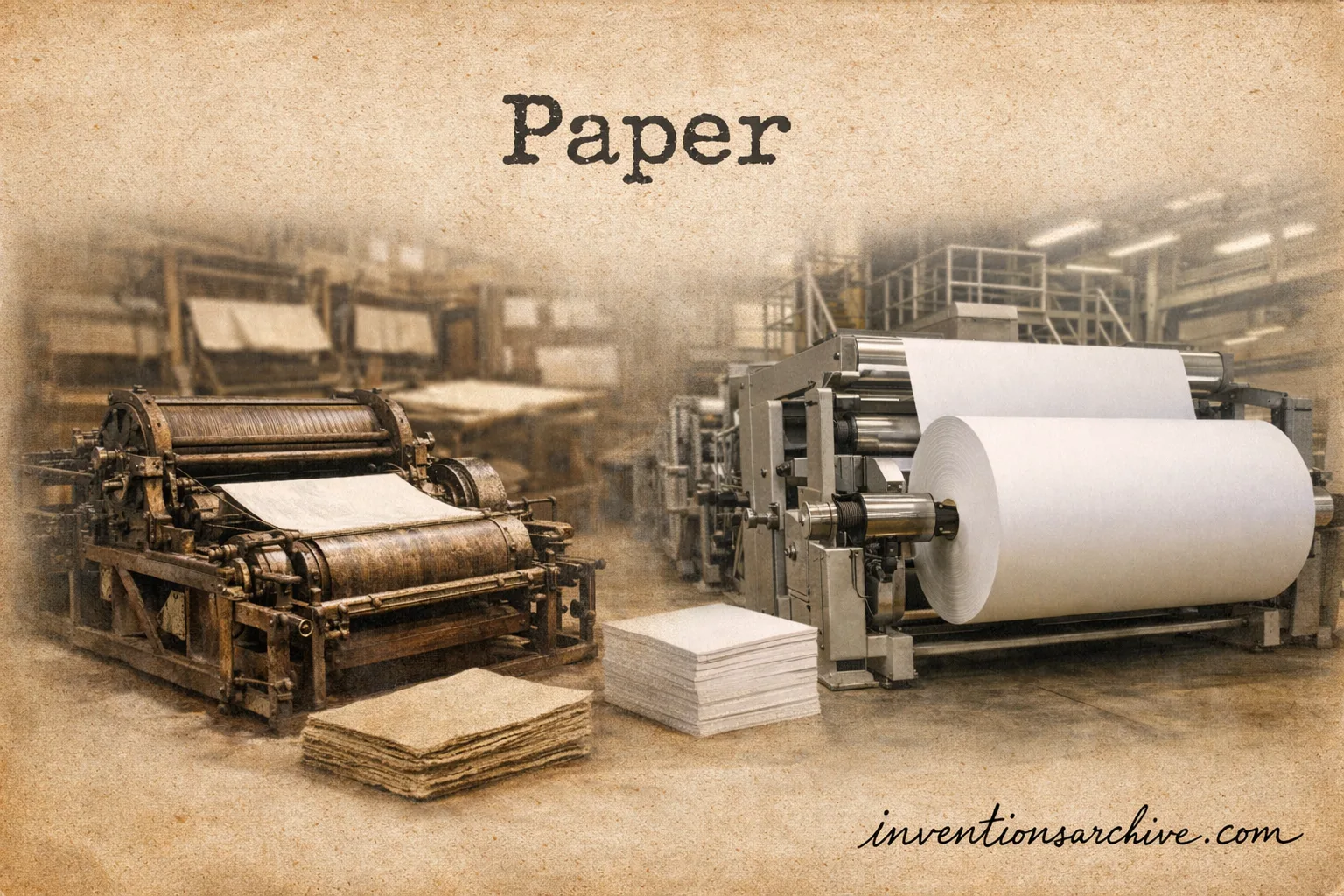
| Invention Name | Paper |
|---|---|
| Short Definition | A thin sheet made from matted plant or textile fibers, formed from a water suspension and dried for writing, printing, wrapping, drawing, and record keeping. |
| Approximate Date / Period | Early surviving evidence: 2nd century BCE Based on surviving evidence Formal papermaking record: about 105 CE Approximate |
| Geography | China, especially Han-period western and imperial contexts |
| Inventor / Source Culture | Cai Lun is traditionally credited with improving and presenting the process; earlier paper evidence suggests a collective and longer development. |
| Category | Communication, education, administration, art, manufacturing, record keeping |
| Evidence Status | Attribution varies Earliest surviving fragments predate the traditional Cai Lun account. |
| Main Problem Solved | Created a lighter, more flexible, and often cheaper writing surface than bamboo, wooden slips, silk, or parchment-like alternatives. |
| Material / Technical Base | Hemp, ramie, rags, bark fibers, mulberry-related fibers, bamboo fibers, water, screens, pressing, drying |
| How It Works | Fibers are separated into pulp, suspended in water, caught as a thin mat on a screen, drained, pressed, and dried. |
| Early Uses | Maps, documents, writing, Buddhist texts, administration, painting, wrapping, later printing |
| Development Path | Bamboo slips / silk / papyrus-like surfaces → fiber-based paper → handmade sheets → paper mills → wood-pulp paper → modern paper products |
| Surviving Evidence | Archaeological paper fragments, manuscript evidence, historical records, preserved books and scrolls |
| Related Inventions | Ink, brush, bamboo slips, papyrus, parchment, woodblock printing, movable type, bookbinding |
| Modern Descendants | Printing paper, archival paper, paperboard, packaging paper, banknote paper, specialty art paper |
| Why It Matters | It changed how societies stored records, copied texts, taught students, made books, printed images, traded information, and preserved culture. |
Paper is one of the most important writing materials in human history because it turned information into something easier to copy, store, carry, teach, trade, and preserve. In technical terms, paper is a matted sheet of cellulose-rich fibers formed from a water suspension, not simply a flat plant surface. Its roots are traced to China, where an early paper map from Fangmatan in Gansu dates to the second century BCE, while formal records of papermaking appear around 105 CE.[a]
What Paper Is
Paper is not just any thin sheet used for writing. The important difference is the way the sheet is made. True paper is formed when plant or textile fibers are broken apart, mixed with water, spread into a thin fiber mat, and dried into a usable surface.
This separates paper from papyrus, which was made from pressed strips of the papyrus plant. Papyrus could be a writing material, but it was not made from a suspended pulp of separated fibers. That difference matters because the fiber-pulp method made paper easier to adapt across many raw materials, workshops, climates, and later industries.
Early paper could be rough, uneven, and local in quality. It was not automatically like modern printer paper. Some sheets were made from hemp or rag fibers. Others used bark, bamboo, mulberry-related fibers, or blends of available materials. The invention was less about one fixed recipe and more about a repeatable principle: turning flexible fibers into a thin, dry, writable sheet.
How the Origin Is Traced
The origin of paper is traced through three kinds of evidence: archaeological fragments, written historical accounts, and later manuscript collections. The earliest surviving paper fragment from Fangmatan is especially important because it shows that paper existed before the traditional Cai Lun date. The fragment appears to have been part of a map, with topographical marks in black ink, and was found in a tomb dated to the early Western Han period.[b]
Cai Lun still matters. The traditional account credits him not simply with finding a loose sheet, but with refining, organizing, and presenting a process that could be useful at court. That distinction is important. In the history of inventions, the person most remembered is often the person who standardized, improved, or promoted a technology, not necessarily the first person who ever experimented with it.
The Problem Paper Answered
Before paper became common, people used several writing surfaces. Each had value, but each also had limits.
- Bamboo and wooden slips could hold written records, but bundles became heavy and awkward.
- Silk was light and fine, but too expensive for ordinary record keeping.
- Papyrus served the Mediterranean world well, but it belonged to a different plant-strip technology.
- Parchment and vellum could be durable, but they required animal skin and skilled preparation.
- Clay, stone, bone, and metal preserved certain records, yet they were not practical for fast writing and broad copying.
Paper answered a practical need: a writing surface that could be made from more available fibrous materials, carried in larger quantities, cut into different sizes, folded, pasted, printed, and stored with less weight. This helped schools, monasteries, workshops, courts, merchants, artists, and later printers.
How Paper Worked in Simple Terms
Early papermaking worked by separating fibers and letting them lock together as a sheet. The historic process used plant or textile fibers that were softened, broken down, mixed with water, lifted on a screen, drained, pressed, and dried. The screen allowed water to escape while the fibers stayed behind as a thin mat.[d]
The strength of paper came from the way fibers overlapped and bonded as water left the sheet. A good sheet needed enough fiber bonding to hold together, enough surface smoothness to receive ink, and enough flexibility to fold or roll without falling apart. Later makers adjusted fiber choice, beating, sizing, drying, polishing, and surface treatment to change how the paper behaved.
Main Technical Principle
The central principle is fiber suspension and sheet formation. The raw material mattered, but the method mattered more. Once makers understood that many fibrous materials could be reduced into pulp and remade into sheets, paper became adaptable.
- Fiber source: hemp, rags, bark, bamboo, mulberry-related fibers, later wood pulp.
- Water: carried the fibers and allowed them to spread evenly.
- Screen or mold: caught the fibers while draining water.
- Pressing and drying: removed water and stabilized the sheet.
- Sizing or surface treatment: changed absorbency for writing, painting, or printing.
Before and After Paper
| Before Paper | What Changed After Paper |
|---|---|
| Bamboo and wooden slips could be bulky when used for long texts. | Longer texts became easier to copy, carry, bind, store, and consult. |
| Silk offered a fine surface but was too costly for broad everyday use. | More ordinary administrative, educational, and commercial records could be written on a lighter surface. |
| Writing surfaces often depended on local materials and specialized preparation. | Papermakers could adapt many fibrous materials into sheets. |
| Copying texts by hand was still possible, but materials limited scale. | Paper supported manuscript copying, woodblock printing, later movable type, notebooks, account books, and printed images. |
| Storage and transport of records could be heavy or expensive. | Records, letters, maps, drawings, and books became easier to circulate across institutions and trade routes. |
Earlier Ideas and Materials Before Paper
Paper did not appear in a vacuum. Many older writing materials prepared the way for it by showing what people needed from a record surface: smoothness, portability, durability, and compatibility with ink or carving tools.
Bamboo and Wooden Slips
In early China, bamboo and wooden slips were practical for many records. They could be tied together into bundles and stored, but large texts became heavy. Paper answered that limitation by offering a lighter surface for writing and copying.
Silk
Silk was light and suitable for writing or painting, yet its cost kept it from being a mass writing material. Paper kept some of silk’s flexibility while using cheaper fiber sources.
Papyrus and Parchment
Papyrus and parchment belong to a broader history of writing surfaces. They are related in use, not in manufacture. Papyrus was made from plant strips; parchment from prepared animal skin. Paper’s fiber-pulp method gave it a different path.
Development Path from Early Sheets to Modern Paper
| Stage | Form | What Changed |
|---|---|---|
| Earlier Tools | Bamboo slips, wooden tablets, silk, papyrus, parchment | People had writing surfaces, but each had limits in cost, weight, flexibility, or availability. |
| Early Paper | Hemp, rag, and bark-fiber sheets in China | Fibers could be remade into a lighter sheet suitable for writing, wrapping, and mapping. |
| Improved Handmade Paper | Refined molds, better fiber preparation, sizing, polishing | Sheets became more consistent for writing, painting, copying, and printing. |
| Paper and Printing | Sheets used with woodblock printing and later movable type | Texts and images could be multiplied more easily than by hand copying alone. |
| Industrial Paper | Machine-made paper, rag and wood-pulp papers, paperboard | Production scale increased, making paper central to newspapers, books, packaging, offices, schools, and commerce. |
| Modern Descendants | Archival paper, banknote paper, paperboard, coated paper, specialty art papers | Paper became a family of materials designed for different strengths, surfaces, lifespans, and uses. |
Early Uses of Paper
Paper first gained value because it solved ordinary information problems. It helped people write, copy, send, teach, count, label, draw, fold, and store. Its early importance was not limited to literature.
- Administration: government records, notices, registers, and accounting.
- Learning: copying texts, teaching students, preserving commentaries.
- Religion: Buddhist manuscript copying and later printed devotional texts.
- Mapping: paper could carry drawn routes, land features, and practical spatial information.
- Art: painting, calligraphy, sketches, design, and decorative work.
- Commerce: receipts, contracts, packaging, labels, and later paper money.
Paper’s usefulness came from its balance. It was light but not uselessly fragile, absorbent but adjustable, and flexible enough for scrolls, sheets, folded booklets, and later bound books.
How Paper Spread and Changed Over Time
Paper spread because it served institutions that produced large amounts of writing. Courts, monasteries, schools, merchants, printers, and libraries all needed surfaces that could handle repeated copying and storage. Paper reached Central Asia by the eighth century, Baghdad by the late eighth century, and parts of Europe through later paper-mill traditions. In China, paper also supported printing because it was strong enough for pressure and absorbent enough to receive ink.[e]
As it moved, paper changed. Makers adapted local fibers, water sources, tools, drying methods, and surface treatments. In some regions, rag-based paper became dominant. In others, bark or bamboo fibers remained important. Later European mills added water-powered beating equipment. Industrial papermaking eventually shifted toward wood pulp, which increased supply but also created new problems for preservation when acidic papers aged poorly.
Main Types and Variations
| Type or Variation | Main Material or Feature | Common Historical or Practical Use |
|---|---|---|
| Hemp or Rag Paper | Textile fibers such as hemp, ramie, linen, or worn cloth | Manuscripts, documents, early books, durable writing surfaces |
| Bark or Mulberry Paper | Bast fibers from bark and related plants | Writing, painting, wrapping, local manuscript traditions |
| Bamboo Paper | Bamboo fibers processed into pulp | Writing, printing, and regional East Asian papermaking |
| Xuan Paper | Traditional Chinese handmade paper linked with calligraphy, painting, and book printing | Art, calligraphy, conservation, cultural craft traditions |
| Laid Paper | Visible lines from a wire or ribbed mold | Historical documents, books, letters, art papers |
| Wove Paper | Smoother sheet formed on a finer mesh surface | Printing, writing, drawing, later commercial use |
| Wood-Pulp Paper | Fibers from wood processed for mass production | Newspapers, books, office paper, packaging, everyday print materials |
| Archival Paper | Made for long-term stability, often with controlled acidity | Records, conservation, fine printing, museum and library use |
One important traditional variation is Xuan paper, associated with Jing County in Anhui Province. UNESCO describes it as a handmade paper valued for a strong, smooth surface, absorbency with ink, and repeated folding without breaking; it has been used in calligraphy, painting, and book printing.[f]
Materials and Surface Behavior
Paper changes depending on its fibers and surface treatment. A sheet made for brush calligraphy is not the same as a sheet made for a printed book, a banknote, a shipping label, or a watercolor painting.
Fiber Choice
Long fibers can help strength. Shorter or heavily processed fibers may make smoother sheets but can change durability. Hemp, linen, ramie, bark, bamboo, cotton, and wood pulp all produce different textures and aging behavior.
Absorbency
Unsized paper absorbs ink quickly. Sized paper resists liquid more strongly, giving writers and printers more control. This difference shaped calligraphy, painting, manuscript copying, and later printing quality.
Surface Finish
Paper can be left rough, polished, coated, pressed, or textured. A smoother sheet may work better for fine writing or printing. A more absorbent sheet may suit brushwork. The invention’s flexibility comes from these adjustable properties.
Why Paper Appeared When It Did
Paper became useful in Han China because several needs and resources met at the same time. There was demand for administration, communication, and record keeping. There were existing writing habits, brush and ink technologies, textile waste, plant fibers, and craft knowledge. A lighter surface could serve both government and cultural life.
The invention also depended on observation and workshop practice. Papermaking was not only an idea; it was a material process. It required fiber preparation, tools, water control, drying surfaces, skill, and repeated improvement. That is why its origin is better understood as a craft technology, not a single isolated object.
Related articles: Pound Lock [Medieval Inventions Series], Codex Book Format [Ancient Inventions Series]
Common Misunderstandings
Cai Lun Was Not Necessarily the First Maker
Cai Lun is traditionally credited with presenting and improving papermaking around 105 CE. Earlier fragments show that paper existed before this account.
Papyrus Is Not the Same as Paper
Papyrus was a writing surface, but it was made from pressed plant strips. Paper is made from separated fibers formed into a sheet.
The Oldest Surviving Fragment Is Not the First Sheet Ever Made
Archaeology gives the earliest known surviving evidence, not the full beginning of experimentation.
Paper Was Not Immediately Cheap Everywhere
Raw materials, labor, water, tools, and workshop skill affected cost. Paper became more available over time and in different ways across regions.
Modern Printer Paper Is a Late Form
Early paper was often handmade, fibrous, uneven, and locally varied. Machine-made office paper belongs to a much later industrial story.
Digital Paper Is Not Material Paper
E-paper and digital documents inherit the idea of a readable page, but they do not share the same fiber-based material technology.
What Changed Because of Paper
Paper changed the scale and movement of information. It made it easier to keep records, copy texts, produce books, draw maps, send letters, teach students, record accounts, and print images. The effect was gradual, but broad.
In education, paper supported notebooks, exercises, copied texts, and exam cultures. In administration, it supported registers, orders, reports, tax records, and archives. In trade, it supported contracts, bills, receipts, labels, packaging, and later paper money. In art, it gave calligraphers, painters, designers, and printers a surface that could be made in many grades.
Paper also helped later inventions. Woodblock printing, movable type, bookbinding, printed maps, newspapers, notebooks, standardized forms, and many office systems depended on a reliable sheet material. The long-term influence of paper came from its ability to connect writing, manufacturing, education, and distribution.
Related Inventions
Paper sits inside a wider history of recording, copying, and communication. These related inventions and materials help explain its place:
- Ink — made paper useful as a writing and drawing surface.
- Brush and Pen — shaped how paper was written on, marked, and designed.
- Bamboo Slips — an earlier Chinese writing medium that paper partly replaced.
- Papyrus — a separate plant-based writing material often confused with paper.
- Parchment — a durable writing surface used widely before and alongside paper in many regions.
- Woodblock Printing — used paper to multiply texts and images.
- Movable Type — depended on suitable sheets for repeated printing.
- Bookbinding — turned loose sheets, folded leaves, and gatherings into easier-to-use books.
Frequently Asked Questions
Who Invented Paper?
Cai Lun is traditionally credited with improving and presenting papermaking to the Chinese imperial court around 105 CE. Surviving evidence shows that paper existed earlier, so the invention is best understood as a Chinese development with a longer prehistory.
When Was Paper First Invented?
The earliest surviving evidence dates to the second century BCE in China, while the formal written tradition of papermaking is linked to about 105 CE. The exact first date is not known.
What Was Paper Made From at First?
Early paper used fibrous materials such as hemp, ramie, rags, bark fibers, and related plant materials. Recipes varied by region, period, and available resources.
Is Papyrus the Same as Paper?
No. Papyrus was made by pressing strips from the papyrus plant. Paper is made from separated plant or textile fibers suspended in water and formed into a sheet.
Why Was Paper Important for Printing?
Paper gave printers a sheet that could receive ink, withstand pressure, and be made in larger quantities than many older writing surfaces. This made printed texts, images, and books easier to produce and circulate.
What Are Modern Descendants of Paper?
Modern descendants include printing paper, archival paper, paperboard, packaging paper, banknote paper, coated papers, art papers, and many specialty fiber sheets.
Sources and Verification
- [a] Paper | Definition, Papermaking, & Facts | Britannica — Used to verify the technical definition of paper, the Fangmatan paper map date, the formal 105 CE papermaking record, and the broad spread of papermaking. (Reliable because it is an established institutional reference work with editorial review.)
- [b] Origins of paper | cabinet — Used to verify the Fangmatan fragment, its early Western Han context, and why the earliest surviving evidence does not prove the absolute first use. (Reliable because it is an Oxford institutional educational resource.)
- [c] Spring 2013 – International Dunhuang Programme — Used to verify manuscript research on rag paper, ramie and hemp fibers, and the point that rag paper in China predates the Cai Lun attribution. (Reliable because the International Dunhuang Programme is an institutional research and collection collaboration involving major libraries and scholarly partners.)
- [d] The ancient papermaking process | cabinet — Used to verify the basic historical stages of papermaking, including fiber preparation, pulp casting, pressing, and drying. (Reliable because it is an Oxford institutional educational resource.)
- [e] The History of Printing in Asia According to Library of Congress Asian Collections – Part 1 — Used to verify paper’s importance for Chinese writing, printing, portability, and the relationship between paper and later print culture. (Reliable because it is published by the Library of Congress.)
- [f] Traditional Handicrafts of Making Xuan Paper — Used to verify Xuan paper’s material qualities and its use in calligraphy, painting, and book printing. (Reliable because it is an official UNESCO Intangible Cultural Heritage page.)