
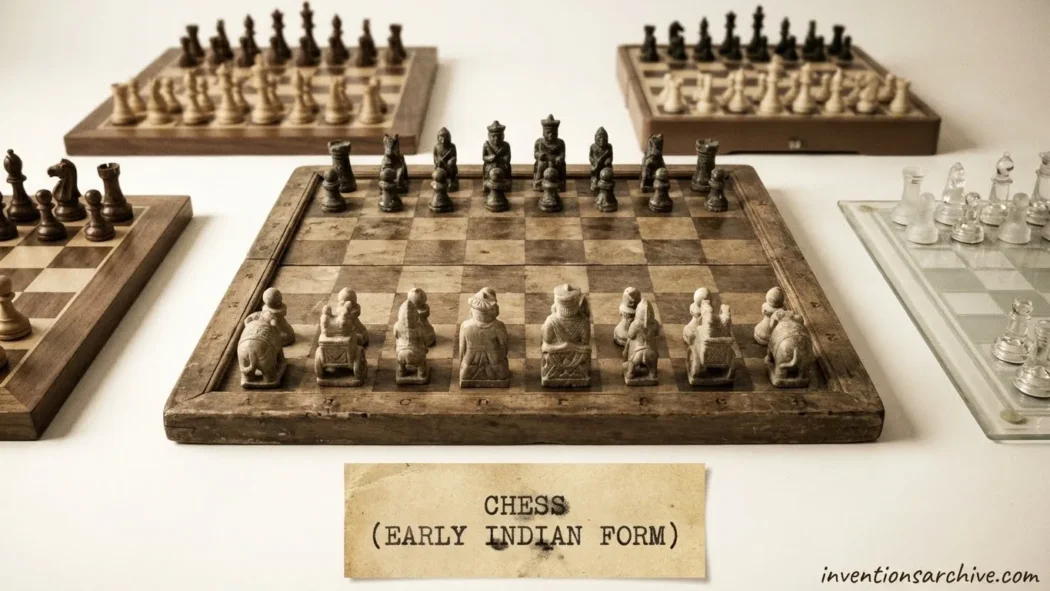
| Invention Name | Chess (Early Indian Form) |
|---|---|
| Early Name | Chaturanga / caturaṅga |
| Short Definition | A strategic board game representing an army on a square board. |
| Approximate Date / Period | 6th century CE Approximate |
| Geography | North India / northwestern India Attribution varies |
| Inventor / Source Culture | Anonymous / collective Indian game tradition |
| Category | Education, strategy, culture, game design |
| Main Problem Solved | Turned army movement, planning, risk, and positional judgment into a board game. |
| How It Worked | Pieces moved across an 8-by-8 board as symbolic army units. |
| Technical Basis | Grid board, rule-based movement, capture, ranked pieces, strategic turns. |
| Main Pieces | King, counselor or minister, elephant, horse, chariot, foot soldiers. |
| Evidence Status | Written and literary evidence Based on surviving evidence |
| Surviving Evidence | Early textual references, Persian accounts, later chess objects, museum records. |
| Development Path | Indian board games → chaturanga → Persian chatrang / shatranj → medieval chess → modern chess. |
| Why It Matters | It created the direct ancestor of the world’s best-known strategy board game. |
| Related Inventions | Ashtapada board, dice board games, shatranj, chessboard, chess notation, chess clock, computer chess. |
| Modern Descendants | International chess, chess variants, tournament systems, chess engines, AI game search. |
What Chess Was in Its Early Indian Form
Early Indian chess was not modern chess with different names. It was a related but older game idea: a contest of organized forces on a square board. The name chaturanga is usually understood as “four limbs” or “four divisions,” referring to the traditional army units of elephants, horses, chariots, and foot soldiers.
The game’s lasting idea was simple and powerful: military order could be represented through movement, position, threat, and protection. A player did not merely count pieces. A player had to understand space.
This was the invention’s true step forward. It turned conflict into abstraction. The board became a controlled model where rank, movement, sacrifice, and long-term planning could be studied without real danger.
How Its Origin Is Traced
The origin of chaturanga is traced through a mix of language, texts, and later historical memory. The Sanskrit name points to India. Persian forms such as chatrang and Arabic shatranj show how the name changed as the game travelled. The later European word “chess” belongs to that longer chain of adaptation.
There is no reliable evidence that modern-like chess existed before the 6th century CE. Older game pieces and boards from different regions are sometimes described as “chess,” but many belong to other board-game families. Some used dice. Some used race mechanics. Some used square boards without chess-style army pieces.
The Problem It Answered
Before chaturanga, people already had board games, dice games, race games, and counting games. What chaturanga added was a more focused form of strategic conflict on a fixed board.
The practical value was not that it taught real battlefield command in a direct way. It did something subtler. It trained players to think about:
- how different units can have different powers,
- how a weak piece can still matter in the right position,
- how protecting the ruler changes every move,
- how short-term gain can damage long-term control,
- how one side’s plan can be interrupted by the other side’s response.
That made early chess useful as a courtly and educational pastime. It rewarded patience, memory, and judgment, not only chance.
How It Worked in Simple Terms
The early Indian form was based on a gridded board and pieces with different roles. The exact earliest rules are not fully preserved, so modern descriptions must be careful. The main form that led to later chess appears to have used two opposing forces, each with a ruler, supporting officer, and army units.
The pieces represented an ordered army:
- King — the central figure whose safety shaped the game.
- Counselor or minister — the early ancestor of the later queen, but far weaker than the modern queen.
- Elephant — a piece tied to the military importance of elephants in South Asian and Persian imagination.
- Horse — the ancestor of the knight.
- Chariot — the ancestor of the rook.
- Foot soldiers — the ancestors of pawns.
The game’s deeper invention was not any single piece. It was the system: a symbolic army, a board of limited space, and rules that made each decision depend on future consequences.
Earlier Ideas and Tools Before Chaturanga
Chaturanga did not appear in a vacuum. India already had a long culture of board games and mathematical play. The ashtapada, often described as a board of sixty-four squares, is frequently discussed as part of the background. It was not necessarily chess, but it shows that square game boards were already familiar.
Dice-based games were also important. Some earlier games mixed chance with movement. Chaturanga’s later reputation, though, rests on strategy more than chance. That shift is one reason chess became so adaptable across cultures.
| Stage | Form | What Changed |
|---|---|---|
| Earlier Tool | Ashtapada and other Indian board games | Square boards and game movement were already known. |
| Early Indian Form | Chaturanga | Army units became symbolic pieces with ranked movement. |
| Persian Form | Chatrang / shatranj | The game entered Persian and Arabic-speaking cultures with adapted names and terms. |
| Medieval European Form | Old chess | Pieces and courtly meanings were reinterpreted in Europe. |
| Modern Descendant | International chess | Rules became standardized; queen and bishop gained stronger movement. |
Main Materials, Board, and Technical Principle
The earliest boards and pieces could have been made from perishable materials such as wood, cloth, simple carved pieces, or marked counters. That is one reason early physical evidence is limited. A game can be widely played and still leave few surviving objects.
The technical principle was the translation of social and military roles into rule-based movement. Each type of piece had a different function. The game was not balanced by making every piece equal. It was balanced by making pieces unequal in a structured way.
This unequal structure gave chess its long life. The king was not the strongest piece, but the game revolved around him. Foot soldiers were limited, but their placement could decide space. Long-range and short-range pieces created different kinds of pressure. The result was a game where position mattered as much as capture.
Early Uses and Playing Context
Early chess was likely played in elite, educated, and courtly settings before it became a broader cultural game. Its army symbolism made it suitable for rulers, nobles, scholars, and trained players who valued strategic thought.
The board also made the game portable. Unlike physical contests, it needed only pieces, a playing surface, and shared rules. That helped chess move across languages and courts. A board game can travel with merchants, scholars, envoys, soldiers, and manuscripts.
In Persian and Arabic-speaking settings, chess became shatranj. From there, it entered literary culture, mathematical writing, courtly education, and later European play. The game kept its basic idea while local cultures renamed pieces and adjusted meanings.
Before and After the Early Indian Game
| Before | After |
|---|---|
| Many board games relied more heavily on race, counting, or dice. | Chaturanga placed more weight on planned movement and positional judgment. |
| Game pieces often served as counters rather than specialized units. | Pieces represented different army roles with different powers. |
| Military order was harder to model in a compact game. | The board gave players a small model of organized conflict and protection. |
| Local games often stayed tied to one region or rule tradition. | Chess adapted across Persia, the Islamic world, Europe, and Asia. |
| Strategy games left fewer shared international descendants. | Chess became a global family of games, not just one local pastime. |
How It Spread and Changed Over Time
The most accepted line of spread runs from India into Persia, then into Arabic-speaking regions, and later into Europe. The name changed as the game crossed languages: chaturanga became chatrang, then shatranj, and eventually chess-related words in European languages.
National Museums Scotland summarizes this cultural route by tracing the game from Indian chaturanga to Iran, where it became shatranj, and then into medieval Europe, where the name and rules changed again.[d]
The most visible European change came later. The counselor or minister became the queen. The elephant became the bishop in many European traditions. The queen and bishop also gained stronger movement, making modern chess faster and sharper than its older forms.
Main Types and Related Early Forms
One common source of confusion is the difference between two-player chaturanga and later descriptions of four-player Indian chess. These are related in historical discussion, but they should not be treated as identical without caution.
| Form | Main Features | Evidence or Role |
|---|---|---|
| Two-player chaturanga | Two armies, ranked pieces, king-centered play. | Most often treated as the direct ancestor of later chess. |
| Four-player chaturanga / chaturaji | Four players, dice in some descriptions, four small armies. | Known from later descriptions; not safely treated as the original form. |
| Persian chatrang | Adapted name and Persian terminology. | Bridge between Indian chaturanga and Arabic shatranj. |
| Shatranj | Slower queen-like and bishop-like pieces than modern chess. | Major medieval form in the Islamic world. |
| Medieval European chess | Christian courtly reinterpretations of several pieces. | Stage before the faster modern rule set. |
The four-player version is especially useful for understanding how Indian chess-like games could vary. The Ludii Digital Ludeme Project records evidence for a four-player form described through al-Biruni’s account, with dice controlling which type of piece could move. That evidence is valuable, but it belongs to a later documented variant, not a simple proof that all chess began as a dice game.[e]
Common Misunderstandings
“Chess Was Invented by One Named Person”
No known inventor can be named with confidence. The early Indian form is better understood as a collective cultural invention that became clearer through use, transmission, and later writing.
“The First Surviving Evidence Means the First Game Ever Played”
Surviving evidence only shows what has reached us. A game may have existed earlier in forms that left no durable pieces, boards, or manuscripts.
“Chaturanga Was Exactly the Same as Modern Chess”
The family link is strong, but the rules and piece powers changed. The modern queen and bishop are much stronger than their early equivalents.
“All Four-Player Indian Chess Was the Original Chess”
Four-player forms are part of the wider history, but they should not be treated as the proven first version. The relationship between two-player and four-player forms is still handled carefully by historians.
What Changed Because of It
The early Indian form of chess created one of the most durable models of strategic thought in game history. Its effect can be seen in several areas:
- Game design: it showed how unequal pieces could create balanced strategic tension.
- Education: it became a tool for attention, planning, and memory.
- Language: words connected with chess moved across Sanskrit, Persian, Arabic, and European languages.
- Material culture: it encouraged carved pieces, portable boards, luxury sets, and later printed diagrams.
- Mathematics and computing: chess later became a classic model for search, decision-making, and artificial intelligence.
This is why chaturanga matters beyond the history of games. It helped define a reusable pattern: a small board can hold a large problem.
Related Inventions
- Ashtapada board — an earlier Indian square board often discussed in relation to chess history.
- Dice board games — older game traditions that shaped Indian play culture, even if not identical to chess.
- Shatranj — the Persian and Arabic form that carried chess into wider medieval cultures.
- Chessboard — the fixed grid that made structured movement and position possible.
- Chess notation — later systems for recording games and studying positions.
- Chess clock — a modern tournament tool that added time control to competitive play.
- Computer chess — a later field that used chess as a test case for search and evaluation.
- Chess engines — modern software descendants of chess as a formal decision problem.
Frequently Asked Questions
Was chaturanga the first form of chess?
Chaturanga is usually treated as the earliest clear ancestor of modern chess. The exact first version is not fully documented, so the safest wording is that modern chess developed from early Indian chess-like forms, especially chaturanga.
Who invented early Indian chess?
No individual inventor is known. Early Indian chess is best described as an anonymous or collective invention that grew from older board-game traditions and later became known through textual and cultural evidence.
Was early Indian chess played with the same rules as modern chess?
No. The early game shared the core idea of ranked pieces on a board, but several piece powers changed over time. The modern queen and bishop became much stronger in later European chess.
Why is the date of early chess uncertain?
The earliest phase is known through later texts, language history, and surviving objects from later periods. There is no signed invention record or complete original rulebook from the first period of the game.
How did chaturanga become modern chess?
The game spread from India into Persia, then into Arabic-speaking regions and Europe. Names, piece meanings, and movement rules changed along the way, eventually producing the faster modern version of chess.
Sources and Verification
- [a] Chess and Other Games – Cambridge Core — Used to verify the likely Indian 6th-century origin, the name chaturanga, army-division meaning, and later spread of chess. (Reliable because it is an academic publisher page for a Cambridge University Press book chapter.)
- [b] CHESS – Encyclopaedia Iranica — Used to verify the Sanskrit, Middle Persian, Persian, and Arabic naming chain, the late first certain mention of catur-aṅga, Persian textual evidence, and the caution around legendary accounts. (Reliable because it is a specialist encyclopaedia article with scholarly authorship and bibliography.)
- [c] Chess set – The Metropolitan Museum of Art — Used to verify museum-record evidence that chess probably originated in India and that Indian ivory chess pieces are known from as early as the eighth century. (Reliable because it is an official museum collection record.)
- [d] Chess and Ludo: Board Games with South Asian Origins – National Museums Scotland — Used to verify the broad South Asian origin tradition and the route from chaturanga to Iran, shatranj, and medieval European chess. (Reliable because it is published by a national museum institution.)
- [e] Evidence for Four-Player Chaturanga (al-Biruni) – Ludii Portal — Used to verify the documented four-player chaturanga evidence connected with al-Biruni’s account and dice-based play. (Reliable because it is part of the Digital Ludeme Project, associated with Maastricht University and funded by the European Research Council.)