
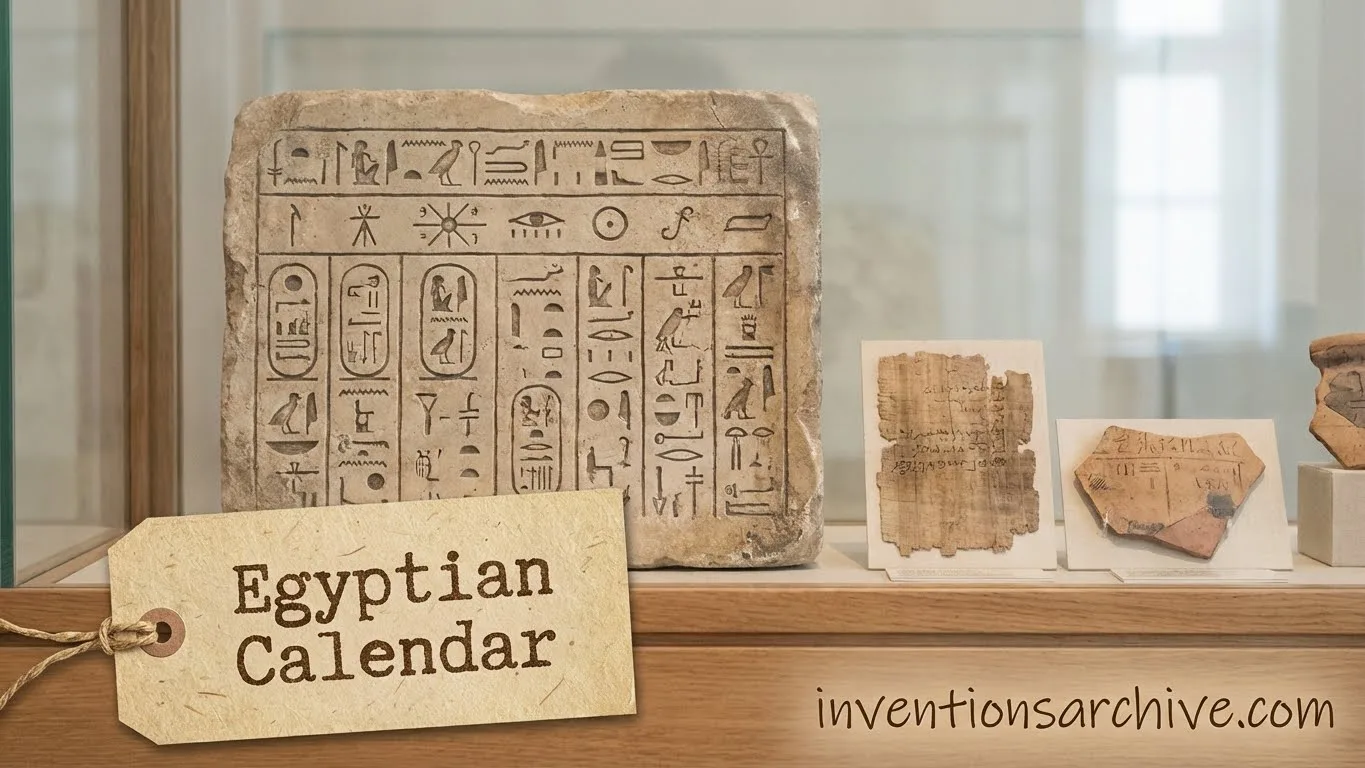
| Invention Name | Egyptian Calendar |
|---|---|
| Short Definition | A 365-day civil calendar used in ancient Egypt to organize dates, seasons, records, festivals, and administration. |
| Approximate Date / Period | By the middle Old Kingdom, around 2450 BCE; possibly earlier Approximate |
| Geography | Ancient Egypt, especially the Nile Valley and temple-administrative centers |
| Inventor / Source Culture | Anonymous / collective Egyptian development Attribution varies |
| Category | Measurement, administration, astronomy, agriculture, religion, education |
| Evidence Status | Based on surviving texts, inscriptions, dated objects, temple records, and later scholarly reconstruction Based on surviving evidence |
| Main Problem Solved | Provided a regular year for recording events, scheduling work, organizing festivals, and connecting time to Nile seasons |
| Core Structure | 12 months × 30 days = 360 days, plus 5 extra days at year end |
| Seasonal Structure | Akhet, Peret, Shemu; three seasons of four months each |
| How It Worked | Dates were placed within a season, month, day, and often a ruler’s regnal year |
| Earlier Ideas or Tools | Lunar cycles, agricultural seasons, Nile flood observation, star observation |
| Surviving Evidence | Dated inscriptions, papyri, ostraca, festival lists, temple records, and Ptolemaic calendar reform inscriptions |
| Development Path | Lunar and seasonal reckoning → Egyptian civil calendar → Alexandrian / Coptic calendar forms |
| Related Inventions | Decans, sundials, shadow clocks, water clocks, regnal dating, Nile measurement systems |
| Modern Descendants | Coptic calendar, Alexandrian calendar tradition, historical chronology systems |
| Certainty Issues | Exact origin date and single inventor are not known; the early development was gradual |
What the Egyptian Calendar Is
The Egyptian calendar was one of the most orderly timekeeping systems of the ancient world. Its best-known form was a civil calendar of 365 days, divided into twelve equal months and five extra days at the end of the year. It helped officials date records, temples arrange festivals, workers track duties, and communities connect the year to the visible rhythm of the Nile.
Calling it an “invention” is accurate, but it should be understood as a system invention. It was not a single tool like a wheel or a clock. It was a way of organizing time into a repeatable structure that could be written, taught, copied, and used across generations.
By at least the middle of the Old Kingdom, around 2450 BCE, Egyptians had developed a civil calendar with twelve 30-day months, three seasons, and five epagomenal days added at the end. The same body of evidence connects New Year’s Day with Sopdet/Sirius, while also showing why scholars remain careful about the exact origin date of the system.[a]
How Its Origin Is Traced
The origin of the Egyptian calendar is traced through several kinds of evidence rather than one founding text. The strongest clues come from written dates, temple inscriptions, named festivals, astronomical references, and later records that preserve older practices.
The calendar likely grew from three overlapping needs:
- Seasonal observation: the Nile flood shaped farming, transport, and the timing of work.
- Religious scheduling: temple festivals needed stable days in the official year.
- Administrative dating: scribes needed a practical way to date accounts, deliveries, labor records, and royal events.
The link with Sopdet/Sirius is important, but it should not be oversimplified. The rising of Sirius near the time of the Nile flood helped give the year an astronomical marker. Yet the surviving evidence does not prove that one astronomer “invented” the calendar on a known day.
The Problem It Answered
Before a regular civil calendar, time could be followed through moon phases, seasonal signs, river behavior, and local custom. These methods were useful, but they were not ideal for a large administrative culture that needed consistent records.
The Egyptian calendar answered a practical problem: how to make the year recordable. A fixed 365-day structure made it easier to write dates, schedule recurring events, arrange temple service, count regnal years, and connect public life to a recognizable cycle.
| Before the Calendar System | What Changed After It |
|---|---|
| Time could be followed through moon phases, local seasons, and flood signs. | A repeatable civil year gave scribes a stable dating structure. |
| Festivals and work cycles could depend more heavily on local or seasonal observation. | Official festivals and records could be assigned to named or numbered days. |
| Long-term recordkeeping was harder when time was tied mainly to observation. | Administrative documents could use season, month, day, and regnal year. |
| Agricultural time followed the Nile and visible environmental signals. | The calendar gave that seasonal world a written and transferable structure. |
| Later historians had fewer fixed date systems to compare. | Egyptian dates became important evidence for chronology and historical reconstruction. |
How It Worked in Simple Terms
The civil year had 365 days. It used twelve months of thirty days each, making 360 regular days. Five additional days were placed at the end of the year. Egyptologists call these extra days epagomenal days.
The year was also grouped into three seasons:
- Akhet: often translated as Inundation, linked with the flood season.
- Peret: often translated as Emergence, associated with the growing season.
- Shemu: often translated as Harvest, associated with the later dry and harvest period.
Each season had four months. Each month had thirty days. This made the system easy to count and easy to write. In a scribal culture, that simplicity mattered.
The five extra days were not just mathematical leftovers. UCL’s Digital Egypt material notes that each year five days were added to the twelve 30-day months, and that each of those extra days was associated with the birthday of a particular deity: Osiris, Horus, Seth, Isis, and Nephthys.[b]
The Main Calendar Forms
Ancient Egyptian timekeeping did not rely on one calendar idea only. The civil calendar became the most famous because it was regular and useful for records. Other calendar forms and time systems also existed beside it.
| Form or Variation | Main Use | What Made It Different |
|---|---|---|
| Civil Calendar | Administration, records, official dates | 365 fixed days; 12 equal months; 5 extra days |
| Lunar Reckoning | Religious timing and month-related practice | Followed phases of the moon rather than a fixed 365-day count |
| Luni-Stellar Ideas | Scholarly reconstruction of older religious and astronomical timing | May have connected lunar months with Sopdet/Sirius and correction methods |
| Festival Calendar | Temple ceremonies and public religious dates | Linked named days and months to recurring ritual events |
| Alexandrian / Coptic Calendar | Later Egyptian and Coptic Christian timekeeping | Preserved the ancient structure but added a leap-day pattern |
Materials, Mechanism, and Technical Principle
The Egyptian calendar did not depend on one physical material. Its “mechanism” was conceptual: regular counting. The system converted the year into equal written units that could be recorded on papyrus, carved into stone, painted on tomb or temple walls, written on ostraca, and used in accounts.
Its technical principle was the separation of civil order from exact astronomical correction. A year of 365 days is close to the solar year, but it is short by about a quarter day. That made the Egyptian civil year highly regular, yet slowly drifting against the actual solar year.
This drift is one of the most important details. The calendar’s strength was its simplicity. Its weakness was that it did not originally add a leap day every four years. Over time, the civil dates moved through the natural seasons.
Development Path from Earlier Tools to Later Forms
The Egyptian calendar sits between older observation-based timekeeping and later corrected solar calendars. Its development path is not a straight line with one inventor. It is better read as a long chain of practical improvements.
| Stage | Form | What Changed |
|---|---|---|
| Earlier Tool | Lunar phases and seasonal observation | People tracked visible cycles, but these were less convenient for fixed written records. |
| Environmental Marker | Nile flood cycle | The year was tied to agriculture, movement, fields, and river conditions. |
| Astronomical Marker | Sopdet / Sirius rising | A bright star became associated with New Year timing and seasonal renewal. |
| Invention | 365-day civil calendar | The year became a fixed scribal structure of 12 months and 5 added days. |
| Reform Attempt | Canopus Decree proposal | An extra day every four years was proposed in the Ptolemaic period but did not become the older civil norm. |
| Later Form | Alexandrian / Coptic calendar | The ancient structure continued with a leap-day correction in later Egyptian timekeeping. |
Early Uses in Daily Life and Administration
The calendar mattered because it made time usable on paper, stone, and pottery. A date could be written down and understood later. That sounds simple, but it changed the value of records.
In practice, the Egyptian calendar supported:
- Temple festivals: ceremonies could be assigned to days in the official year.
- Royal and administrative dating: records could be tied to a ruler’s year, month, and day.
- Agricultural planning: the three seasons reflected the broad rhythm of flood, growth, and harvest.
- Labor organization: work groups, deliveries, and duties could be recorded with dates.
- Historical memory: later readers could place events within a named reign and calendar structure.
The system also helped later historians. Dated ostraca, papyri, inscriptions, and stelae give scholars a way to connect Egyptian events to broader chronologies, even when exact conversion is difficult.
How It Spread and Changed Over Time
The calendar spread through use rather than through a single export event. Scribes, priests, administrators, builders, and record keepers used it because it was practical. Its regularity gave it staying power.
Later Egyptian history added new layers. Month names changed. Religious festivals kept old meanings while adapting to new settings. Greek and Roman rule brought further calendar reform attempts. The old civil structure did not simply disappear; it was revised and preserved in later Egyptian calendar forms.
The Chicago Demotic Dictionary material from the Institute for the Study of Ancient Cultures explains the 365-day administrative year, the missing quarter day, the long drift, the three seasons, the five epagomenal days, and the 238 BCE Canopus Decree’s attempt to add an extra epagomenal day every four years.[c]
Related articles: Water Clock [Ancient Inventions Series]
The Canopus Reform and the Leap-Day Question
One common mistake is to treat the ancient Egyptian civil calendar as if it always used a modern leap-year rule. It did not. The older civil calendar had 365 days. It did not keep itself permanently aligned with the solar year.
In the Ptolemaic period, the Canopus Decree proposed adding an extra day every four years. This is historically important because it shows awareness of the missing quarter day. It also shows the difference between recognizing a problem and making a reform permanent across society.
The Egyptian Museum in Cairo identifies the Canopus Decree as a trilingual inscription in Egyptian hieroglyphs, Demotic, and Greek, commemorating a priestly assembly at Canopus in honor of Ptolemy III. For calendar history, the decree is one of the most useful surviving witnesses to an attempted reform of the Egyptian year.[d]
What Changed Because of the Egyptian Calendar
The Egyptian calendar gave one of the ancient world’s largest record-keeping cultures a stable way to write time. Its influence is easiest to see in ordinary functions, not in dramatic claims.
- Dates became easier to record: documents could name a season, month, day, and ruler’s year.
- Festivals became tied to an official year: temple life could be organized in a durable sequence.
- Administration became more consistent: deliveries, duties, and events could be compared across time.
- Chronology became more recoverable: modern scholars can use Egyptian dates as evidence, even when conversion is complex.
- Later calendars inherited its structure: the Coptic and Alexandrian traditions preserved much of the ancient design.
The Egyptian calendar also offered a clean mathematical model: twelve equal months plus added days. That regularity made it especially useful for calculation, even when its seasonal drift required caution.
Common Misunderstandings
It Was Not Invented by One Named Person
No known text names a single inventor. The calendar is better understood as a long Egyptian development shaped by observation, writing, temples, and administration.
The Earliest Evidence Is Not the First Use
The first surviving evidence only shows what has lasted. The system may have been used earlier than the objects and texts that survive today.
It Was Not Only an Astronomical Calendar
Sirius mattered, but the calendar also served records, festivals, labor, agriculture, and royal dating. Its value was practical as well as astronomical.
It Did Not Originally Keep Leap Years
The older civil calendar did not add a leap day every four years. That is why it slowly moved against the solar year.
The Coptic Calendar Connection
The Egyptian calendar did not vanish when ancient Egyptian religion and administration changed. A later corrected form continued through the Alexandrian and Coptic calendar tradition.
UCL’s Digital Egypt page describes the Coptic calendar as the “Alexandrian year,” which became the civil year in Egypt in 30–26 BCE, and explains that it is essentially the ancient Egyptian 365-day calendar with an extra day added every four years to keep it aligned with the solar year of about 365¼ days.[e]
This connection is one reason the Egyptian calendar is more than an ancient curiosity. It shows how a practical timekeeping design could be preserved, corrected, and carried into later cultural and religious life.
Related Inventions and Later Developments
The Egyptian calendar is easier to understand when placed near other systems of measuring, recording, and organizing time.
- Lunar Calendar Systems: older and parallel methods based on moon phases.
- Decans: star groups used in Egyptian night-time reckoning.
- Shadow Clocks: instruments that used shadows to divide daytime.
- Water Clocks: devices that measured time through controlled water flow.
- Regnal Dating: dating events by the reigning ruler’s year.
- Nile Measurement Systems: seasonal water observation linked to agriculture and administration.
- Julian Calendar Reform: later solar correction in the Roman world.
- Coptic Calendar: a later Egyptian calendar form with strong structural continuity.
Frequently Asked Questions
Who invented the Egyptian calendar?
No single inventor is known. The Egyptian calendar was probably a collective development shaped by scribes, priests, administrators, seasonal observation, and astronomical knowledge.
How many days were in the Egyptian calendar?
The best-known Egyptian civil calendar had 365 days: twelve months of thirty days each, plus five extra epagomenal days at the end of the year.
Why was Sirius important to the Egyptian calendar?
The heliacal rising of Sopdet, known through Greek and Latin names as Sothis or Sirius, was associated with New Year timing and the Nile flood. The exact role it played in the calendar’s origin is still treated with caution.
Did the Egyptian calendar have leap years?
The older Egyptian civil calendar did not originally use a leap-day rule. A later Ptolemaic reform attempted to add an extra day every four years, and later Alexandrian and Coptic forms preserved a corrected structure.
Is the Coptic calendar related to the ancient Egyptian calendar?
Yes. The Coptic calendar preserves much of the ancient Egyptian calendar structure, especially the twelve 30-day months and added days, while using a leap-day correction in its later form.
Sources and Verification
- [a] Telling Time in Ancient Egypt — Used to verify the Old Kingdom dating range, the 365-day civil calendar structure, the three seasons, regnal dating, Sopdet/Sirius evidence, and scholarly caution about the exact beginning of the system. (Reliable because it is a museum research essay from The Metropolitan Museum of Art.)
- [b] Festivals in the ancient Egyptian calendar — Used to verify the twelve 30-day months, the five added days, and the association of the epagomenal days with specific deities. (Reliable because it is an academic Digital Egypt resource from University College London.)
- [c] Chicago Demotic Dictionary — Used to verify the 365-day administrative year, the missing quarter-day drift, the three seasons, the five epagomenal days, and the Canopus Decree reform attempt. (Reliable because it is an institutional publication from the Institute for the Study of Ancient Cultures at the University of Chicago.)
- [d] Trilingual Stela of Canopus Decree in Honor of Ptolemy III — Used to verify the Canopus Decree as a trilingual inscription connected with the priestly assembly at Canopus under Ptolemy III. (Reliable because it is an official Egyptian Museum Cairo artefact page.)
- [e] Calendar — Used to verify the Coptic / Alexandrian calendar connection and the addition of an extra day every four years in the later corrected form. (Reliable because it is an academic Digital Egypt resource from University College London.)