
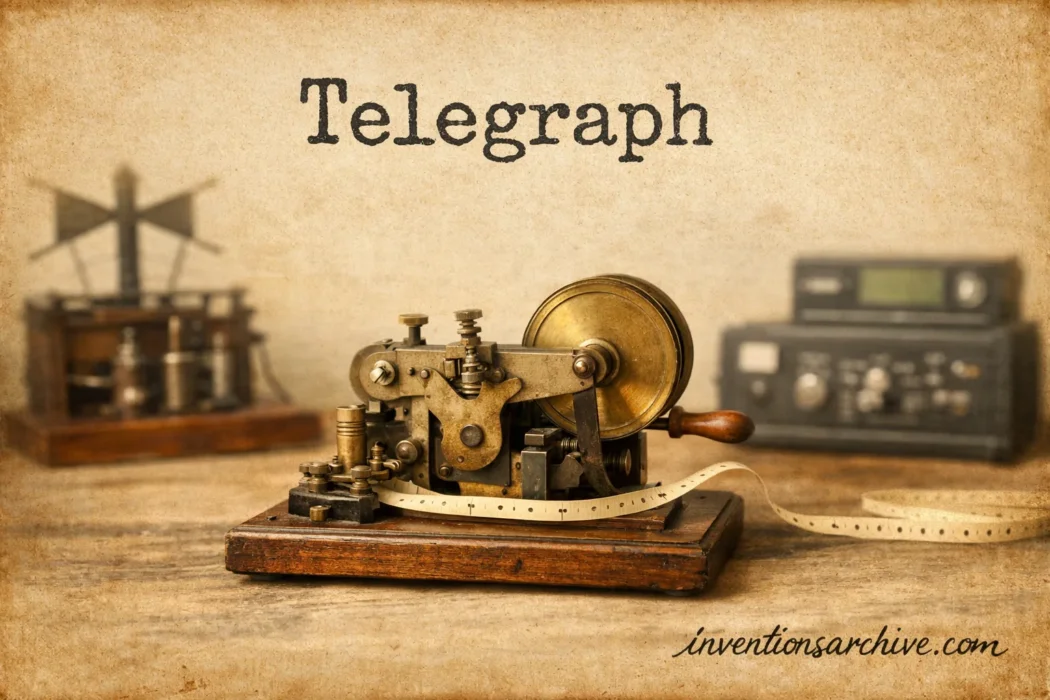
The telegraph turned writing into electricity. Before it, fast messages still depended on distance, weather, roads, ships, and human stamina. Once telegraph networks took hold, a message no longer had to travel with the messenger. It could be encoded, sent as a signal, and recovered far away in minutes. That shift changed railways, markets, newsrooms, timekeeping, diplomacy, and everyday language itself—the words wire, cable, and telegram all came out of this invention family.
| Topic | Details |
|---|---|
| Invention Name | Telegraph |
| Short Definition | Long-distance message system using coded signals; first visual, later electrical. |
| Approximate Date / Period | Semaphore roots: late 18th century; electric prototype: 1816; practical public systems: 1830s–1840s mixed certainty |
| Geography | France, Britain, United States; later Europe, Atlantic routes, global cable corridors |
| Inventor / Source Culture | Anonymous / collective origins; Claude Chappe; Francis Ronalds; William F. Cooke; Charles Wheatstone; Samuel F. B. Morse; Alfred Vail |
| Category | Communication, transport control, business information, public infrastructure |
| Why It Mattered |
|
| Need It Answered | Couriers were too slow for railways, trade, administration, and fast news. |
| How It Worked | Signal encoded → transmitted by line-of-sight or wire → decoded by indicator, sounder, register, or printer |
| Material / Technology Base | Batteries, copper or iron wire, electromagnets, poles, glass or ceramic insulators, paper tape, gutta-percha, cable armor |
| Early Use Areas | State signaling, railways, commercial messaging, shipping notices, news transmission |
| Spread Route | Semaphore France → Europe; railway telegraph Britain → public offices; U.S. trunk lines → submarine cables → intercontinental systems |
| Derived Developments | Stock ticker, printing telegraph, teleprinter, telex, signaling systems, wireless telegraphy |
| Impact Areas | Transport, journalism, finance, timekeeping, weather reporting, administration, diplomacy |
| Debates / Different Views | “First telegraph” depends on definition: visual vs electric, prototype vs public system, experimental vs commercial |
| Predecessors and Successors | Beacons, drums, flags, semaphore → telephone, radio telegraphy, teleprinter, digital messaging |
| Main People and Institutions | Chappe network, Ronalds, Cooke, Wheatstone, Morse, Vail, early railway companies, cable engineers, telegraph firms |
| Varieties It Shaped | Needle telegraph, Morse telegraph, ABC dial systems, printing telegraph, stock ticker, submarine cable telegraph, wireless telegraph |
Table of Contents
What the Telegraph Is
The telegraph was not one single machine. It was a message system, and that matters. Some versions used moving arms on towers. Others used needles, paper strips, clicking sounders, or printing mechanisms. What joined them all was the same basic idea: convert language into signals, send those signals across distance, then convert them back into readable form.
That is why the telegraph belongs to the history of networks as much as the history of devices. A lone instrument did very little by itself. A line, a code, an operator, a receiving instrument, maintenance crews, insulators, poles, relay points, and rules for message handling—those made telegraphy real. Strip those away and it was just clever hardware on a desk.
One more point, and it clears up a lot of confusion: the telegraph was not born all at once, neatly, from a single inventor’s hand. It emerged in stages. Visual systems came first, electrical prototypes followed, then railway use, then public networks, then submarine cables, then automated offshoots.
Before the Electric Telegraph
Long-distance signaling is older than the electric age by a wide margin. People used fires, flags, drums, beacons, and elevated watch points for centuries. Those methods could warn, announce, or alert, but they could not easily carry dense written language. They were fast for simple messages. They were not flexible.
Late eighteenth-century semaphore systems changed that. Tower-to-tower signaling made it possible to relay coded information over land at striking speed when visibility was good. The term telegraph itself first took shape in that visual setting, then shifted toward electrical signaling in the nineteenth century (Details-1).
Semaphore had obvious limits. Fog blocked it. Darkness stopped it unless lights were used. Terrain complicated it. Towers had to stay in sight of one another. The system was quick, yes, but only under the right conditions. That weakness opened the door for electricity, which could move through wire in any weather and at any hour.
Who Developed the Telegraph
The cleanest answer is also the most honest one: several people did, at different moments, for different forms of the invention.
In Britain, Francis Ronalds built a working electrostatic telegraph in 1816. His design used synchronised dials, charged wire, and visible motion at the receiving end. It worked, though it did not become the standard public system later generations would know (Details-2).
Then came William Fothergill Cooke and Charles Wheatstone. Their needle telegraph systems were practical for railway use, and railway companies had a direct need for them—fast control of moving traffic. That gave the invention a real operating environment, not just a demonstration bench. Science Museum records note that telegraph instruments installed on the London and Blackwall Railway in 1840 marked the first commercially successful use of the electric telegraph anywhere in the world (Details-3).
In the United States, Samuel F. B. Morse and Alfred Vail produced the form most people picture today: a simpler electrical line using coded pulses. Vail’s role was not minor—far from it. Smithsonian records tie both men to the forty-mile Washington–Baltimore line completed in May 1844 and to the famous “What Hath God Wrought” transmission, sent from Washington and received by Vail in Baltimore (Details-4).
So who invented the telegraph? The better phrasing is this: who invented which telegraph, and at what stage. Visual telegraphy, early electric telegraphy, railway telegraphy, and long-distance public telegraphy do not point to one tidy origin story. History rarely does.
Why the “First” Claim Stays Disputed
- Visual systems predate electric ones.
- Working prototypes came before public networks.
- Commercial use is not the same as laboratory success.
- National histories often favor local inventors.
- Codes and instruments were refined by teams, not only by headline names.
How the Telegraph Works
Put plainly, telegraphy breaks communication into a chain. An operator or mechanism encodes a message. The system sends that code as a signal. A receiving instrument translates the signal into marks, motion, or sound. Then the message is written out or read aloud.
- Sender: closes a circuit, changes a signal arm, or selects a coded position.
- Medium: line-of-sight space or, more often in the electric era, a wire.
- Energy source: usually batteries in early land systems.
- Receiver: a needle, register, sounder, dial, or printer responds to the pulse.
- Code: letters are represented by positions, pulse lengths, or symbol groups.
The earliest electric receivers did not all “beep” in the modern sense. Some moved pointers. Some marked paper. Some clicked, and trained operators learned to read those clicks by ear. That was a big step. Once sounders became normal, operators no longer needed to watch paper tape constantly. They could listen. Faster, less fussy.
Distance brought technical headaches. Long wires weakened signals. Leakage through damp insulation or poor joints caused failures. Engineers answered with relays, repeaters, better insulators, and improved line materials. Submarine cables made everything harder still. Undersea lines needed insulation that water would not defeat, plus highly sensitive instruments to detect faint signals after long travel.
In essence, the telegraph made a bold trade: it gave up the full sound of spoken language and replaced it with abstract code. In return, it gained reach and speed that older message methods simply could not match.
Types and Descendants of the Telegraph
Telegraphy branched out quickly. It did not stay frozen in one format, and that variety is one of its most useful features to study.
Optical Semaphore Telegraph
This version used towers, movable arms, shutters, or flags. Messages moved from station to station by sight. It worked best for state communication and fixed routes. Weather could stop it cold.
Needle Telegraph
Common in early Britain, this type used magnetic needles that deflected when electrical current passed through coils. Different needle positions represented letters or coded combinations. Railway settings suited it well. Staff could use it for traffic management, line control, and signaling.
Morse Register and Sounder Telegraph
This is the form most often associated with the word telegraph. A sender produced short and long pulses. A register could emboss or mark the pattern on paper, while later sounders let operators hear the rhythm directly. Morse code became the best-known telegraph code, but it was never the only one.
ABC and Dial Systems
Some instruments aimed to simplify operation by pointing directly to letters on a dial. That reduced some training demands. It also appealed to businesses and offices that wanted readable output without deep code skill. Ease of use mattered, even then.
Printing Telegraphs and Stock Tickers
Later systems moved toward automatic character printing. These machines fed directly into finance, brokerage, and office communication. The stock ticker, often treated as its own device class, is really one of telegraphy’s descendants—a specialized one, but clearly related.
Related articles: Railway System [Industrial Age Inventions Series], Fire Signals [Ancient Inventions Series]
Submarine Cable Telegraph
Once telegraph lines went underwater, telegraphy stopped being only a national network and became an intercontinental one. Cable telegraphy demanded new materials, new laying techniques, new testing methods, and new signal detection tools. This was not just a longer land line. It was a tougher engineering category altogether.
Wireless Telegraphy
Radio telegraphy kept the logic of coded signaling while removing the wire. The message still traveled as a sequence of electrical events—now radiated through space rather than carried by a conductor. In that sense, wireless telegraphy did not abandon telegraphy. It extended it.
What the Telegraph Passed On
- Message coding and abbreviated transmission
- Network routing across linked stations
- Priority classes for urgent traffic
- Timestamp discipline and line logging
- Machine-to-machine text output in offices and exchanges
How Telegraph Networks Spread
Railways were the first great home for the electric telegraph. The reason was simple enough: trains moved faster than older signaling habits could safely manage. Telegraph lines let stations coordinate departures, report line conditions, and reduce confusion over distance. From there, telegraphy spilled outward into public offices, newspapers, ports, and business houses.
As networks grew, the telegraph altered the pace of information. Prices could move between cities faster. News agencies could distribute reports on tight schedules. Governments could communicate with more immediacy. The language of messages changed too—shorter, denser, charged by cost per word and line capacity.
Intercontinental reach marked the next jump. The Department of State’s historical office notes that U.S. diplomacy did not fully enter the telegraph age until the successful transatlantic cable of 1866 made durable oceanic telegraphy possible (Details-5). Once that happened, the telegraph no longer merely connected towns or regions. It tightened the time gap between continents.
That new pace had cultural effects. Messages became lean. Offices learned standard forms. News cycles shortened. Market reactions sped up. Even the style of prose changed a little—more compressed, less leisurely, more exact where cost demanded it.
Materials and Engineering Behind the System
The telegraph was an information invention, yes, though it was also a materials invention. It depended on many physical choices that do not always get enough attention.
- Conductors: wire had to carry current with acceptable loss.
- Electromagnets: these turned current into visible or audible action.
- Insulators: glass and ceramic parts kept current from leaking into poles or damp structures.
- Batteries: early systems needed reliable electrical supply station by station.
- Paper media: some systems recorded messages physically for checking and storage.
- Cable insulation: submarine work demanded materials that could survive water pressure and long immersion.
Land telegraphy and submarine telegraphy behaved differently. A land line could be inspected, repaired, re-strung, and rerouted with relative ease. An undersea cable, once laid, was another matter entirely. Engineers had to think about insulation, armoring, laying ships, electrical resistance, and signal delay over long distance. Telegraph history is full of codebooks and operators, true—but it is also full of wire gauges, joints, leakage, batteries, and test equipment. Muddy boots as much as brilliant minds.
The network also needed disciplined maintenance. Poles rotted. Wires snapped. Storms damaged routes. Connections oxidized. Instruments drifted out of adjustment. Telegraphy only looked effortless when all that invisible upkeep was doing its job.
What the Telegraph Changed
The telegraph did not just make communication faster. It reorganized time, attention, and coordination. That is the real story.
- Railways: better traffic control, scheduling, dispatch communication, and line management.
- Journalism: faster news transfer across cities and regions.
- Finance: quicker movement of price data and market information.
- Timekeeping: standardized time signals became easier to distribute.
- Administration: offices could manage far-flung operations with shorter delays.
- Weather reporting: observations from multiple places could be gathered on the same day.
- Maritime and port activity: ship arrivals, cargo notices, and routing information moved faster inland.
Perhaps the sharpest change was psychological. People began to expect distant information quickly. Not eventually. Quickly. That expectation never really went away. The telegraph planted it, and later technologies kept feeding it.
It also made communication more abstract. A telegram did not carry handwriting, voice tone, or gesture. It carried content stripped down to signal form. That economy shaped office language, business language, and news language. Brief, exact, efficient. Sometimes almost clipped.
Limits of the Telegraph
For all its speed, telegraphy had real limits. Operators needed training. Codes had to be learned. Lines failed. Long messages cost more. Networks required constant repair. And for ordinary conversation, the telephone later offered something the telegraph never could: direct speech without translation into code.
Still, telegraphy did not vanish overnight. Parts of it survived in telegram services, rail signaling, marine communication, wireless code work, teleprinters, and telex. Old systems lingered because they still did certain jobs well. That often happens with infrastructure. It fades by layers.
Why the Telegraph Still Matters
Modern messaging looks very different on the surface, but much of its logic feels familiar. Encoding, routing, addressing, short-form transmission, priority handling, network maintenance, and message logs all have telegraphic ancestry. The hardware changed. The mental model stayed remarkably persistent.
So the telegraph should not be treated as a dead curiosity in polished wood and brass. It was the first widely adopted system that made societies live with near-instant text at a distance. That habit stuck. Very much so.
FAQ About the Telegraph
Was Samuel Morse the only inventor of the telegraph?
No. Morse was central to one influential electrical form of telegraphy, especially in the United States, but telegraph history also includes semaphore systems, Francis Ronalds’s early electric prototype, and Cooke and Wheatstone’s railway-based needle systems in Britain.
What is the difference between semaphore and electric telegraphy?
Semaphore telegraphy used visible signals such as movable arms, shutters, or flags and depended on line of sight. Electric telegraphy sent coded pulses through wire and could operate in darkness and poor weather.
How did Morse code fit into telegraph history?
Morse code was one coding method used by electrical telegraph systems associated with Morse and Vail. It became the best-known telegraph code, though early telegraphy also used needle positions, dial systems, and printing methods.
Why did railways adopt the telegraph so early?
Railways needed fast coordination between stations, dispatch points, and line operators. Telegraphy helped manage traffic, timing, and route information more effectively than older signaling methods.
Why were submarine telegraph cables so hard to build?
Undersea cables had to survive water, pressure, long distances, and weak signals. Engineers needed durable insulation, protective armoring, careful laying methods, and sensitive receiving instruments.
Did the telegraph disappear completely?
No. Public telegram services declined in many places, yet telegraphic ideas and descendant systems lived on in wireless code communication, teleprinters, telex, signaling systems, and modern text-based networks.