
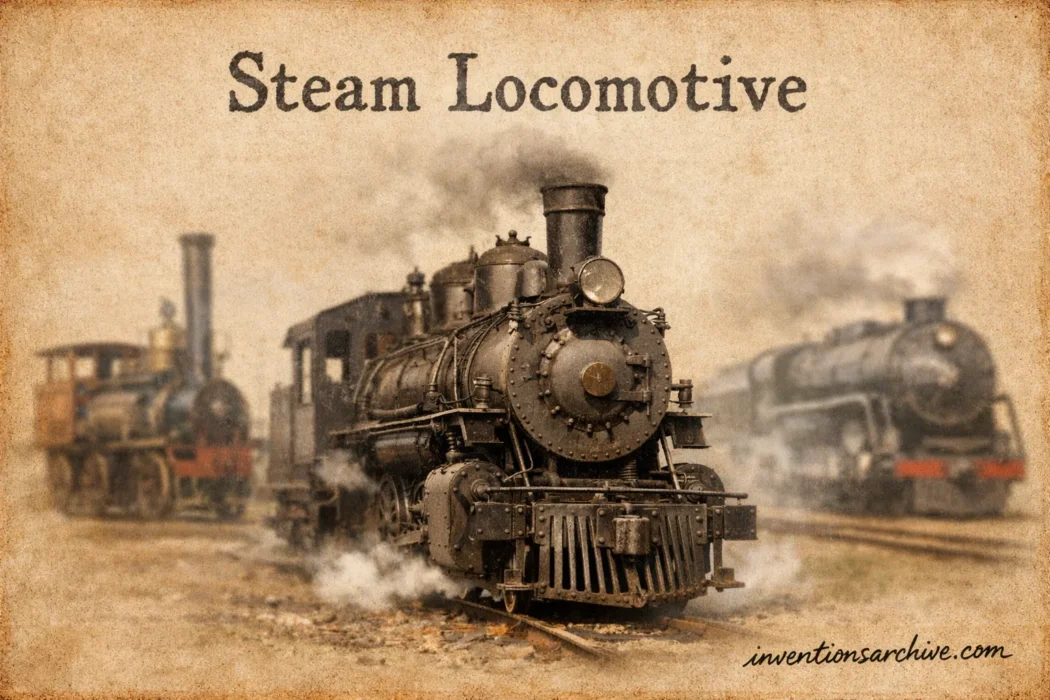
| Topic | Details |
|---|---|
| Invention Name | Steam Locomotive |
| Short Definition | Self-propelled rail vehicle that uses steam pressure to turn wheels and haul cars. |
| Date / Period | 1804 first successful rail haulage by steam (Exact); 1825 public passenger-carrying railway service (Exact); 1829 design breakthrough at Rainhill (Exact); 18th-century stationary steam roots (Approximate) |
| Geography | South Wales, North-East England; later spread across Europe, North America, Asia, Africa, and Latin America. |
| Inventor / Source Culture | Richard Trevithick; later refined by George Stephenson, Robert Stephenson, and other railway engineers within British mining, ironworking, and machine-building culture. |
| Category | Transport, power engineering, heavy industry, rail infrastructure |
| Why It Mattered |
|
| Need Behind It | Cheaper land transport for coal, iron, raw materials, manufactured goods, and growing passenger traffic. |
| How It Works | Fuel burns in the firebox, water becomes steam, steam pushes pistons, rods turn the driving wheels. |
| Material / Technology Base | Iron, later steel, boilers, cylinders, machined valves, rails, high-pressure steam |
| First Uses | Ironworks and collieries; soon after, public freight and passenger railways |
| Spread Route | Britain to continental Europe and the United States, then outward through global railway building. |
| Developments It Opened Up | Mass freight rail, express passenger rail, larger workshops, standardized parts, station networks, and modern transport scheduling. |
| Impact Areas | Industry, trade, mail, urban growth, labor mobility, tourism, machine-tool production |
| Debates | “Who came first?” remains the main historical dispute: Trevithick for early working locomotive use; Stephenson-era engineers for reliable public railway adoption. |
| Precursors and Successors | Precursors: horse-drawn wagonways, Newcomen and Watt steam engines. Successors: diesel, diesel-electric, and electric locomotives. |
| Key People and Groups | Richard Trevithick, George Stephenson, Robert Stephenson, Henry Booth, ironmasters, colliery owners, railway workshops |
| Varieties It Shaped | Tender engines, tank engines, freight engines, passenger engines, articulated engines, geared locomotives, fireless industrial engines |
Contents
Steam locomotives turned heat, water, iron, and timing into one working transport system. They did more than pull wagons. They changed the scale of freight movement, tightened railway schedules, widened labor markets, and gave industrial economies a faster land network than roads could offer for much of the 19th century.
Plainly put: a steam locomotive is a rail engine that carries its own power plant. Fuel heats water, steam builds pressure, pistons move, rods turn the wheels, and the locomotive pulls the train. Simple to say. Hard to perfect.
What the Steam Locomotive Is
A steam locomotive is a mobile steam engine on rails. That distinction matters. Earlier steam engines already existed, but they were fixed in place, usually in mines or workshops. The locomotive became valuable when engineers made steam power compact, strong, and stable enough to travel on track while hauling weight behind it.
The locomotive is only the powered vehicle. The train is the whole formation: locomotive plus wagons, coaches, or both. That small distinction shaped railway language, railway law, and railway engineering.
It was never one neat, finished invention dropped into history in a single moment. Better to see it as a chain of advances: high-pressure steam, stronger rails, improved metalworking, better wheel guidance, safer boiler practice, and more reliable valve control. Put those together and the steam locomotive became practical.
Early Development and Turning Points
Before Rail Locomotion
The steam locomotive did not begin with railways alone. It grew out of stationary steam power, especially engines used for pumping water and driving machinery. Early rail routes were often wagonways worked by horses. So the real breakthrough was not the rail. Not even the steam engine by itself. It was the marriage of the two.
High-pressure steam changed the scale of the problem. It allowed engineers to shrink power into a moving vehicle rather than leave it in one fixed building with ropes, pulleys, or chains doing the hauling.
Trevithick and the 1804 Breakthrough
Richard Trevithick stands at the start of the locomotive story because he built the first successful steam locomotive to haul a load on rails. At Penydarren in South Wales, his locomotive ran on 21 February 1804 and hauled iron, wagons, and people over roughly nine miles. That run did not instantly launch a full railway age, but it proved the principle in public, physical form. (Details-1)
Its weakness was not the idea. It was the surrounding system. Track strength, weight distribution, and day-to-day reliability still lagged behind the engine’s promise.
The 1825 Public Railway Step
By 1825, the steam locomotive had moved beyond experiment into public railway use. Locomotion No. 1 ran on 27 September 1825 on the Stockton and Darlington Railway, marking the first passenger service on that new public line and helping define what the modern railway would become: not an isolated industrial novelty, but a repeatable transport system. (Details-2)
That date matters because it joins machinery to public use. A working invention becomes historically larger when it starts reshaping ordinary movement.
Rocket and the 1829 Design Shift
Stephenson’s Rocket was not the first steam locomotive, and saying otherwise muddies the record. Its place in history is different. Rocket showed how several good ideas—especially a better boiler layout, a stronger draft through the fire, and cleaner power delivery—could be combined into a locomotive that was fast, reliable, and persuasive enough to settle a major railway argument. At the Rainhill Trials in 1829, it averaged 12 mph and reached 30 mph, helping secure the case for locomotive haulage on the Liverpool and Manchester Railway. (Details-3)
That is why Rocket sits so firmly in public memory. Not because it came first, but because it made the steam locomotive look like the future.
Early Spread to the United States
Steam locomotive design changed again when it crossed the Atlantic. The Smithsonian’s John Bull, built in 1831 and used between Philadelphia and New York, shows that early American practice did not merely copy British models. Isaac Dripps’s added pilot truck improved guidance on rougher track and became a lasting American feature on many locomotives. (Details-4)
In other words, the steam locomotive spread globally, but it never stayed frozen. Each railway culture altered it to match local track, fuel, terrain, workshop skill, and traffic needs.
Three Dates That Define the Invention
- 1804 — first successful steam haulage on rails
- 1825 — public railway service enters the picture
- 1829 — the locomotive wins the design argument
How a Steam Locomotive Works
A steam locomotive converts heat into pressure and pressure into motion. Fuel burns in the firebox. Hot gases pass through tubes in the boiler. Water around those tubes turns into steam. That steam is directed into cylinders, where it pushes pistons back and forth. The piston motion passes through rods and crank pins to the driving wheels, and rotary motion takes over. (Details-5)
The cycle depends on timing. Not just pressure. Valve gear admits steam to one side of the piston, then the other, then releases spent steam. Exhaust steam shoots up the blast pipe into the smokebox, which helps pull the fire harder. That is one of the clever feedback loops in steam locomotive design: the engine helps its own fire breathe.
So the machine is not merely a boiler with wheels. It is a synchronized set of thermal, mechanical, and airflow systems all working at once.
Main Parts and Engineering Logic
Look closely at a steam locomotive and nearly every major function remains visible. That is one reason the type still fascinates engineers, museum curators, and rail historians.
- Firebox — the fuel burns here; it is the heat source.
- Boiler — holds water and turns that heat into steam pressure.
- Smokebox and chimney — manage exhaust flow and draft.
- Cylinders — steam pressure acts on pistons here.
- Pistons and rods — convert reciprocating motion into wheel rotation.
- Driving wheels — transfer power to the rails through adhesion.
- Valve gear — times steam admission and exhaust.
- Tender or side tanks — carry water and fuel, unless the locomotive is built as a tank engine.
- Cab — crew control point for regulator, reverser, brake equipment, and gauges.
Later steam locomotives grew more refined. Engineers added superheaters, better lubrication, improved valve events, larger fireboxes, feedwater heating, and in some cases articulated frames. Yet the basic logic remained the same. Fire. Water. Steam. Motion.
Very direct, really. Very demanding too.
Types and Variations
The steam locomotive was never a single shape. It became a family of machines, each tuned to a job.
| Variant | Usual Role | What Set It Apart |
|---|---|---|
| Tender Engine | Long-distance passenger and freight | Separate tender for larger fuel and water capacity |
| Tank Engine | Yards, branches, commuter lines, industrial work | Water and fuel on the locomotive itself; compact and often reversible |
| Passenger Engine | Faster scheduled service | Larger driving wheels, smoother running, lighter axle balance |
| Freight Engine | Heavy haulage | More tractive effort, smaller drivers, emphasis on pull rather than speed |
| Articulated Engine | Heavy grades and long freight trains | Multiple engine units under one boiler for power and curve flexibility |
| Geared Locomotive | Logging, mining, rough track | Power sent through gears instead of standard side rods; strong at low speed |
| Fireless Engine | Factories and enclosed industrial settings | No onboard fire; used stored steam from a stationary plant |
Wheel Arrangements
Wheel arrangement became one of the quickest ways to describe what a steam locomotive was built for. A small 0-4-0 might switch wagons in tight industrial space. A 2-8-0 Consolidation fit freight work. A 4-6-2 Pacific became a classic passenger layout. Very large articulated machines, such as 4-8-8-4 engines, handled extreme heavy-haul work on demanding grades.
Tender Engines and Tank Engines
Tender engines carried water and fuel in a separate vehicle, which made them better for longer runs. Tank engines stored those supplies on the locomotive frame itself, making them shorter, handier, and often better for branch lines, yards, docks, and suburban routes.
Geared and Industrial Forms
Not all steam locomotives chased speed. Some were built for bad track, sharp curves, and low-speed pulling. Geared locomotives—Shay, Heisler, and Climax types are the best-known examples—traded pace for controlled pulling power. Fireless locomotives, by contrast, were a response to place. Where open flame posed a problem, stored steam offered a safer industrial answer.
Later Refinements
As rail traffic grew denser, builders improved drafting, superheating, combustion, valve timing, and weight distribution. Streamlining appeared on a few late passenger icons, though it mattered far less than boiler efficiency, route quality, and mechanical reliability on everyday railways.
Fuel, Water, and Operating Limits
Many general histories stop at invention dates. That leaves out half the story. A steam locomotive was only as useful as the support system around it.
It needed fuel, constant water supply, ash disposal, inspection, lubrication, and crew skill. Coaling stages, water towers, turntables, roundhouses, workshops, and repair pits were not side notes. They were part of the locomotive’s real operating body.
Coal became the best-known fuel, though early locomotives often used coke, and some regions used wood or oil. The choice depended on local supply, price, smoke control, and railway policy. Water mattered just as much. Poor water quality could damage boilers through scale and corrosion, so railways often treated water before use.
Startup time was another limit. Steam power did not leap into motion instantly. Crews had to raise steam, manage the fire, watch pressure, monitor water level, and keep moving parts fed with oil. Powerful, yes. Effortless, no.
Boilers also demanded discipline. A steam locomotive worked with hot metal and stored pressure; routine inspection and skilled shop work were built into its life cycle.
One overlooked truth: the steam locomotive was not just a machine. It was an infrastructure-dependent machine. Railways had to build an entire service ecosystem around it.
Why the Steam Locomotive Changed Transport and Industry
The steam locomotive made overland movement of heavy goods more regular, more predictable, and far cheaper over distance than road haulage had been in many settings. Coal could move from pit to port with less friction. Iron, textiles, grain, timber, and manufactured goods followed.
Then came the social effects. Towns gained station districts. Commuting widened. Mail moved faster. Newspapers arrived sooner. Factory regions tied themselves to ports and inland markets with a tighter time structure. Railway time, timetables, and scheduled interchange all rested on the fact that locomotives could pull planned loads along fixed routes in repeatable patterns.
And the influence ran backward into industry. Locomotives demanded better foundries, more accurate machining, standardized replacement parts, stronger bridges, improved metallurgy, and bigger workshops. The steam locomotive did not merely use industrial skill. It pushed that skill forward.
That is why it belongs not only in transport history, but also in the history of engineering, labor, finance, urban growth, and state administration.
Why Steam Gave Way to Diesel and Electric
Steam locomotives were powerful, adaptable, and visually unforgettable. Yet they asked a lot from railways.
Diesel-electric locomotives needed less daily servicing, could be started faster, spent more time available for traffic, and reduced the labor load of firing, ash handling, and heavy boiler maintenance. Electric locomotives, where wires and power supply made sense, removed onboard combustion and performed especially well on dense routes and steep gradients.
Steam did not vanish everywhere at the same pace. Some railways kept it longer because coal was available, workshop traditions were strong, capital budgets were tight, or electrification was too expensive. Even so, the long trend was clear by the mid-20th century: railways wanted locomotives that spent more time working and less time being prepared, cleaned, watered, or repaired.
The steam locomotive lost ground not because it stopped working, but because newer forms worked with less interruption.
Legacy, Preservation, and Lasting Value
Steam locomotives still matter because they make engineering visible. On a diesel-electric locomotive, much of the action hides inside. On steam, the logic is out in the open: rods move, valves shift, exhaust beats, heat becomes motion before your eyes.
That visibility gives the steam locomotive a special place in museums and preserved railways. It helps explain thermodynamics, mechanical motion, industrial labor, maintenance culture, and the scale of 19th- and early-20th-century engineering. A preserved engine is never just a vehicle. It is also a record of machining standards, fuel practice, route demands, and the workshop habits of its railway.
There is another reason, too. Steam locomotives sit right at the point where invention became system. Track, stations, schedules, repair shops, signaling, staffing, and national transport policy all had to line up around them. That broad reach explains why the steam locomotive remains one of the defining inventions of the industrial age.
Frequently Asked Questions
Who invented the steam locomotive?
No single person created the finished form all at once. Richard Trevithick built the first successful steam locomotive to haul a load on rails in 1804. George Stephenson, Robert Stephenson, Henry Booth, and other railway engineers then helped turn the locomotive into a reliable public-railway machine.
Was Rocket the first steam locomotive?
No. Rocket was not the first. Its fame comes from proving a highly effective locomotive design in 1829 at the Rainhill Trials. Trevithick’s work came earlier, and other engineers also contributed important designs before and after Rocket.
How does a steam locomotive move?
Fuel burns in the firebox and heats water in the boiler. Steam pressure then enters cylinders and pushes pistons. Rods connect that motion to the driving wheels, which move the locomotive along the rails.
What fuel did steam locomotives use?
Coal became the best-known fuel, though many locomotives also used coke, wood, or oil depending on place, period, and railway practice. All steam locomotives also required large amounts of water.
Why were steam locomotives replaced?
Railways gradually replaced them because diesel-electric and electric locomotives needed less daily servicing, started faster, and stayed available for traffic longer. Steam remained useful for many years, but it demanded more fuel handling, water supply, maintenance, and crew effort.
Are steam locomotives still used today?
Yes, though mainly on preserved railways, museum lines, excursion services, and a small number of ceremonial or heritage operations. Today they are valued less for ordinary transport and more for education, preservation, and historical interpretation.