
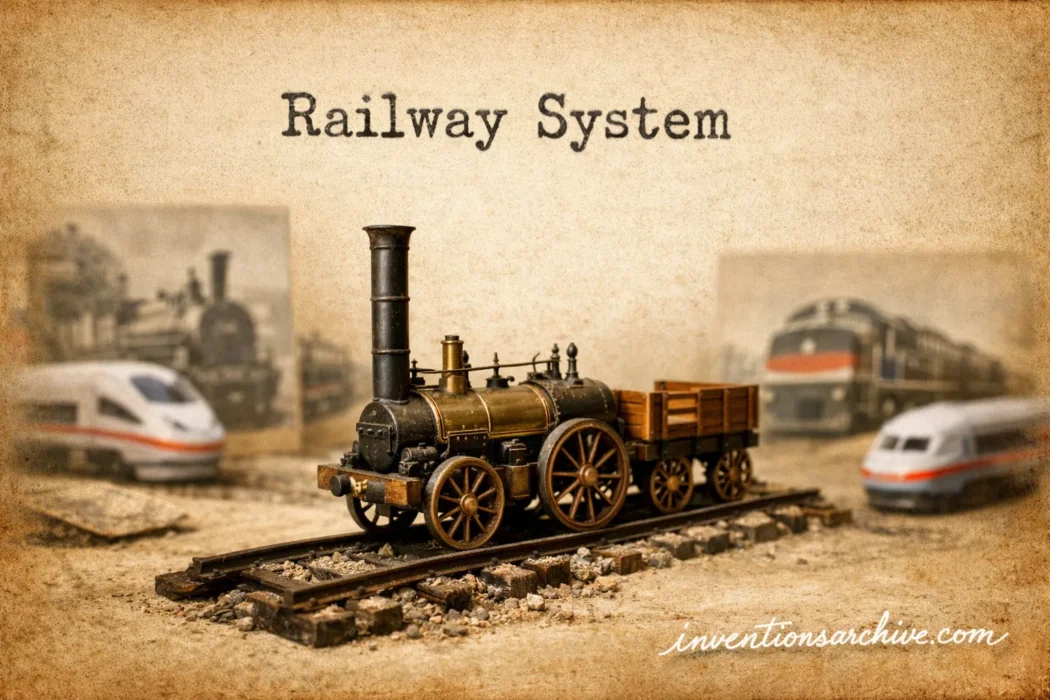
Long before express trains linked major cities, engineers and mine operators had already learned a simple truth: a guided wheel on a fixed rail can move more weight with less effort than a cart on an ordinary road. From that practical idea grew the railway system—not one device, not one workshop breakthrough, but a layered transport system built from track, vehicles, switches, signalling, stations, power, and time control. Its roots reach back to early wagonways, while its public form took shape in the early nineteenth century and then spread across continents, cities, ports, and industrial belts.
| Item | Information |
|---|---|
| Invention Name | Railway System |
| Short Definition | A guided land transport system in which flanged wheels run on fixed rails for freight and passenger movement. |
| Approximate Date / Period | 16th–17th century roots; 1825–1830 public railway breakthrough — Mixed certainty: early roots documented, the “first” depends on definition |
| Geography | Early European mining districts; public railway model matured in Britain; later global spread |
| Inventor / Source Culture | Anonymous / collective; later linked with engineers such as George Stephenson and many railway builders, surveyors, and operators |
| Category | Transport infrastructure, mechanical engineering, civil engineering, communications |
| Why It Mattered |
|
| Need Behind It | Lower friction, larger loads, steadier routes, faster scheduled movement |
| How It Works | Rails guide flanged wheels; switches route trains; traction provides motion; signalling separates movements; braking controls stopping |
| Material / Technology Base | Wood, iron, steel, ballast, sleepers/ties, steam power, diesel-electric traction, electric traction, telecommunications |
| First Main Uses | Mine haulage, industrial freight, later public passenger transport |
| Spread Route | Britain to continental Europe and North America, then to Asia, Africa, Latin America, and global urban networks |
| Derived Developments | Timetables, standard time, telegraph dispatching, metros, suburban rail, electrification, high-speed rail, digital control |
| Areas of Effect | Industry, trade, urban growth, education access, tourism, logistics, science, daily mobility |
| Different Views and Disputes | Debate usually concerns what counts as the first railway: wagonway, plateway, public railway, steam passenger railway, or modern network |
| Predecessors and Successors | Predecessors: roads, sledges, canals, wagonways. Successors: metro, intercity rail, electric rail, freight corridors, high-speed rail |
| Key People / Cultures | Mining communities, British colliery engineers, railway companies, state rail administrations, Japanese and French high-speed planners |
| Varieties Influenced by This System | Freight rail, intercity passenger rail, suburban rail, metro, tram/light rail, mountain rail, high-speed rail |
On This Page
One point matters more than it first seems: the railway system is not only a train and a track. It is a controlled movement network. The rails carry the load, yes, but the real system includes routing, timing, spacing, power, maintenance, and communication.
Origins and Early Railways
The earliest roots of rail transport were practical, almost plain. Mines needed a steadier way to move coal, ore, and stone. Roads were rough, mud could swallow wheels, and animal haulage lost efficiency as loads grew. A fixed running path changed that. Early railways were often wagonways or plateways, first built in wood and later strengthened with iron. Britannica traces those roots to late medieval and early modern transport patterns, especially where heavy mineral traffic demanded less friction and more control (Details-1).
Not one invention, really. A stack of inventions.
Rails alone were not enough. The railway system became recognizably modern when fixed track, improved wheels, engineered alignments, scheduled traffic, and powered traction began to work together. Railway 200 notes that by the 1700s wooden tracks were already used to haul coal in northeast England, and it marks 27 September 1825—the run of Locomotion No. 1 on the Stockton and Darlington Railway—as a defining public milestone (Details-2).
Why Early Rails Beat Ordinary Roads
- Guidance: wheels followed a fixed path, which reduced side drift and energy loss.
- Load capacity: heavy bulk freight moved more easily on rails than on rough road surfaces.
- Repeatability: routes could be measured, graded, repaired, and scheduled.
- Scalability: once track and structures existed, traffic volume could grow.
The Meaning of “First” Is Not Simple
Many short summaries flatten the story. They should not. “First railway” may refer to an early mine wagonway, a public railway, a horse-worked line, a steam-worked line, or a line carrying both freight and passengers. That distinction matters because the railway system did not appear in one clean flash. It formed through use, repair, redesign, and expansion, then settled into a network model that other regions could copy.
How a Railway System Works
A railway works by combining guided motion with controlled separation between trains. The wheel and rail contact is small, smooth, and efficient. Flanged wheels help keep vehicles aligned. Switches move the running path from one track to another. Power units pull or push the train. Brakes convert movement into manageable stopping distance. Then a higher layer takes over: signalling, route setting, and traffic control.
Simple to describe. Hard to run well.
That is why a railway system depends on discipline in geometry, maintenance, and timing. Track must stay within tight tolerances. Junctions must be protected. Train spacing must reflect speed, braking distance, gradient, and line capacity. When that control layer weakens, the railway slows first. Safety always comes before flow.
The Basic Motion Chain
- Track provides the fixed path.
- Rolling stock carries passengers or freight.
- Traction supplies movement through steam, diesel, electricity, or distributed electric power.
- Points and switches choose the route.
- Signals and train protection keep movements safely separated.
- Timetables and dispatching turn individual trains into a network.
Main Parts of the System
Track, Gauge, and the Permanent Way
The fixed path includes rails, sleepers or ties, fastenings, ballast, subgrade, drainage, and structures such as bridges and tunnels. Rail gauge—the distance between the inner faces of the rails—shapes interoperability, vehicle design, and cost. Standard gauge became widely adopted, yet broad-gauge and narrow-gauge systems also survived where terrain, legacy choices, or operating needs made them useful.
The phrase permanent way still matters. It reminds us that the railway is not just a vehicle service; it is a durable civil-engineering corridor.
Rolling Stock
Rolling stock includes locomotives, multiple units, passenger coaches, freight wagons, brake vans in earlier practice, maintenance vehicles, and specialized cars for mail, livestock, minerals, containers, or heavy industry. Once railways matured, vehicle specialization grew fast. A coal train, a suburban commuter set, and a sleeping-car express may share rails, yet they impose very different demands on braking, scheduling, and terminal layout.
Stations, Yards, and Junctions
Stations organize passenger exchange. Yards sort freight and assemble trains. Junctions allow one line to feed another. These are the places where the railway reveals its real identity as a network system, not merely a long steel road. Capacity problems often start here—at merges, terminal throats, platform limits, and conflicting movements.
Signals, Points, and Train Control
Network Rail describes signalling as a railway traffic-light system, though that phrase is only the starting point. The broader system also includes train position detection, route control, points, safe-movement logic, and protection against driver error. Just as important, it is designed to fail safely, which is why faults often force signals to stay at red until the line condition is known (Details-3).
Three ideas sit at the heart of train control:
- Separation — keep enough distance between movements.
- Authority — allow a train to move only on a protected route.
- Detection — know whether the track section ahead is clear.
Types of Railway Systems
People often say “railway” as if it names one thing. It does not. The family is broad, and each type answers a different transport need.
Freight Rail
Freight systems were the original backbone of rail development. Coal, ore, grain, timber, mail, manufactured goods, and later containers all favored the railway because fixed steel paths handle bulk loads with low rolling resistance. Freight rail shaped ports, warehouses, inland terminals, and industrial districts. It still does.
Related articles: Steam locomotive [Industrial Age Inventions Series]
Intercity Passenger Rail
Intercity rail ties together major urban centers. Its priorities are speed, comfort, timetable reliability, and station access. This form of rail turned distance into schedule. More than that, it trained the public to expect clock-based travel—departure boards, booked seats, through tickets, and planned transfers.
Suburban Rail and Metro
Suburban rail focuses on daily regional movement, often feeding large city centers. Metro systems push that idea further with short headways, dedicated corridors, platform discipline, and rapid boarding. The design logic changes here: fast turnover matters as much as line speed. So do station spacing, vertical circulation, and network legibility.
Tram and Light Rail
Tramways and light rail sit closer to the street environment. They borrow rail’s guidance and efficiency but often mix with public space and shorter urban trips. Their value lies in fine-grained access, not in hauling very long trains over very long distances.
High-Speed Rail
High-speed rail is not simply “an ordinary train, faster.” It needs carefully engineered alignment, stable track geometry, powerful traction, advanced braking, high-grade signalling, and tight operational control. UIC places the modern high-speed breakthrough in 1964 with Japan’s Shinkansen and notes the next major European step in 1981 with France’s TGV (Details-4).
| Type | Main Purpose | Typical Strength | Common Limitation |
|---|---|---|---|
| Freight Rail | Bulk and long-distance goods movement | High load efficiency | Terminal handling can slow the chain |
| Intercity Rail | City-to-city passenger travel | Scheduled medium- to long-distance travel | Capacity pressure near major stations |
| Suburban Rail | Daily regional commuting | High corridor capacity | Peak crowding |
| Metro | Dense urban movement | Very frequent service | Short station spacing limits top speed |
| Light Rail / Tram | Urban corridor access | Closer integration with streets and neighborhoods | Mixed environments can reduce speed |
| High-Speed Rail | Fast intercity travel on dedicated or highly managed lines | Time-competitive long trips | High infrastructure cost |
Materials, Power, and Control
From Wood to Steel
Early railways used wood. Iron improved wear resistance. Steel transformed durability, axle loads, and speed. That shift sounds technical—and it is—but its consequences were broad. Better rails allowed heavier locomotives, longer trains, tighter maintenance standards, and far more reliable service over long distances.
Steam, Diesel, and Electric Traction
Steam traction gave railways their early public image: boilers, pistons, driving wheels, smoke, cinders, and long water stops. Diesel later cut servicing time and removed many steam-era operating burdens. Electric traction went another way. It shifted power generation away from the locomotive, improved acceleration, reduced local exhaust on the line, and supported very intensive urban and mainline service. In practice, the history of traction is a history of trade-offs between fuel handling, maintenance effort, route density, and desired speed.
Electrification and Modern Control
Electrified lines typically use overhead wires or, in some networks, third-rail supply. Power delivery is only one part of the story. Modern rail also depends on interlockings, track circuits or axle counters, central control rooms, cab signalling in some corridors, automatic train protection, and more digital supervision than casual passengers ever notice. Quietly, almost invisibly, this control layer is what lets dense traffic run without chaos.
Social and Economic Effects
The railway system changed how goods moved, how cities expanded, how time was organized, and where people could work, study, or trade. Ports and inland towns gained new value when rail connected them. Industrial districts shifted around stations and yards. Wholesale markets widened. Newspaper distribution sped up. Mail became more predictable. Tourism, too, grew on railway timetables.
In the United States, the Library of Congress notes that by 1900 much of the national railroad system was already in place and that rail opened new economic opportunities while tying towns and communities together (Details-5).
And there was a subtler shift. Railways disciplined distance. Once a journey could be timetabled, distance stopped being merely geographic and became operational. Minutes mattered. Connections mattered. Station clocks mattered. That new habit of synchronized movement reached far beyond transport.
- Industry: cheaper bulk movement for raw materials and finished goods.
- Cities: station districts, commuter belts, and urban expansion.
- Education and culture: easier travel for students, teachers, performers, and printed material.
- Logistics: repeatable long-distance schedules for freight and mail.
- Daily life: clock-based travel habits and planned transfers.
From Steam to Digital Rail
The public memory of rail often stops at steam. It should not. Steam created the image, yes, but later layers reshaped the system more deeply: heavier steel rails, welded track, electric traction, centralized control, automatic train protection, urban rapid transit, containerized freight, and high-speed lines built for sustained precision rather than spectacle.
Seen over the long run, the railway system keeps the same aim while changing its tools: move many people or many tons safely, on time, and with repeatable control. That is the thread connecting a mine wagonway, a Victorian station throat, an electric metro tunnel, and a modern high-speed line.
Common Misunderstandings
- Railway and locomotive are not the same thing. The locomotive is one vehicle type inside the system.
- Early railways were not all passenger lines. Freight led the story for a long time.
- Speed alone does not define railway progress. Capacity, safety, and reliability matter just as much.
- Modern rail is as much about control systems as about wheels and rails.
Questions About Railway Systems
When did the railway system begin?
Its roots go back to early wagonways in Europe during the 16th and 17th centuries, while the public railway model took clearer shape in the early 19th century. The exact answer depends on whether the term refers to guided tracks in mines, public railways, or steam-worked lines.
Who invented the railway system?
No single person invented the full railway system. It emerged from the work of mining communities, track builders, mechanical engineers, civil engineers, signal specialists, and railway operators. George Stephenson is central to early public steam railway history, though he was part of a much larger chain of development.
Why were railways so effective for heavy freight?
A steel wheel running on a steel rail creates low rolling resistance compared with road haulage on rough surfaces. That allows railways to move large loads with lower friction and more stable guidance over long distances.
What makes a railway system different from a single train line?
A full railway system includes track, stations, power supply, rolling stock, switches, signalling, maintenance, scheduling, and traffic control. A single line may be only one corridor inside that larger structure.
How is high-speed rail different from conventional rail?
High-speed rail needs stricter alignment, advanced control systems, powerful traction, strong braking, and infrastructure built for sustained fast operation. It is a system-level upgrade, not just a faster train.