
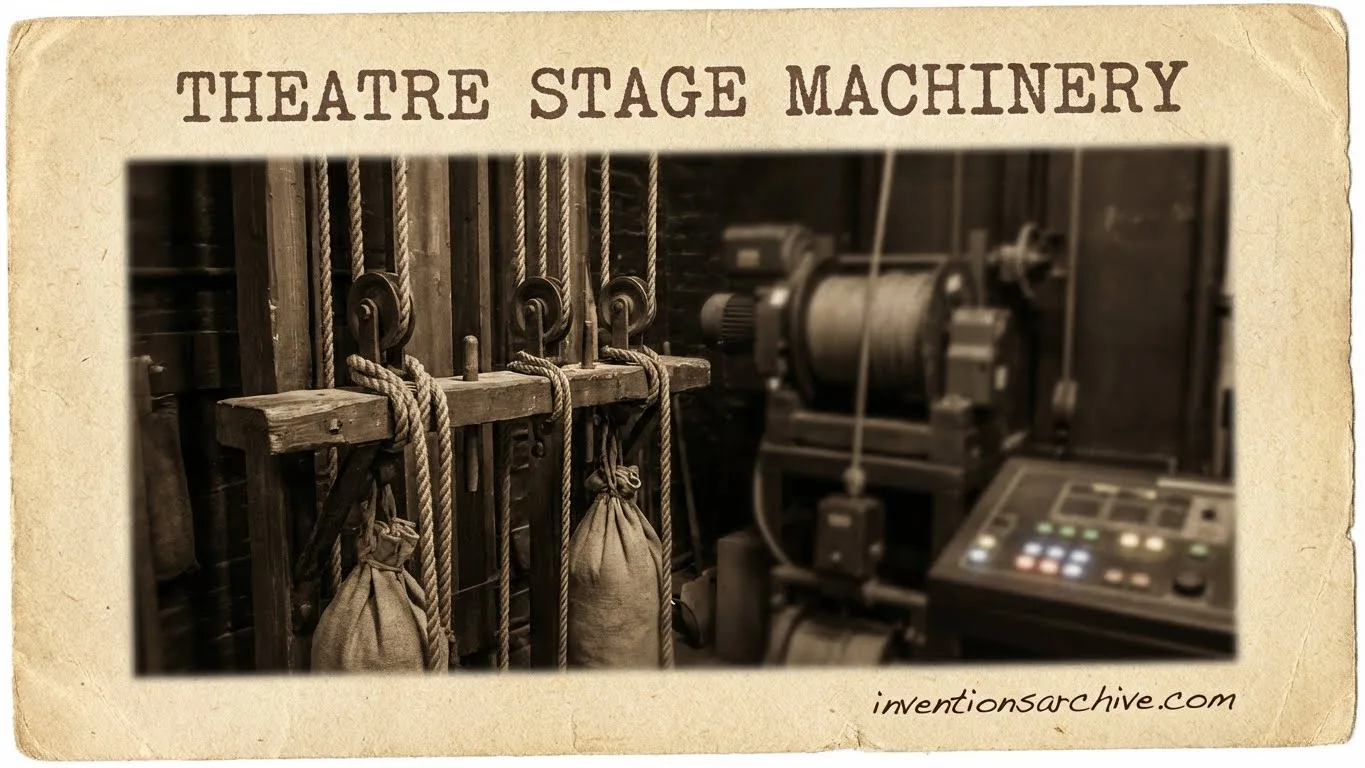
| Invention Name | Theatre stage machinery |
|---|---|
| Short Definition | Mechanical systems used to move scenery, actors, props, curtains, sound effects, and stage surfaces during a performance. |
| Approximate Date / Period | Greek theatrical devices: 5th century BCE Based on surviving evidence; codified European scenic machinery: 16th–17th centuries Confirmed |
| Geography | Ancient Greek theatres; Renaissance and Baroque Italy; later European court and public theatres |
| Inventor / Source Culture | Anonymous / collective; later developed by architects, engineers, theatre carpenters, and scenographers |
| Category | Performance technology; mechanical engineering; theatre architecture; visual culture |
| Main Problem Solved | How to create visible scene changes, appearances, flights, moving settings, and effects without stopping the performance |
| Early Examples | Ekkyklema, mechanē, periaktoi, thunder devices, trap-like openings |
| How It Worked | Ropes, pulleys, winches, rollers, capstans, counterweights, tracks, under-stage trolleys, stage slots, and overhead rigging |
| Material / Technical Base | Wood, rope, iron fittings, wheels, drums, painted scenery, canvas flats, later steel, hydraulics, electric motors, and digital control |
| First Main Use | Revealing interior scenes, lifting divine or heroic figures, changing scenic backgrounds, and producing stage effects |
| Evidence Status | Ancient origin partly reconstructed from texts and art; Baroque systems verified by treatises, drawings, and preserved theatres |
| Development Path | Greek stage devices → Renaissance sacred and court machines → Baroque chariot-and-pole systems → counterweight, hydraulic, and automated stage systems |
| Surviving Evidence | Historical texts, theatre treatises, engravings, preserved wooden machinery, stage sets, theatre buildings, and museum or heritage records |
| Related Inventions | Crane, pulley, winch, counterweight system, trapdoor, revolving stage, scenic automation |
| Modern Descendants | Fly systems, stage lifts, revolves, automated tracks, powered hoists, programmable scenic control |
| Importance | Allowed theatre to show movement, transformation, weather, supernatural appearances, and rapid scene changes as part of live performance |
Theatre stage machinery is not one single machine. It is a family of mechanical ideas that changed what a stage could show. A plain platform could become a palace, a sea, a street, a sky, or an interior room. Actors could appear from above, scenery could slide away, and sound effects could be produced from behind or below the stage. The invention matters because it joined performance, engineering, architecture, painting, and timing into one working system.
What Theatre Stage Machinery Is
Theatre stage machinery means the hidden and visible mechanical equipment that lets a live stage change while a performance continues. It may move painted flats, raise curtains, lower clouds, open trapdoors, rotate scenery, slide platforms, lift actors, imitate wind, or create thunder.
The term can describe very different systems:
- Under-stage machinery, such as trolleys, traps, winches, drums, and moving platforms.
- Over-stage machinery, such as ropes, pulleys, flying systems, counterweights, and later powered hoists.
- Scenic change machinery, used to move wings, shutters, backdrops, and borders.
- Effect machinery, used for clouds, waves, storms, appearances, disappearances, and sound effects.
- Modern automation, where motors, sensors, computers, and trained operators coordinate moving parts.
The invention is best understood as a long technical tradition. It grew from simple lifting and rolling devices into complex theatre architecture.
The Problem It Answered
Before stage machinery became organized, theatre had limits that were easy to see. A scene could be spoken about, painted, or imagined, but it was hard to change space quickly in front of an audience. Interior events were difficult to show. Divine appearances, storms, flying figures, or sudden transformations needed a physical solution.
Theatre machinery answered that problem by giving the stage controlled movement. It did not remove the audience’s imagination. It gave that imagination a mechanical partner.
| Before the Invention | What Changed After It |
|---|---|
| Scene changes depended mostly on speech, static decoration, or pauses. | Scenery could move, reveal, slide, rotate, or be replaced during performance. |
| Interior rooms and offstage events were hard to show directly. | Rolling platforms and reveal devices helped bring hidden action into view. |
| Supernatural or aerial appearances were difficult to stage convincingly. | Cranes, flying devices, and overhead rigging created visible entrances from above. |
| Weather, sea, thunder, and cloud effects were mostly described in words. | Effect machines gave audiences sound and motion cues as part of the stage picture. |
| Large scenic change required many visible workers or long pauses. | Coordinated systems let stagehands move several scenic elements at once. |
Earlier Ideas and Ancient Stage Devices
Stage machinery did not appear from nowhere. It borrowed from familiar technologies: the wheel, the cart, the crane, the pulley, the winch, the boatyard, the building site, and the workshop. Theatre adapted these practical tools for illusion, timing, and storytelling.
Ancient Greek theatre is often the first place readers meet named stage devices. The main examples are the mechanē, the ekkyklema, and later rotating scenic forms such as periaktoi. The European Theatre Lexicon describes the mechanē as a theatrical device whose exact introduction is debated, while noting its use in late fifth- and fourth-century BCE stage practice; it also records periaktoi as rotating triangular scenic machines known from later theatrical writing.[b]
The Mechanē
The mechanē was a crane-like device associated with figures appearing above the stage. It is closely linked with the phrase deus ex machina, meaning a god brought in by a machine. In theatre history, this phrase began as a practical stage effect before becoming a wider literary term.
Its exact structure is still discussed. The safest statement is that it was a lifting device used in ancient theatre to create aerial appearances. Claims about its exact shape, size, or first inventor should be treated with care.
The Ekkyklema
The ekkyklema was a wheeled platform connected with the skene, the stage building. It could roll out to reveal an interior or a tableau. Its importance is simple: it helped the audience see a space that the open stage could not easily show.
This was not modern automation. It was a practical theatrical answer to a staging problem. A hidden area could become visible at the right moment.
Periaktoi and Rotating Scenery
Periaktoi were rotating triangular scenic units. Each side could carry a different painted surface. When turned, the unit could suggest a change of place without rebuilding the whole stage.
They show an early principle that returned many times in theatre history: one object could hold several scenic states.
How It Worked in Simple Terms
The basic principle was controlled movement. A stage machine converted human effort into a timed visual effect. A stagehand turned a winch, pulled a rope, pushed a trolley, released a counterweight, or operated a capstan. The audience saw the result: a cloud moved, a wave appeared, a set changed, or a figure entered from above.
Most pre-modern theatre machinery used familiar mechanical parts:
- Ropes carried pulling force across distances.
- Pulleys changed the direction of movement.
- Winches and drums wound ropes in a controlled way.
- Counterweights balanced heavy scenic loads.
- Tracks and trolleys moved flats, wings, and platforms.
- Trapdoors allowed entrances, disappearances, or scenic reveals.
- Capstans let several workers move a large system together.
In preserved eighteenth-century machinery at Drottningholm Palace Theatre, the wooden stage system still uses capstans, rollers, drums, blocks, ropes, and counterweights by hand.[e] That surviving equipment helps explain why theatre machinery was both mechanical and choreographic. The machine had to work, but the timing had to fit the music, speech, and audience sightline.
From Stage Tricks to Scenic Systems
Early devices solved single problems. A crane lifted a character. A platform revealed an interior. A rotating scenic unit suggested a different place. The major change came when these devices were combined into complete scenic systems.
| Stage | Form | What Changed |
|---|---|---|
| Earlier Tool | Crane, cart, pulley, rope, wheel, winch | Practical workshop tools supplied the mechanical base. |
| Ancient Theatre Device | Mechanē, ekkyklema, periaktoi | Movement became part of staged storytelling. |
| Renaissance Expansion | Sacred machines, court machines, perspective scenery | Mechanical effects were joined with architecture and painted illusion. |
| Baroque System | Wing-and-groove systems, chariot-and-pole systems, cloud and wave machines | Several scenic parts could move in coordination. |
| Industrial Theatre | Iron stage machinery, traps, bridges, counterweight systems, hydraulic lifts | Heavier scenery and larger theatres required stronger equipment. |
| Modern Descendant | Powered fly systems, revolves, lifts, scenic automation | Movement could be programmed, repeated, monitored, and integrated with lighting and sound cues. |
Renaissance and Baroque Development
The Renaissance changed theatre machinery because it changed the visual idea of the stage. Perspective scenery, court festivals, opera, and indoor theatres created new demands. Audiences expected transformations, gods, clouds, waves, storms, and changes of place.
Nicola Sabbatini’s Pratica di fabricar scene e machine ne’ teatri is one of the most important early printed witnesses to this world. The Internet Archive record for the Getty Research Institute copy identifies the work as a 1638 publication on theatres, stage-setting, scenery, and seventeenth-century Italian theatre practice.[c]
Why Treatises Matter
Treatises did not invent every machine they described. Their value is different. They recorded stage knowledge that had often been held inside workshops, courts, and theatre companies. A printed book could preserve drawings, terms, and principles that otherwise might have vanished.
This is one reason the Baroque period is so important in the history of theatre stage machinery. The equipment became more organized, and its knowledge became easier to transmit.
The Chariot-and-Pole Idea
The chariot-and-pole system became one of the best-known Baroque scenic systems. Upright poles held scenic wings above the stage. Below the stage, wheeled chariots ran in tracks. Ropes connected the moving parts to a central control point, so several pieces could shift together.
This system did not simply make theatre more spectacular. It solved a real coordination problem. Instead of moving each scenic wing separately, the stage crew could change a whole visual field in a controlled sequence.
Main Types and Variations
Theatre stage machinery developed into several recognizable families. Some moved scenery. Some moved people. Some changed the stage surface. Some created effects that supported the action.
| Type or Variation | Main Function | Historical Use | Later Form |
|---|---|---|---|
| Mechanē / Flying Device | Lifting figures or objects above the stage | Divine or heroic appearances in Greek theatre | Fly systems, performer flying rigs, powered hoists |
| Ekkyklema / Rolling Platform | Revealing an interior or hidden scene | Classical stage reveal device | Stage wagons, trucks, rolling scenic units |
| Periaktoi | Rotating scenic surfaces | Changing place through painted faces | Rotating panels and scenic towers |
| Trapdoor and Trap Room | Entrances, exits, reveals, disappearances | Under-stage movement and surprise effects | Stage lifts, elevators, modern trap systems |
| Wing-and-Groove System | Sliding scenic wings in grooves | Early modern perspective scenery | Tracked scenic flats and sliding systems |
| Chariot-and-Pole System | Coordinated scenic wing changes | Baroque opera and court theatre | Linked scenic automation and under-stage track systems |
| Counterweight Flying System | Balancing heavy flown scenery | Nineteenth- and twentieth-century theatres | Manual and powered fly systems |
| Revolve | Rotating a stage area or scenic unit | Scene shifts, reveals, moving viewpoints | Motorized revolving stages with cue control |
| Hydraulic and Electric Stage Systems | Raising, lowering, or moving heavier scenery | Large modern theatres and opera houses | Computer-controlled scenic automation |
Preserved Evidence and Working Heritage
Stage machinery is difficult to preserve. Wood wears out. Ropes are replaced. Theatres burn, change ownership, or get rebuilt for new productions. That makes surviving theatres especially valuable.
Drottningholm Palace Theatre in Sweden is one of the clearest examples. UNESCO states that the Palace Theatre is the only surviving eighteenth-century theatre where the original machinery is still regularly used and the original stage sets are preserved. The same record notes that the machinery was built by Georg Fröman according to drawings prepared by Christian Gottorp Reuss, and that it permits quick scene changes with the curtain up.[d]
Český Krumlov Castle Theatre is another major survival. The official castle page describes it as the best-preserved Baroque theatre in Europe, with the original building, orchestra pit, stage, machinery, sets, librettos, and props preserved.[f]
These places matter because they show theatre machinery as an environment, not just a drawing. The stage floor, side spaces, under-stage area, fly space, scenery storage, ropes, painted flats, and working crew all belonged to the same system.
What Changed Because of It
Theatre stage machinery changed the rhythm of live performance. A scene no longer had to remain fixed. Space could shift with music, speech, and movement. This gave designers and playwrights a new kind of stage grammar.
Several changes were especially important:
- Scenic time became faster. A change of place could happen in seconds rather than through a long pause.
- Hidden work became part of theatre craft. Stagehands, carpenters, fly operators, and mechanists gained specialized roles.
- Opera and court theatre expanded visual scale. Large scenic transformations became part of the audience’s experience.
- Architecture changed. Stages needed under-stage space, fly towers, grooves, wings, side stages, traps, and stronger structural support.
- Later entertainment technology borrowed the logic. Revolves, lifts, automated scenery, and controlled cue systems all descend from the same need: repeatable movement in front of an audience.
The effect was not only visual. It changed labor, training, design, and the economics of theatre buildings. A theatre with machinery could stage works that a bare platform could not easily support.
Real Use in Theatre Practice
In daily theatrical work, machinery served practical production needs. It helped a small group of workers move large scenic pieces. It let a scene change happen during music. It allowed an actor to appear at a precise moment. It also let designers reuse scenic elements in different combinations.
Modern theatre still keeps that division of work. The Theatres Trust describes flymen as operators of flying systems, which may use counterweight or power-flying equipment, and mechanists as workers who operate systems for moving sets such as revolves, lifts, and trucks.[g]
That modern vocabulary shows the long life of the invention. The tools changed. The need stayed recognizable: controlled movement, safe timing, repeatable cues, and coordination between scenery, performers, lighting, sound, and stage management.
Common Misunderstandings
It Was Not Invented by One Person
Stage machinery is a chain of inventions. Greek devices, Renaissance festival machines, Baroque scenic systems, nineteenth-century stage engineering, and modern automation all belong to the story. One named designer may improve a system, but the whole invention is collective.
The Earliest Evidence Is Not Always the First Use
Ancient theatre evidence is incomplete. A reference in a text or a painted image may show that a device existed by a certain period. It does not prove that the device began exactly then.
Baroque Machinery Was Not Only Decoration
Clouds, waves, thunder, and rapid scene changes can look ornamental today. In their own setting, they solved real stage problems: how to show place, time, weather, movement, and transformation in a live room.
Modern Automation Did Not Replace the Old Logic
Motors and computers changed control, speed, and repeatability. They did not erase the old principles of balance, guided movement, load management, sightlines, and cue timing.
Related Inventions
These related inventions and systems help place theatre stage machinery in a wider history of technology:
- Pulley — changed the direction of force and made lifting systems more practical.
- Crane — supplied an early model for overhead stage lifting.
- Winch — allowed controlled winding of ropes and movement of heavy objects.
- Counterweight System — balanced scenic loads and reduced manual strain.
- Trapdoor — made under-stage entrances, reveals, and disappearances possible.
- Revolving Stage — turned scenic movement into a controlled change of viewpoint.
- Hydraulic Lift — expanded the vertical movement of platforms and stage sections.
- Scenic Automation — connected traditional stage movement with motors, sensors, and programmable cues.
Frequently Asked Questions
Who invented theatre stage machinery?
No single inventor can be named for theatre stage machinery as a whole. It developed through many cultures, workshops, architects, engineers, stage carpenters, and designers. Ancient Greek devices came first in the evidence record, while Renaissance and Baroque Europe later created more coordinated scenic systems.
What is the earliest known theatre stage machinery?
The best-known early devices are from ancient Greek theatre: the mechanē, used for aerial appearances, and the ekkyklema, a wheeled platform used to reveal interior or hidden scenes. Their exact origins are not fully certain because the physical evidence is limited.
What did Baroque stage machinery do?
Baroque stage machinery moved scenic wings, changed painted settings, created clouds and waves, produced thunder sounds, opened traps, and coordinated rapid transformations. It was especially important in opera and court theatre.
What is a chariot-and-pole system?
A chariot-and-pole system is a scenic change system in which upright poles carrying scenery are connected to wheeled chariots below the stage. Ropes and a central control point allow several scenic units to move together.
Is theatre stage machinery still used today?
Yes. Modern theatres use fly systems, counterweights, lifts, revolves, trucks, powered hoists, and automated scenic systems. The equipment is newer, but the basic need remains the same: controlled movement during live performance.
Sources and Verification
- [a] Theater in Ancient Greece – The Metropolitan Museum of Art — Used to verify the ancient Greek ekkyklema and mechanē references, including the wheeled platform and crane-like stage device. (Reliable because it is an institutional museum essay from The Metropolitan Museum of Art.)
- [b] European Theatre Lexicon | Stage mechanism, Machine — Used to verify historical terminology, debates around ancient mechanisms, and the broader development of stage machinery from ancient devices to early modern scenic systems. (Reliable because it is an academic theatre lexicon published by Mimesis Journals.)
- [c] Pratica di fabricar scene e machine ne’ teatri : Sabbattini, Nicola, approximately 1575-1654 : Internet Archive — Used to verify the 1638 publication record, subject matter, and Getty Research Institute copy of Sabbatini’s theatre machinery treatise. (Reliable because it is a digitized archival book record contributed by the Getty Research Institute through the Internet Archive.)
- [d] Royal Domain of Drottningholm – UNESCO World Heritage Centre — Used to verify the preserved eighteenth-century Drottningholm Palace Theatre machinery, its original sets, and the attribution to Georg Fröman and Christian Gottorp Reuss. (Reliable because it is the official UNESCO World Heritage Centre record.)
- [e] Drottningholm Palace Theatre – Kungliga slotten — Used to verify the hand-operated wooden machinery and its components, including capstans, rollers, drums, blocks, ropes, and counterweights. (Reliable because it is an official Royal Palaces of Sweden page.)
- [f] Baroque Castle Theatre in Český Krumlov — Used to verify the preserved Baroque theatre, including its original building, orchestra pit, stage, machinery, sets, librettos, props, and costumes. (Reliable because it is the official Český Krumlov Castle visitor and heritage page.)
- [g] Who works in a theatre? — Used to verify modern theatre roles and equipment categories such as flymen, counterweight or power-flying systems, mechanists, revolves, lifts, and trucks. (Reliable because Theatres Trust is the national advisory public body for theatres in the United Kingdom.)