
| Invention Name | Hydraulic Mining |
|---|---|
| Short Definition | A mining method that used high-pressure water to break down gold-bearing gravel, move the slurry, and separate heavier minerals through sluices. |
| Approximate Date / Period | Early 1850s Approximate |
| Geography | Nevada County, California; strongly associated with the Sierra Nevada gold fields. |
| Inventor / Source Culture | California placer-mining communities; individual attribution varies. |
| Category | Mining, manufacturing, water engineering, extraction technology |
| Main Problem Solved | Accessing deep or high gravel deposits after surface placer gold became harder to recover. |
| How It Worked | Water was carried by ditches, flumes, and pipes, then aimed through a monitor or nozzle at a gravel bank. |
| Technology Base | Water pressure, gravity flow, sluice separation, ditch and flume engineering. |
| Early Use | Gold-bearing placer gravels in California mining districts. |
| Evidence Status | Based on surviving evidence Park records, mining-company archives, court records, official historical interpretation. |
| Surviving Evidence | Mining landscapes, monitors, archival records, legal case files, park collections. |
| Development Path | Gold pan and rocker → ground sluicing → hydraulic mining → regulated hydraulic operations and hydraulic excavation systems. |
| Main Variations | Ground sluicing, monitor-based hydraulic mining, hydraulic reworking of tailings, hydraulic transport of slurry. |
| Impact Areas | Mining, water infrastructure, land management, environmental law, sediment control, industrial-scale extraction. |
| Related Inventions | Gold pan, rocker box, sluice box, long tom, mining monitor, dredge, hydraulic pump. |
| Modern Descendants | Hydraulic monitors, dredging systems, slurry pipelines, controlled hydraulic excavation. |
What Hydraulic Mining Is
Hydraulic mining is a method for removing loose or partly compacted mineral-bearing earth with water under pressure. In its best-known form, miners aimed a powerful stream of water at a gravel bank. The broken material flowed as a muddy slurry into sluice boxes, where heavier particles could settle while lighter waste moved away.
The method became famous in the California Gold Rush because it turned placer mining from small hand labor into a larger industrial operation. A person with a pan could work only a small amount of sediment. A hydraulic mine could move entire banks of ancient river gravel.
That shift explains why hydraulic mining belongs in an invention archive. It was not just “using water.” It combined water delivery, pressure control, nozzles, sluices, drainage tunnels, and company-scale capital into one working system.
The Problem It Answered
Early gold miners often began with simple tools: pans, rockers, long toms, and sluice boxes. These worked well for shallow stream deposits, but the easiest gold did not last. Many richer gravels sat in elevated ancient river channels, packed into hillsides or buried under later sediments.
Hydraulic mining answered three practical problems:
- Depth: gold-bearing gravel could be exposed without digging every shovelful by hand.
- Volume: much more material could be moved through a mine than with pans or rockers.
- Water control: water could break, carry, and sort material in one linked process.
The method also changed who could mine at scale. It favored companies that could pay for ditches, flumes, reservoirs, iron pipe, monitors, drainage works, and workers. In that sense, hydraulic mining marked a move from individual placer mining toward industrial mining infrastructure.
How It Worked In Simple Terms
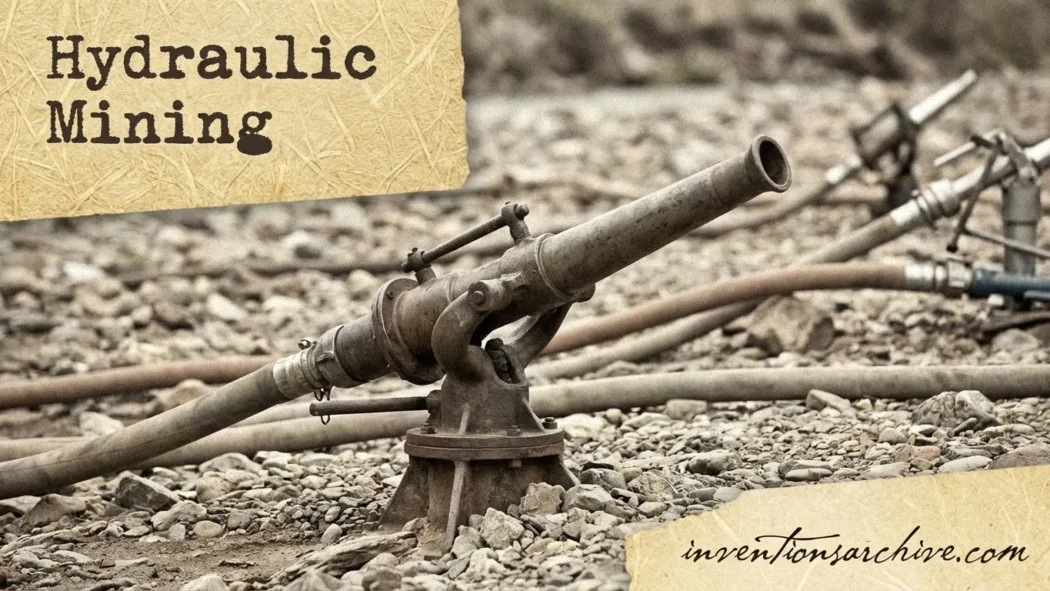
The working principle was simple to describe, even though the infrastructure was demanding. Water stored or diverted from higher ground moved through channels and pipes. Gravity and pipe pressure gave the stream force. At the mine face, the water passed through a monitor, sometimes called a water cannon, and struck a gravel bank.
USGS describes hydraulic mining as a variation on ground sluicing in which water was delivered through a nozzle at high pressure onto a cliff face, washing away boulders, gravel, and dirt. The same USGS description notes that these water cannons could be extremely powerful in 1870s California mining scenes.[b]
Main Parts Of The System
- Ditches and flumes: carried water from higher sources to the mine.
- Pipes: delivered water toward the working face.
- Monitor or nozzle: concentrated the water into a directed jet.
- Mine face: the gravel bank or hillside being broken down.
- Sluice boxes: used flowing water and gravity to help separate heavy gold from lighter material.
- Drainage works: moved mud, water, and debris away from the pit.
Earlier Tools and Ideas Before It
Hydraulic mining did not appear from nothing. It grew out of older placer-mining and water-management methods.
The gold pan was the simplest tool. It sorted sediment by hand and by weight. The rocker box and long tom increased the amount of gravel one person or a small team could wash. Sluices improved the same idea by letting water carry material along a channel where heavy particles could settle.
Ground sluicing came closer to hydraulic mining. It used water to wash surface material into a channel. What changed in California hydraulic mining was the use of a directed high-pressure stream against deep gravel banks, supported by larger waterworks and better nozzles.
The invention therefore sits between simple placer mining and later heavy mining systems. It used an old natural force, water, but reorganized it as an engineered extraction tool.
Development Path
| Stage | Form | What Changed |
|---|---|---|
| Earlier Tool | Gold pan | Small amounts of sediment could be washed and sorted by hand. |
| Improved Placer Tool | Rocker box, long tom, and sluice box | More gravel could be processed with flowing water and gravity. |
| Earlier Water Method | Ground sluicing | Water began doing more of the work of moving loose earth. |
| Invention | Hydraulic mining with monitors | Pressurized water was aimed at gravel banks to break and move large volumes of material. |
| Improved Form | Company-scale hydraulic mines | Long ditches, flumes, pipes, drainage tunnels, and large sluice systems made the method industrial. |
| Modern Descendant | Hydraulic excavation and slurry transport | Controlled water movement became part of later mining, dredging, and sediment-handling technologies. |
Main Types and Variations
Hydraulic mining is often described as one method, but several related forms existed. They shared one idea: water did work that would otherwise require far more hand labor or mechanical digging.
| Variation | Main Use | How It Differed |
|---|---|---|
| Ground Sluicing | Washing loose surface deposits | Used flowing water, but without the same monitor-based pressure system. |
| Monitor Hydraulic Mining | Breaking down gravel banks | Used a directed water jet from a nozzle or monitor. |
| Hydraulic Reworking | Reprocessing older mine tailings or sediment | Applied water movement to material already disturbed by earlier mining. |
| Hydraulic Elevating | Raising slurry in some mining systems | Used water flow to help lift or move material, depending on the equipment and site. |
| Hydraulic Transport | Moving slurry through channels or pipes | Focused less on breaking the bank and more on moving material after excavation. |
Before and After Hydraulic Mining
The importance of hydraulic mining becomes clearer when it is compared with earlier placer methods. The change was not only speed. It changed the scale of mining, the need for water rights, and the relationship between mining districts and downstream communities.
| Before Hydraulic Mining | What Changed After It |
|---|---|
| Miners relied heavily on pans, rockers, long toms, and simple sluices. | Water pressure became a main extraction force, not just a washing aid. |
| Work focused on shallow stream deposits and smaller gravel volumes. | Deep ancient river gravels and large hillsides became workable at industrial scale. |
| Small teams could operate with simple tools and local water access. | Large mines needed capital, water systems, engineering, and organized labor. |
| Sediment movement was usually local and limited by hand labor. | Huge debris flows entered creeks and rivers when not contained. |
| Mining disputes centered mostly on claims, labor, and local access. | Debates expanded to downstream land, navigation, water quality, and legal control. |
Early Use and Spread
California’s Sierra Nevada foothills gave hydraulic mining the conditions it needed: gold-bearing gravel, steep land, and water that could be diverted from higher elevations. Once the method proved effective, it demanded a large support system. Ditches, flumes, dams, pipes, and drainage tunnels became part of the mining landscape.
Malakoff Diggins became the best-known surviving example. California State Parks describes it as California’s largest hydraulic gold mine, with cliffs carved by powerful jets of water. The park now preserves the historic town of North Bloomfield and the Diggins site as a place where the scale of the method can still be read in the land.[c]
Hydraulic mining also influenced mining beyond California. Engineers and miners carried ideas about water delivery, monitors, sluices, and slurry movement into other mining regions. The method’s spread was not simply a story of tools moving from one place to another. It also required water control, suitable deposits, and enough investment to build the system.
What Changed Because Of It
Hydraulic mining changed gold mining in four visible ways.
Mining Became More Industrial
The method favored organized companies over isolated miners. A productive hydraulic mine required water rights, long supply works, pipes, maintenance crews, and sediment handling. The mine was no longer only a place where people dug. It became a water-powered extraction system.
Water Became A Mining Asset
Water was not just a natural convenience. It became the force that made the mine possible. Control of water routes, seasonal flow, storage, and delivery shaped whether a hydraulic mine could operate profitably.
Landscapes Became Part Of The Historical Record
Hydraulic mining left unusually visible evidence. In some places, carved cliffs, exposed gravel beds, tailings, drainage tunnels, and altered creek channels still show how the method worked. These landscapes are not decorative remains. They are large-scale artifacts.
Law Had To Address Mining Debris
The most lasting change may have been legal. The National Archives describes the North Bloomfield hydraulic mining case as a landmark in U.S. environmental history. In 1882, Edward Woodruff filed suit over the agricultural impact of hydraulic mining, and Judge Lorenzo Sawyer’s 1884 decision prohibited the dumping of mining debris into waterways.[d]
Related articles: Hydraulic Pump (Renaissance Engineering) [Renaissance Inventions Series], Tunnel boring techniques [Industrial Age Inventions Series]
Legal Limits and Later Regulation
The Sawyer Decision did not make the physical idea of hydraulic mining disappear. It changed the conditions under which it could be practiced. The central issue was debris. When sediment moved into rivers, it affected farms, navigation, and public infrastructure downstream.
Federal regulation later addressed hydraulic mining through the California Debris Commission. The legal text for 33 CFR § 209.160 states that the Act of Congress of March 1, 1893 created the commission to regulate hydraulic mining in the Sacramento and San Joaquin river systems under federal supervision.[e]
This history is important because it shows that hydraulic mining was not only a mining invention. It also became part of the early history of sediment control, water law, and environmental regulation.
Materials, Mechanism and Technical Principle
The essential material was water, but the invention depended on engineered parts. Wooden flumes, earth ditches, iron pipes, metal nozzles, timber sluice structures, riffles, drainage tunnels, and retaining works all shaped the method.
The physical principle was gravity-assisted pressure. Water moved from a higher source toward a lower mine face. Narrowing and directing the flow through a nozzle made the stream forceful enough to break down gravel. Once the material entered the sluice, gravity did a second job: heavy particles settled more readily than lighter sand, mud, and gravel.
This is why hydraulic mining sits at the intersection of mining, fluid movement, civil engineering, and mineral separation. The same water broke the bank, moved the material, and helped sort it.
Common Misunderstandings
It Was Not Just A Bigger Hose
The monitor was only one visible part. Hydraulic mining also depended on water rights, long supply channels, pipes, sluices, drainage, labor, and capital. Without that system, the nozzle alone did not make an industrial mine.
It Was Not The Same As Simple Panning
Panning sorted small amounts of sediment by hand. Hydraulic mining moved and sorted large masses of gravel with water power. Both belonged to placer mining, but their scale and infrastructure were very different.
The Earliest Evidence Does Not Prove Every First Use
Surviving records point strongly to early 1850s California development, especially in Nevada County. They do not prove that every water-based mining idea began there. Older ground-sluicing methods existed before the monitor-based California form.
It Is Not Hydraulic Fracturing
Hydraulic mining used water to break and move surface or near-surface mineral-bearing material. Hydraulic fracturing is a later oil and gas technique involving subsurface rock formations. The shared word “hydraulic” means water or fluid power, not the same invention.
Environmental Legacy In Historical Context
Hydraulic mining produced visible land change because it moved so much sediment. It also belongs to the history of mercury contamination in California gold mining. Mercury was used in many gold recovery operations because it could bind with gold during amalgamation, and some of that mercury remained in mining-affected sediments.
USGS describes legacy mercury contamination from historical gold mining as a continuing risk to human health and the environment, with data focused on sediment, water, and biota in the Sierra Nevada and related California mining areas.[f]
For an invention archive, this legacy should be stated plainly. Hydraulic mining was technically effective, but its history also shows why large extraction technologies require sediment control, water management, and legal limits.
Related Inventions
These related inventions and systems help place hydraulic mining within the wider history of mining technology:
- Gold Pan: the simplest placer-mining tool for hand sorting sediment.
- Rocker Box: an early device that increased placer processing beyond hand panning.
- Long Tom: a trough-like placer tool that handled more gravel than a rocker.
- Sluice Box: a water-fed channel that helped separate dense gold from lighter sediment.
- Mining Monitor: the nozzle device that gave hydraulic mining its recognizable form.
- Dredge: a later mining and excavation system that also moved sediment with water-related methods.
- Hydraulic Pump: a broader fluid-power technology used across mining, industry, and construction.
Frequently Asked Questions
Was hydraulic mining a machine or a method?
Hydraulic mining was a method, but it depended on machines and engineered parts. The monitor or nozzle was the most visible device, while ditches, flumes, pipes, sluices, and drainage works made the full system possible.
Who invented hydraulic mining?
Official historical sources place the invention of California hydraulic mining in Nevada County in the early 1850s. A single inventor attribution is difficult because the method grew from earlier placer tools, ground sluicing, and local mining improvements.
How was hydraulic mining different from panning?
Panning processed small amounts of sediment by hand. Hydraulic mining used pressurized water to break down large gravel banks and move the material into sluices, making it a far larger industrial mining method.
Why was hydraulic mining restricted in California?
The major legal issue was mining debris. Sediment from hydraulic mines entered waterways, affected farms and navigation, and led to court action. The 1884 Sawyer Decision restricted the dumping of debris into rivers.
Is hydraulic mining the same as hydraulic fracturing?
No. Hydraulic mining was a surface or near-surface mining method that used water jets to break and move mineral-bearing material. Hydraulic fracturing is a much later subsurface oil and gas technique.
Sources and Verification
- [a] Guide to the Malakoff Diggins State Historic Park Collection — Used to verify the early Nevada County attribution, the 1852–1853 dating, the Malakoff Diggins context, and the basic description of hydraulic mining operations. (Reliable because it is an official California State Parks collection guide.)
- [b] Hydraulic mining techniques, California, 1870s | U.S. Geological Survey — Used to verify the technical description of water delivered through a nozzle at high pressure and the 1870s California mining context. (Reliable because it is an official U.S. Geological Survey page.)
- [c] Malakoff Diggins State Historic Park — Used to verify Malakoff Diggins as California’s largest hydraulic gold mine and the visible landscape features left by hydraulic mining. (Reliable because it is an official California State Parks page.)
- [d] North Bloomfield Hydraulic Mining Environmental Case | National Archives — Used to verify the Woodruff case, Judge Lorenzo Sawyer’s decision, and the prohibition on dumping mining debris into waterways. (Reliable because it is an official National Archives page.)
- [e] 33 CFR § 209.160 – The California Debris Commission — Used to verify the legal creation and regulatory role of the California Debris Commission after the 1893 Act of Congress. (Reliable because it reproduces federal regulatory text through Cornell Law School’s Legal Information Institute.)
- [f] Legacy Mercury Contamination from Historical Gold Mining | U.S. Geological Survey — Used to verify the continuing environmental context of mercury contamination linked to historical gold mining in California. (Reliable because it is an official U.S. Geological Survey science and data resource.)