
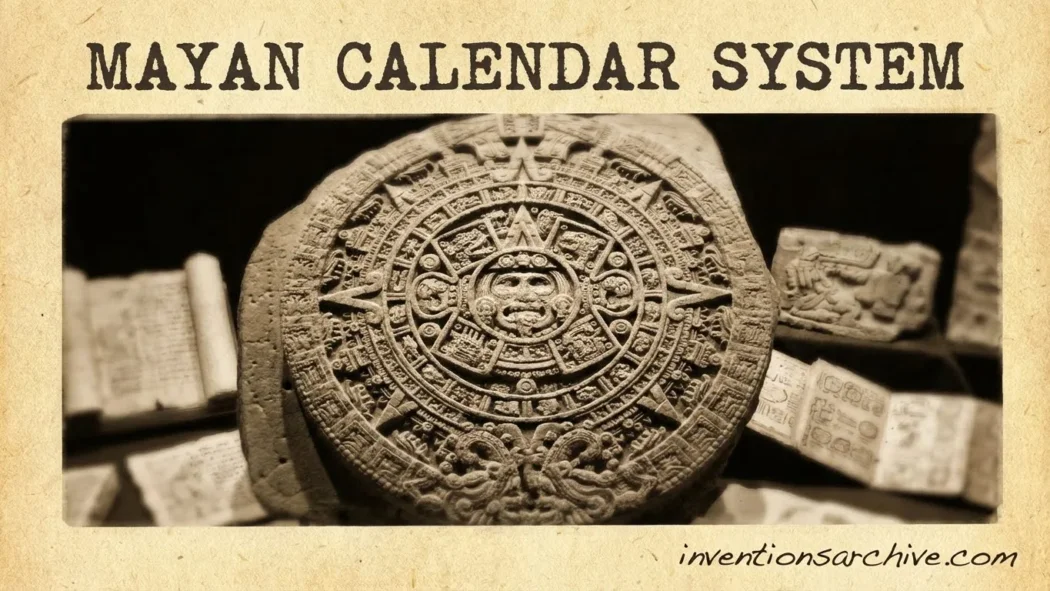
| Invention Name | Maya Calendar System (often searched as Mayan Calendar System) |
|---|---|
| Short Definition | A linked set of ritual, solar, and historical day-count systems used to place time, ceremonies, agriculture, dynastic events, and inscriptions into ordered cycles. |
| Approximate Date / Period | Secure Maya calendar notation by 300–200 BCE Based on surviving evidence |
| Geography | Maya region of Mesoamerica: southern Mexico, Guatemala, Belize, and nearby areas |
| Inventor / Source Culture | Anonymous / collective; developed within wider Mesoamerican timekeeping traditions |
| Category | Measurement, astronomy, writing, religion, agriculture, historical recordkeeping |
| Main Cycles | Tzolk’in 260 days; Haab 365 days; Calendar Round 52 Haab years; Long Count linear day count [a] |
| Main Problem Solved | Coordinating ritual days, farming seasons, political records, mythic time, and long historical intervals |
| How It Works | Different cycles run at the same time; a date may combine a day sign, number, month position, and Long Count place values |
| Material / Technology Base | Observation-based astronomy, vigesimal mathematics, glyphic writing, stone monuments, painted books, murals, ceramics |
| Early Use Area | Ritual timing, civic events, agricultural planning, dynastic inscriptions, astronomical records |
| Evidence Status | Confirmed for surviving calendar records; Approximate for earliest origin |
| Surviving Evidence | Mural fragments, carved stelae, codices, inscriptions, ceramic texts, archaeological alignments |
| Development Path | Observed cycles → 260-day count and solar year → Calendar Round → Long Count inscriptions → later Short Count and modern scholarly conversion |
| Related Inventions | Glyphic writing, positional numerals, zero sign, codex books, astronomical tables, stone stelae |
| Modern Descendants | Calendar conversion tables, epigraphic chronology, archaeological dating studies, cultural calendar keeping in some Maya communities |
The Maya calendar system was a way of organizing time through interlocking cycles, not a single calendar page like a modern wall calendar. It joined ritual days, solar-year counting, long historical chronology, astronomy, agriculture, and public memory. A Maya date could identify a sacred day, a position in the solar year, and a point in a long count of elapsed days. That made the system useful for ceremonies, inscriptions, farming schedules, dynastic history, and astronomical records.
It is better to call it the Maya calendar system rather than “the Mayan calendar,” although many readers search for the older phrase. The important point is simple: this was a group of related timekeeping methods. Each part served a different need, and together they gave Maya scribes and communities a refined way to describe both recurring time and historical time.
What the Maya Calendar System Is
The Maya calendar system worked through several cycles running side by side. A day could be named in the Tzolk’in, placed inside the Haab, paired in the Calendar Round, and fixed in deep historical time through the Long Count.
This made the system unusually flexible. A short ritual event could be placed within a 260-day cycle. A seasonal activity could be tied to the solar year. A royal accession, dedication, or mythic event could be written as a Long Count date, giving it a more precise historical position.
The Main Parts of the System
| Cycle | Basic Form | Main Use |
|---|---|---|
| Tzolk’in | 260 days from 13 numbers and 20 day names | Ritual timing, divination, naming days, ceremonial order |
| Haab | 365 days: 18 months of 20 days plus 5 Wayeb days | Solar-year rhythm, seasonal timing, community ceremonies |
| Calendar Round | Tzolk’in and Haab combined for a 52-Haab-year cycle | Dating ordinary life events within a repeating cycle |
| Long Count | Linear day count using k’in, winal, tun, k’atun, and bak’tun | Historical chronology, monument dates, mythic and dynastic records |
| Supplementary Cycles | Lunar, Venus, Lord of the Night, and other counts | Astronomical and ceremonial refinement |
How Its Origin Is Traced
The origin of the Maya calendar system is traced through a mix of archaeology, epigraphy, astronomy, and surviving texts. Scholars look at painted day signs, carved inscriptions, architectural alignments, codices, and later colonial-period records. No single object tells the whole story.
The calendar’s roots also reach into the wider Mesoamerican world. Research on architectural orientations in the Olmec and Maya regions has argued that alignments built between about 1100 and 750 BCE may reflect use of the 260-day cycle before the earliest known Maya written calendar records [c]. That matters because it separates two questions: when the cycle may have been used, and when surviving written Maya evidence can prove it.
The Problem It Answered
Before a system like this could be written and used consistently, communities still observed seasons, counted days, followed ritual cycles, and marked events. The difficulty was coordination. A farming season, a ceremonial day, a royal dedication, and a long historical interval do not all fit into one simple count.
The Maya calendar system answered that problem by letting different kinds of time remain distinct while still connecting them. Ritual time did not need to be forced into the solar year. Solar time did not need to replace long historical counting. Each cycle could do its own job.
| Before the Invention | What Changed After It |
|---|---|
| Days, seasons, and ceremonies could be tracked locally, but long-range coordination was harder. | Events could be placed inside repeated cycles and, when needed, fixed in long historical time. |
| Seasonal observation helped farming, but it did not by itself create a written historical chronology. | The Haab and other solar-linked practices helped connect timekeeping with seasonal and civic life. |
| Ritual days could be remembered through tradition, but written proof depended on surviving notation. | The Tzolk’in gave named days a repeatable structure of 13 numbers and 20 day signs. |
| Historical events could be remembered orally or through local records. | The Long Count allowed rulers and scribes to place events in a larger day-count sequence. |
| A date in a short cycle could repeat and become ambiguous over longer spans. | Long Count dating reduced ambiguity for monuments, dynastic records, and mythic-historical statements. |
How It Worked in Simple Terms
The system worked by combining cycles. The Tzolk’in used 13 numbers with 20 day names. Since 13 and 20 advance together, the same number-name combination returns after 260 days.
The Haab followed a 365-day year made from 18 months of 20 days and a short 5-day period called Wayeb. The Tzolk’in and Haab together formed the Calendar Round. A full pairing repeated after 18,980 days, or about 52 Haab years.
The Long Count did something different. It counted elapsed days through place values: k’in for one day, winal for 20 days, tun for 360 days, k’atun for 7,200 days, and bak’tun for 144,000 days. Smithsonian’s calendar converter explains the Long Count as a system beginning from a mythic creation date commonly correlated to August 11, 3114 BCE in that presentation [d].
The Long Count Place Values
| Unit | Value | Role in a Date |
|---|---|---|
| K’in | 1 day | Smallest day unit |
| Winal / Uinal | 20 k’in | 20-day count |
| Tun | 18 winal, or 360 days | Near-solar administrative count |
| K’atun | 20 tun, or 7,200 days | Long historical period |
| Bak’tun | 20 k’atun, or 144,000 days | Large historical cycle |
Earlier Ideas and Tools Before It
The Maya calendar system grew from earlier and shared practices: watching the Sun’s path, noticing seasonal change, marking ritual days, counting repeated intervals, and aligning public architecture with meaningful horizon events. These were not small habits. They were practical ways to connect land, ceremony, food production, and social order.
Earlier tools and ideas included:
- Horizon observation for sunrise and sunset positions.
- Seasonal knowledge tied to maize and rainfall patterns.
- Ritual day counts used across Mesoamerica.
- Numerical notation based on dots, bars, and zero signs.
- Glyphic writing for names, titles, events, and dates.
- Monuments and painted surfaces that preserved dates in durable or semi-durable form.
Main Materials, Mechanism and Technical Principle
The calendar was not a machine with gears. Its mechanism was mathematical and written. It depended on repeating cycles, place-value counting, and glyphic signs. Maya numbers used dots for ones, bars for fives, and zero signs. This made it possible to write large values and to place dates in the Long Count.
The Penn Museum describes the Maya numerical system as using dots, bars, and zero signs, with a vigesimal or base-20 structure. It also explains that the Long Count rose through units of 1 day, 20 days, 360 days, 7,200 days, and 144,000 days [e].
Early Uses
The Maya calendar system was used in public and learned settings. It helped organize ceremonies, mark important days, connect rulers with sacred time, and give inscriptions a precise temporal setting. It also helped communities relate time to agriculture and celestial cycles.
Early and later uses included:
- Ritual timing: selecting and naming days through the 260-day count.
- Agricultural rhythm: connecting solar-year awareness with maize and seasonal practice.
- Dynastic recordkeeping: recording accessions, dedications, births, and other public events.
- Monumental inscriptions: carving dates on stelae, temples, panels, and altars.
- Astronomical tables: tracking cycles such as Venus and lunar patterns in surviving codices.
How It Spread and Changed Over Time
The calendar system did not remain frozen. The 260-day calendar had deep Mesoamerican roots, while the Maya developed highly visible forms of calendrical writing in the Classic period. The Long Count became especially important on monuments, where dates could support historical narratives and public memory.
After the Classic period, some forms of Long Count inscription became less common, while other calendar traditions continued in adapted forms. The Short Count preserved a more compact way to name recurring k’atun periods. In some Maya communities, sacred daykeeping traditions continued into the present, especially around the 260-day calendar.
Development Path
| Stage | Form | What Changed |
|---|---|---|
| Earlier Idea or Tool | Sun, horizon, season, and ritual-cycle observation | Time was linked to farming, ceremony, and visible celestial patterns. |
| Shared Mesoamerican Cycle | 260-day count | Named ritual days formed a repeating cycle used beyond the Maya region. |
| Maya Written Form | Glyphic day signs and calendar notation | Calendar dates could be painted, carved, and attached to events. |
| Expanded Historical Form | Long Count | Dates could be placed in a long sequence rather than only in repeated short cycles. |
| Improved Record Form | Stelae, codices, tables, and supplementary series | Dates could include lunar, Venus, and other calendrical details. |
| Modern Descendant | Epigraphic conversion and cultural daykeeping | Scholars convert ancient dates, while some communities continue living calendar traditions. |
Main Types, Versions and Variations
The Maya calendar system is best understood as a set of versions with different jobs. Calling one part “the calendar” can hide how the system really worked.
| Type or Version | Length or Structure | Main Function |
|---|---|---|
| Tzolk’in / Chol Q’ij | 260 days | Sacred day count, ceremonies, day meanings, divination |
| Haab | 365 days | Solar-year rhythm, named months, seasonal ceremonies |
| Calendar Round | 18,980 days | Combines Tzolk’in and Haab into a 52-year repeating cycle |
| Long Count | Linear count of days | Places events in long chronological order |
| Short Count | 13 k’atun cycle | Later historical-reckoning form used after Long Count inscriptions became less common |
| Venus Tables | 584-day Venus cycle in surviving codex material | Astronomical-ritual tracking of Venus appearances |
| Lunar Series | Moon-related notations | Adds lunar age and related information to some inscriptions |
Written Records, Codices and Astronomical Tables
Maya calendar knowledge survived in several media. Stone monuments preserved public dates. Painted murals and ceramics preserved shorter records. Bark-paper books, known as codices, preserved more complex tables and ritual-astronomical material, though only a small number survived into the modern period.
The Dresden Maya Codex is one of the most important surviving sources for Maya calendrical astronomy. The Saxon State and University Library Dresden describes pages 24 and 46–50 as Venus tables dealing with the planet’s 584-day cycle over a period of 104 years [f].
This is one reason the Maya calendar system should not be reduced to a “prediction calendar” or a simple ritual list. It also held recorded knowledge about repeated celestial intervals, written in a way that required trained interpretation.
Glyphs and Reading Calendar Dates
Maya dates were written in glyphs, not only in numbers. The writing system combined signs that could represent words and syllables. Calendar inscriptions often included an introductory sign, numerical values, time-period glyphs, Tzolk’in and Haab positions, and sometimes extra lunar or deity-related information.
Smithsonian’s explanation of Maya calendar glyphs notes that the script includes hundreds of signs and that glyphs are read in paired columns from left to right and top to bottom. It also presents Stela C of Quiriguá as a major monument preserving a narrative tied to Maya creation time [g].
What Changed Because of It
The Maya calendar system changed how time could be stored and communicated. It gave scribes and communities a way to connect daily life with longer cycles. It also made dates portable across monuments, codices, and inscriptions.
Several practical changes stand out:
- Public events became dateable. Monument inscriptions could link rulers, buildings, and ceremonies to specific positions in time.
- Ritual timing gained structure. The Tzolk’in gave days a repeatable order with number-name combinations.
- Seasonal rhythm had a formal count. The Haab gave the solar year a named structure.
- Long intervals became recordable. The Long Count could place events beyond the 52-year Calendar Round.
- Astronomical knowledge could be tabulated. Codices preserved repeated intervals such as Venus cycles.
Common Misunderstandings
The Maya Calendar Was Not One Single Calendar
It was a system of calendars and counts. The Tzolk’in, Haab, Calendar Round, Long Count, and supplementary cycles had different roles.
It Was Not Invented by One Named Person
The system developed through collective knowledge. Scribes, astronomers, ritual specialists, rulers, and communities all helped preserve and use it.
The 2012 Date Was Not the End of the Calendar
December 21, 2012 marked the completion of a major Long Count cycle in a common modern correlation. A cycle ending is not the same as the end of timekeeping.
The Earliest Surviving Evidence Is Not the Absolute Origin
A dated mural fragment or carved text shows what has survived. The practice itself may be older, especially where archaeological alignments suggest earlier cycle use.
Maya Timekeeping Was Not Only Astronomical
Astronomy mattered, but the calendar also carried ritual, agricultural, political, and historical meaning.
Related Inventions
The Maya calendar system sits inside a wider history of writing, counting, observation, and public recordkeeping. Closely related inventions and systems include:
- Maya glyphic writing — the script that allowed dates, names, events, and titles to be recorded.
- Mesoamerican positional numerals — dot, bar, and zero-sign notation used for calendar values.
- Codex books — folded manuscript books used to preserve calendrical, ritual, and astronomical material.
- Stone stelae — public monuments that carried Long Count dates and historical inscriptions.
- Astronomical tables — recorded cycles for Venus, the Moon, and other repeated celestial intervals.
- Architectural alignment systems — built orientations that helped connect civic space with solar observation.
- Calendar conversion methods — modern scholarly tools used to compare Maya dates with Gregorian dates.
Frequently Asked Questions
Is “Mayan calendar” or “Maya calendar” more accurate?
“Maya calendar” is the more common specialist wording when Maya is used as an adjective. “Mayan calendar” is still widely searched by general readers, but the article refers mainly to the Maya calendar system.
Who invented the Maya calendar system?
There is no known single inventor. The system developed collectively within Maya and wider Mesoamerican intellectual traditions, with scribes, astronomers, ritual specialists, and communities preserving different parts of it.
What are the main parts of the Maya calendar system?
The main parts are the Tzolk’in 260-day count, the Haab 365-day year, the 52-year Calendar Round, and the Long Count, which places events in a longer day-count chronology.
What is the earliest known evidence for the Maya calendar?
One of the strongest early pieces of evidence is the “7 Deer” day notation from San Bartolo, Guatemala, dated to about 300–200 BCE. It is currently treated as the earliest securely dated Maya calendar notation known from surviving evidence.
Did the Maya calendar end in 2012?
No. The 2012 date marked the completion of a major Long Count cycle in a common modern correlation. It was a cycle transition, not the end of the calendar system.
Sources and Verification
- [a] The Calendar System | Living Maya Time — Used to verify the main Maya calendar cycles, including the Tzolk’in, Haab, Calendar Round, and Long Count. (Reliable because it is an institutional education resource from the Smithsonian National Museum of the American Indian.)
- [b] An early Maya calendar record from San Bartolo, Guatemala – PubMed — Used to verify the San Bartolo “7 Deer” calendar notation and its 300–200 BCE date range. (Reliable because it is a PubMed-indexed scholarly article record.)
- [c] Origins of Mesoamerican astronomy and calendar: Evidence from the Olmec and Maya regions – University of Arizona — Used to verify the scholarly claim that architectural orientations from 1100–750 BCE may show early use of the 260-day cycle in Mesoamerica. (Reliable because it is a university research record for a peer-reviewed Science Advances article.)
- [d] Maya Calendar Converter | Living Maya Time — Used to verify Long Count units and the Smithsonian-presented correlation for the mythic creation date. (Reliable because it is an institutional Smithsonian calendar education tool.)
- [e] Expedition Magazine | Maya Calendars — Used to verify the dot-bar-zero number notation, vigesimal counting, and Long Count place-value explanation. (Reliable because it is a Penn Museum publication by a recognized Maya epigraphy scholar.)
- [f] Content – SLUB Dresden — Used to verify the Dresden Maya Codex Venus tables and the 584-day Venus cycle. (Reliable because it is the official page of the Saxon State and University Library Dresden, which holds the codex.)
- [g] Reading the Calendar Glyphs | Living Maya Time — Used to verify Maya glyph reading direction, the nature of the writing system, and the role of calendar inscriptions such as Stela C of Quiriguá. (Reliable because it is an institutional Smithsonian resource on Maya calendar glyphs.)