
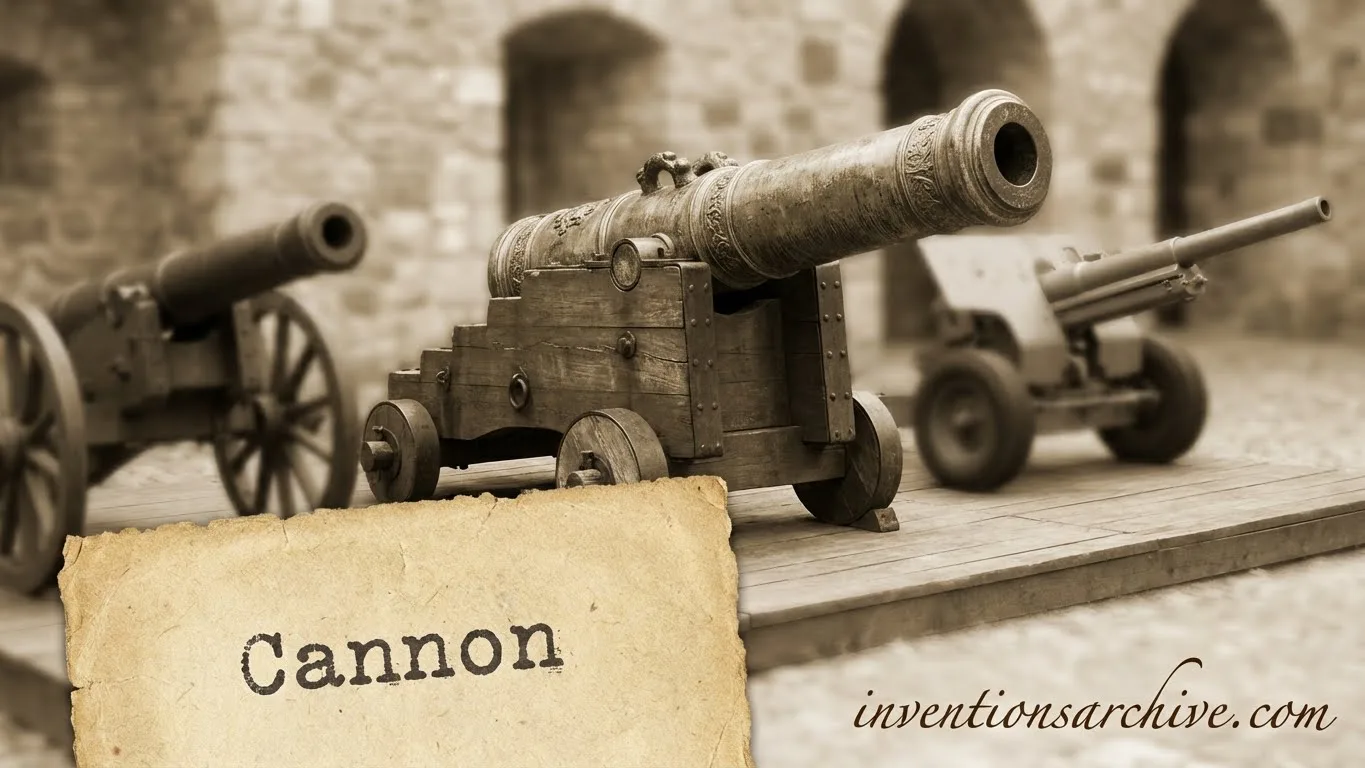
| Invention Name | Cannon |
|---|---|
| Short Definition | A large tubular gun that uses expanding propellant gas to launch a projectile. |
| Approximate Origin | Late 12th to 13th century Approximate |
| Geographic Origin | China, followed by rapid development across Eurasia |
| Inventor or Source Culture | Anonymous / collective development |
| Category | Military technology, metallurgy, mechanical engineering, and manufacturing |
| Evidence Status | Based on surviving evidence Attribution varies |
| Earliest Secure Evidence | Chinese evidence by the late 13th century; a surviving bronze cannon bears a date equivalent to 1332 |
| European Documentary Evidence | Metal cannon recorded in Florence in 1326; an early illustration dates from the same period |
| Main Problem Solved | Delivering concentrated projectile force from a compact metal tube, especially against fixed structures and distant targets |
| Basic Principle | Rapid gas expansion inside a strong barrel accelerates a projectile toward the muzzle |
| Early Materials | Cast bronze; forged iron bars and hoops; later cast iron |
| Early Uses | Sieges, fortified positions, ships, gates, walls, and field support |
| Development Path | Fire-lance and tube weapons → early metal cannon → bombards and mobile guns → rifled and breech-loading artillery |
| Main Variations | Bombard, field cannon, siege cannon, naval cannon, swivel gun, smoothbore, rifled, muzzle-loading, and breech-loading forms |
| Surviving Evidence | Inscribed bronze and iron barrels, museum objects, manuscript images, foundry marks, written records, and later patents |
| Modern Descendants | Rifled field artillery, naval guns, vehicle-mounted guns, ceremonial cannon, and other large-calibre gun systems |
| Related Inventions | Gunpowder, fire lance, metal casting, gun carriage, rifling, breech-loading mechanism |
| Why It Matters | Changed fortification design; advanced foundry practice, transport systems, measurement, and projectile science |
A cannon is a strong barrel designed to direct the pressure of expanding gas behind a projectile. The idea appears simple, yet an effective cannon depended on several difficult achievements arriving together: reliable propellant, a tube able to survive repeated pressure, metalworking skill, a stable mounting, and methods for aiming and transport. Its history is therefore best understood as a chain of linked improvements, not as a single moment credited to one named inventor.
What A Cannon Is
The word cannon usually refers to a large gun whose barrel is too heavy to be treated as an ordinary hand-held firearm. Historical usage was less tidy. Records may call early pieces guns, gonnes, bombards, fire tubes, or artillery. Size alone did not define them; mounting, purpose, barrel form, and local vocabulary also mattered.
A cannon combines four broad elements: a pressure-resistant barrel, a rear section that contains the initial pressure, an open muzzle, and a support system that holds or moves the barrel. Later pieces added better carriages, trunnions for pivoting, sights, recoil-control systems, rifling, and mechanical breeches.
Artillery is the wider family. Cannon are part of that family, alongside related forms such as howitzers and mortars. The borders between these labels shifted by period and country.
How The Origin Is Traced
The cannon grew from earlier Chinese experiments with gunpowder and tubular weapons. Academic research on the global history of firearms places the origin of true firearms in China, where gunpowder weapons developed from flame-projecting devices into tubes that used propellant force to launch solid projectiles.[a]
No surviving document names a single inventor. The transition probably occurred through repeated work by military workshops, metalworkers, court officials, and soldiers. A fire lance could project flame and debris from a tube; replacing a weak tube with a stronger metal barrel and using a fitted projectile created the basic firearm principle.
A bronze cannon found at Yunju Temple near Beijing carries an inscription dating it to 1332. The National Museum of China identifies it as the earliest surviving cannon with a readable production date. Its inscribed number also suggests organized manufacture rather than a lone experimental object.[b]
Western European records become clearer in the early 14th century. The Royal Armouries traces an early written gunpowder recipe to the Chinese Wujing Zongyao, compiled around 1040. It also notes metal cannon in Florence in 1326 and an early surviving image from the same period. By the later 14th and 15th centuries, records and museum objects show cannon in several sizes, from small guns to massive bombards.[c]
The Problem It Answered
Before cannon, people relied on mechanical engines and manual methods to project force at a distance. Trebuchets and other stone-throwing machines could strike walls, while battering tools and excavation attacked structures at close range. These methods could work, but they required large frames, many workers, prepared positions, and repeated mechanical effort.
The cannon offered a different source of energy. A relatively compact barrel could release stored chemical energy in a sudden pulse. Early pieces were often heavy, slow, inaccurate, and hazardous to their own crews, yet they could direct repeated blows at gates, walls, ships, or grouped targets.
| Before the Cannon | What Changed After It |
|---|---|
| Large mechanical engines stored energy in ropes, weights, or bent materials. | Propellant gas delivered a short, concentrated impulse inside a metal barrel. |
| Siege engines often needed substantial timber structures and assembly space. | Cannon could be mounted on prepared platforms, carriages, ships, or fortifications. |
| Projectile speed and repeatability depended heavily on the condition and adjustment of the engine. | Standard barrels and projectiles encouraged more repeatable manufacture and measurement. |
| High stone walls were built mainly for older forms of assault. | Fortifications adapted with lower profiles, thicker masses, angled bastions, and protected gun positions. |
| Heavy projectile systems were mainly specialist siege equipment. | Different cannon forms developed for field, naval, fortress, and mobile use. |
How The Cannon Worked In Simple Terms
The basic principle is the conversion of chemical energy into motion. Propellant reacts rapidly inside a confined rear section of the barrel. Expanding gas presses in every direction, but the barrel blocks most paths. The projectile can move toward the open muzzle, so the pressure accelerates it along the bore.
The barrel must contain pressure long enough to direct that motion without splitting. Its thickness, material quality, internal shape, and condition therefore mattered as much as the propellant itself. Weak castings, hidden cracks, uneven metal, or poor fit reduced safety and accuracy.
A smoothbore barrel has a plain interior. A rifled barrel has spiral grooves that make a fitted projectile spin, which can improve stability and accuracy. Muzzle-loading pieces received their components from the open front, while breech-loading pieces used an opening or removable chamber at the rear. These are design categories, not instructions for operation.
The central idea remained stable: pressure was created behind a projectile and guided through a tube. Later changes improved control, repeatability, range, mobility, and durability.
Materials and Main Parts
Early makers had to create a barrel strong enough to resist repeated internal pressure. Some iron cannon were built from lengthwise iron bars held together by heated hoops. Casting later became common because it could form a barrel as one main body.
Bronze was easier to cast with the furnace technology available to many early foundries. It also resisted corrosion and could be melted for reuse. Cast iron became attractive because it was cheaper where suitable iron production and foundry skill existed, though flawed castings and brittleness remained concerns. The National Park Service records the long historical use of forged iron, cast bronze, and cast iron cannon, each chosen according to cost, resources, climate, and workshop skill.[d]
Parts That Shaped Later Designs
- Barrel: the pressure-bearing tube.
- Breech: the closed or closable rear portion of the barrel.
- Muzzle: the open front end.
- Bore: the interior passage through which the projectile travels.
- Trunnions: side projections that allow a barrel to pivot on its mounting.
- Carriage or mounting: the structure that supports, aims, transports, or secures the piece.
The cannon was therefore also an invention in support engineering. Wheels, axles, timber frames, ship mountings, fortress platforms, lifting gear, roads, and foundries all shaped where a piece could be used.
From Earlier Tools To Later Forms
| Stage | Form | What Changed |
|---|---|---|
| Earlier Tool | Trebuchet, traction engine, fire lance | Mechanical projectile throwing and early use of gunpowder in tubes |
| Early Firearm | Metal hand cannon and small cannon | A stronger tube directed gas pressure behind a solid projectile |
| Heavy Medieval Form | Bombard | Larger barrels delivered heavier projectiles against fixed structures |
| Improved Mounted Form | Cast cannon with trunnions and carriage | Better elevation control, transport, and standard mounting |
| Specialized Forms | Field, siege, fortress, naval, and swivel cannon | Barrel size and mounting were adapted to distinct settings |
| Industrial-Era Form | Rifled and breech-loading artillery | Spinning projectiles, stronger materials, improved sealing, and faster handling |
| Modern Descendant | Field guns, naval guns, vehicle-mounted guns, and ceremonial pieces | Precision manufacture, recoil management, steel alloys, and integrated aiming systems |
Early Uses and Wider Spread
Early cannon first proved useful where weight and slow handling were less restrictive. Fortified sites and sieges provided prepared ground, storage, crews, and time. Large bombards could be placed opposite walls, while smaller pieces could defend gates, bridges, ships, and fixed approaches.
As carriages improved, lighter cannon became more mobile. Ships carried broadside or swivel-mounted pieces; fortifications placed guns behind openings or on raised platforms; field forces used lighter barrels that could travel with transport animals and wagons.
Trade, specialist labour, diplomacy, captured equipment, and moving foundry workers carried cannon designs between regions. A British Museum bronze breech-loading swivel gun dated to about 1540 was made in Lisbon and later recorded in Benin City. Its object history shows both the wide movement of cannon and the care needed when reconstructing the route of a surviving piece.[e]
Spread did not produce one uniform design. Workshops adapted barrels, decoration, mountings, chamber systems, and metal choices to local resources and uses.
Main Types and Variations
| Type or Variation | Defining Feature | Typical Historical Context |
|---|---|---|
| Hand Cannon | Small early metal barrel held on or attached to a support | Early transition from tube weapon to portable firearm |
| Bombard | Very heavy, large-bore cannon, often difficult to move | Medieval and early modern sieges |
| Field Cannon | Lighter piece carried on a mobile carriage | Movement with forces over roads and open ground |
| Siege Cannon | Heavy piece intended for use against fortified structures | Prepared batteries and prolonged operations |
| Naval Cannon | Barrel and mounting adapted to shipboard space and motion | Vessels, coastal defense, and harbour protection |
| Swivel Gun | Smaller cannon on a pivoting mount | Ships, walls, gates, and compact defensive positions |
| Smoothbore | Plain interior barrel | Dominant form for much of cannon history |
| Rifled Cannon | Spiral grooves inside the bore | Greater projectile stability and improved accuracy |
| Muzzle-Loading | Front-loading barrel | Most early and many later smoothbore cannon |
| Breech-Loading | Rear opening or removable chamber | Early chambered examples and later industrial designs |
How Cannon Changed Buildings and Engineering
High vertical walls were well suited to resisting ladders, arrows, and older mechanical engines, but concentrated cannon fire encouraged new defensive forms. Builders lowered profiles, thickened vulnerable areas, used earth to absorb impact, and arranged projecting bastions so defenders could cover the faces of a fort from several angles.
The National Park Service describes the bastion system as an architectural response to black-powder weapons. Its angled forms reduced blind areas while creating protected positions for cannon.[f]
The effect reached beyond fortifications. Cannon production promoted larger furnaces, boring equipment, metal testing, standardized dimensions, stronger roads and bridges, dockyard lifting systems, and organized supply records. The need to predict projectile motion also linked artillery practice with measurement, geometry, and later experimental physics.
The cannon changed both attack and defense. Every improvement in barrels or projectiles encouraged a response in walls, ships, transport, armour, or protective construction.
Rifling, Breech Loading and Industrial Manufacture
For centuries, many cannon remained smoothbore and muzzle-loading. Their effectiveness depended on barrel quality, projectile fit, crew practice, and the stability of the mounting. Industrial manufacturing made it possible to control these variables more closely.
Related articles: Fortified Stone Castle [Medieval Inventions Series], Trebuchet (Counterweight Type) [Medieval Inventions Series]
Rifling gave elongated projectiles spin, improving flight stability. Breech mechanisms reduced reliance on the open muzzle as the only access point. Steel production, precision machining, stronger closures, and recoil-management systems then changed the cannon from a largely freestanding barrel and carriage into a more integrated machine.
The Rodman casting method offers a clear example of foundry improvement. Thomas Jackson Rodman patented a process in 1847 that cooled a cast barrel from the inside to reduce harmful flaws. Yet large smoothbores produced by this method were soon challenged by rifled cannon, which offered greater range and accuracy. The change shows how one advanced manufacturing method could be overtaken by a different barrel principle.[g]
What Changed Because Of The Cannon
The cannon altered the practical value of walls, ships, gates, roads, and foundries. It also changed how governments and institutions organized skilled labour. Large pieces required metalworkers, carpenters, miners, transport crews, surveyors, and specialists who could inspect barrels and maintain equipment.
Its effects were not immediate or identical everywhere. Early cannon could be less reliable than mature mechanical engines, and many fortifications remained useful for centuries. The change came through accumulation: better metal, more consistent manufacture, stronger carriages, improved aiming, and more specialized forms.
- Architecture: walls and forts adapted to resist and mount artillery.
- Metallurgy: foundries learned to cast larger, more uniform objects.
- Transport: roads, wagons, ships, cranes, and platforms had to carry great loads.
- Measurement: bore size, projectile fit, elevation, and range encouraged standard records.
- Manufacturing: states and workshops developed repeatable patterns, inspections, and inventories.
- Science: projectile motion became a practical problem for geometry and experimental study.
Its longest influence may lie in system design: the cannon joined materials, chemistry, mechanics, logistics, and measurement in one demanding technology.
Common Misunderstandings
One Person Invented The Cannon
No reliable evidence identifies one inventor. The cannon developed through anonymous and institutional work on gunpowder, tubes, projectiles, casting, and mountings.
The Earliest Surviving Cannon Was The First Cannon
A surviving dated object proves that the technology existed by that date. It does not prove that no earlier cannon had been made.
All Early Cannon Fired Iron Balls
Early projectiles varied. Stone shot remained common in large medieval pieces, while later periods used a wider range of metal projectiles.
Breech Loading Was Entirely Modern
Early removable-chamber and breech-loading cannon existed, especially among smaller swivel guns. Industrial-era breech systems were more durable, better sealed, and more standardized.
Cannon Immediately Replaced Older Technology
Trebuchets, hand weapons, older fortifications, and early cannon overlapped for long periods. Adoption depended on cost, metal supply, workshop skill, transport, and local needs.
Related Inventions
- Gunpowder: the chemical propellant that made the cannon principle possible.
- Fire Lance: an earlier tubular gunpowder weapon in the path toward true firearms.
- Trebuchet: a mechanical predecessor used to throw heavy projectiles.
- Bronze Casting: a metalworking method used for many durable early barrels.
- Gun Carriage: the supporting structure that made aiming and movement more practical.
- Trunnions: pivot points that improved mounting and elevation control.
- Rifling: spiral barrel grooves that improved projectile stability.
- Breech-Loading Mechanism: a rear closure system developed in several early and later forms.
Frequently Asked Questions
Who invented the cannon?
No single inventor is securely known. The cannon emerged through collective development in China from gunpowder weapons, stronger tubes, metal casting, and solid projectiles.
When was the cannon invented?
The transition to true cannon probably occurred during the late 12th or 13th century. Chinese material evidence is earlier than clear European records, while a surviving Chinese bronze cannon bears the date 1332.
Where did the cannon originate?
The strongest evidence places the origin of true firearms in China. Cannon technology then spread and developed across Central Asia, the Middle East, Europe, South Asia, and other regions.
What is the oldest dated surviving cannon?
A bronze cannon found at Yunju Temple near Beijing carries an inscription dating it to 1332. It is identified by the National Museum of China as the earliest surviving cannon with a readable production date.
What is the difference between a smoothbore and a rifled cannon?
A smoothbore cannon has a plain barrel interior. A rifled cannon has spiral grooves that spin a fitted projectile, usually improving stability and accuracy.
How did cannon affect fort design?
Builders developed lower and thicker defenses, earth-backed walls, angled bastions, and protected gun positions. These forms were intended to resist cannon impact and provide wider fields of fire.
Sources and Verification
- [a] Introduction (Chapter 1) — Firearms — Used to verify the Chinese origin of true firearms and the gradual development from earlier gunpowder weapons. (Reliable because it is a scholarly book chapter published by Cambridge University Press.)
- [b] The Earliest Surviving Dated Cannon — Used to verify the 1332 bronze cannon, its inscription, find location, and evidence of organized production. (Reliable because it is a research page from the National Museum of China.)
- [c] The Hundred Years’ War 1337–1453 — Used to verify the early gunpowder record, Florence’s 1326 metal cannon reference, early illustrations, and medieval bombards. (Reliable because it is an institutional history page from the Royal Armouries.)
- [d] Cannon — Castillo de San Marcos National Monument — Used to verify forged iron construction, bronze and cast-iron production, and historical material tradeoffs. (Reliable because it is an official U.S. National Park Service history resource.)
- [e] Cannon — British Museum Collection — Used to verify the circa-1540 bronze breech-loading swivel gun, its Lisbon manufacture, trunnions, and uncertain route to Benin City. (Reliable because it is a catalogued museum object record with curatorial notes.)
- [f] Bastions — Castillo de San Marcos National Monument — Used to verify how black-powder cannon influenced angled bastions and fortification design. (Reliable because it is an official U.S. National Park Service interpretation page.)
- [g] Begin DRTO Cannon Conservation Project — Used to verify Rodman’s internal-cooling casting method and the later advantage of rifled cannon over large smoothbores. (Reliable because it is an official U.S. National Park Service conservation and history record.)

