
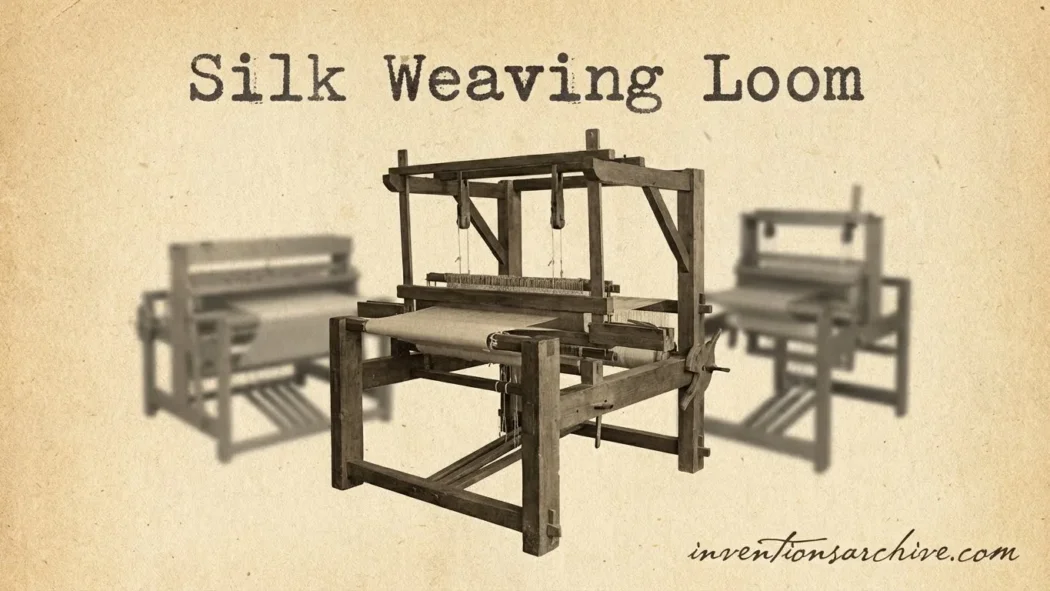
| Invention Name | Silk Weaving Loom |
|---|---|
| Short Definition | A loom adapted to hold fine silk warp threads under tension and interlace them with weft threads to make silk cloth. |
| Approximate Date / Period | Neolithic silk weaving: around the 3rd millennium BCE Based on surviving evidence; pattern loom evidence: second half of the 2nd century BCE Based on surviving evidence [a] |
| Geography | Ancient China, with evidence connected to Zhejiang, Henan, Sichuan, and later Silk Road regions |
| Inventor / Source Culture | Anonymous / collective; later tradition links silk culture to Empress Leizu or Luozu Attribution varies |
| Category | Manufacturing; textile technology; craft production; material culture |
| Main Problem Solved | Turning delicate silk filament into stable cloth, then into repeatable patterned textiles |
| Basic Working Principle | Warp threads are held tight; selected threads are lifted; a weft thread passes through; the structure is beaten into cloth |
| Material / Technology Base | Wooden or bamboo frames, beams, cords, heddles, treadles, shuttles, silk yarn, later pattern rods and draw mechanisms |
| Early Use | Silk ribbons, cloth, robes, court textiles, tax textiles, diplomatic gifts, trade goods, patterned jin silk |
| Evidence Status | Early silk survives as fragments and ribbons; early pattern looms survive as Han Dynasty tomb models Based on surviving evidence [b] |
| Development Path | Backstrap or simple loom → treadle loom → multi-heddle pattern loom → drawloom → Jacquard and modern patterned looms [c] |
| Related Inventions | Sericulture, silk reel, heddle, shuttle, drawloom, Jacquard mechanism, punch card, power loom |
| Modern Descendants | Jacquard looms, dobby looms, computerized weaving machines, textile design software, industrial silk weaving systems |
| Why It Matters | It made fine silk cloth, repeatable patterns, workshop production, luxury trade, and later programmable textile control possible |
The silk weaving loom was not a single machine invented on one clear day. It was a family of weaving devices shaped by silk fiber, workshop skill, and long technical refinement. Its early forms helped turn reeled silk into cloth; its later forms helped weavers create damask, gauze, brocade, satin, and patterned silk with a level of control that plain hand interlacing could not reach.
What the Silk Weaving Loom Is
A silk weaving loom is a textile machine or frame used to weave silk yarn into fabric. It holds a set of lengthwise threads, called the warp, under controlled tension. A second thread, called the weft, crosses the warp to build cloth.
What made silk weaving demanding was the material itself. Silk filament is fine, smooth, and strong, but it needs careful handling. A loom used for silk had to keep threads aligned, separate them cleanly, and allow repeated crossings without damaging the yarn.
In its simplest form, the loom solved a physical problem: how to organize many thin threads so they could become a stable surface. In its more advanced forms, it solved a second problem: how to repeat a visible pattern across cloth without selecting every thread by hand each time.
This is why the silk weaving loom belongs to both textile history and machine history. It was a craft tool, but it also carried early ideas about stored patterns, repeated motion, and controlled thread selection.
How Its Origin Is Traced
The oldest silk weaving evidence is not a complete loom. Organic materials decay easily, so early looms rarely survive. Instead, historians look for indirect and partial evidence: woven silk fragments, silk ribbons, impressions, early tools, later illustrations, and excavated workshop models.
Chinese museum evidence places early silk in the Neolithic period, with finds such as silk fragments and braided silk ribbons from the Qianshanyang site in Zhejiang. The same record notes early written evidence in oracle bone inscriptions that include terms for mulberry, silkworm, silk, and silk textiles.
The more specific story of the pattern loom becomes clearer much later. The Laoguanshan tomb finds in Chengdu include four wooden model pattern looms, weaving-related tools, and figurines connected with silk production. These models are important because they preserve machine form, not just finished fabric.
The Problem It Answered
Before specialized silk weaving systems matured, people could interlace fibers by hand, use simple frames, or weave narrow and plain textiles on early looms. Those methods worked, but they had limits.
Silk created a special challenge. The fiber was valuable and delicate. Poor tension could waste thread. Uneven shedding could cause mistakes. Complex patterns took time and memory. A better loom made the work more controlled.
The silk weaving loom answered several practical needs:
- It kept fine silk warp threads in order.
- It allowed the weaver to separate selected warp threads more quickly.
- It made broader, longer, and more regular cloth possible.
- It supported repeated decorative structures such as damask, gauze, brocade, and later satin.
- It helped workshops produce textiles for clothing, ritual use, court supply, taxation, and trade.
The change was not only faster production. It was also better control over repeatable structure. That is what separated advanced silk weaving from simple thread crossing.
How the Loom Worked in Simple Terms
A loom works by making a temporary opening between warp threads. This opening is called a shed. The weft passes through that opening. Then the threads change position, and the next weft pass locks the structure in place.
In early silk weaving, the weaver might lift threads by hand, with rods, or with simple heddles. In later treadle looms, foot pedals helped raise selected warp groups. This freed the hands for moving the shuttle and beating the weft into position.
Pattern looms added another layer. They did not merely open the warp for plain cloth. They stored or organized pattern information, so a design could repeat. In multi-heddle and drawloom systems, selected warp groups could be lifted in a planned order, allowing figured silk to show motifs, bands, animals, clouds, inscriptions, or geometric designs.
The same basic language remained: warp, weft, heddle, shed, shuttle, beam, and reed. Later loom parts became more refined, but the main idea stayed surprisingly stable. Smithsonian’s textile records describe heddles as devices that raise and lower warp threads, and the reed as a comb-like part that spaces warp yarns evenly [e].
Earlier Tools and Skills Before It
The silk weaving loom depended on more than the frame itself. It needed a chain of earlier skills. Without mulberry cultivation, silkworm care, cocoon reeling, thread preparation, and winding, the loom had nothing suitable to weave.
Sericulture was the foundation. UNESCO describes Chinese sericulture and silk craftsmanship as a sequence that includes planting mulberry, raising silkworms, unreeling silk, making thread, designing fabric, and weaving. This shows that the loom was one part of a larger production culture, not an isolated device [d].
Earlier tools and practices included:
- Spindles and reels for preparing thread.
- Backstrap or simple frame looms for controlled tension.
- Warping devices for arranging threads before weaving.
- Heddle rods for lifting selected warp groups.
- Small shuttles for carrying silk weft through the shed.
Once those skills came together, the loom could develop from a simple tensioning frame into a machine for planned textile structure.
Materials and Mechanism
Early silk looms were mostly made from materials that could be shaped locally: wood, bamboo, cord, and sometimes ceramic or stone-related parts. The machine did not need metal to be inventive. Its value came from arrangement.
The main parts usually included:
- Warp beam: held unwoven warp threads.
- Cloth beam: collected finished woven fabric.
- Heddles or shafts: lifted selected warp threads.
- Reed or beater: helped space threads and press the weft into place.
- Shuttle: carried weft yarn across the warp.
- Treadles: used foot motion to operate shedding in more developed looms.
- Pattern rods or draw cords: stored or called up pattern sequences in advanced systems.
The technical principle was simple to describe but hard to perfect: separate, pass, beat, repeat. Pattern weaving added another layer: select different warp groups in a controlled order so the cloth itself carries the design.
Early Uses in Silk Workshops
Early silk weaving served practical, social, and administrative needs. Silk cloth could become garments, ribbons, covers, banners, gifts, and stored value. In some periods, silk was also linked with taxation and official supply systems.
Plain silk fabrics answered basic textile needs. Patterned silk answered higher-value uses: court clothing, ceremonial objects, diplomatic exchange, and trade goods. The more complex the pattern, the more important the loom became.
Silk workshops also needed division of labor. A single textile could involve silkworm raising, reeling, twisting, dyeing, warping, weaving, finishing, and inspection. The loom sat near the end of this chain, where prepared thread became visible cloth.
How It Spread and Changed Over Time
The silk weaving loom changed as silk production moved through regions, workshops, and trade routes. Early Chinese silk weaving developed within a long sericulture culture. Later, patterned silk and loom technology became tied to the Silk Roads, where textiles, skills, and design ideas traveled across Central Asia and beyond.
The pattern loom was one of the major changes. It allowed designs to be repeated more reliably. The drawloom then made more elaborate figured textiles possible by separating ground weaving from pattern selection. Some drawlooms required more than one worker: one at the weaving position and another controlling pattern cords.
Much later, European punched-card systems changed pattern control again. Basile Bouchon used perforated paper in the 1720s, Jean-Baptiste Falcon used linked perforated cards in 1728, and Joseph-Marie Jacquard refined the system in the early 1800s. The Science Museum Group describes Falcon’s model as an early punch-card-controlled loom and notes that Jacquard later refined the method [g].
The Jacquard mechanism did not invent silk weaving. It changed how complex pattern information could be stored and repeated. Science Museum Group records explain that Jacquard punched cards controlled which warp threads rose, allowing detailed designs to be woven with less direct human selection [f].
Main Types and Variations
| Type or Variation | Main Use | What Made It Different |
|---|---|---|
| Backstrap Loom | Plain or relatively simple woven textiles | Used the weaver’s body to control warp tension; portable and flexible |
| Frame Loom | Stable weaving on a fixed support | Held warp threads on a frame rather than relying mainly on body tension |
| Treadle Loom | Faster plain weaving and some structured textiles | Foot pedals lifted warp groups, leaving the hands freer for shuttle and beating |
| Multi-Heddle Pattern Loom | Repeatable patterned silk, including early jin silk | Used multiple heddles or shafts to organize pattern selection |
| Drawloom | Large and complex figured silk patterns | Used draw cords or pattern harnesses to lift selected warp groups for motifs |
| Jacquard Loom | Detailed repeat patterns in silk and other fabrics | Used punched cards to control warp selection for each row of a design |
| Modern Computerized Loom | Industrial patterned textile production | Uses digital control while still relying on warp and weft interlacing |
Before and After the Silk Weaving Loom
| Before | After |
|---|---|
| Fibers could be interlaced by hand or on simpler frames, often with limited width, speed, or pattern control. | Silk warp and weft could be managed with greater order, tension, and repeatability. |
| Complex designs required slow manual selection and strong memory from the weaver. | Heddles, pattern rods, draw cords, and later cards helped store or repeat pattern choices. |
| Fine silk thread could be wasted by uneven tension, tangling, or poor alignment. | Better loom structure reduced disorder and made high-value silk production more reliable. |
| Plain cloth and small decorative effects were easier than broad repeat patterns. | Brocade, damask, gauze, satin, and figured silk could be produced with more control. |
| Textile output depended heavily on single-person hand selection. | Workshop systems could divide labor between thread preparation, weaving, pattern control, and finishing. |
| Later machine control had fewer early models to build on. | Pattern looms helped prepare the path for drawlooms, Jacquard punched cards, and modern textile programming. |
Development Path
| Stage | Form | What Changed |
|---|---|---|
| Earlier Tool | Hand interlacing, mats, simple frames, early backstrap-style weaving | Threads could be crossed, but width, tension, and pattern control were limited. |
| Early Silk Weaving | Backstrap or simple silk looms | Prepared silk yarn could be woven into ribbons, plain cloth, and early textile forms. |
| Improved Loom | Treadle and multi-heddle systems | Foot control and heddle systems improved speed and made repeated structures easier. |
| Pattern Loom | Han Dynasty pattern loom and related systems | Pattern programs could be organized through shafts and heddles for repeated figured silk. |
| Later Form | Drawloom | More complex motifs could be woven by separating ground weaving from pattern selection. |
| Modern Descendant | Jacquard, dobby, and computerized looms | Pattern control moved from cords and cards to mechanical and digital selection systems. |
What Changed Because of It
The silk weaving loom changed the scale and precision of silk production. It did not make silk common in the modern sense, but it made high-value silk textiles more repeatable and technically varied.
Several changes followed:
- Textile design became more repeatable. Patterns could be planned, stored, and reproduced more reliably.
- Workshops gained technical depth. Silk production required skilled roles, not just raw fiber and hand labor.
- Silk trade gained variety. Plain cloth, patterned cloth, gauze, damask, and brocade could serve different markets and uses.
- Later machines borrowed the same idea of controlled selection. Jacquard punched cards are the best-known example.
The long-term effect is easy to miss. The loom did not simply make cloth. It showed that a machine could store a pattern and repeat an operation. That idea later mattered far beyond silk.
Common Misunderstandings
The Silk Weaving Loom Was Not Invented by One Clearly Recorded Person
Silk legends name cultural figures, but surviving evidence points to a long technical tradition. The safer historical view is anonymous and collective invention, refined across many generations.
The Earliest Silk Is Not the Same as the Earliest Loom
A silk fragment proves that silk was made and woven. It does not always show the exact loom form. Looms were often made of perishable materials, so textile evidence and machine evidence must be read separately.
Jacquard Did Not Invent Silk Weaving
Joseph-Marie Jacquard refined a punched-card control system for patterned weaving in the early 1800s. Silk weaving and pattern looms were much older. His work belongs to the later history of loom control, not the origin of silk weaving itself.
Patterned Silk Was a Technical Product, Not Only Decoration
Patterns required planned thread selection, prepared yarn, dye knowledge, and skilled loom operation. A figured silk textile is evidence of both design and machine control.
Related Inventions
The silk weaving loom sits inside a wider chain of textile inventions and later machine systems. Closely related inventions and technologies include:
- Sericulture: the cultivation of silkworms and mulberry trees for silk fiber.
- Silk Reel: a device or method for unwinding filament from cocoons.
- Spindle and Winder: tools used to prepare thread and bobbins before weaving.
- Heddle: a thread-control device that lifts selected warp threads.
- Shuttle: a tool that carries weft yarn across the warp.
- Drawloom: a later loom system for complex figured textiles.
- Jacquard Mechanism: a punched-card control system for patterned weaving.
- Power Loom: a mechanized loom that later changed large-scale textile production.
Frequently Asked Questions
Who invented the silk weaving loom?
No single inventor is securely recorded. The silk weaving loom is best understood as a collective invention developed in ancient Chinese textile culture and refined over many generations. Later traditions connect silk culture with Leizu or Luozu, but that is not the same as a verified inventor record.
When did silk weaving looms first appear?
Early silk weaving evidence in China reaches back to the Neolithic period, while the earliest direct artifact evidence for advanced pattern loom technology comes from Western Han tomb models dated to the second half of the 2nd century BCE. The exact first loom is not known because early looms were usually made from perishable materials.
How did a silk weaving loom work?
It held silk warp threads under tension, lifted selected threads to create a shed, passed a weft thread through that opening, and pressed the weft into the cloth. Pattern looms added systems of heddles, rods, draw cords, or later cards to repeat more complex designs.
Was the Jacquard loom the first silk weaving loom?
No. The Jacquard mechanism belongs to the much later history of patterned weaving. It refined punched-card control in the early 19th century, while silk weaving and pattern looms existed many centuries earlier.
Why was the silk weaving loom important?
It made fine silk yarn easier to control, helped produce regular cloth, supported patterned textile production, and influenced later loom technologies. Its pattern-control systems also connect textile history with the later history of programmable machines.
Sources and Verification
- [a] The Origin and Development of Silk — Used to verify early Chinese silk evidence, Neolithic silk references, oracle bone wording, and early silk finds such as Qianshanyang material. (Reliable because it is a China National Silk Museum institutional source.)
- [b] The Earliest Evidence of Pattern Looms: Han Dynasty Tomb Models from Chengdu, China — Used to verify the Laoguanshan tomb models, the second-century BCE pattern loom evidence, and the connection with jin silk production. (Reliable because it is an academic journal article hosted by Cambridge University Press.)
- [c] IIDOS Website of China National Silk Museum — Used to verify the broad loom development path from early looms to treadle, multi-heddle, and drawloom systems in Chinese textile history. (Reliable because it is connected with the China National Silk Museum and presents institutional textile-history material.)
- [d] Sericulture and Silk Craftsmanship of China — Used to verify that silk-making includes mulberry planting, silkworm raising, unreeling silk, thread making, designing, and weaving. (Reliable because it is an official UNESCO Intangible Cultural Heritage source.)
- [e] 1837 Hartford and Tilton’s Patent Model of a Loom Heddle — Used to verify heddles as mechanisms that raise and lower warp threads and to support the technical explanation of loom parts. (Reliable because it is an official Smithsonian National Museum of American History collection record.)
- [f] Jacquard Hand Loom — Used to verify Jacquard punched-card control, the 1804–1805 development date, and the way cards controlled raised warp threads. (Reliable because it is an official Science Museum Group collection record.)
- [g] Model of Falcon’s Loom — Used to verify Falcon’s 1728 punch-card loom model, Bouchon’s earlier perforated-paper system, and Jacquard’s later refinement. (Reliable because it is an official Science Museum Group collection record.)