
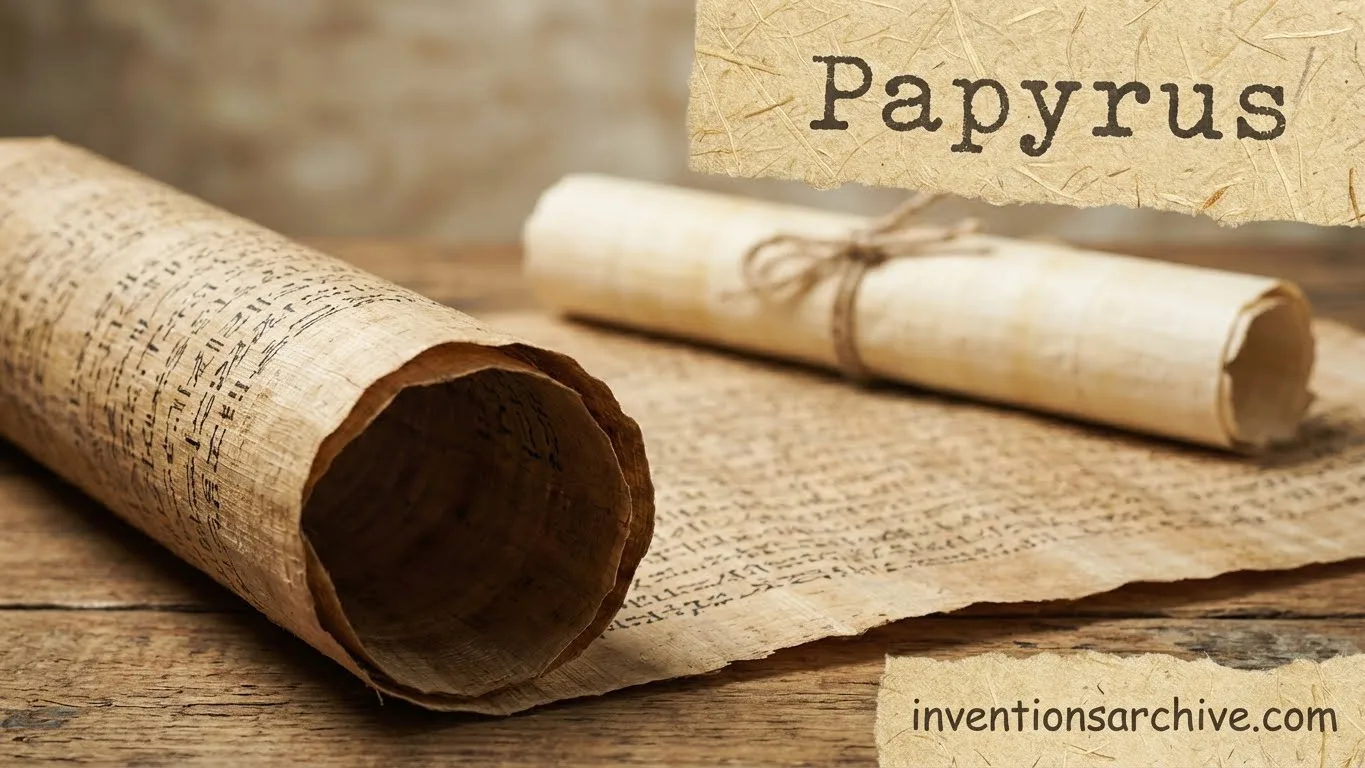
Papyrus was one of the most important writing materials of the ancient Mediterranean. It was made from the inner pith of the Cyperus papyrus plant, a wetland sedge associated with the Nile Valley. As an invention, papyrus was not a single object made once by a named inventor. It was a material technology: a repeatable way to turn a river plant into a smooth, portable surface for writing, record keeping, literature, teaching, trade and administration.
| Invention Name | Papyrus |
|---|---|
| Short Definition | A plant-based writing material made by layering, pressing and drying strips from the pith of the papyrus plant. |
| Approximate Date / Period | Third millennium BCE; earliest known blank roll around 2900 BCE Based on surviving evidence |
| Geography | Ancient Egypt, especially the Nile Valley and Delta; later used across the Mediterranean. |
| Inventor / Source Culture | Anonymous ancient Egyptian craft tradition Attribution varies |
| Category | Communication; writing material; record keeping; education; administration; book history. |
| Evidence Status | Origin is approximate; early surviving examples are physical rolls, fragments and written papyri. |
| Main Problem Solved | Provided a lighter, smoother and more portable writing surface than stone, clay, wood or potsherds. |
| Material / Technical Basis | Cyperus papyrus pith strips; cross-layering; pressure; drying; sheet joining. |
| How It Worked | Thin pith strips were arranged in two directions, pressed into a sheet, dried and often joined into rolls. |
| First Known Uses | Writing, accounting, administrative records, letters, religious texts and literary copying. |
| Surviving Evidence | Blank early rolls; written papyrus fragments; administrative logbooks; museum and library collections. |
| Development Path | Plant pith sheets → papyrus rolls → cut sheets and codices → later parchment and paper book forms. |
| Related Inventions | Ink, reed pen, scroll, codex, parchment, paper, archive systems. |
| Modern Descendants | Archival documents, manuscript studies, conservation science, paper history and book design. |
| Main Impact | Made long-distance administration, written learning, literature and portable records easier to preserve and circulate. |
What Papyrus Is
Papyrus is often described as ancient paper, but that phrase can mislead. Modern paper is normally made from pulped fibers. Papyrus was made from layered strips of plant pith. The strips kept much of their natural structure, which is why many papyrus sheets show a visible pattern of crossing fibers.
The invention mattered because it connected three things that older writing surfaces did not combine as well:
- Portability: a papyrus roll could carry far more text than a stone inscription or clay tablet of similar weight.
- Writing comfort: a prepared surface could receive ink with a reed or brush.
- Length: sheets could be joined into rolls, making longer accounts, stories, letters and religious texts possible.
Papyrus was both practical and fragile. It could survive very well in dry desert conditions, yet moisture could damage it. That survival pattern shapes what modern readers know. Many papyri survive from Egypt not because papyrus was used only there, but because Egypt’s dry climate preserved material that would decay in wetter places.
The Problem Papyrus Answered
Before papyrus became widely useful, people wrote on surfaces such as stone, clay, wood, bone, wax tablets, leather, potsherds and other prepared materials. Each had value. None gave Egyptian scribes the same balance of lightness, length and smoothness.
Stone could last, but it was heavy and slow to inscribe. Clay tablets worked well in regions where clay writing systems were common, but they were not ideal for every Egyptian administrative habit. Ostraca, or potsherds, were useful for notes, drafts and short records. They were cheap, but limited in size.
Papyrus answered a different need: a portable record that could travel with officials, scribes, merchants, priests and teachers. It helped writing move away from walls and monuments into offices, schools, workshops, homes, temples and archives.
| Before Papyrus | What Changed After Papyrus |
|---|---|
| Stone and clay could preserve text, but they were heavy or limited in format. | Longer written records could be stored, carried, copied and rolled. |
| Short notes often used small surfaces such as ostraca, wood or wax. | Scribes had a smoother surface for letters, accounts, school texts and formal documents. |
| Large public writing was often tied to fixed places such as monuments or walls. | Writing became more useful for mobile administration, trade and learning. |
| Keeping long sequences of accounts or texts was harder on small or rigid surfaces. | Joined sheets made scrolls suitable for extended records, stories and religious works. |
| Archiving depended heavily on durable but bulky media or short-lived informal notes. | Bundles and rolls of documents could support offices, temples and private collections. |
How Papyrus Worked
The technical idea was simple in principle, but it required skill. The useful part of the plant was the pale inner pith. Strips were cut, placed in layers that crossed each other, pressed and dried. Several sheets could then be joined into a roll. The Berlin Papyrus Database describes papyrus scrolls as products of the third millennium BCE, made from a plant native to Egypt, distributed across the Mediterranean, and formed by cutting the pith into strips, layering it crosswise, pressing and drying it.[c]
The strength came from the crossing direction of the strips. One layer helped resist tearing in one direction; the second layer helped in the other. The result was not paper in the modern sense. It was a laminated plant sheet.
Main Materials and Principles
- Papyrus plant: a wetland sedge with a strong outer rind and soft inner pith.
- Pith strips: the plant material that formed the writing sheet.
- Cross-layering: strips laid in two directions to create a stable surface.
- Pressure and drying: the process that helped the layers bond into a usable sheet.
- Sheet joining: separate sheets could be attached edge to edge to form a roll.
- Ink and reed tools: scribes wrote on the surface with black and red inks, using brush-like or reed writing tools.
Earlier Tools and Materials Before Papyrus
Papyrus did not appear in a world without writing surfaces. It entered a wider history of marks, records and written communication. Earlier or parallel materials included:
- Clay tablets: strong in some writing cultures, especially where clay was abundant and wedge-shaped writing tools were used.
- Stone inscriptions: durable for monuments, labels, public statements and religious texts.
- Wood and wax tablets: useful for temporary notes, schooling and reusable writing in some regions.
- Ostraca: broken pottery or limestone flakes used for short notes, drafts, receipts and exercises.
- Leather and parchment: animal-skin writing materials that later became more important in book production.
The real shift was not that papyrus replaced everything. It did not. Rather, it gave scribes a different option: a surface suited to extended but movable text. A state office could keep accounts. A teacher could use school texts. A temple could preserve ritual writing. A merchant or official could send a letter.
Early Uses in Real Life
Many famous papyri are religious, literary or scientific, but ordinary documents show the invention’s practical side. The University of Michigan Library describes its papyrology collection as containing documents dated from about 1000 BCE to 1000 CE, including personal letters, school primers, sales contracts and other records of daily life in the ancient world.[d]
That range shows why papyrus should not be treated only as a museum object. It was a working material for many kinds of written activity:
- Administration: accounts, tax records, work logs, orders and inventories.
- Education: school exercises, copied passages and writing practice.
- Trade and property: contracts, receipts, letters and legal documents.
- Religion: funerary texts, ritual instructions, hymns and temple records.
- Literature and learning: stories, poetry, mathematics, medicine and copied older works.
Its importance is easier to see when treated as office technology, not only book technology. Papyrus helped institutions remember. It let people send instructions across distance. It gave scribes a material that matched the pace of record keeping.
How Papyrus Spread and Changed Over Time
Papyrus began as an Egyptian material, but it became part of Mediterranean writing culture. Greek, Roman, Coptic, Aramaic and Arabic documents were written on papyrus at different times. The material moved through trade, conquest, administration, scholarship and religious copying.
Its spread depended on Egypt’s plant supply and craft knowledge. Egypt was not only a place where papyrus was used; it was also a major source of the raw material and prepared rolls. This made papyrus part of economic life as well as scribal life.
Over time, papyrus faced competition from parchment and later paper. Parchment was more durable in some book formats and climates. Paper, developed in China and later transmitted across wider regions, eventually became more common in many administrative and literary settings. Papyrus did not vanish immediately. It declined gradually, with different regions changing at different speeds.
| Stage | Form | What Changed |
|---|---|---|
| Earlier Tools | Stone, clay, wood, wax, ostraca, leather | Useful for specific records, but often heavy, short, rigid or less suited to long portable text. |
| Invention | Papyrus sheet | Plant pith became a smoother writing surface for ink. |
| Expanded Form | Papyrus roll or scroll | Joined sheets allowed longer texts, accounts and books. |
| Later Form | Cut sheets and codices | Some papyrus moved from roll format toward page-based book forms. |
| Modern Descendants | Paper books, archives, conservation science | Later materials kept the idea of portable written records, but changed the fibers, binding and durability. |
Main Forms and Variations
Papyrus was not one single product in use everywhere in exactly the same way. Its form depended on purpose, length, quality and later reuse.
| Form or Variation | Main Use | What Makes It Distinct |
|---|---|---|
| Single Sheet | Short letters, notes, smaller records | Useful when a long roll was unnecessary. |
| Roll or Scroll | Books, accounts, religious texts, longer records | Sheets joined edge to edge; read by unrolling. |
| Administrative Papyrus | Accounts, work logs, tax records, receipts | Shows papyrus as everyday office material, not only literary material. |
| Illustrated Papyrus | Religious and funerary texts, decorated manuscripts | Combined writing with colored imagery. |
| Reused Papyrus | Secondary writing on the reverse or reused fragments | Reflects the value of the material and the habit of economical reuse. |
| Papyrus Codex Leaves | Early page-based books | Sheets arranged more like later books rather than long scrolls. |
From Roll to Codex
The papyrus roll was one of the earliest major book forms. It suited long texts written in columns and read by unrolling. Later, the codex changed reading habits by arranging sheets as pages bound at one side. Princeton University Library explains that the papyrus or textile scroll dates back to the mid-third millennium BCE and that codices later made passages easier to find, allowed writing on two sides and gave pages more protection through covers.[e]
This shift did not make papyrus unimportant overnight. The change was gradual. Rolls remained useful, and papyrus was sometimes used in codex form. Yet the codex pointed toward the modern book: separate pages, easier reference and better handling for certain texts.
Related articles: Codex Book Format [Ancient Inventions Series], Paper Mill (Europe) [Medieval Inventions Series]
Reading Carbonized Papyrus Without Unrolling It
The Herculaneum papyri show that a papyrus roll can survive in a form that is physically present but almost impossible to open safely. PHerc. 1667 was carbonized during the eruption of Mount Vesuvius in 79 CE and later became too fragile for ordinary mechanical unrolling.
Researchers imaged the scroll with high-resolution phase-contrast X-ray micro-tomography at the European Synchrotron Radiation Facility. Computational reconstruction separated the tightly wound layers in digital form, while machine-learning models detected faint traces of carbon-based ink. Papyrologists then interpreted the recovered ancient Greek writing. [g]
The recovery also reveals why the structure of papyrus matters. A roll is made from joined sheets, and each sheet contains crossing plant fibers. When the roll is compressed, distorted, or carbonized, those layers must be followed as three-dimensional surfaces rather than treated as flat pages.
The development path now extends beyond the historical roll and codex: papyrus sheet → scroll → carbonized artifact → three-dimensional scan → virtually reconstructed surface → readable text.
Uses Beyond Writing
The papyrus plant had a wider material life. Egyptians used parts of the plant for practical objects such as boats, mats, baskets, sandals and ropes. The Metropolitan Museum of Art describes papyrus plant uses that included skiffs, mats, boxes, baskets, lids, sandals and rope, while identifying the writing surface as the plant’s most important use.[f]
This matters because papyrus was not an isolated invention made in a workshop far from daily life. It came from a plant people already knew. The writing material was one result of broader plant knowledge: cutting, stripping, binding, drying and shaping wetland reeds into useful forms.
Common Misunderstandings
Papyrus Was Not Modern Paper
It looked paper-like, but it was not made from pulped fibers. It was made from layered strips of plant pith.
The Inventor Is Not Known
The safest attribution is to ancient Egyptian craft practice, not to one named person.
Earliest Evidence Is Not Always First Use
The oldest surviving roll or written fragment shows what has survived. It does not prove the first day papyrus was ever made.
Papyrus Was Not Only for Sacred Texts
Many surviving examples are official, legal, educational, commercial or personal documents.
Related Inventions
Papyrus sits in a wider chain of writing and record technologies. These related inventions and materials help place it in context:
- Ink: made writing on papyrus practical and visible.
- Reed Pen: gave scribes a controlled tool for writing on prepared surfaces.
- Scroll: turned joined papyrus sheets into a long readable format.
- Ostraca: provided a cheaper surface for short notes and practice writing.
- Codex: changed long texts from rolls into page-based books.
- Parchment: became a major later writing support, especially in codex form.
- Paper: eventually replaced papyrus in many regions as a more flexible fiber-based writing material.
- Archive Systems: gave written records a place in offices, temples, libraries and modern collections.
Frequently Asked Questions
Who invented papyrus?
No named inventor is known. Papyrus is best understood as an ancient Egyptian material technology developed by anonymous craftspeople and scribal communities over time.
Is papyrus the same as paper?
No. Papyrus is made from layered strips of plant pith. Modern paper is generally made from pulped fibers that are broken down and reformed into sheets.
What is the earliest evidence for papyrus?
The earliest known blank roll is associated with the First Dynasty tomb of Hemaka, around 2900 BCE. The earliest known written papyri are from Wadi el-Jarf and date to the reign of Khufu in the Old Kingdom.
Why did so many papyri survive in Egypt?
Papyrus is organic and can decay in damp conditions. Egypt’s dry desert climate helped many papyri survive, especially in burials, settlements and discarded document deposits.
What replaced papyrus?
Papyrus was gradually replaced in many uses by parchment and later by paper. The timing varied by region, language, institution and document type.
Sources and Verification
- [a] Papyrus-Making in Egypt – The Metropolitan Museum of Art — Used to verify the meaning of papyrus as both plant and writing support, the early Saqqara roll, the approximate date, the long use period and the limits of evidence for the manufacturing process. (Reliable because it is an official museum essay from The Metropolitan Museum of Art.)
- [b] IFAO – Ouadi el-Jarf — Used to verify the Wadi el-Jarf papyri, including the discovery of fragments from about thirty rolls and their status as very early written papyri linked to accounts and logbooks from the reign of Khufu. (Reliable because it is an official page from the Institut français d’archéologie orientale.)
- [c] Writing materials | Berlin Papyrus Database — Used to verify the technical description of papyrus manufacture, including pith strips, cross-layering, pressing, drying, scroll formation and Mediterranean distribution. (Reliable because it is a specialist institutional database connected to the Berlin papyrus collection.)
- [d] Papyrology Collection | University of Michigan Library — Used to verify examples of papyrus documents as everyday records, including letters, school primers and sales contracts dated across a long period. (Reliable because it is an official university library collection page.)
- [e] From papyrus scroll to codex | Digital PUL — Used to verify the transition from papyrus scrolls to codices and the practical advantages of the codex form. (Reliable because it is an official Princeton University Library digital exhibition page.)
- [f] Papyrus in Ancient Egypt – The Metropolitan Museum of Art — Used to verify the wider uses of the papyrus plant, including boats, mats, baskets, sandals, rope and the importance of papyrus as a writing surface. (Reliable because it is an official museum essay from The Metropolitan Museum of Art.)
- [g] AI Reads an Entire Vesuvius-Charred Scroll for the First Time — Used to verify the non-destructive X-ray micro-tomography, digital unwrapping, carbon-ink detection, and papyrological interpretation applied to PHerc. 1667. (Reliable because it is an official University of Kentucky Center for Computational Sciences research page.)