
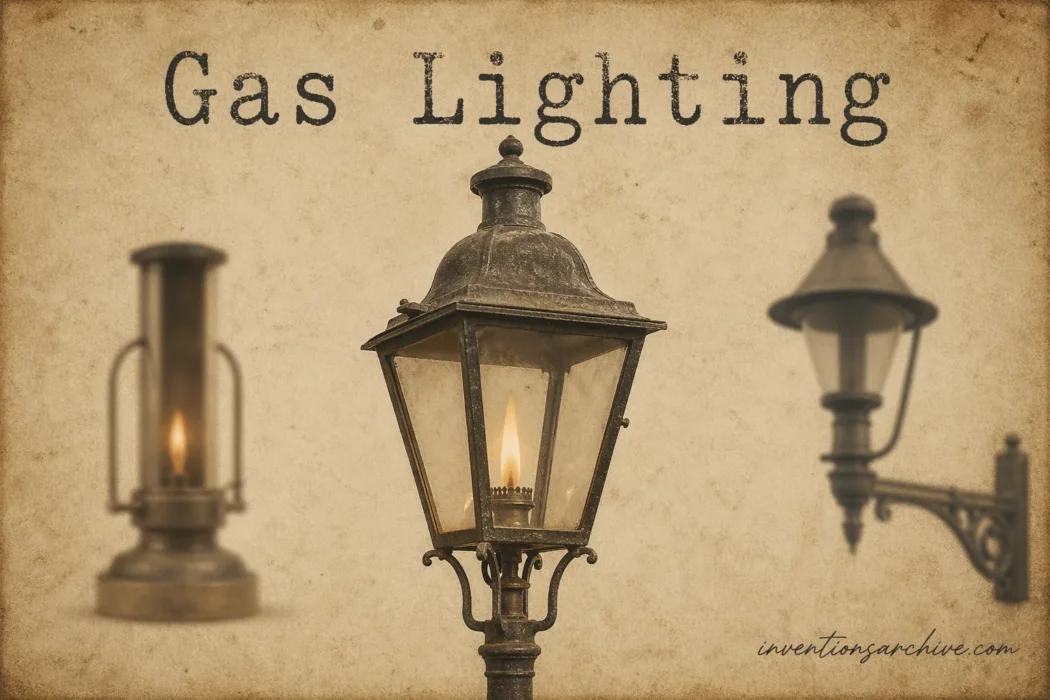
| Invention Name | Gas Lighting |
|---|---|
| Short Definition | Illumination produced by burning manufactured or supplied gas in lamps connected to a fuel source or distribution network |
| Approximate Date or Period | Approximate Practical development in the 1790s; public-network expansion from the early 1800s |
| Geography | Early development in Britain and France; rapid 19th-century adoption across Europe, North America, and other industrializing regions |
| Inventor or Source Culture | William Murdoch and Philippe Lebon were early experimenters; Frederick Albert Winsor and Samuel Clegg helped develop public supply systems |
| Category | Lighting technology, manufactured gas, urban infrastructure |
| Importance | Made large-scale artificial lighting a networked utility for factories, streets, shops, public buildings, and eventually homes |
| Evidence Status | Attribution varies Different people pioneered gas production, practical lighting, public demonstrations, and utility distribution |
| Main Problem Solved | Provided brighter and more centrally supplied illumination than reliance on numerous individual candles and oil lamps |
| Development Path | Experimental gas production → private factory systems → centralized gasworks → street pipe networks → improved burners → incandescent gas mantles |
| System Principle | Fuel gas was produced or supplied centrally, stored and regulated, distributed through pipes, and burned at individual lighting fixtures |
| Early Use Context | Factories and mills requiring long working hours, followed by streets, commercial buildings, and wealthier homes |
Gas Lighting Was an Infrastructure Invention, Not Simply a New Lamp
The decisive change introduced by gas lighting was not the discovery that combustible gases could produce light. People had observed flammable gases long before cities were illuminated by them. What transformed lighting was the creation of a practical system that could manufacture gas in one place, control its supply, move it through pipes, and burn it at many separate lamps.
This made gas lighting different from candles and oil lamps. Those earlier forms of illumination carried their own fuel at the point of use. A gas lamp in a street or factory could instead become the visible endpoint of a much larger industrial network extending back to a gasworks, storage equipment, regulators, meters, and underground mains.
The manufactured-gas industry emerged in the 1790s through experiments associated especially with the Scottish engineer William Murdoch and the French inventor Philippe Lebon. Murdoch worked with gas obtained from coal, while Lebon experimented with gas produced from wood. Historic England describes both men as pioneers of the experimental plant from which the manufactured-gas industry developed.[a]
William Murdoch and the Move From Experiment to Practical Illumination
William Murdoch, an engineer employed by Boulton & Watt, occupies a central place in the British history of gas lighting because he demonstrated that coal-derived gas could be used for sustained practical illumination rather than as a laboratory curiosity.
Surviving historical accounts place an important experiment at Redruth in Cornwall in 1792, when Murdoch used coal gas to light his house and office. His later work for Boulton & Watt connected gas illumination directly with industrial production, where reliable artificial light had clear economic value.[b]
Factories were an unusually suitable early market. Large mills contained many workspaces that needed illumination for extended hours, and maintaining scores or hundreds of individual lamps or candles was cumbersome. A private gas plant could supply many burners from the same source.
Murdoch’s work therefore represents an important stage in the invention: the point at which manufactured gas became a usable lighting technology inside a large establishment. Boulton & Watt subsequently supplied private gas installations to mills and factories during the opening years of the 19th century.
Samuel Clegg, who had worked with Murdoch before becoming an independent gas engineer, helped turn these early arrangements into more controllable systems. His later work included improvements to purification, gas storage, metering, and supply regulation. These developments mattered because a citywide gas service demanded far more than a burner that produced a bright flame. The quantity and pressure of gas had to be managed across an expanding network.[a]
Why No Single Inventor Fully Explains Gas Lighting
Calling gas lighting the invention of one person hides the way the technology developed. Several separate achievements had to occur before it became a public utility.
Murdoch demonstrated practical coal-gas illumination and promoted factory installations. Philippe Lebon pursued a parallel French line of experimentation involving gas generated from wood. Samuel Clegg became an important engineer of gasworks equipment and distribution. Frederick Albert Winsor, a German-born entrepreneur working in Britain, concentrated on something different again: centralized manufacture followed by distribution to multiple customers through street pipes.
These were not interchangeable accomplishments. Producing gas, lighting one building, creating reliable storage equipment, regulating supply, and establishing a commercial urban network were different technical and institutional problems.
Pall Mall and the Demonstration of Public Gas Lighting
Frederick Albert Winsor began publicly promoting gas illumination in London during the first decade of the 19th century. His ambition extended beyond lighting a single factory. He argued for centralized gas production and a network capable of supplying streets and buildings from common works.
Gas lighting demonstrations took place in London’s Pall Mall in 1807, and contemporary historical research records the lighting of both sides of the street by 1808. The event became one of the best-known landmarks in the history of public gas illumination because it showed urban spectators what a piped lighting service could look like.[a]
Pall Mall should not, however, automatically be described as the unquestionably first street anywhere to receive gas lighting. Historic England’s research on the manufactured-gas industry notes evidence for other early installations in London and at industrial sites, some of which may predate Winsor’s demonstration. The surviving record is clearer about Pall Mall’s importance as a highly visible public demonstration than about an absolute global first.
The Gas Light and Coke Company Changed the Scale of the Technology
The transition from demonstration to utility required corporate organization, capital, gasworks, street mains, and permission to install infrastructure beneath public space. That transition became visible in Britain with the creation of the Gas Light and Coke Company.
Following prolonged parliamentary debate, legislation received Royal Assent in 1812. The company began building the facilities needed to supply customers from centralized works in Westminster. The National Gas Museum describes the enterprise as the foundation of the world’s first public gasworks system, with operations beginning in Westminster in the following period.[b]
This institutional step altered what a lighting system could be. Instead of each mill owning a small gas-producing plant, an independent utility could manufacture gas and sell a continuous service to many users. The arrangement anticipated the later structure of electricity, water, telephone, and other network utilities.
From Coal to a Flame Miles Away
Early urban gas lighting depended mainly on manufactured coal gas, also widely called town gas in its later municipal context. Historic gasworks produced it by heating coal in enclosed retorts. The process released combustible gases while leaving coke and other by-products behind.[a]
The raw gas could not simply pass directly from a retort to a street lamp. A functioning gasworks incorporated equipment for cooling and cleaning the gas, storage, measurement, and pressure control. Large gasholders balanced the difference between production and consumption: gas could be manufactured at one rate while demand changed throughout the day and rose sharply when lamps were lit after dark.
From the works, mains carried gas beneath streets. Smaller service pipes supplied individual premises and lamp standards. At the fixture, a valve controlled the flow to a burner where the gas was ignited.
The technology was therefore divided across several linked stages:
| Stage | Function | Why It Mattered |
|---|---|---|
| Gas Manufacture | Combustible gas was extracted from coal or other feedstocks at a gasworks | Separated fuel production from the individual lamp |
| Cleaning and Conditioning | Undesirable components were removed before distribution | Made the supply more practical for equipment and urban use |
| Storage | Gasholders accommodated differences between production and demand | Allowed a relatively continuous city supply |
| Pressure Control and Metering | Governors and meters helped regulate and account for gas flow | Supported reliable operation and commercial billing |
| Pipe Distribution | Underground mains and service pipes carried gas to lamps | Allowed one works to serve many streets and buildings |
| Burner | The supplied gas was converted into a controlled flame or mantle-heating flame | Produced the visible light at the point of use |
The Burner Determined What the Gas Actually Looked Like
For much of the 19th century, the light seen by users came directly from the gas flame. Burner design controlled the shape of that flame and therefore affected brightness, stability, fuel use, and smoke formation.
Common burner forms included types known as fishtail and cockspur burners. These produced broad luminous flames rather than the concentrated flame associated with later laboratory burners. The National Gas Museum notes that naked-flame burners dominated gas lighting for most of the century.[c]
Related articles: Electric light arc lamp [Industrial Age Inventions Series], Electric tram [Industrial Age Inventions Series]
The luminosity of such flames depended partly on tiny carbon particles heated within the flame until they glowed. The arrangement could produce much more useful illumination than many older domestic lamps, but it also generated heat and combustion products inside buildings. Gas fixtures therefore changed not only lighting levels but also ventilation requirements and interior design.
Ceiling fixtures, wall brackets, chandeliers, street lanterns, shop lights, and theatre fittings were all adapted to the new fuel. Glass shades and chimneys could shape airflow or reduce glare, while valves allowed individual burners to be controlled.
Factories Adopted Gas Before It Became an Ordinary Household Utility
Gas lighting spread unevenly because the economics favored users who consumed large quantities of light in concentrated areas.
Industrial mills were early customers because extending productive hours could justify the cost of private gas equipment. City authorities then saw an advantage in lighting major streets from centralized works. Shops, theatres, clubs, public buildings, and prosperous households followed where distribution mains were available.
Domestic adoption among lower-income households came more slowly. According to the National Gas Museum, public buildings, shops, and larger houses commonly gained gas lighting before it became affordable to much of the working population during the later 19th century.[c]
This sequence illustrates an important feature of network technologies: invention alone did not guarantee access. A household could use a candle anywhere, but gas lighting depended on whether pipes had reached the street, whether a building was connected, and whether the consumer could pay for fixtures and continuing fuel.
Gas Lamps Changed the Nighttime City
Street gas lighting allowed municipalities and private companies to illuminate larger urban areas with lamps supplied from common networks. Streets no longer depended solely on individually serviced oil lamps with limited brightness and fuel capacity.
The effect extended beyond visibility. Regular street illumination supported evening retail, transport, entertainment, policing, and pedestrian movement. It also created new municipal routines. Lamps had to be lit, extinguished, inspected, cleaned, and repaired. The lamplighter became a familiar occupation in cities where automatic ignition had not yet appeared.
Gasworks themselves became major features of the industrial landscape. Retort houses, coal stores, purifier buildings, meter houses, and large gasholders occupied extensive sites, commonly positioned with access to canals, railways, or other routes capable of delivering coal. Historic England identifies such installations as part of England’s earliest energy distribution networks.[a]
The new system also introduced drawbacks. Manufactured gas could leak, combustion consumed oxygen and released heat and pollutants indoors, and the production of town gas created contaminated industrial sites and troublesome by-products. Gas lighting solved important lighting problems without being a clean or hazard-free technology.
The Welsbach Mantle Changed What Produced the Light
The greatest late-19th-century improvement in gas illumination came from an idea that changed the source of visible light. Instead of relying primarily on the luminosity of the flame itself, an incandescent mantle used the flame to heat a mineral structure until it glowed intensely.
The Austrian chemist Carl Auer, later Carl Auer von Welsbach, patented an early gas-mantle design in 1885. Science Museum Group records show that he continued refining the material during the following years, including work with rare-earth oxides.[d]
This was an important distinction. In a conventional luminous gas flame, the flame produced the useful light directly. In a mantle lamp, the flame acted mainly as the heat source for an incandescent material capable of emitting a much brighter light.
Mantle lighting dramatically improved the usefulness of gas just as electric lighting was becoming a serious competitor. Upright mantles were followed by improved arrangements, including inverted mantle systems in which the glowing element could direct more useful illumination downward into streets and rooms.
Competition With Electricity Did Not End Gas Lighting Overnight
Electric arc lamps began appearing in public spaces during the 19th century, while practical incandescent electric lamps created a more direct competitor for indoor gas lighting from the 1880s onward.
The replacement was gradual. Cities had already invested heavily in gasworks, mains, lamp standards, and indoor fixtures. Gas companies also improved their products rather than abandoning lighting immediately. The incandescent mantle gave existing gas networks a brighter and more efficient lighting technology without requiring customers to convert to an entirely different energy system.
For a period, gas and electricity therefore developed side by side. Some streets retained gas while major roads adopted electric lamps. Buildings could contain both systems during transitional years. Local economics, infrastructure, municipal contracts, and the availability of electric distribution all affected the pace of change.
Electric lighting eventually gained decisive advantages for most illumination. It produced light without local combustion, was easier to switch and control, avoided indoor gas exhaust, and could share an expanding electrical network with motors and appliances. During the first half of the 20th century, electric lamps displaced gas from most ordinary lighting applications.[c]
What Survived After Gas Ceased to Dominate Lighting
Gas lighting left two different kinds of legacy. One is physical: surviving gas lamp standards, lanterns, gasworks buildings, and gasholder structures preserve parts of the infrastructure that once supplied entire districts. Some historic streets still operate genuine gas lamps for heritage reasons.
The other legacy is structural. Gas lighting helped establish the idea that urban energy could be produced centrally and sold through a permanent distribution network. Customers no longer had to purchase all lighting fuel as individual solid or liquid units. Instead, energy arrived continuously through infrastructure embedded in the city.
That model outlasted gas illumination itself. Electric power later replaced gas for most lighting, but it used a comparable utility relationship: centralized or networked generation, distribution lines, metering, regulated supply, and numerous connected consumers.
Gas also survived after its lighting role declined. Once towns possessed gas networks, the fuel found expanding uses for cooking, water heating, and space heating. The original lighting industry therefore helped create infrastructure whose purpose became much broader than the invention that had first driven its construction.
Sources and Verification
- [a] Gasworks and Gasholders: Introductions to Heritage Assets — Historic England’s research overview documents the 1790s work of Murdoch and Lebon, early factory installations, Winsor’s public-lighting campaign, Samuel Clegg’s engineering contributions, the Gas Light and Coke Company, and the structure of manufactured-gas works.
- [b] The Early Days — The National Gas Museum records Murdoch’s 1792 Redruth lighting, Boulton & Watt’s industrial installations, Winsor’s London demonstrations, and the development of public gas supply.
- [c] Gas lighting — The National Gas Museum summarizes 19th-century street and domestic adoption, naked-flame burner forms, the gas mantle, and the eventual displacement of gas lighting by electricity.
- [d] Carl Auer von Welsbach — Science Museum Group’s collection record documents Auer von Welsbach’s scientific career and his 1885 patent work on the incandescent gas mantle.