
| Aspect | Information |
|---|---|
| Invention Name | Modern parachute / backpack, ripcord, and later ram-air parachute forms |
| Short Definition | A fabric aerodynamic safety device that slows descent by creating drag, lift, or both. |
| Approximate Date / Period | 1783 for the first demonstrated modern parachute use; 1911–1919 for the aircraft-ready modern form Approximate / staged development |
| Geography | France, Russia, United States; later adopted worldwide |
| Inventor / Source Culture | Louis-Sébastien Lenormand, André-Jacques Garnerin, Gleb Kotelnikov, Floyd Smith, Guy Ball, Leslie Irvin, Domina Jalbert |
| Category | Aviation safety, aerodynamics, emergency equipment, textile engineering |
| Why It Matters | Reduced fall speed; made emergency aircraft escape more practical; shaped skydiving, cargo drops, spacecraft recovery, and aerial safety systems. |
| Problem It Answered | People and equipment needed a way to descend from height without relying on rigid umbrellas, balloons, or aircraft-mounted cords. |
| Basic Working Principle | A canopy opens into moving air, increases air resistance, spreads load through suspension lines, and slows descent. |
| Material / Technology Base | Early canvas and silk; later nylon, Kevlar blends, webbing, harness hardware, deployment bags, pilot chutes, sliders, reefing systems. |
| First Use Area | Balloon descents and public demonstrations; later aircraft emergency escape. |
| Spread Route | France → European aeronautics → Russia and United States → military aviation → civil aviation, sport parachuting, spaceflight. |
| Derived Developments | Backpack parachute, ripcord system, pilot chute, reserve parachute, drogue chute, ram-air canopy, spacecraft recovery systems. |
| Areas Affected | Aviation, aerospace, emergency safety, sport, logistics, research testing, high-altitude recovery. |
| Debates / Different Views | The “first parachute” depends on definition: concept drawing, public descent, balloon descent, backpack form, or ripcord aircraft parachute. |
| Predecessors and Successors | Predecessors: umbrella-like descent devices, Leonardo-style concepts, balloon parachutes. Successors: Type A parachute, ram-air parafoil, modern reserve systems. |
| Related Types | Round, cruciform, ribbon, ring-slot, drogue, pilot, reserve, ram-air, parafoil, spacecraft main parachute. |
A parachute looks simple only after it has opened. Before that moment, it is a tightly packed piece of fabric, webbing, metal, and careful geometry. The modern parachute did not appear in one clean step. It grew from balloon-era experiments, aircraft escape systems, military tests, sport canopies, and space recovery work. A good parachute does one thing first: it turns dangerous speed into controlled descent.
Contents
What the Modern Parachute Is
A modern parachute is not just a large cloth canopy. It is a controlled descent system. The full system usually includes a canopy, suspension lines, risers, harness, container, deployment device, and sometimes a reserve unit. In aircraft and spacecraft use, it may also include pilot chutes, drogue chutes, reefing lines, pyrotechnic cutters, sensors, and staged deployment hardware.
The word “modern” matters here. Earlier parachute ideas often used rigid frames, umbrella-like shapes, or balloon-mounted arrangements. The aircraft-age parachute had a harder job. It had to be carried by the person or vehicle, packed into a small space, opened at speed, and survive the shock of inflation.
That is where the real invention sits—not only in the canopy, but in the whole controlled deployment system.
Why the Modern Form Was Different
The modern form changed parachuting in three practical ways:
- It could be packed and carried. The parachute no longer had to hang open from a balloon or rigid frame.
- It could open after separation. A jumper or payload could move away from the aircraft before the canopy deployed.
- It could be controlled more safely. Later designs used ripcords, pilot chutes, reserve systems, and ram-air steering.
Simple idea. Hard execution.
Early Evidence and Timeline
Parachute history has more than one “first.” A drawing is not the same as a working device. A balloon descent is not the same as an aircraft escape parachute. A backpack parachute is not the same as a ripcord-operated free-fall parachute. This is why the modern parachute has several important origin points.
Concepts Before Working Modern Parachutes
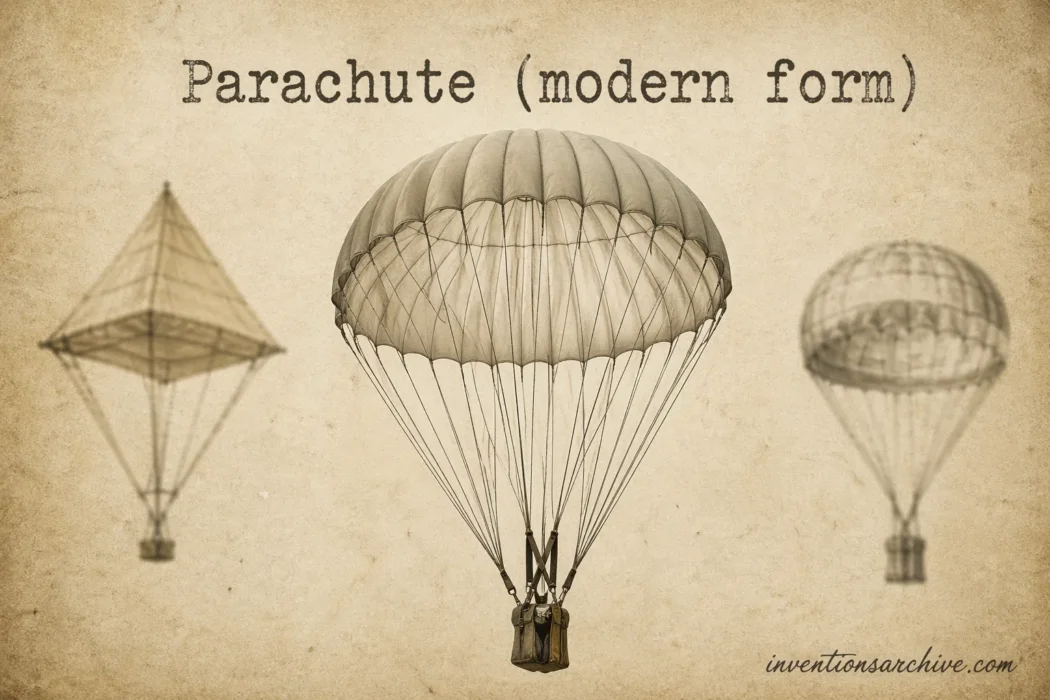
Historical reports describe umbrella-like descent ideas long before aviation. Leonardo da Vinci also drew a pyramidal parachute concept in the Codex Atlanticus, although there is no evidence that he built and tested it. The working modern path begins later, with European ballooning and public descent experiments (Details-1).
Lenormand and the First Public Demonstration
In 1783, Louis-Sébastien Lenormand demonstrated a parachute descent in France. His work gave the device a clearer practical identity. The term parachute comes from French roots linked to “guarding against” and “fall,” a plain name for a plain job: protect the body during descent.
Garnerin and Balloon-Era Parachuting
André-Jacques Garnerin moved parachuting from tower-style demonstration into the air. In 1797, he made a high-altitude parachute descent from a balloon above Paris. His device was still unlike a present-day parachute: it had umbrella-like features and carried a basket below the canopy. Still, it proved that a person could descend from an airborne platform under a dedicated canopy.
Kotelnikov and the Backpack Idea
The airplane changed the problem. A parachute for a balloon could be large and awkward. A parachute for a pilot had to be close to the body, quick to deploy, and usable in a moving aircraft emergency.
In 1911, Gleb Kotelnikov developed the RK-1, a backpack-style parachute with a harness. It addressed a need that earlier balloon parachutes did not solve well: the parachute had to stay with the pilot. His work also connects to the later drag chute idea, because he tested parachute braking with a fast car (Details-2).
Floyd Smith and the Ripcord System
The ripcord-operated parachute made the aircraft escape system far more practical. Floyd Smith designed a parachute that the jumper could wear and open manually after clearing the aircraft. His Aerial Life Pack used a ripcord release rather than depending fully on an aircraft-tethered static line. The U.S. Patent and Trademark Office describes Smith’s design as the first parachute to incorporate a manually operated ripcord (Details-3).
The later Type A parachute, developed from this line of work, gave pilots a compact emergency device with a soft pack, harness, ripcord, and pilot chute. Those parts still sound familiar for a reason.
How a Parachute Works
A parachute works by managing airflow. During a fall, air pushes against the canopy. The canopy spreads that force across fabric panels and suspension lines, then transfers it to the harness or payload. The result is less downward acceleration and a lower descent speed.
Drag, Lift, and Controlled Descent
Not all parachutes slow descent the same way.
- Round parachutes rely mostly on drag. They act like a large air brake.
- Ram-air parachutes create both drag and lift. They behave more like soft wings.
- Drogue parachutes stabilize or slow a fast-moving object before the main canopy opens.
- Spacecraft parachutes often deploy in stages because one sudden opening at high speed can overload the fabric and lines.
The canopy must inflate at the right pace. Too slow, and it may not provide enough control. Too fast, and opening shock can damage the system or injure the jumper. The answer, often, is staged inflation.
Why Airflow Matters
Airflow gives the parachute shape. In a round canopy, air fills the underside and creates pressure. In a ram-air canopy, air enters front openings called cells, inflates the wing, and helps it glide. In a drogue system, the canopy may be smaller but stronger for high-speed deployment.
Small details matter here: porosity of fabric, vent shape, line length, canopy area, seam strength, and packing method. A parachute is cloth, yes—but cloth under aerodynamic load.
Main Types of Modern Parachutes
Modern parachutes come in several forms. The shape depends on the job: saving a pilot, dropping cargo, landing a spacecraft, slowing a racing vehicle, or giving a skydiver steering control.
| Type | Main Shape | Primary Use | Main Feature |
|---|---|---|---|
| Round Parachute | Circular canopy | Personnel, cargo, older emergency systems | High drag, limited steering |
| Cruciform Parachute | Cross-shaped canopy | Cargo and military drops | More stable descent than many plain round forms |
| Ribbon / Ring-Slot | Canopy with openings | High-speed and heavy-duty uses | Better airflow relief and stability |
| Drogue Parachute | Small stabilizing canopy | Aircraft, spacecraft, tandem skydiving, braking | Stabilizes before main deployment |
| Pilot Chute | Small extraction canopy | Sport and emergency systems | Pulls the main canopy from its container |
| Ram-Air Parachute | Rectangular or elliptical soft wing | Skydiving, sport canopy flight, precision landing | Glide, steering, flare control |
| Spacecraft Main Parachute | Large engineered canopy system | Crew capsule recovery | Often used in multi-parachute sequences |
Round Parachutes
Round parachutes are the older familiar shape. They descend mainly by drag. Some include vents or slots to reduce swinging. They do not glide like a wing, so steering remains limited compared with ram-air designs.
Drogue and Pilot Parachutes
Drogue and pilot chutes are smaller but not minor. A drogue parachute can slow and stabilize a fast object before the main canopy opens. A pilot chute extracts the main parachute from its pack or container. In many modern systems, the small parachute starts the sequence, and the large parachute finishes the job.
Ram-Air and Parafoil Parachutes
The ram-air canopy changed parachuting again. Instead of acting only as a falling brake, the canopy becomes a soft wing. Air enters cells at the leading edge, inflates the structure, and creates a steerable airfoil. Domina Jalbert’s multi-cell ram-air wing work helped shape modern skydiving, paragliding, kiting, and related canopy sports (Details-4).
That is why many sport parachutes now look rectangular rather than round. They are not just falling. They are flying downward.
Modern Parachute Parts
A parachute system works because several parts share the load. Remove one, and the whole design changes.
Canopy
The canopy is the fabric surface that creates drag, lift, or both. Its shape controls descent behavior. A round canopy slows mostly by drag; a ram-air canopy also glides. Fabric strength, seam design, and porosity all affect performance.
Suspension Lines and Risers
Suspension lines connect the canopy to risers. Risers connect the lines to the harness or vehicle. These parts distribute load. In high-load systems, line material and stitching matter as much as canopy size.
Harness and Container
The harness holds the jumper or payload. The container stores the packed canopy. Modern containers must release the canopy in a predictable order, with lines moving cleanly and fabric leaving the pack without knots or snags.
Ripcord, Pilot Chute, and Deployment Bag
The ripcord or release handle begins deployment in many systems. A pilot chute may then pull out a deployment bag, which helps the main canopy unfold in sequence. This sounds small, almost tidy. It is not. Clean deployment prevents line twists, fabric damage, and violent opening shock.
Reserve System
A reserve parachute gives a second canopy path if the main parachute cannot do its job. In sport and emergency aviation systems, the reserve is packed and inspected with special care. Its purpose is direct: provide another controlled descent option.
From Balloon Canopy to Aircraft Safety System
The shift from balloon parachuting to aircraft parachuting forced inventors to solve new problems. Aircraft moved faster. Pilots sat in tight cockpits. Emergencies could involve spinning, diving, or damaged aircraft. A parachute tied to the aircraft could tangle. A large rigid canopy could not fit where it was needed.
The modern parachute answered those problems through packing, body-worn harnesses, manual release, and staged deployment.
Why the Backpack Design Mattered
A backpack parachute made the parachute part of the person, not part of the aircraft. That sounds obvious now. It was not obvious when pilots were still flying early machines with open cockpits and limited safety gear.
The backpack form also made emergency escape more flexible. A pilot could leave the aircraft and then open the parachute after gaining separation. In a messy aircraft emergency, that separation could make all the difference.
Why the Ripcord Mattered
The ripcord gave control over timing. A static line opens a parachute automatically when the jumper exits. That can work well in some situations, but it also depends on the aircraft connection. A ripcord lets the jumper open the canopy after clearing the aircraft.
In short: the ripcord separated escape from the aircraft itself.
Impact on Aviation and Spaceflight
The modern parachute changed far more than sport jumping. It became a safety system, a recovery tool, and a way to move equipment through the air with controlled descent.
Aviation Safety
For pilots and flight crews, parachutes turned some aircraft failures into survivable events. Early adoption was uneven, partly because aircraft leaders debated weight, training, and pilot behavior. Practical need won out. Aircraft became faster, higher, and more complex, and parachutes became part of the safety conversation.
Military and Cargo Use
Parachutes allowed supplies, equipment, and trained personnel to descend into places where landing an aircraft was not possible. Cargo parachutes also pushed the design toward stronger fabrics, better packing, and more stable canopy shapes.
Sport and Civil Use
Skydiving turned parachute design toward steering, comfort, canopy control, and repeatable packing. The ram-air parachute made landings more precise and opened the door to canopy piloting, tandem systems, and modern recreational parachuting.
Spacecraft Recovery
Spacecraft recovery shows how far the invention has moved beyond one canopy and one jumper. NASA’s Orion parachute system uses multiple parachutes in sequence, including forward bay cover parachutes, drogue parachutes, pilot parachutes, and main parachutes. NASA describes Orion’s system as having 11 parachutes, with main parachutes intended to slow the crew module to a safe landing speed (Details-5).
That is the modern parachute at its most engineered: not one fabric dome, but a timed recovery sequence.
Technical Limits and Design Challenges
Parachutes deal with speed, air density, fabric stress, packing order, temperature, moisture, and human factors. They do not simply “open.” They inflate through a violent, fast-changing interaction between cloth and air.
Opening Shock
Opening shock is the sudden force created when the canopy inflates. A parachute that opens too sharply can damage lines, tear fabric, or harm the person wearing it. Designers use pilot chutes, sliders, reefing systems, and staged deployment to reduce that shock.
Oscillation and Stability
Early parachutes could swing heavily under the canopy. Vents, slots, ribbon forms, and better line geometry helped reduce that movement. Stability matters for safe descent and accurate landing.
Packing and Reliability
Packing is part of the machine. A modern parachute’s fabric and lines must leave the container in an intended order. Poor line stowage, twisted risers, or uneven fabric release can affect deployment. For this reason, parachute design includes not only flight shape, but also folding, storage, and release behavior.
Materials That Shaped the Invention
The parachute’s history is also a material history. The invention depended on strong, light, flexible textiles.
Canvas and Silk
Early parachutes used canvas or silk. Silk offered lightness and packability, which mattered as parachutes moved from public demonstrations into aviation. Yet natural materials had limits in supply, moisture behavior, and consistency.
Nylon and Synthetic Fabrics
Nylon gave parachute makers a strong, flexible material that could be produced at scale. It also suited the needs of packed canopies, suspension lines, and later high-performance parachute systems. Modern parachutes may combine nylon, Kevlar, polyester webbing, stainless or alloy hardware, and reinforced stitching.
Engineering Beyond the Fabric
The fabric gets the attention. The seams do the quiet work. Lines, tapes, rings, grommets, harness stitching, deployment bags, and release handles all carry part of the design burden. A parachute fails or succeeds as a system.
Why There Is No Single Inventor Only
Many inventions have one famous name. The parachute does not fit that pattern neatly.
Lenormand demonstrated a modern parachute principle. Garnerin proved high-altitude balloon descent. Kotelnikov made the backpack idea practical for pilots. Smith and his collaborators moved the aircraft parachute toward a manually deployed free-fall system. Jalbert helped reshape the canopy into a soft wing. NASA and aerospace contractors later turned parachutes into multi-stage recovery systems.
So, who invented the modern parachute?
The most accurate answer is this: the modern parachute is a staged invention. Different inventors solved different parts of the same problem.
FAQ
Who invented the modern parachute?
The modern parachute has several inventors, depending on the form being discussed. Louis-Sébastien Lenormand demonstrated an early practical parachute in 1783. Gleb Kotelnikov developed a backpack-style parachute in 1911. Floyd Smith later created a ripcord-operated aircraft parachute that shaped the modern emergency form.
What was the first modern parachute used for?
Early working parachutes were used for demonstrations and balloon descents. The aircraft-ready modern parachute later focused on emergency escape for pilots and controlled descent from airplanes.
How does a parachute slow a fall?
A parachute slows a fall by increasing air resistance. The canopy catches and redirects airflow, spreading force across the fabric and suspension lines. Ram-air parachutes also create lift because they inflate into wing-like shapes.
What is the difference between a round parachute and a ram-air parachute?
A round parachute mainly creates drag and descends downward with limited steering. A ram-air parachute inflates like a soft wing, creates lift, glides forward, and gives the user more control over direction and landing.
Why was the ripcord important?
The ripcord allowed a jumper to open the parachute manually after leaving the aircraft. This reduced dependence on aircraft-mounted static lines and made emergency escape more flexible.
Do spacecraft use parachutes?
Yes. Crew capsules and some space missions use parachute systems to slow descent after atmospheric reentry. These systems often use several parachutes in sequence rather than one canopy.