
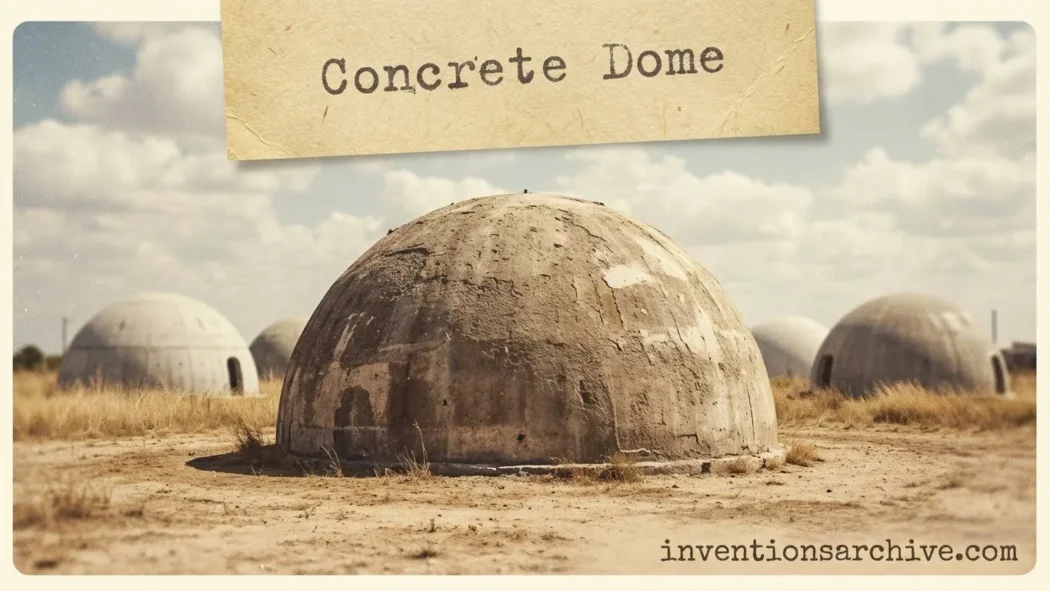
| Invention Name | Concrete dome |
|---|---|
| Short Definition | A curved roof or vault made from concrete, designed to span a large space mainly through compression. |
| Approximate Date / Period | Roman concrete domes by the 1st century CE; Pantheon rebuilt in 118–125 AD Based on surviving evidence [a] |
| Geography | Roman Empire; later Europe, the United States, and global engineering practice |
| Inventor / Source Culture | Anonymous / collective; Roman builders, later structural engineers, cement chemists, and reinforced-concrete designers |
| Category | Architecture, construction, structural engineering, materials technology |
| Evidence Status | Attribution varies The form developed through many builders rather than one named inventor. |
| Main Problem Solved | Covering a large interior space without a forest of internal columns. |
| How It Works | Curved geometry carries loads around the shell and down into walls, piers, ribs, or an edge ring. |
| Material / Technical Base | Roman hydraulic concrete, later Portland cement concrete, reinforcement, shell geometry, formwork, and stress analysis. |
| Important Early Example | The Pantheon in Rome, with a 43.30 m unreinforced concrete dome. |
| Modern Material Turning Point | Portland cement patent, 1824, helped shape modern concrete practice Confirmed [b] |
| Development Path | Masonry vaults and Roman concrete vaulting → mass concrete domes → reinforced concrete domes → thin-shell and sprayed concrete forms |
| Related Inventions | Arch, vault, hydraulic cement, Portland cement, reinforced concrete, thin-shell roof, pneumatic formwork |
| Modern Descendants | Stadium domes, planetarium shells, storage domes, cooling-tower shells, thin concrete roof structures |
What a Concrete Dome Is
A concrete dome is a curved roof structure made from concrete. It may be thick and heavy, like a Roman mass-concrete dome, or thin and reinforced, like many 20th-century shell roofs. Its purpose is simple: it covers a wide space while sending most of the load down through a curved surface instead of relying on many interior posts.
The idea matters because concrete is strong in compression. A dome uses that strength well. The curve spreads weight around the shell, then into the supporting wall, ring beam, piers, ribs, or foundation below. This does not make every concrete dome light or easy to build. It means the shape helps the material do the work it is naturally good at.
Concrete dome is therefore both a material invention and a geometric solution. The material gave builders a moldable mass. The dome gave that mass a shape that could span rooms, halls, baths, temples, planetariums, storage buildings, and civic spaces.
How Its Origin Is Traced
The origin of the concrete dome is traced through surviving structures, written descriptions of concrete, later engineering analysis, and institutional records. Roman concrete was already well developed before the Pantheon. A University of Nebraska-Lincoln publication on Roman concrete notes a sequence of evidence from non-concrete aqueducts to hydraulic concrete works, including a surviving concrete dome from the early imperial period and the Pantheon as the high point of Roman cast-in-place concrete construction [c].
That evidence does not support a neat “invented by” sentence. Roman builders did not leave a patent for the dome. They left the structure itself. Later engineers left papers, calculations, standards, patents, and built examples. The history is a chain of practice, not a single moment.
The Problem It Answered
Before concrete domes, builders could cover large spaces with timber roofs, stone lintels, arches, vaults, corbelled masonry, and brick or stone domes. Each method had limits. Timber could burn, rot, or require large straight beams. Stone lintels could not easily span very wide rooms. Masonry vaults were powerful but heavy and needed careful support.
The concrete dome answered a practical architectural problem: how to create a large open interior without filling the floor with supports. In baths, temples, halls, and later public buildings, that open space changed how people gathered, moved, heard sound, and experienced light.
| Before the Concrete Dome | What Changed After It |
|---|---|
| Large rooms often needed timber trusses, many columns, or heavy masonry vaults. | Builders could cover a broad circular or polygonal space with a continuous curved surface. |
| Stone and brick systems depended on individual units and mortar joints. | Concrete could be cast into a continuous mass or shell, depending on the period and method. |
| Wide interiors were harder to make without blocking sightlines. | Temples, halls, planetariums, storage spaces, and arenas could gain clearer interior volume. |
| Earlier roofs often carried loads through beams or closely spaced supports. | Curvature allowed loads to move through compression paths toward the perimeter. |
| Design depended mostly on craft tradition and rule-of-thumb building knowledge. | Modern reinforced-concrete domes added calculation, reinforcement, shell theory, and testing. |
How It Worked in Simple Terms
A dome behaves differently from a flat roof. A flat slab bends strongly under load. A dome, because it is curved, can carry much of its load through membrane action: forces travel around and down the curved surface. This is why a dome can feel visually light even when the material is heavy.
Ancient mass-concrete domes relied on thickness, geometry, gradual weight reduction, and strong supporting walls. Modern reinforced-concrete domes add steel reinforcement or mesh so the shell can handle tension and cracking more effectively. In a thin shell, the concrete may be only a small fraction of the span, but the shape must be controlled with great care.
In simple terms: the curve helps the concrete avoid acting like a flat beam. It turns the roof into a continuous shell.
Main Materials and Structural Principles
The concrete dome depends on two linked ideas: a moldable material and a stable curved form. Roman builders used concrete made with lime, aggregates, and volcanic materials in some hydraulic applications. Modern concrete relies heavily on Portland cement, aggregates, water, and often steel reinforcement.
Portland cement changed the later history of concrete domes because it offered a more standardized binder for modern structural work. The American Concrete Institute defines Portland cement as a product made by pulverizing clinker, mainly hydraulic calcium silicates, with some calcium sulfate, and notes Joseph Aspdin’s 1824 patent as the first Portland cement patent [d].
Structural Forces in Plain Language
- Compression: the force concrete handles well, especially along the curve of the dome.
- Hoop tension: a spreading force near parts of the dome that later designs often control with rings, reinforcement, or supports.
- Edge support: the wall, rib, beam, or ring that receives the dome’s load.
- Shell action: the way a curved surface carries load across its whole form instead of acting as separate beams.
- Formwork or centering: temporary support used historically to shape some domes while material hardened.
From Earlier Tools to Later Forms
| Stage | Form | What Changed |
|---|---|---|
| Earlier Tool | Arch, vault, corbelled dome, timber roof | Builders learned how curved forms and compression could cover space. |
| Ancient Concrete Form | Roman mass-concrete vaults and domes | Concrete could be cast into curved forms, allowing broad interior volumes. |
| Large Surviving Landmark | Pantheon dome, Rome | The unreinforced concrete dome showed the scale Roman builders could reach. |
| Modern Reinforced Form | Reinforced concrete ribbed and shell domes | Steel reinforcement and cement technology expanded span, shape, and public-building use. |
| Thin-Shell Phase | Calculated concrete shell domes | Mathematical stress analysis made lighter curved structures more predictable. |
| Later Variations | Sprayed, precast, and air-formed concrete shells | New forming methods reduced some dependence on heavy traditional formwork. |
The broader history of masonry and concrete domes has been studied as a long sequence of construction and structural theory, with reference points such as the Pantheon, Hagia Sophia, Renaissance domes, and 20th-century reinforced-concrete domes [e]. That sequence helps explain why concrete dome history belongs to both architecture and engineering.
Important Early and Modern Examples
The Pantheon and Ancient Mass Concrete
The Pantheon is the best-known ancient concrete dome because it still stands and can be measured. Its dome is unreinforced, massive compared with modern thin shells, and supported by a thick cylindrical wall. Its central oculus also reduces material at the crown while bringing light into the interior.
The Pantheon should not be treated as a modern reinforced-concrete structure. It is a Roman mass-concrete dome. Its survival shows the strength of the form, but also the importance of proportion, support, material gradation, and long-term maintenance.
Centennial Hall and Reinforced Concrete Scale
In the early 20th century, reinforced concrete changed dome construction again. UNESCO describes the Centennial Hall in Wrocław, built in 1911–1913 by architect Max Berg, as a milestone in reinforced concrete architecture and states that it was the largest reinforced concrete dome in the world at the time of its construction [f].
This step matters because it shows a shift from ancient mass to modern structure. The dome was no longer only a heavy roof over a sacred or ceremonial interior. It became a civic and engineering solution for exhibitions, assemblies, performances, and public events.
Zeiss Planetarium and the Thin Concrete Shell
The Zeiss Planetarium in Jena, completed in 1926, is a major reference point for thin-shell concrete. Structurae records it as a thin-shell planetarium building with a 25 m span and a 6 cm shell thickness, using a steel grid encased in concrete [g].
That example shows the modern logic of the concrete dome: less mass, more geometry, more calculation. The structure does not imitate the Pantheon by weight. It follows the curve with a much thinner shell.
Main Types and Variations
| Type or Variation | Typical Character | Common Use or Importance |
|---|---|---|
| Mass Concrete Dome | Thick, heavy, usually unreinforced in ancient examples | Roman monumental interiors, baths, temples, rotundas |
| Ribbed Reinforced Concrete Dome | Concrete ribs carry much of the load, often with panels between ribs | Large halls, civic buildings, arenas, exhibition spaces |
| Thin-Shell Concrete Dome | Curved reinforced shell that uses geometry to reduce material | Planetariums, roofs, auditoriums, industrial covers |
| Precast Concrete Dome | Made from prefabricated pieces assembled into a curved form | Projects where repeated pieces and controlled production are useful |
| Shotcrete or Sprayed Concrete Dome | Concrete or mortar is sprayed over a prepared support system | Industrial shells, storage covers, some specialized roof forms |
| Air-Formed or Inflated-Form Shell | Uses an inflated form or fabric-based method in some modern systems | Low-cost shell experiments and later dome-building methods; ACI records fabric and inflation-based concrete shell work in the 1980s [h] |
Why Thin-Shell Attribution Is Complicated
Modern thin-shell concrete structures are often linked with Franz Dischinger and the Zeiss-Dywidag system, but the attribution is not simple. ACI’s abstract on thin-shell identification notes that received wisdom credits Dischinger with the invention of thin-shell concrete structure in the 1920s, while also stressing that earlier precursors and definitions make the claim difficult to settle cleanly.
Related articles: Chimney [Medieval Inventions Series], Gramophone [Industrial Age Inventions Series]
This is a useful reminder. The word invention can hide several different achievements: imagining the form, making the material, calculating stresses, building a large example, standardizing a method, or spreading it through industry. A concrete dome needed all of those layers.
How Concrete Domes Spread and Changed Over Time
Concrete domes spread because they answered different needs in different periods. Roman builders used concrete vaulting and domes for durable, monumental interiors. Modern engineers used reinforced concrete to cover assembly spaces, markets, arenas, planetariums, water and material storage, and industrial buildings.
Several changes shaped that spread:
- Better binders: modern cement made concrete more predictable than many earlier local mixtures.
- Steel reinforcement: reinforcement helped concrete resist tension and cracking in thinner forms.
- Mathematical analysis: shell theory gave engineers a clearer picture of stress paths.
- New forming methods: formwork, sprayed concrete, precast elements, and inflated supports expanded design options.
- Public-building demand: halls, exhibition spaces, sports venues, and planetariums needed open interiors.
The practical change was not only bigger roofs. Concrete domes changed the feeling and function of interior space. They made it easier to gather many people under one continuous cover with fewer visual interruptions.
What Changed Because of the Concrete Dome
The concrete dome changed architecture by combining shape, material, and scale. It gave builders a way to make interiors that felt unified rather than divided by rows of supports. It also encouraged later engineers to treat roofs as curved surfaces, not only as beams, trusses, or flat slabs.
In Architecture
Concrete domes gave public buildings a strong central space. Rotundas, halls, planetariums, and exhibition buildings could use the dome as both structure and spatial identity.
In Engineering
The dome pushed structural thinking toward curved-shell behavior. Engineers had to understand compression, tension, cracking, buckling, edge support, and reinforcement in a continuous surface.
In Materials History
The dome shows why concrete is not one material across all history. Roman concrete, early Portland cement concrete, reinforced concrete, and modern sprayed or precast systems are related, but they are not identical.
Common Misunderstandings
It Was Not Invented by One Person
The concrete dome grew from shared craft, materials, geometry, and later engineering science. Named engineers become clearer in the modern period, but the ancient origin is collective.
The Pantheon Is Not Reinforced Concrete
The Pantheon dome is famous because it is unreinforced Roman concrete. Modern reinforced concrete domes use steel or other reinforcement to handle forces that ancient builders addressed differently.
Thin Does Not Mean Simple
A thin concrete shell may use less material, but it demands careful geometry, support, analysis, and workmanship. The curve is doing structural work.
A Concrete Dome Is Not a Geodesic Dome
A geodesic dome is usually a network of many straight members. A concrete dome is a continuous concrete surface or ribbed concrete system. Some ideas overlap, but the structures are not the same.
Related Inventions and Later Developments
These related inventions and technologies help place the concrete dome within a wider history of construction:
- Arch: the curved compression form that helped prepare the way for vaults and domes.
- Barrel vault: an extended arch form used before and alongside domes.
- Roman concrete: the ancient material tradition behind major cast vaults and domes.
- Portland cement: the modern binder that changed concrete production after the 19th century.
- Reinforced concrete: concrete strengthened with steel to handle tension and cracking.
- Thin-shell roof: a later structural form that used curvature and calculation to reduce material.
- Shotcrete: sprayed concrete used in some shell and dome construction systems.
- Pneumatic formwork: inflatable support used in some modern dome-building approaches.
Frequently Asked Questions
Who invented the concrete dome?
No single inventor can be named with confidence. Ancient concrete domes came from Roman building practice, while modern reinforced and thin-shell concrete domes developed through many engineers, cement makers, designers, and contractors.
Is the Pantheon a concrete dome?
Yes. The Pantheon in Rome has a large unreinforced Roman concrete dome. It is one of the clearest surviving ancient examples of concrete dome construction.
What is the difference between a mass concrete dome and a thin-shell concrete dome?
A mass concrete dome is thick and depends heavily on weight, geometry, and support. A thin-shell concrete dome is much thinner and uses reinforcement, shell geometry, and structural analysis to carry loads efficiently.
Why is concrete suitable for domes?
Concrete is strong in compression, and a dome shape carries much of its load through compression paths. Modern reinforced concrete also uses steel to help resist tension and cracking.
Are concrete domes still used today?
Yes. Concrete domes and concrete shell forms are still used for storage buildings, planetariums, industrial covers, public spaces, and specialized roof structures, though they require professional design and code review.
Sources and Verification
- [a] Pantheon and Basilica of Santa Maria ad Martyres — Used to verify the Pantheon’s rebuilt date range, dome diameter, and status as a major unreinforced concrete dome. (Reliable because it is an official Italian museum and cultural heritage source.)
- [b] Definition of portland cement — Used to verify the Portland cement definition and Joseph Aspdin’s 1824 patent reference. (Reliable because it is provided by the American Concrete Institute, a specialist concrete institution.)
- [c] Roman Concrete: The Ascent, Summit, and Decline of an Art — Used to verify the Roman concrete chronology and the evidence-based discussion of early concrete dome construction. (Reliable because it is a university-hosted academic publication.)
- [d] Definition of portland cement — Used to verify modern Portland cement’s material basis and historical patent context. (Reliable because it is an American Concrete Institute technical source.)
- [e] A history of masonry and concrete domes in building construction — Used to verify the long historical sequence from masonry domes to reinforced concrete domes. (Reliable because it is an academic journal article indexed by ScienceDirect.)
- [f] Centennial Hall in Wrocław — Used to verify Centennial Hall’s 1911–1913 construction, Max Berg attribution, and reinforced-concrete dome significance. (Reliable because it is an official UNESCO World Heritage Centre page.)
- [g] Zeiss Planetarium — Used to verify the Jena planetarium’s date, thin-shell classification, span, and shell thickness. (Reliable because Structurae is a specialist international database for structures and engineering works.)
- [h] Inflate it First — Used to verify the existence of inflation-based concrete shell construction methods in later concrete dome development. (Reliable because it is indexed in the American Concrete Institute International Concrete Abstracts Portal.)